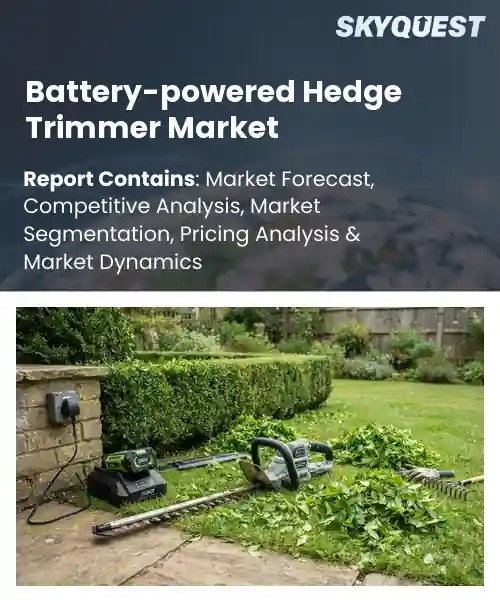
Battery-powered Hedge Trimmer Market
Report ID: SQMIG25H2175
Report ID: SQMIG25H2175
[email protected]
USA +1 351-333-4748
Report ID:
SQMIG25H2175 |
Region:
Global |
Published Date: August, 2026
Pages:
157
|Tables:
142
|Figures:
78


Global Battery-Powered Hedge Trimmer Market size was valued at USD 2.84 Billion in 2024 and is poised to grow from USD 3.03 Billion in 2025 to USD 5.14 Billion by 2033, growing at a CAGR of 6.8% during the forecast period (2026-2033).
The battery‑powered hedge trimmer market comprises electric tools that replace gasoline engines with rechargeable lithium‑ion packs, enabling homeowners and professional landscapers to trim shrubs without emissions or noisy operation. Its significance stems from rising environmental regulations, urban noise restrictions, and a growing DIY culture that values clean, low‑maintenance equipment. Historically, the segment lagged behind corded models until 2015 %2015, when advances in battery energy density and cost reductions produced tools comparable to gas‑powered units. Brands such as Black+Decker and Bosch introduced 20‑V and 36‑V models that delivered up to 60 minutes of runtime, prompting adoption across suburban neighborhoods and commercial contracts. Building on this foundation, the primary growth driver for the battery‑powered hedge trimmer market is the adoption of cordless ecosystems by landscapers who prioritize tool interchangeability and downtime. Standardized battery packs now powers mowers, blowers, and trimmers, letting a single charger service a fleet and reducing capital and inventory costs. This efficiency convinced parks to replace gasoline units; a city swapped 60‑V trimmers and cut fuel expenses by 30 % while noise complaints fell 45 %. Consequently, manufacturers are increasing R&D to boost density and add smart‑charging, creating a virtuous cycle that deepens market penetration and enables services such as predictive maintenance.
How is IoT integration impacting the performance and market growth of battery-powered hedge trimmers?
IoT integration is reshaping battery‑powered hedge trimmers by linking the tool to cloud platforms and mobile apps. Sensors monitor blade load, motor temperature and battery health, allowing the device to adjust power output for optimal efficiency. Real‑time data lets users schedule maintenance before failures occur, reducing downtime and extending tool life. Connectivity also enables firmware updates that improve cutting performance and add new features without physical service visits. As landscapers adopt smart equipment, demand grows for trimmers that can be tracked in fleets, improving resource allocation and lowering operating costs. The overall market is gaining momentum as manufacturers highlight these benefits to differentiate their products.In March 2024 a leading manufacturer released an IoT‑enabled hedge trimmer that streams performance metrics to a user dashboard, demonstrating how connectivity boosts reliability and accelerates market adoption.
Market snapshot - (2026-2033)
Global Market Size
USD 2.84 Billion
Largest Segment
Cordless Hedge Trimmers
Fastest Growth
Telescopic Hedge Trimmers
Growth Rate
6.8% CAGR
To get more insights on this market click here to Request a Free Sample Report
Global battery-powered hedge trimmer market is segmented by product type, battery type, blade length, application, end user and region. Based on product type, the market is segmented into Cordless Hedge Trimmers, Pole Hedge Trimmers and Telescopic Hedge Trimmers. Based on battery type, the market is segmented into Lithium-Ion and Nickel-Metal Hydride. Based on blade length, the market is segmented into Up to 20 Inches, 21–24 Inches and Above 24 Inches. Based on application, the market is segmented into Residential and Commercial Landscaping. Based on end user, the market is segmented into Homeowners, Landscaping Professionals and Municipalities. Based on region, the market is segmented into North America, Europe, Asia Pacific, Latin America and Middle East & Africa.
Lithium Ion segment dominates because its high energy density and lightweight design enable longer runtimes and easier handling, meeting the core demand for mobility and efficiency in battery-powered hedge trimmers. The chemistry’s low self discharge and fast charging further reinforce user confidence, driving manufacturers to prioritize this power source across product lines. Its reliability under varied temperature conditions also appeals to professional users, while the decreasing cost of cells makes it economically attractive for mass adoption.
However, Nickel Metal Hydride segment is witnessing the strongest growth momentum as recent advances in electrode materials improve its energy capacity and durability, making it a viable alternative for cost sensitive markets. This renewed interest expands product portfolios and opens opportunities in entry level models, accelerating overall market expansion.
Cordless Hedge Trimmers segment leads because they combine the freedom of battery operation with the versatility required for diverse trimming tasks, eliminating the constraints of cords while delivering sufficient power for most garden applications. Their compact form factor and ease of storage make them the preferred choice for both casual users and professionals seeking efficient, low maintenance tools. Additionally, the rapid improvement in battery chemistry extends runtime, allowing users to complete larger projects without interruption, which reinforces market confidence and drives repeat purchases across residential and commercial segments.
Meanwhile, Telescopic Hedge Trimmers segment emerges as the key high growth area as users demand greater reach for tall hedges without ladder use, prompting manufacturers to integrate lightweight telescoping shafts with robust battery packs. This functional innovation opens new use cases in commercial landscaping, fueling rapid adoption and expanding market horizons.
To get detailed segments analysis, Request a Free Sample Report
Asia Pacific commands the global battery‑powered hedge trimmer market through a convergence of manufacturing excellence, advanced battery technology, and a growing culture of garden care. The region hosts world‑leading original equipment manufacturers that integrate high‑energy density cells with ergonomic designs, delivering reliable performance at competitive pricing. Robust domestic demand driven by rising homeownership and landscaping interest fuels continuous product refinement. Supportive regulatory frameworks promote low‑emission equipment, encouraging swift adoption across urban and suburban settings. Integrated supply chains and proximity to key component suppliers further shorten development cycles, reinforcing the region’s position as the primary source of innovative, cost‑effective solutions for both professional and hobbyist users.
Battery-powered Hedge Trimmer Market Japan showcases a blend of precision engineering and consumer focus. Local manufacturers leverage deep expertise in compact motor design and high‑efficiency lithium cells, delivering tools that prioritize quiet operation and lightweight handling. Strong garden culture and a preference for premium, durable products drive demand for advanced features such as brushless motors and smart battery management. Collaboration between equipment makers and battery specialists accelerates product cycles, reinforcing Japan’s reputation for quality and technological leadership.
Battery-powered Hedge Trimmer Market South Korea reflects rapid adoption of cordless landscaping tools driven by a tech‑savvy consumer base. Domestic firms combine cutting‑edge battery chemistries with sleek ergonomic designs, offering tools that emphasize power‑to‑weight efficiency and extended runtime. Government incentives for low‑emission equipment further stimulate market growth, while strong export capabilities position South Korean brands as prominent players in adjacent Asian markets. Ongoing investment in R&D ensures continual integration of smart features such as torque control and connectivity, reinforcing the nation’s reputation for innovative, high‑performance garden equipment.
Europe experiences rapid expansion of the battery‑powered hedge trimmer market as environmental regulations and consumer preferences converge on quieter, zero‑emission tools. Stringent emission standards compel professional landscapers to replace gasoline‑driven equipment, while homeowners increasingly value low‑noise operation for residential settings. Strong retail networks and a mature DIY culture accelerate product diffusion, and manufacturers benefit from a well‑established supply chain for advanced lithium‑ion cells across the continent. Collaborative standards initiatives promote interoperability and safety, fostering confidence among end‑users. As sustainability commitments deepen, European stakeholders prioritize energy‑efficient designs, positioning the region as a hub of innovation and market growth.
Battery-powered Hedge Trimmer Market Germany stands as the dominant force within Europe, anchored by a robust engineering heritage and extensive aftermarket support. German manufacturers emphasize durability and precision, integrating high‑performance brushless motors with sophisticated battery management systems. The country’s strong professional landscaping sector drives demand for reliable, heavy‑duty models, while an enthusiastic homeowner base seeks premium, ergonomically refined tools. Close collaboration with battery suppliers ensures rapid incorporation of the latest cell technologies, sustaining Germany’s leadership in quality and performance.
Battery-powered Hedge Trimmer Market United Kingdom is characterized by the fastest growing adoption rate, propelled by a burgeoning DIY culture and heightened environmental awareness. British retailers highlight cordless convenience and low‑noise operation, resonating with urban gardeners and cottage owners alike. Manufacturers respond with lightweight designs and diverse power options to suit compact garden spaces. Policy incentives encouraging low‑emission equipment further stimulate purchase decisions, while a vibrant online marketplace accelerates product visibility. Collectively these factors create a dynamic environment for accelerated market expansion.
Battery-powered Hedge Trimmer Market France emerges as an emerging segment, driven by a strong tradition of garden aesthetics and increasing urban green space initiatives. French consumers prioritize sleek, user‑friendly designs that blend style with functionality, prompting manufacturers to focus on aesthetic finishes and intuitive controls. Government programmes supporting sustainable landscaping encourage a shift away from petrol‑based tools. Growing awareness of noise pollution in densely populated areas also fuels interest in quiet, battery‑operated alternatives. These cultural and policy influences nurture steady growth within the French market.
North America strengthens its position in the battery‑powered hedge trimmer market through a combination of consumer demand for convenience, extensive distribution networks, and ongoing technological innovation. Home improvement retailers and big‑box chains provide broad accessibility, while a vibrant professional landscaping industry seeks reliable, high‑output cordless solutions. Manufacturers invest heavily in research to enhance battery energy density and motor efficiency, delivering tools that meet expectations for longer runtimes and robust performance. Environmental awareness and noise regulations further encourage the shift from gasoline to electric options, reinforcing the region’s role as a key driver of market adoption and product evolution.
Battery-powered Hedge Trimmer Market United States benefits from a massive homeowner base keen on easy‑to‑use landscaping equipment and a large professional services sector. Retail giants and online platforms ensure wide product availability, while strong brand competition drives rapid iteration of features such as smart battery indicators and ergonomic grips. Environmental campaigns and local ordinances limiting gas‑powered tools amplify interest in silent, emission‑free alternatives. Continuous collaboration with battery technology firms accelerates advancements in runtime and charge speed, consolidating the United States as a central hub for market growth and innovation.
Battery-powered Hedge Trimmer Market Canada reflects a market shaped by a climate that encourages seasonal garden maintenance and a cultural emphasis on sustainable outdoor practices. Consumers value lightweight, low‑noise tools suited to compact residential yards and multi‑property management. Government encouragement of low‑emission equipment aligns with consumer preferences, prompting retailers to stock a broad array of cordless models. Partnerships with northern‑focused battery manufacturers address performance in colder temperatures, ensuring reliable operation throughout the gardening season. These factors collectively support Canada’s steady expansion in the battery‑powered hedge trimmer landscape.
To know more about the market opportunities by region and country, click here to
Buy The Complete Report
Growing Preference For Battery Power
Advances In Lithium‑Ion Technology
Higher Initial Cost Of Units
Limited Battery Life In Demanding Tasks
Request Free Customization of this report to help us to meet your business objectives.
The competitive landscape is shaped by aggressive product innovation and strategic alliances, with manufacturers accelerating cordless hedge‑trimmer releases that integrate advanced lithium‑ion battery packs, while larger tool firms pursue partnerships to broaden distribution channels and secure component supply. Recent M&A activity sees established brands acquiring niche battery‑technology firms to enhance performance and reduce weight, intensifying competition on both price and runtime efficiency.
Top Player’s Company Profile
Recent Developments
SkyQuest’s ABIRAW (Advanced Business Intelligence, Research & Analysis Wing) is our Business Information Services team that Collects, Collates, Correlates, and Analyses the Data collected by means of Primary Exploratory Research backed by robust Secondary Desk research. As per SkyQuest analysis, the battery‑powered hedge trimmer market is being propelled primarily by the growing preference for cordless tools that eliminate emissions and noise, a driver that fuels both residential and professional adoption. A second catalyst is the rapid advancement of lithium‑ion technology, which delivers longer runtimes and faster charging, making electric models competitive with gasoline units. Asia‑Pacific dominates the market thanks to its strong manufacturing base, cost‑effective supply chains and rising DIY culture. Within product categories, cordless hedge trimmers hold the largest share, driven by their flexibility and ease of use. However, higher upfront prices act as a restraint, slowing adoption among cost‑sensitive buyers.
| Report Metric | Details |
|---|---|
| Market size value in 2024 | USD 2.84 Billion |
| Market size value in 2033 | USD 5.14 Billion |
| Growth Rate | 6.8% |
| Base year | 2024 |
| Forecast period | (2026-2033) |
| Forecast Unit (Value) | USD Billion |
| Segments covered |
|
| Regions covered | North America (US, Canada), Europe (Germany, France, United Kingdom, Italy, Spain, Rest of Europe), Asia Pacific (China, India, Japan, Rest of Asia-Pacific), Latin America (Brazil, Rest of Latin America), Middle East & Africa (South Africa, GCC Countries, Rest of MEA) |
| Companies covered |
|
| Customization scope | Free report customization with purchase. Customization includes:-
|
To get a free trial access to our platform which is a one stop solution for all your data requirements for quicker decision making. This platform allows you to compare markets, competitors who are prominent in the market, and mega trends that are influencing the dynamics in the market. Also, get access to detailed SkyQuest exclusive matrix.
Table Of Content
Executive Summary
Market overview
Parent Market Analysis
Market overview
Market size
KEY MARKET INSIGHTS
COVID IMPACT
MARKET DYNAMICS & OUTLOOK
Market Size by Region
KEY COMPANY PROFILES
Methodology
For the Battery-powered Hedge Trimmer Market, our research methodology involved a mixture of primary and secondary data sources. Key steps involved in the research process are listed below:
1. Information Procurement: This stage involved the procurement of Market data or related information via primary and secondary sources. The various secondary sources used included various company websites, annual reports, trade databases, and paid databases such as Hoover's, Bloomberg Business, Factiva, and Avention. Our team did 45 primary interactions Globally which included several stakeholders such as manufacturers, customers, key opinion leaders, etc. Overall, information procurement was one of the most extensive stages in our research process.
2. Information Analysis: This step involved triangulation of data through bottom-up and top-down approaches to estimate and validate the total size and future estimate of the Battery-powered Hedge Trimmer Market.
3. Report Formulation: The final step entailed the placement of data points in appropriate Market spaces in an attempt to deduce viable conclusions.
4. Validation & Publishing: Validation is the most important step in the process. Validation & re-validation via an intricately designed process helped us finalize data points to be used for final calculations. The final Market estimates and forecasts were then aligned and sent to our panel of industry experts for validation of data. Once the validation was done the report was sent to our Quality Assurance team to ensure adherence to style guides, consistency & design.
Analyst Support
Customization Options
With the given market data, our dedicated team of analysts can offer you the following customization options are available for the Battery-powered Hedge Trimmer Market:
Product Analysis: Product matrix, which offers a detailed comparison of the product portfolio of companies.
Regional Analysis: Further analysis of the Battery-powered Hedge Trimmer Market for additional countries.
Competitive Analysis: Detailed analysis and profiling of additional Market players & comparative analysis of competitive products.
Go to Market Strategy: Find the high-growth channels to invest your marketing efforts and increase your customer base.
Innovation Mapping: Identify racial solutions and innovation, connected to deep ecosystems of innovators, start-ups, academics, and strategic partners.
Category Intelligence: Customized intelligence that is relevant to their supply Markets will enable them to make smarter sourcing decisions and improve their category management.
Public Company Transcript Analysis: To improve the investment performance by generating new alpha and making better-informed decisions.
Social Media Listening: To analyze the conversations and trends happening not just around your brand, but around your industry as a whole, and use those insights to make better Marketing decisions.
REQUEST FOR SAMPLE
 REQUEST FREE CUSTOMIZATION


Want to customize this report? This report can be personalized according to your needs. Our analysts and industry experts will work directly with you to understand your requirements and provide you with customized data in a short amount of time. We offer $1000 worth of FREE customization at the time of purchase.
Feedback From Our Clients


 USA (+1) 351-333-4748

