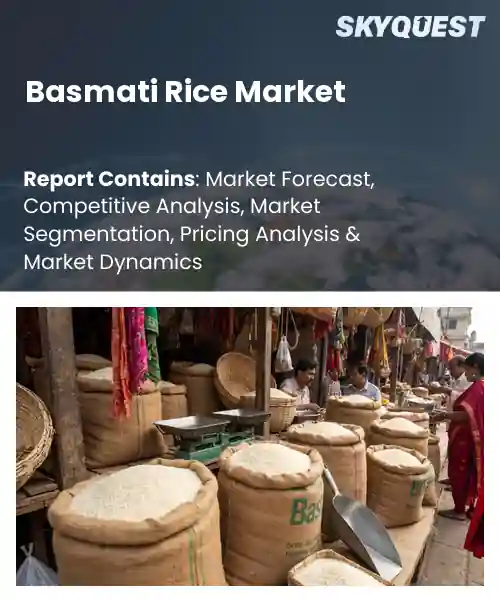
Basmati Rice Market
Report ID: SQMIG30H2467
Report ID: SQMIG30H2467
[email protected]
USA +1 351-333-4748
Report ID:
SQMIG30H2467 |
Region:
Global |
Published Date: July, 2026
Pages:
157
|Tables:
172
|Figures:
79


Global Basmati Rice Market size was valued at USD 13.22 Billion in 2024 and is poised to grow from USD 14.34 Billion in 2025 to USD 27.55 Billion by 2033, growing at a CAGR of 8.5% during the forecast period (2026-2033).
The global basmati rice market can be defined as the market for aromatic long-grain variety of rice produced mostly in Indo-Pak subcontinent and recently being cultivated in places like California and Australia. This market is very important due to the high price of basmati rice, food security issues, and employment opportunities. The main factor behind its growth is an increase in consumer preference for ethnic foods in regions like North America, Europe, and the Middle East. It should be mentioned that basmati rice has been popular since the 1970s when small regional consumption was transformed into a billion-dollar export industry.
Another critical determinant that influences the basmati rice industry includes the emergence of health-oriented demand that facilitates innovations as well as new distribution channels. In view of the connection of low glycemic index and high aroma with the perception of basmati as healthier than refined rice, the retail sector introduces organic, parboiled, and quick-to-cook varieties of basmati that provide additionalprofit margins. Such developments help to develop markets in such fast-growing locations as Southeast Asia, where there is an increasing consumer base seeking convenient and healthy food solutions, thus forcing producers to collaborate with e-commerce websites and introduce vitamin-enriched varieties.
How are AI-driven Supply Chain Automation Trends Influencing the Basmati Rice Market?
AI-based automated logistics for Basmati rice production are changing the market through integration of farms, manufacturers and retailers via predictions and live tracking. The use of machine learning algorithms helps predict yields and arrange logistics depending on the demand peaks and avoid losses due to deterioration. Digital twins help predict storage conditions and price changes for traders, which allows them to arrange better deals. Cloud services help small farmers exchange information, making the network more transparent and attracting buyers looking for stable quality.
Market snapshot - (2026-2033)
Global Market Size
USD 13.22 Billion
Largest Segment
White Basmati Rice
Fastest Growth
Brown Basmati Rice
Growth Rate
8.5% CAGR
To get more insights on this market click here to Request a Free Sample Report
Global basmati rice market is segmented by product type, nature, grain length, distribution channel, end user, packaging type and region. Based on product type, the market is segmented into White Basmati Rice, Brown Basmati Rice, Parboiled Basmati Rice and Others. Based on nature, the market is segmented into Conventional Basmati Rice and Organic Basmati Rice. Based on grain length, the market is segmented into Extra Long Grain, Long Grain and Medium Grain. Based on distribution channel, the market is segmented into Supermarkets & Hypermarkets, Convenience Stores, Online Retail and Others. Based on end user, the market is segmented into Household Consumers, Foodservice Industry, Food Processing Companies and Others. Based on packaging type, the market is segmented into Bulk Packaging and Retail Packaging. Based on region, the market is segmented into North America, Europe, Asia Pacific, Latin America and Middle East & Africa.
White Basmati Rice holds dominance because the product category is viewed by the consumer base as one which delivers high quality of aroma and fluffiness, in addition to being rich in traditional history associated with cooking. The supply chain management, extensive farm coverage and brand recognition all contribute to the pull forces that keep this product category as the leader within the market for basmati rice, and innovations in the way the product is managed will only increase its popularity.
On the other hand, it is the brown basmati rice segment which is experiencing the highest growth momentum due to consumers looking to buy healthier foods that preserve the natural nutrients and fibers in their original state. The growing awareness of sustainability and demand for clean labels increases the momentum of growth for this category.
Supermarkets/hypermarkets segments dominate due to their provision of large product range, customer flows and credibility in the market making them the principal route to buying for consumers and bulk buyers. The ability of these stores to bargain with suppliers for competitive prices and promotional activities done instore contributes greatly to this. In this way the high volume turns achieved keep them at the forefront of the basmati rice industry.
The online retail segment, on the other hand, is emerging as the fastest growing segment due to the benefits like convenience, home delivery, and personalized suggestions provided by these websites making them appealing to young customers. Expansion of e-commerce infrastructure and ability to market specific varieties make this segment generate significant revenues.
To get detailed segments analysis, Request a Free Sample Report
Asia Pacific is at the forefront of the global Basmati rice market due to factors such as culture, tradition, and effective logistics chain. Customers in the region have a discerning eye for the unique taste and smell of Basmati rice, thus making consistent demand for both premium and regular types of rice. Retail infrastructures provide effective distribution of the rice type, while the food service industry makes use of it in various types of meals. Collaborations between the importers and producers within the region help maintain high quality and traceability of the product. Innovations in the packaging and marketing of the product also play an important role in the region's leadership in the market. In addition to that, the region conducts agricultural research that helps develop high-quality varieties of rice, and consumers are educated about their health benefits.
It is valued for its fragrant quality and fine grains and thus suits the taste of local people who prefer high-quality rice. In terms of retail sales, it has gained popularity due to its assured quality and traceability, besides being healthy in nature. It also takes advantage of the efficient distribution networks, and its promotion has been done through various culinary personalities and their dishes.
Market of Basmati Rice in South Korea is an indication of increasing popularity of exotic grains that go well with the refined taste buds of the country. The retail market ensures that the products have their place of origin indicated, along with high-quality packaging, while restaurants use them in Korean Fusion and International cuisine. Importers make sure that strict testing and tracing are carried out to meet the customer'srequirements.
The fast development of the market for Basmati rice in Europe is supported by new consumer trends, which involve preference to consume foods with authentic tastes and good quality grains. Rising interest towards exotic culinary traditions makes consumers eager to add aromatic rice to their daily cooking practices and gourmet recipes as well. Retail chains across Europe underline the importance of origin and certification of Basmati rice, thus increasing confidence among health-conscious consumers. Cooking experts promote Basmati rice in terms of its flexibility of use both in traditional European recipes and in fusion cuisine. Well-developed import connections guarantee regular supply of quality products, while sustainable features match consumer needs in Europe and support quick market penetration.
Market for Basmati Rice in Germany is driven by the presence of an educated consumer segment seeking true aromatic rice for daily consumption as well as special occasions. Consumer education programs revolve around origin and organic qualities, with chefs incorporating Basmati into contemporary European cuisine. The distribution chain places strong emphasis on maintaining quality standards, while importers work together with producers. Health-conscious diet preferences serve to fuel the popularity of this market even more.
Market Position of UK Basmati Rice is strong because there is high recognition of good rice qualities within the culture in the modern and traditional cuisine context. Shelf space in supermarkets is well allocated, with emphasis put on origins and aroma, and in the food service sector, it appears in the menus in fine dining outlets. There are good relationships with importers who ensure consistency, and there is consumer education on the versatile nature of Basmati.
The market for Basmati Rice in France is growing due to chefs exploring different international tastes and consumers looking for scented substitutes to traditional rice. Specialty food retailers stress artisanal production and terroir, and cooking schools include Basmati in their curriculum. Importers are working towards becoming more sustainable to match French consumer preferences, and distribution channels are being developed to cater to niche restaurants.
North America is building up its presence in the Basmati rice market through the use of a blend of factors such as health consciousness, cultural diversity, and supply chain developments. Consumers are looking for aromatic rice varieties that provide good nutrition alongside unique flavors, thus increasing their demand. This leads to the provision of shelf space and promotions by retailers, which stress the superior quality of the product. Quality assurance and sustainable sourcing are the key areas of interest for importers. Besides, digital media and cooking influencers help increase consumer interest through the versatility of Basmati.
The Basmati Rice Market in the United States is dominated by a wide array of consumers who not only appreciate the ethnic cuisines but also the healthy meals. Major retailers emphasize the fragrant rice in special sections while food service establishments integrate the basmati variety in their entire menu offering. The importers pay attention to certification, whereas chefs focus on cooking versatility via various digital channels.
Opportunities in Canadian Basmati Rice Market include the presence of a diverse population with varied tastes and growing focus on healthy grain choices. The retail outlets have reserved space on their shelves for Basmati Rice while the food service outlets have included Basmati Rice in both conventional and fusion recipes. The import route stresses fair trade and high-quality control standards appealing to environmentally conscious consumers.
To know more about the market opportunities by region and country, click here to
Buy The Complete Report
Rising Consumer Preference for Aromatic Rice
Aromatic types are gaining popularity among consumers due to the unique aroma and texture associated with basmati rice, making it an attractive option in domestic and restaurant cuisine. In order to cater to the growing need for this type of rice, more basmati variants can be introduced by businesses along with branding and improved logistics to support the growing interest. This will lead to increased demand in both existing and new markets, thereby fueling the growth of the market. In addition, it also makes basmati rice fit for healthy dishes.
Expansion of International Food Service Chains
Food-service chains expanding globally are adopting a standard menu containing basmati rice, taking advantage of its consistency and high quality. As these food chains expand into new areas, they create avenues for sourcing their products that motivate local producers to tailor their products according to international standards. A virtuous circle is created whereby demand from the food chains creates better supply channels, which further boosts the reputation of basmati rice among consumers, resulting in increased market growth.
Susceptibility to Climate Variability
Climate variability and its impact on basmati yields and grain quality in the form of unpredictable monsoons and temperatures is an important determinant of the problem under discussion. The presence of these factors may cause limited time for planting, higher risks of pest infestation, and high levels of post-harvesting loss, which will make it necessary for the farmers to employ risk management measures that will increase production costs. This issue may lead to lower supplies, greater volatility of prices, and reluctance to invest in expansion, thus limiting growth of the market despite high demand.
Stringent Import Regulations
Rigorous import rules in major countries importing basmati rice ensure stringent quality certifications, pesticide residue restrictions, and labeling guidelines in the exported basmati rice. This process calls for thorough tests and paperwork; thus, making the process more complicated and leading to higher costs of operation by the exporters. The effect is such that there are cases of difficulties in penetrating the market due to delays in shipping of the basmati rice. As a result, the exporters fail to grow their operations because of spending money to meet regulatory standards.
Request Free Customization of this report to help us to meet your business objectives.
Global Basmati Rice Market Competitive Landscape The competition in the global basmati rice market is characterized by consolidation of the industry to a medium degree, and the leading players compete through superior product quality, GI certification, sustainability of production, and effective distribution channels globally. There is an emphasis on the development of export markets, the introduction of organic and value-added basmati rice, and increasing brand recognition through strategic alliances and acquisitions. The major players of the international basmati rice market include Riviana Foods' Mahatma, Lundberg Family Farms, KRBL, LT Foods, Kohinoor Foods, Adani Wilmar, and Amira Nature Foods. The stiff competition within the industry is a result of the battle by these brands to target premium price segments and to explore export routes. Changes in market share of recent times include Mahatma's at 10% and Lundberg's at about 7% from 2024 to 2026.
Premium Health Positioning Gains Traction: There is an increased appreciation for the unique flavor and health aspects associated with the use of basmati rice among consumers in North America, Europe, and developing countries in Asia. The result is the increased demand for organic and fortifiable basmati varieties. In response, there is the allocation of more space in the retail sector to showcase the basmati rice through marketing its low glycemic index and natural fragrance. Food service companies are using basmati rice in their high-class menu items due to the health-conscious customers.
Supply Chain Diversification Accelerates: Exporters and farmers are modifying their logistical networks to minimize their dependence on existing corridors which have geopolitical or climatic challenges. Collaborations with ports in West Africa, South-east Asia, and the Middle East help in fast transit, while cold chain investments help maintain the integrity of the grains in case of long-distance transport. Processing centers are being developed domestically in major consumer countries, ensuring shorter times in bringing rice from the farms to the plates.
SkyQuest’s ABIRAW (Advanced Business Intelligence, Research & Analysis Wing) is our Business Information Services team that Collects, Collates, Correlates, and Analyses the Data collected by means ofPrimary Exploratory Research backed by robust Secondary Desk research.
As per SkyQuest analysis, the growing consumer demand for aromatic rice leads to high pricing and widespread acceptance, thereby serving as a key growth driver. The development of the global food service industry drives the demand even further because basmati rice becomes part of the menu across all continents. The market's growth is constrained by its vulnerability to weather changes that may affect production and cause fluctuations in prices. The Asia-Pacific region is the leading region because of cultural tradition and strong logistics chain infrastructure. White basmati rice is the largest category of the product because of its pleasant aroma and texture.
| Report Metric | Details |
|---|---|
| Market size value in 2024 | USD 13.22 Billion |
| Market size value in 2033 | USD 27.55 Billion |
| Growth Rate | 8.5% |
| Base year | 2024 |
| Forecast period | (2026-2033) |
| Forecast Unit (Value) | USD Billion |
| Segments covered |
|
| Regions covered | North America (US, Canada), Europe (Germany, France, United Kingdom, Italy, Spain, Rest of Europe), Asia Pacific (China, India, Japan, Rest of Asia-Pacific), Latin America (Brazil, Rest of Latin America), Middle East & Africa (South Africa, GCC Countries, Rest of MEA) |
| Companies covered |
|
| Customization scope | Free report customization with purchase. Customization includes:-
|
To get a free trial access to our platform which is a one stop solution for all your data requirements for quicker decision making. This platform allows you to compare markets, competitors who are prominent in the market, and mega trends that are influencing the dynamics in the market. Also, get access to detailed SkyQuest exclusive matrix.
Table Of Content
Executive Summary
Market overview
Parent Market Analysis
Market overview
Market size
KEY MARKET INSIGHTS
COVID IMPACT
MARKET DYNAMICS & OUTLOOK
Market Size by Region
KEY COMPANY PROFILES
Methodology
For the Basmati Rice Market, our research methodology involved a mixture of primary and secondary data sources. Key steps involved in the research process are listed below:
1. Information Procurement: This stage involved the procurement of Market data or related information via primary and secondary sources. The various secondary sources used included various company websites, annual reports, trade databases, and paid databases such as Hoover's, Bloomberg Business, Factiva, and Avention. Our team did 45 primary interactions Globally which included several stakeholders such as manufacturers, customers, key opinion leaders, etc. Overall, information procurement was one of the most extensive stages in our research process.
2. Information Analysis: This step involved triangulation of data through bottom-up and top-down approaches to estimate and validate the total size and future estimate of the Basmati Rice Market.
3. Report Formulation: The final step entailed the placement of data points in appropriate Market spaces in an attempt to deduce viable conclusions.
4. Validation & Publishing: Validation is the most important step in the process. Validation & re-validation via an intricately designed process helped us finalize data points to be used for final calculations. The final Market estimates and forecasts were then aligned and sent to our panel of industry experts for validation of data. Once the validation was done the report was sent to our Quality Assurance team to ensure adherence to style guides, consistency & design.
Analyst Support
Customization Options
With the given market data, our dedicated team of analysts can offer you the following customization options are available for the Basmati Rice Market:
Product Analysis: Product matrix, which offers a detailed comparison of the product portfolio of companies.
Regional Analysis: Further analysis of the Basmati Rice Market for additional countries.
Competitive Analysis: Detailed analysis and profiling of additional Market players & comparative analysis of competitive products.
Go to Market Strategy: Find the high-growth channels to invest your marketing efforts and increase your customer base.
Innovation Mapping: Identify racial solutions and innovation, connected to deep ecosystems of innovators, start-ups, academics, and strategic partners.
Category Intelligence: Customized intelligence that is relevant to their supply Markets will enable them to make smarter sourcing decisions and improve their category management.
Public Company Transcript Analysis: To improve the investment performance by generating new alpha and making better-informed decisions.
Social Media Listening: To analyze the conversations and trends happening not just around your brand, but around your industry as a whole, and use those insights to make better Marketing decisions.
REQUEST FOR SAMPLE
 REQUEST FREE CUSTOMIZATION
Global Basmati Rice Market size was valued at USD 13.22 Billion in 2024 and is poised to grow from USD 14.34 Billion in 2025 to USD 27.55 Billion by 2033, growing at a CAGR of 8.5% during the forecast period (2026-2033).
Mahatma (Riviana Foods), Lundberg Family Farms, KRBL, LT Foods, Kohinoor Foods, Adani Wilmar and Amira Nature Foods dominate the global basmati rice market, driving intense competition as brands vie for premium‑price segments and expanding export corridors. Recent share shifts—Mahatma holding roughly 10% and Lundberg around 7% between 2024 and 2026—reflect aggressive pricing, product differentiation and strategic distribution partnerships that are reshaping market dynamics. 'LT Foods Limited', 'KRBL Limited', 'Amira Nature Foods Ltd.', 'Adani Wilmar Limited', 'Kohinoor Foods Limited', 'Daawat Foods Limited', 'Nature Bio Foods Limited', 'Sarveshwar Foods Limited', 'Supple Tek Industries Pvt. Ltd.', 'GRM Overseas Limited', 'Veer Overseas Limited', 'Amrit Corp. Limited', 'Sungold Trade Pvt. Ltd.', 'Shree Krishna Rice Mills', 'Hanuman Rice Mills', 'Punjab Riceland Pvt. Ltd.', 'Tilda Limited', 'Ebro Foods, S.A.', 'Falak Rice', 'Matco Foods Limited'
Consumers increasingly favor aromatic varieties for their distinct fragrance and texture, positioning basmati as a premium choice in both home cooking and foodservice settings. This preference encourages retailers and manufacturers to expand basmati product lines, invest in branding, and enhance distribution networks. As a result, demand escalates across traditional and emerging markets, reinforcing the market’s growth trajectory through sustained consumer enthusiasm and willingness to pay higher price points for quality. Furthermore, the sensory appeal of basmati supports its inclusion in health‑focused meals, further broadening its audience.
Premium Health Positioning Gains Traction: Consumers across North America, Europe and emerging Asian markets are increasingly valuing the distinctive aromatic profile and perceived health benefits of basmati rice, driving demand for premium, organic, and fortified variants. Retailers respond by expanding dedicated aisles and promotional campaigns that highlight low glycemic index and natural fragrance. Foodservice operators incorporate basmati into upscale menus to meet wellness‑focused diners. This shift enables producers to command higher price points, invest in quality certifications, and differentiate their brands in a crowded grain landscape.
Why does Asia Pacific Dominate the Global Basmati Rice Market? |@12


Want to customize this report? This report can be personalized according to your needs. Our analysts and industry experts will work directly with you to understand your requirements and provide you with customized data in a short amount of time. We offer $1000 worth of FREE customization at the time of purchase.
Feedback From Our Clients


 USA (+1) 351-333-4748

