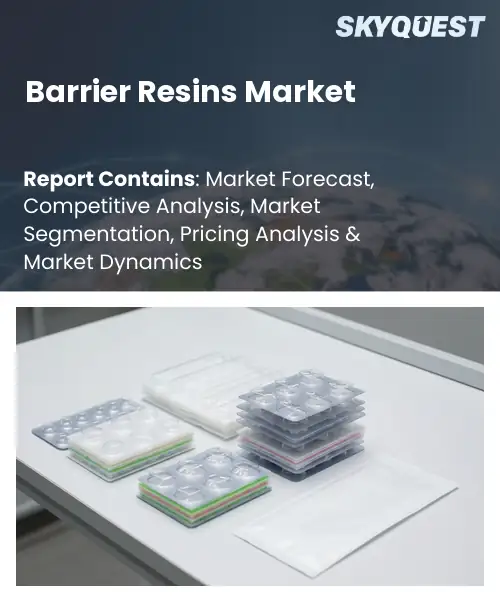
Barrier Resins Market
Report ID: SQMIG15E3840
Report ID: SQMIG15E3840
[email protected]
USA +1 351-333-4748
Report ID:
SQMIG15E3840 |
Region:
Global |
Published Date: June, 2026
Pages:
157
|Tables:
118
|Figures:
77


Global Barrier Resins Market size was valued at USD 4.52 Billion in 2024 and is poised to grow from USD 4.78 Billion in 2025 to USD 7.52 Billion by 2033, growing at a CAGR of 5.82% during the forecast period (2026-2033).
Barrier resins are polymeric materials designed to form moisture, gas, and chemical seals on packaging substrates, thereby extending product shelf life and preserving integrity. The market has risen as consumer demand for longer food, pharmaceuticals, and electronics intensifies, prompting manufacturers to replace films with lighter, recyclable alternatives. A primary driver originates from stringent regulatory mandates on food safety and pharmaceutical sterility, forcing producers to adopt barriers that satisfy migration limits. In the last decade, Europe’s sustainable packaging laws and expansion have accelerated adoption, exemplified by a 2022 shift of a snack brand to a polypropylene‑coated barrier resin for its bags.
The surge in sustainable packaging initiatives drives the barrier resins market toward recyclable, low‑carbon solutions that maintain performance. Retailers’ pledge to eliminate single‑use plastics raises demand for resin films replacing glassine and aluminum laminates, spurring investment in epoxy and polyurethane formulations. This shift creates opportunities for chemical producers to partner with converters, illustrated by a 2023 joint venture between a European resin maker and an Asian packaging firm that launched a compostable barrier liner for fresh produce. Consequently, revenue expands across Europe, North America and Asian economies as stricter environmental policies and rising e‑commerce volume boost demand for lightweight barriers.
How is AI-driven automation influencing the Barrier resins market?
AI‑driven automation is reshaping the barrier resins market by streamlining formulation, reducing cycle times, and improving consistency across production lines. Machine‑learning models analyze raw‑material variations and predict optimal mixing parameters, allowing manufacturers to maintain tight specifications while cutting waste. Real‑time sensors feed data into control systems that adjust temperature, pressure and curing schedules without human intervention, which accelerates scale‑up and shortens time‑to‑market for new resin grades. These capabilities are especially valuable in the pharmaceutical and medical sectors, where stringent barrier performance and regulatory compliance drive demand for reliable, high‑quality products. The overall effect is a more agile supply chain and faster adoption of advanced resin technologies.
In August 2021 a leading barrier resin producer introduced AI‑enhanced automation, enabling tighter process control and boosting overall efficiency, which supports continued market growth.
Market snapshot - (2026-2033)
Global Market Size
USD 4.52 Billion
Largest Segment
EVOH (Ethylene Vinyl Alcohol)
Fastest Growth
Growth Rate
5.82% CAGR
To get more insights on this market click here to Request a Free Sample Report
Global barrier resins market is segmented by resin type, application, processing, end-use and region. Based on resin type, the market is segmented into EVOH (Ethylene Vinyl Alcohol), PVDC (Polyvinylidene Chloride), MXD6 Nylon and PEN (Polyethylene Naphthalate). Based on application, the market is segmented into Food & Beverage Packaging, Pharmaceutical Packaging and Agricultural. Based on processing, the market is segmented into Co-extrusion, Blow Molding and Thermoforming. Based on end-use, the market is segmented into Food Packaging, Medical Packaging and Industrial. Based on region, the market is segmented into North America, Europe, Asia Pacific, Latin America and Middle East & Africa.
EVOH segment dominates because its outstanding oxygen barrier performance satisfies stringent shelf life demands, making it the preferred choice for preserving product freshness. Its compatibility with existing film production lines facilitates seamless integration, while regulatory pressure for reduced preservative use reinforces its relevance. Consequently, manufacturers prioritize EVOH to enhance package integrity, driving its leading position in the barrier resins market and supporting compliance with food safety standards, further solidifying its market appeal.
However, MXD6 Nylon segment is witnessing the strongest growth momentum as its moisture barrier and mechanical strength enable new high performance flexible packages, attracting manufacturers seeking lightweight solutions. The segment’s alignment with sustainability goals and compatibility with co extrusion processes fuels rapid market expansion and creates fresh opportunities for product innovation.
Food & Beverage Packaging dominates because it drives the highest demand for barrier resins that protect taste, aroma, and nutritional value, compelling producers to adopt advanced materials. Stringent shelf life expectations and consumer preference for fresh taste products push manufacturers toward high performance films. Additionally, the need to comply with food safety regulations intensifies reliance on robust barrier solutions, cementing this application’s leading role in market dynamics and long term brand reputation.
Meanwhile, Agricultural segment emerges as the key high growth area as barrier resins enable extended protection for seeds, fertilizers, and agro chemicals against moisture and oxygen. Growing emphasis on crop yield optimization and climate resilient packaging drives adoption, while innovative co extrusion formats expand functionality, accelerating market expansion and presenting new revenue streams.
To get detailed segments analysis, Request a Free Sample Report
Asia Pacific leads the barrier resins market due to a convergence of advanced manufacturing capabilities, strong demand for high‑performance packaging, and proactive environmental regulations. The region benefits from deep expertise in polymer engineering, supported by extensive research institutions and a culture of innovation. Major automotive and electronics producers drive the need for durable, lightweight barrier solutions, while consumer goods manufacturers seek improved shelf life for food and pharmaceuticals. Government incentives encourage adoption of sustainable materials, prompting manufacturers to integrate barrier resins into next‑generation products. The presence of major chemical producers with dedicated barrier resin divisions further reinforces supply chain resilience, while collaborations between academia and industry accelerate the development of specialty grades tailored to regional applications.
Barrier Resins Market in Japan is characterized by high consumer expectations for food safety and advanced electronics reliability. Local manufacturers leverage sophisticated polymer processing techniques to create ultra‑thin, high‑performing films that meet stringent quality standards. Collaborative research between universities and leading chemical firms fuels continuous innovation, while strong domestic demand from automotive and packaging sectors sustains robust production volumes. The focus on sustainability drives adoption of recyclable barrier solutions nationwide.
Barrier Resins Market in South Korea benefits from an integrated supply chain linking raw material producers with high‑tech end users. The country’s emphasis on miniaturization in display and battery technologies creates demand for barrier films that combine thinness with exceptional moisture protection. Government support for green chemistry encourages bio‑based resin alternatives, while conglomerates invest in R&D to tailor barrier properties for automotive interiors and medical packaging. This ecosystem promotes commercialization.
North America experiences rapid expansion of the barrier resins market driven by increasing consumer demand for extended product freshness and heightened regulatory focus on packaging safety. The presence of large multinational consumer‑goods corporations accelerates adoption of high‑performance barrier films across food, beverage, and pharmaceutical sectors. Innovation ecosystems in key technology hubs foster development of advanced resin formulations that balance barrier efficiency with recyclability, aligning with sustainability objectives. Strong investment in manufacturing infrastructure and collaborative ventures between resin producers and end‑user manufacturers streamline supply chains, reducing time‑to‑market for new barrier solutions. The region’s emphasis on circular economy principles pushes companies to adopt recyclable barrier resin systems, further stimulating market momentum.
Barrier Resins Market in United States is propelled by a consumer base demanding premium food preservation and electronics packaging. Domestic chemical giants invest heavily in research to create next‑generation barrier films that meet rigorous performance criteria while supporting recycling initiatives. Close collaboration with major food processors and pharmaceutical firms accelerates product rollout, and a logistics network ensures efficient distribution across the continent. Sustainability mandates further encourage adoption of resin technologies.
Barrier Resins Market in Canada is shaped by environmental standards and a growing demand for sustainable packaging solutions across the food and medical sectors. Canadian resin manufacturers prioritize development of bio‑based and recyclable barrier polymers to comply with regulatory expectations. Partnerships with food processors facilitate integration of barrier films into supply chains. The country’s emphasis on green innovation and a supportive research ecosystem drive improvement of resin performance and footprint.
Europe strengthens its position in the barrier resins market through a combination of rigorous regulatory frameworks, advanced materials research, and a mature consumer goods ecosystem that values product integrity. Collaborative initiatives among leading polymer manufacturers, academic institutions, and industry associations drive the development of high‑performance, recyclable barrier solutions tailored to food safety and pharmaceutical standards. The region’s strong emphasis on circular economy principles incentivizes the adoption of renewable‑based resin chemistries, while substantial public and private funding supports pilot projects aimed at reducing packaging waste. Integration of digital manufacturing technologies further enhances production efficiency and customization capabilities, allowing European firms to rapidly respond to evolving market demands. These coordinated efforts elevate Europe’s reputation as a hub for innovative, sustainable barrier resin applications.
Barrier Resins Market in Germany is driven by an automotive sector that requires barrier films for interior components and battery enclosures, as well as a strong food packaging industry focused on extending shelf life. German chemical companies emphasize precision engineering and sustainability, investing heavily in bio‑based resin research. Close cooperation with research institutes accelerates innovation cycles, while strict environmental regulations promote the uptake of recyclable barrier solutions across product lines.
Barrier Resins Market in United Kingdom benefits from a life‑science sector and a mature food & beverage industry that prioritize barrier technologies for product safety and compliance. British polymer firms focus on developing high‑performance, recyclable resins that meet European directives. Collaboration with leading universities drives research into novel barrier chemistries, while government incentives support scale‑up of sustainable manufacturing processes. These factors collectively enhance the market’s growth trajectory and global competitiveness.
Barrier Resins Market in France is reinforced by a strong emphasis on sustainable packaging and a cosmetics industry that demands barrier performance for product stability. French chemical groups invest in eco‑friendly resin development, targeting carbon footprints and recyclability. Partnerships with research laboratories accelerate the creation of innovative barrier polymers suitable for food, pharmaceutical, and luxury goods applications. National environmental policies further stimulate adoption of recyclable barrier solutions across market segments.
To know more about the market opportunities by region and country, click here to
Buy The Complete Report
Increasing Demand for Lightweight Structures
Advancements In Sustainable Resin Technologies
High Cost Of Advanced Materials
Regulatory Challenges In Chemical Usage
Request Free Customization of this report to help us to meet your business objectives.
The competitive landscape in the global barrier resins market is shaped by aggressive M&A activity, strategic joint ventures, and rapid technology innovation, as leading chemical producers acquire niche polymer firms to broaden their high‑performance resin portfolios while startups introduce bio‑based barrier solutions and advanced manufacturing processes that intensify product differentiation and pressure incumbents to accelerate R&D collaborations.
SkyQuest’s ABIRAW (Advanced Business Intelligence, Research & Analysis Wing) is our Business Information Services team that Collects, Collates, Correlates, and Analyses the Data collected by means of Primary Exploratory Research backed by robust Secondary Desk research. As per SkyQuest analysis the global barrier resins market is being propelled primarily by rising demand for lightweight, high‑performance packaging that meets stricter food‑safety and sustainability regulations, while a secondary driver is the rapid adoption of AI‑enabled automation that shortens formulation cycles and improves consistency. The main restraint comes from the high cost of advanced resin formulations, which can deter price‑sensitive manufacturers. Asia Pacific leads the market, benefitting from strong manufacturing bases and proactive environmental policies. Within the product landscape EVOH remains the dominating segment because of its superior oxygen‑barrier properties that align with food‑packaging needs, supporting continued growth across regions.
| Report Metric | Details |
|---|---|
| Market size value in 2024 | USD 4.52 Billion |
| Market size value in 2033 | USD 7.52 Billion |
| Growth Rate | 5.82% |
| Base year | 2024 |
| Forecast period | (2026-2033) |
| Forecast Unit (Value) | USD Billion |
| Segments covered |
|
| Regions covered | North America (US, Canada), Europe (Germany, France, United Kingdom, Italy, Spain, Rest of Europe), Asia Pacific (China, India, Japan, Rest of Asia-Pacific), Latin America (Brazil, Rest of Latin America), Middle East & Africa (South Africa, GCC Countries, Rest of MEA) |
| Companies covered |
|
| Customization scope | Free report customization with purchase. Customization includes:-
|
To get a free trial access to our platform which is a one stop solution for all your data requirements for quicker decision making. This platform allows you to compare markets, competitors who are prominent in the market, and mega trends that are influencing the dynamics in the market. Also, get access to detailed SkyQuest exclusive matrix.
Table Of Content
Executive Summary
Market overview
Parent Market Analysis
Market overview
Market size
KEY MARKET INSIGHTS
COVID IMPACT
MARKET DYNAMICS & OUTLOOK
Market Size by Region
KEY COMPANY PROFILES
Methodology
For the Barrier Resins Market, our research methodology involved a mixture of primary and secondary data sources. Key steps involved in the research process are listed below:
1. Information Procurement: This stage involved the procurement of Market data or related information via primary and secondary sources. The various secondary sources used included various company websites, annual reports, trade databases, and paid databases such as Hoover's, Bloomberg Business, Factiva, and Avention. Our team did 45 primary interactions Globally which included several stakeholders such as manufacturers, customers, key opinion leaders, etc. Overall, information procurement was one of the most extensive stages in our research process.
2. Information Analysis: This step involved triangulation of data through bottom-up and top-down approaches to estimate and validate the total size and future estimate of the Barrier Resins Market.
3. Report Formulation: The final step entailed the placement of data points in appropriate Market spaces in an attempt to deduce viable conclusions.
4. Validation & Publishing: Validation is the most important step in the process. Validation & re-validation via an intricately designed process helped us finalize data points to be used for final calculations. The final Market estimates and forecasts were then aligned and sent to our panel of industry experts for validation of data. Once the validation was done the report was sent to our Quality Assurance team to ensure adherence to style guides, consistency & design.
Analyst Support
Customization Options
With the given market data, our dedicated team of analysts can offer you the following customization options are available for the Barrier Resins Market:
Product Analysis: Product matrix, which offers a detailed comparison of the product portfolio of companies.
Regional Analysis: Further analysis of the Barrier Resins Market for additional countries.
Competitive Analysis: Detailed analysis and profiling of additional Market players & comparative analysis of competitive products.
Go to Market Strategy: Find the high-growth channels to invest your marketing efforts and increase your customer base.
Innovation Mapping: Identify racial solutions and innovation, connected to deep ecosystems of innovators, start-ups, academics, and strategic partners.
Category Intelligence: Customized intelligence that is relevant to their supply Markets will enable them to make smarter sourcing decisions and improve their category management.
Public Company Transcript Analysis: To improve the investment performance by generating new alpha and making better-informed decisions.
Social Media Listening: To analyze the conversations and trends happening not just around your brand, but around your industry as a whole, and use those insights to make better Marketing decisions.
REQUEST FOR SAMPLE
 REQUEST FREE CUSTOMIZATION
Global Barrier Resins Market size was valued at USD 4.52 Billion in 2024 and is poised to grow from USD 4.78 Billion in 2025 to USD 7.52 Billion by 2033, growing at a CAGR of 5.82% during the forecast period (2026-2033).
The competitive landscape in the global barrier resins market is shaped by aggressive M&A activity, strategic joint ventures, and rapid technology innovation, as leading chemical producers acquire niche polymer firms to broaden their high‑performance resin portfolios while startups introduce bio‑based barrier solutions and advanced manufacturing processes that intensify product differentiation and pressure incumbents to accelerate R&D collaborations. 'Kuraray Co. Ltd.', 'Solvay SA', 'Dow Inc.', 'BASF SE', 'LyondellBasell', 'Celanese Corporation', 'Mitsubishi Chemical', 'Toray Industries', 'Chang Chun Petrochemicals', 'Noltex LLC', 'Ineos Group', 'Honeywell (Aclar)', 'Sealed Air (Cryovac)', 'Berry Global Group', 'Ampac Holdings', 'Sigma Plastics', 'ProAmpac LLC', 'Bemis Company (Amcor)', 'Coveris Holdings', 'Winpak Ltd.'
The push for lighter vehicle and aircraft components reduces overall fuel consumption and emissions, prompting manufacturers to replace traditional metals with high‑performance barrier resins. These polymers provide superior strength‑to‑weight ratios while maintaining barrier properties, enabling designers to meet stringent efficiency standards without compromising safety. As OEMs prioritize weight reduction across product lines, procurement teams increasingly specify resin systems that deliver both structural integrity and moisture resistance, thereby expanding the demand base for barrier resin solutions worldwide.
Sustainable Compounding Growth: Manufacturers are increasingly prioritizing eco‑friendly barrier resins to meet consumer demand for recyclable packaging and corporate sustainability pledges. The shift is driven by heightened awareness of plastic waste, corporate ESG commitments, and voluntary green procurement standards across food, beverage, and personal care sectors. Suppliers are responding with bio‑based polymer blends, low‑VOC formulations, and closed‑loop recycling programs, positioning barrier resins as a strategic component in circular packaging strategies and enhancing brand credibility for long‑term market resilience and stakeholder trust globally today.
Why does Asia Pacific Dominate the Global Barrier Resins Market? |@12


Want to customize this report? This report can be personalized according to your needs. Our analysts and industry experts will work directly with you to understand your requirements and provide you with customized data in a short amount of time. We offer $1000 worth of FREE customization at the time of purchase.
Feedback From Our Clients


 USA (+1) 351-333-4748

