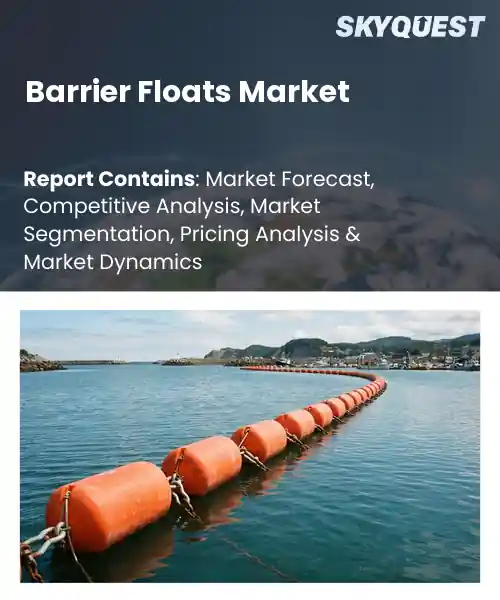
Barrier Floats Market
Report ID: SQMIG20I3769
Report ID: SQMIG20I3769
[email protected]
USA +1 351-333-4748
Report ID:
SQMIG20I3769 |
Region:
Global |
Published Date: August, 2026
Pages:
157
|Tables:
174
|Figures:
79


Global Barrier Floats Market size was valued at USD 487.3 Million in 2024 and is poised to grow from USD 513.61 Million in 2025 to USD 782.28 Million by 2033, growing at a CAGR of 5.4% during the forecast period (2026-2033).
The barrier float market comprises specialized buoyancy devices used to protect offshore infrastructure such as pipelines, cable trays, and subsea equipment from impact, erosion, and hydrodynamic forces. Its significance stems from the rising demand for reliable energy transmission across harsh marine environments, where traditional protective methods prove costly or ineffective. Historically, the sector emerged in the early 2000s when oil and gas operators adopted floating skirts for deep‑water pipelines; by 2015, the market expanded to include renewable‑energy installations like offshore wind farms. This evolution reflects a broader shift toward modular, low‑maintenance solutions that can be deployed quickly, reducing downtime and operational risk for companies. Among the drivers shaping the global barrier floats market, the proliferation of offshore renewable projects stands out as the pivotal catalyst, because the sector’s expanding capacity intensifies demands for cost‑effective, environmentally benign protection. As wind turbines multiply in deeper waters, operators must mitigate blade‑strike and seabed scouring, prompting the adoption of modular float barriers that absorb kinetic energy while maintaining minimal ecological footprint. This shift creates a feedback loop: increased deployment lowers unit costs, encouraging broader application across subsea telecom cables and marine research stations. Consequently, manufacturers are investing in polymer composites and sensor integration, unlocking revenue streams and reinforcing the market’s trajectory.
How is IoT integration enhancing safety and monitoring in the barrier floats market?
IoT integration is reshaping safety and monitoring for barrier floats by turning passive structures into connected assets. Sensors measure water pressure, movement and structural strain while wireless modules transmit data to cloud dashboards. Operators receive real time alerts that highlight abnormal conditions before a breach occurs. Remote diagnostics allow technicians to assess health without physical inspection, reducing exposure to hazardous environments. Predictive analytics use historical patterns to schedule maintenance, extending service life and lowering downtime. Early adopters are embedding GPS trackers on marine floating barriers to monitor drift and position, and adding level sensors to flood barriers for precise water rise detection. These capabilities create a proactive safety net that aligns with the market’s push for smarter, more resilient infrastructure.In July 2026 a leading barrier float producer launched an IoT enabled monitoring platform that streams sensor data to a centralized hub, allowing instant anomaly detection and coordinated response, thereby boosting operational efficiency and supporting market expansion. The system also integrates with existing emergency protocols, streamlining communication between field crews and control centers.
Market snapshot - (2026-2033)
Global Market Size
USD 487.3 Million
Largest Segment
Cylindrical Barrier Floats
Fastest Growth
Modular Barrier Floats
Growth Rate
5.4% CAGR
To get more insights on this market click here to Request a Free Sample Report
Global barrier floats market is segmented by product type, material, application, end user, installation, distribution channel and region. Based on product type, the market is segmented into Cylindrical Barrier Floats, Spherical Barrier Floats, Modular Barrier Floats and Others. Based on material, the market is segmented into HDPE, Polyethylene Foam, Composite Materials and Others. Based on application, the market is segmented into Oil Spill Containment, Marine Safety, Aquaculture and Others. Based on end user, the market is segmented into Marine Authorities, Oil & Gas Companies, Aquaculture Operators and Others. Based on installation, the market is segmented into Permanent and Temporary. Based on distribution channel, the market is segmented into Direct Sales, Marine Equipment Distributors and Others. Based on region, the market is segmented into North America, Europe, Asia Pacific, Latin America and Middle East & Africa.
Cylindrical Barrier Floats segment dominates because they provide reliable buoyancy, easy deployment, and proven performance in containment operations. Their simple geometry allows rapid installation and stable positioning, which meets the core requirement of quick spill mitigation. Operators favor them for their durability and cost effectiveness, reinforcing their market leadership. Regulators often reference these units for emergency response plans, and their low maintenance requirements reduce lifecycle costs, further cementing their dominance.
However, Modular Barrier Floats are witnessing the strongest growth momentum because their flexible design enables customized configurations for complex spill scenarios and emerging offshore installations. Innovation in interlocking mechanisms and lightweight composites drives adoption, opening new market opportunities and accelerating overall market expansion. These attributes also align with sustainability goals, further propelling demand.
HDPE segment dominates because it offers exceptional chemical resistance, high tensile strength, and proven longevity in harsh marine environments. Manufacturers value its ease of molding, which supports mass production while maintaining consistent quality. The material’s affordability and recyclability also meet industry sustainability pressures, reinforcing its leading position. Regulators often reference HDPE compliance in safety standards, and its resistance to UV degradation ensures prolonged service life, further cementing its dominance across diverse applications.
On the other hand, Composite Materials are emerging as the key high growth area because they combine lightweight characteristics with superior strength, enabling innovative float designs that reduce drag and improve handling. Advances in fiber technology and resin systems attract eco conscious buyers, expanding market reach and creating new opportunities for premium product lines.
To get detailed segments analysis, Request a Free Sample Report
North America retains a leading position in the Barrier Floats market due to a confluence of advanced manufacturing capabilities, robust infrastructure investment, and strong regulatory frameworks that prioritize safety and environmental stewardship. The region benefits from deep integration of research institutions with industrial partners, fostering rapid iteration of float designs and material innovations. Established supply chains ensure reliable availability of high‑quality polymers and coating technologies, while a culture of stringent compliance accelerates product adoption across offshore and inland applications. The presence of major energy and maritime hubs also creates a feedback loop that drives continuous improvement and customization of barrier float technologies. Collaboration among government agencies, standards organizations, and private firms further consolidates North America advantage, ensuring that market participants can rapidly respond to evolving operational challenges.
United States Barrier Floats Market
Barrier Floats Market in the United States benefits from a well‑established ecosystem of coastal engineering firms and offshore operators that demand high‑performance solutions for spill containment and habitat protection. Close collaboration between research laboratories and industry accelerates material testing, while a proactive regulatory environment encourages adoption of advanced barrier designs. The market also leverages extensive logistics networks that guarantee timely delivery of customized float configurations to diverse project sites.
Canada Barrier Floats Market
Barrier Floats Market in Canada is shaped by a strong emphasis on environmental stewardship and a growing offshore wind sector that requires reliable containment systems. Collaboration between government research institutes and private manufacturers drives innovation in biodegradable coatings and low‑temperature resistant polymers. The market also benefits from a geographic layout that includes extensive coastline and inland water bodies, prompting diverse applications ranging from oil spill response to ecosystem restoration projects.
Europe experiences rapid expansion of the Barrier Floats market as sustainability imperatives intersect with advanced engineering expertise across the continent. Strong policy frameworks incentivize low‑impact spill mitigation technologies, while a dense network of research universities fosters continuous material breakthroughs. Industry clusters in key maritime nations leverage shared knowledge to deliver highly customized float systems that address varied regulatory and environmental conditions. Additionally, the presence of mature offshore energy installations and a growing emphasis on coastal resilience creates consistent demand for innovative barrier solutions, reinforcing Europe’s position as a hub for next‑generation containment technologies. Cross‑border collaboration among European standards bodies ensures harmonized performance criteria, simplifying market entry for manufacturers across the region. Moreover, a culture of public‑private partnership accelerates pilot deployments that demonstrate the efficacy of barrier floats in protecting sensitive marine habitats, further encouraging adoption by both governmental agencies and private operators.
Germany Barrier Floats Market
Barrier Floats Market in Germany is anchored by a strong engineering tradition and a comprehensive regulatory environment that emphasizes both safety and ecological balance. Close cooperation between technical universities and leading manufacturers accelerates the development of high‑strength, recyclable float materials. The market also serves a diversified client base that includes port authorities, renewable energy firms, and environmental agencies, fostering a culture of continual refinement and application‑specific customization for global relevance.
United Kingdom Barrier Floats Market
Barrier Floats Market in the United Kingdom is characterised by adoption driven by ambitious coastal protection programmes and a vibrant offshore wind sector. Collaborative research initiatives between universities and marine service firms generate innovative coating technologies that enhance durability in harsh sea conditions. The market benefits from agile regulatory pathways that expedite approval of barrier designs, while a network of distributors ensures rapid deployment to ports, estuaries, and offshore installations.
France Barrier Floats Market
Barrier Floats Market in France is emerging as a niche yet promising segment, supported by environmental policies and investment in marine renewable projects. Partnerships between coastal engineering consultancies and academic laboratories drive experimentation with lightweight biodegradable float composites. The market leverages France riverine network and Atlantic coastline, enabling pilots that showcase barrier float effectiveness in preventing pollutant spread. Gradual regulatory endorsement is fostering broader acceptance among local authorities and stakeholders.
Asia Pacific is strengthening its position in the Barrier Floats market through a blend of rapid industrialization, expanding maritime infrastructure, and a growing emphasis on environmental risk mitigation. Nations in the region are investing heavily in offshore energy developments, prompting demand for reliable containment solutions that can operate under diverse climatic conditions. Collaborative ecosystems linking shipbuilding corridors with specialized polymer manufacturers accelerate the rollout of high‑performance floats tailored to local needs. Additionally, heightened awareness of coastal vulnerability drives governmental support for innovative barrier technologies, positioning the region as a burgeoning hub for next‑generation float applications. Regional trade agreements facilitate smoother cross‑border movement of raw materials, reducing lead times and encouraging multinational collaborations. Moreover, a rising cohort of marine research institutes is spearheading studies on eco‑friendly float degradation pathways, aligning product development with stricter environmental standards across the Pacific basin.
Japan Barrier Floats Market
Barrier Floats Market in Japan is propelled by engineering culture and a focus on disaster resilience, especially in the context of frequent coastal hazards. Integration of advanced polymer science from leading research institutes yields floats with superior buoyancy and durability. The market serves an array of stakeholders, including port authorities, oil spill response teams, and renewable energy developers, fostering continual refinement of designs that meet stringent safety and environmental criteria.
South Korea Barrier Floats Market
Barrier Floats Market in South Korea is advancing through governmental support for marine safety initiatives and a growing offshore wind sector. Collaboration between shipbuilding giants and specialty chemical firms produces floats that combine high strength with corrosion resistance for harsh sea environments. The market also benefits from ports that serve as logistics hubs, enabling swift distribution of barrier solutions to regional operators focused on spill containment and coastal habitat preservation.
To know more about the market opportunities by region and country, click here to
Buy The Complete Report
Using Advanced Polymer Technology
Growing Demand For Sustainable Solutions
High Production Cost Challenges
Regulatory Uncertainty In Emerging Markets
Request Free Customization of this report to help us to meet your business objectives.
The competitive landscape of the global barrier floats market is shaped by intense rivalry among manufacturers seeking to differentiate through strategic M&A, joint ventures, and advanced material innovations. Recent activity includes a notable acquisition of a niche float‑design firm by a leading marine equipment group in 2025, while another major player forged a partnership with a coastal engineering consortium to co‑develop smart‑sensor‑enabled barrier systems, accelerating product differentiation and market reach.
Top Player’s Company Profile
Recent Developments
SkyQuest’s ABIRAW (Advanced Business Intelligence, Research & Analysis Wing) is our Business Information Services team that Collects, Collates, Correlates, and Analyses the Data collected by means of Primary Exploratory Research backed by robust Secondary Desk research. As per SkyQuest analysis the global barrier floats market is projected to rise to $782.3 million by 2033, driven primarily by the expansion of offshore renewable projects that demand cost‑effective protection, while a second strong driver is the growing demand for sustainable solutions prompting manufacturers to adopt biodegradable and recycled materials. High production cost challenges remain a restraint, limiting adoption where budgets are tight. North America continues to dominate the market thanks to its advanced manufacturing base and robust regulatory framework, and within the product mix cylindrical barrier floats hold the largest share because of their proven reliability and quick‑deployment capability. These dynamics together shape the market’s outlook.
| Report Metric | Details |
|---|---|
| Market size value in 2024 | USD 487.3 Million |
| Market size value in 2033 | USD 782.28 Million |
| Growth Rate | 5.4% |
| Base year | 2024 |
| Forecast period | (2026-2033) |
| Forecast Unit (Value) | USD Million |
| Segments covered |
|
| Regions covered | North America (US, Canada), Europe (Germany, France, United Kingdom, Italy, Spain, Rest of Europe), Asia Pacific (China, India, Japan, Rest of Asia-Pacific), Latin America (Brazil, Rest of Latin America), Middle East & Africa (South Africa, GCC Countries, Rest of MEA) |
| Companies covered |
|
| Customization scope | Free report customization with purchase. Customization includes:-
|
To get a free trial access to our platform which is a one stop solution for all your data requirements for quicker decision making. This platform allows you to compare markets, competitors who are prominent in the market, and mega trends that are influencing the dynamics in the market. Also, get access to detailed SkyQuest exclusive matrix.
Table Of Content
Executive Summary
Market overview
Parent Market Analysis
Market overview
Market size
KEY MARKET INSIGHTS
COVID IMPACT
MARKET DYNAMICS & OUTLOOK
Market Size by Region
KEY COMPANY PROFILES
Methodology
For the Barrier Floats Market, our research methodology involved a mixture of primary and secondary data sources. Key steps involved in the research process are listed below:
1. Information Procurement: This stage involved the procurement of Market data or related information via primary and secondary sources. The various secondary sources used included various company websites, annual reports, trade databases, and paid databases such as Hoover's, Bloomberg Business, Factiva, and Avention. Our team did 45 primary interactions Globally which included several stakeholders such as manufacturers, customers, key opinion leaders, etc. Overall, information procurement was one of the most extensive stages in our research process.
2. Information Analysis: This step involved triangulation of data through bottom-up and top-down approaches to estimate and validate the total size and future estimate of the Barrier Floats Market.
3. Report Formulation: The final step entailed the placement of data points in appropriate Market spaces in an attempt to deduce viable conclusions.
4. Validation & Publishing: Validation is the most important step in the process. Validation & re-validation via an intricately designed process helped us finalize data points to be used for final calculations. The final Market estimates and forecasts were then aligned and sent to our panel of industry experts for validation of data. Once the validation was done the report was sent to our Quality Assurance team to ensure adherence to style guides, consistency & design.
Analyst Support
Customization Options
With the given market data, our dedicated team of analysts can offer you the following customization options are available for the Barrier Floats Market:
Product Analysis: Product matrix, which offers a detailed comparison of the product portfolio of companies.
Regional Analysis: Further analysis of the Barrier Floats Market for additional countries.
Competitive Analysis: Detailed analysis and profiling of additional Market players & comparative analysis of competitive products.
Go to Market Strategy: Find the high-growth channels to invest your marketing efforts and increase your customer base.
Innovation Mapping: Identify racial solutions and innovation, connected to deep ecosystems of innovators, start-ups, academics, and strategic partners.
Category Intelligence: Customized intelligence that is relevant to their supply Markets will enable them to make smarter sourcing decisions and improve their category management.
Public Company Transcript Analysis: To improve the investment performance by generating new alpha and making better-informed decisions.
Social Media Listening: To analyze the conversations and trends happening not just around your brand, but around your industry as a whole, and use those insights to make better Marketing decisions.
REQUEST FOR SAMPLE
 REQUEST FREE CUSTOMIZATION


Want to customize this report? This report can be personalized according to your needs. Our analysts and industry experts will work directly with you to understand your requirements and provide you with customized data in a short amount of time. We offer $1000 worth of FREE customization at the time of purchase.
Feedback From Our Clients


 USA (+1) 351-333-4748

