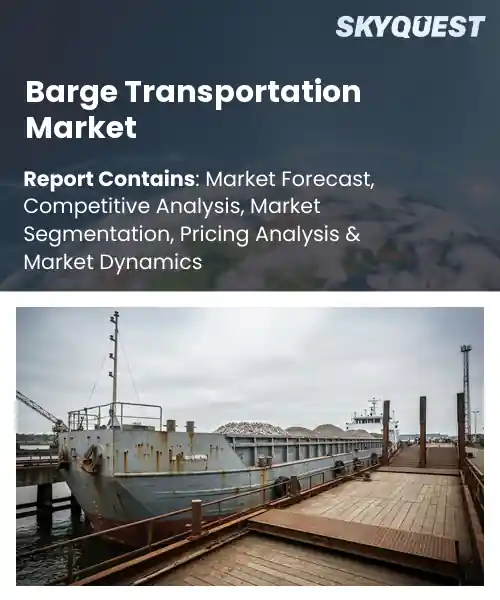
Barge Transportation Market
Report ID: SQMIG20T2046
Report ID: SQMIG20T2046
[email protected]
USA +1 351-333-4748
Report ID:
SQMIG20T2046 |
Region:
Global |
Published Date: June, 2026
Pages:
157
|Tables:
120
|Figures:
77


Global Barge Transportation Market size was valued at USD 18.52 Billion in 2024 and is poised to grow from USD 19.47 Billion in 2025 to USD 28.85 Billion by 2033, growing at a CAGR of 5.12% during the forecast period (2026-2033).
Global barge transportation market covers the movement of bulk commodities and containers along inland waterways and coastal seas using vessels that can haul thousands of tons per trip. Its relevance lies in shifting freight from congested road and rail routes to a mode that consumes far less fuel per ton‑mile, thereby reducing logistics costs and emissions. In the last two decades the market has grown as governments invested in lock‑and‑dam infrastructure, exemplified by United States’ Mississippi River system now handling over 150 million tons annually. Upgrades in the Rhine and Yangtze basins have boosted barge volumes, making this sector a pillar of supply chains.
A second pivotal factor shaping the barge transportation market is the rising demand for logistics driven by stricter regulations and sustainability goals. When shippers prioritize emissions reductions, they increasingly allocate cargo to waterways where barge fuel consumption can be up to 80 percent lower than that of trucks, resulting in cost savings and compliance advantages. This shift has opened opportunities for technology providers to deploy electric‑assist propulsion and automated navigation systems that further cut fuel use and improve safety. For instance, the Port of Rotterdam’s pilot of autonomous barges has shortened transit times for bulk chemicals, encouraging other terminals to consider investments and expanding the market’s service scope.
How is AI-driven automation improving efficiency in the barge transportation market?
AI driven automation is reshaping barge transportation by linking sensors, analytics and decision engines across the fleet. Route planning tools use machine learning to match cargo loads with optimal waterways, cutting travel distance and reducing idle time. Predictive maintenance models read vibration and engine data to schedule repairs before breakdowns occur, keeping vessels on schedule. Real time cargo monitoring alerts operators to temperature or weight shifts, allowing immediate corrective action. Autonomous navigation assists pilots in tight channels, improving safety and lowering fuel consumption. Together these capabilities create a more responsive network that moves goods faster while using fewer resources.
In June 2026 a market outlook highlighted the growing adoption of AI tools across North American barge operators, noting that firms are investing in digital platforms to streamline scheduling and fuel management, a shift that is expected to accelerate efficiency gains throughout the sector.
Market snapshot - (2026-2033)
Global Market Size
USD 18.52 Billion
Largest Segment
Container
Fastest Growth
Oversized/Heavy Lift
Growth Rate
5.12% CAGR
To get more insights on this market click here to Request a Free Sample Report
Global barge transportation market is segmented by cargo type, waterway, service type, end-use industry and region. Based on cargo type, the market is segmented into Dry Bulk (Grain, Coal), Liquid Bulk (Petroleum, Chemicals), Container and Oversized/Heavy Lift. Based on waterway, the market is segmented into River Barging, Coastal/Intracoastal and Canal. Based on service type, the market is segmented into Towing and Self-Propelled. Based on end-use industry, the market is segmented into Agriculture, Energy, Construction and Manufacturing. Based on region, the market is segmented into North America, Europe, Asia Pacific, Latin America and Middle East & Africa.
Dry bulk segment dominates because it carries the highest volumes of raw commodities that underpin industrial supply chains, and barges excel at moving these low value, high weight goods over short to medium distances with minimal fuel consumption. The simplicity of handling grain and coal reduces turnaround time, while the predictable loading patterns enable operators to optimize fleet utilization, reinforcing its central position in barge logistics throughout the broader transport network.
However, container segment is witnessing the strongest growth momentum as shippers increasingly rely on intermodal connectivity to streamline door to door delivery, and barges offer a low cost, environmentally friendly alternative to road freight. Rising demand for just in time inventory and advancements in loading automation are accelerating its adoption, creating new opportunities for fleet expansion.
Self propelled segment leads because operators can directly control vessel speed and routing, eliminating reliance on external tugs and thereby reducing operational latency. This autonomy supports tighter schedule adherence and enables rapid response to demand fluctuations, fostering higher asset turnover. Integrated engine technologies also improve fuel efficiency, while crew familiarity with self propelled systems enhances safety, consolidating its prominence in barge logistics across diverse cargo categories and seasonal peaks.
Meanwhile, towing segment is emerging as the key high growth area as shippers seek cost effective solutions for moving oversized and heavy lift cargoes that exceed self propelled capabilities. Advances in tug power and maneuverability reduce turnaround time, while regulatory incentives for reduced emissions encourage wider adoption, propelling market expansion.
To get detailed segments analysis, Request a Free Sample Report
Asia Pacific dominance stems from extensive inland waterway networks, high industrial output, and supportive regulatory frameworks that prioritize multimodal logistics. Countries in the region invest heavily in modernizing fleets, integrating advanced navigation technologies, and fostering collaboration between ports and manufacturers. Strategic location of major rivers and coastal corridors enables efficient bulk movement of commodities, reducing reliance on road and rail. Environmental initiatives encourage the shift to lower‑emission barge solutions, while government incentives lower operational barriers. The convergence of these factors creates a robust ecosystem where barge transport is viewed as a cost‑effective and sustainable cornerstone of supply chains across the region.
Barge Transportation Market in Japan benefits from a dense network of rivers and coastal channels that connect industrial hubs with export terminals. Continuous investment in vessel modernization and digital traffic management enhances reliability and turnaround speed. Collaborative initiatives between shipping firms and logistics providers streamline intermodal transfers, while environmental policies promote fuel‑efficient operations. These dynamics reinforce Japan’s role as a benchmark for high‑value, low‑carbon freight movement.
Barge Transportation Market in South Korea leverages a strategic coastline and well‑developed river systems linking heavy‑industry zones with global ports. Government support for green shipping drives adoption of low‑emission propulsion and alternative fuels. Integration of smart navigation platforms improves scheduling precision and cargo safety. Close coordination with petrochemical and steel sectors ensures steady demand, while export‑focused logistics networks amplify the appeal of barge solutions for bulk commodities.
North America experiences rapid expansion due to abundant freshwater resources, expansive inland waterway corridors, and a growing emphasis on sustainable freight solutions. Stakeholders prioritize barge transport to alleviate highway congestion and reduce carbon footprints, especially for bulk agricultural and energy products. Industry collaborations focus on enhancing vessel efficiency, implementing real‑time tracking, and improving terminal infrastructure. Policy frameworks encourage investment in cleaner propulsion technologies, while market participants respond to consumer demand for greener supply chains. The convergence of logistical efficiencies, environmental incentives, and strategic investments positions barge transport as a pivotal growth engine within the continent’s broader transportation ecosystem.
United States Barge Transportation Market is anchored by extensive river systems such as the Mississippi and Ohio, providing critical links between interior producers and coastal export hubs. Ongoing upgrades to lock and dam infrastructure enhance navigational reliability, while private‑sector innovation drives adoption of fuel‑efficient engines and automated loading systems. Partnerships between barge operators and major agricultural, energy, and manufacturing firms streamline intermodal connections, reinforcing the United States as a central hub for high‑volume bulk movement across North America.
Canada Barge Transportation Market draws strength from its Great Lakes and St. Lawrence Seaway, which serve as vital arteries for cross‑border trade and domestic commodity flow. Investment in ice‑class vessel designs extends operational windows, while federal initiatives promote low‑emission fuel use and emissions monitoring. Collaborative efforts between port authorities and logistics providers improve cargo handling efficiency, supporting sectors such as forestry, mining, and grain. These elements collectively enhance Canada’s capacity to offer reliable, environmentally conscious barge services within the continental network.
Europe strengthens its position through coordinated investment in inland waterway modernization, stringent environmental standards, and integrated multimodal logistics frameworks. The region’s dense river basin network, coupled with advanced port digitalization, facilitates seamless transfer of bulk goods across national borders. Collaborative research programs promote alternative fuels, hybrid propulsion, and emission‑reduction technologies, aligning with the European Union’s sustainability agenda. Public‑private partnerships fund infrastructure upgrades, enhancing lock capacity and channel depth. Together, these initiatives boost operational efficiency, lower carbon intensity, and reinforce Europe’s reputation as a leader in sustainable heavy‑weight freight movement.
Germany Barge Transportation Market benefits from a comprehensive Rhine‑Danube corridor that interlinks industrial heartlands with major seaports. Continuous investment in lock modernization and channel deepening ensures high navigability, while digital traffic management systems optimize vessel scheduling. Strong collaboration between chemical, automotive, and logistics sectors sustains robust cargo volumes. Environmental directives incentivize the adoption of low‑sulphur fuels and electrified auxiliary power, positioning Germany as a benchmark for eco‑efficient barge operations within the continent.
United Kingdom Barge Transportation Market leverages the extensive Thames and Humber estuary networks to connect manufacturing clusters with maritime gateways. Initiatives focused on shore‑side electrification and green fuel trials reduce emissions and improve community acceptance. Integration with rail and road intermodal hubs streamlines supply chain flows, while policy support encourages investment in newer, fuel‑efficient vessels. These efforts collectively enhance the United Kingdom’s capacity to deliver sustainable, high‑capacity freight solutions.
France Barge Transportation Market is anchored by the Seine, Rhône, and extensive canal system that link agricultural and industrial regions to major ports such as Le Havre. National strategies prioritize modernization of lock infrastructure and adoption of alternative propulsion technologies. Partnerships between barge operators and major agro‑food exporters facilitate efficient bulk handling, while environmental incentives promote the use of bio‑fuels and hybrid systems. This coordinated approach reinforces France’s role in advancing low‑carbon inland shipping across the European landscape.
To know more about the market opportunities by region and country, click here to
Buy The Complete Report
Growth is Driven By Energy
Adoption of Sustainable Practices
Regulatory Compliance is Complex
Infrastructure Limitations are Significant
Request Free Customization of this report to help us to meet your business objectives.
The competitive landscape in the global barge transportation market is shaped by digital platforms and strategic investments that streamline freight‑barge matching, drive efficiency, and expand service networks. Companies are pursuing partnerships with terminal operators and leveraging technology to offer real‑time logistics visibility, while recent capital infusions enable rapid product development and geographic expansion, intensifying competition among incumbents and new entrants.
SkyQuest’s ABIRAW (Advanced Business Intelligence, Research & Analysis Wing) is our Business Information Services team that Collects, Collates, Correlates, and Analyses the Data collected by means of Primary Exploratory Research backed by robust Secondary Desk research. As per SkyQuest analysis, the global barge transportation market is propelled primarily by the growing demand for energy commodities such as coal, oil and LNG, which fuels high‑volume bulk shipments and secures cost advantages over road and rail. A second driver is the accelerating adoption of sustainable practices, with shippers favoring low‑emission waterway transport and operators investing in green propulsion and digital tools. The dry‑bulk cargo segment remains the dominant contributor because of its sheer volume and simple handling, while Asia Pacific leads the market thanks to extensive inland waterways, strong industrial output and supportive policies. However, complex regulatory compliance across jurisdictions poses a significant restraint, slowing investment and operational agility.
| Report Metric | Details |
|---|---|
| Market size value in 2024 | USD 18.52 Billion |
| Market size value in 2033 | USD 28.85 Billion |
| Growth Rate | 5.12% |
| Base year | 2024 |
| Forecast period | (2026-2033) |
| Forecast Unit (Value) | USD Billion |
| Segments covered |
|
| Regions covered | North America (US, Canada), Europe (Germany, France, United Kingdom, Italy, Spain, Rest of Europe), Asia Pacific (China, India, Japan, Rest of Asia-Pacific), Latin America (Brazil, Rest of Latin America), Middle East & Africa (South Africa, GCC Countries, Rest of MEA) |
| Companies covered |
|
| Customization scope | Free report customization with purchase. Customization includes:-
|
To get a free trial access to our platform which is a one stop solution for all your data requirements for quicker decision making. This platform allows you to compare markets, competitors who are prominent in the market, and mega trends that are influencing the dynamics in the market. Also, get access to detailed SkyQuest exclusive matrix.
Table Of Content
Executive Summary
Market overview
Parent Market Analysis
Market overview
Market size
KEY MARKET INSIGHTS
COVID IMPACT
MARKET DYNAMICS & OUTLOOK
Market Size by Region
KEY COMPANY PROFILES
Methodology
For the Barge Transportation Market, our research methodology involved a mixture of primary and secondary data sources. Key steps involved in the research process are listed below:
1. Information Procurement: This stage involved the procurement of Market data or related information via primary and secondary sources. The various secondary sources used included various company websites, annual reports, trade databases, and paid databases such as Hoover's, Bloomberg Business, Factiva, and Avention. Our team did 45 primary interactions Globally which included several stakeholders such as manufacturers, customers, key opinion leaders, etc. Overall, information procurement was one of the most extensive stages in our research process.
2. Information Analysis: This step involved triangulation of data through bottom-up and top-down approaches to estimate and validate the total size and future estimate of the Barge Transportation Market.
3. Report Formulation: The final step entailed the placement of data points in appropriate Market spaces in an attempt to deduce viable conclusions.
4. Validation & Publishing: Validation is the most important step in the process. Validation & re-validation via an intricately designed process helped us finalize data points to be used for final calculations. The final Market estimates and forecasts were then aligned and sent to our panel of industry experts for validation of data. Once the validation was done the report was sent to our Quality Assurance team to ensure adherence to style guides, consistency & design.
Analyst Support
Customization Options
With the given market data, our dedicated team of analysts can offer you the following customization options are available for the Barge Transportation Market:
Product Analysis: Product matrix, which offers a detailed comparison of the product portfolio of companies.
Regional Analysis: Further analysis of the Barge Transportation Market for additional countries.
Competitive Analysis: Detailed analysis and profiling of additional Market players & comparative analysis of competitive products.
Go to Market Strategy: Find the high-growth channels to invest your marketing efforts and increase your customer base.
Innovation Mapping: Identify racial solutions and innovation, connected to deep ecosystems of innovators, start-ups, academics, and strategic partners.
Category Intelligence: Customized intelligence that is relevant to their supply Markets will enable them to make smarter sourcing decisions and improve their category management.
Public Company Transcript Analysis: To improve the investment performance by generating new alpha and making better-informed decisions.
Social Media Listening: To analyze the conversations and trends happening not just around your brand, but around your industry as a whole, and use those insights to make better Marketing decisions.
REQUEST FOR SAMPLE
 REQUEST FREE CUSTOMIZATION
Global Barge Transportation Market size was valued at USD 18.52 Billion in 2024 and is poised to grow from USD 19.47 Billion in 2025 to USD 28.85 Billion by 2033, growing at a CAGR of 5.12% during the forecast period (2026-2033).
The competitive landscape in the global barge transportation market is shaped by digital platforms and strategic investments that streamline freight‑barge matching, drive efficiency, and expand service networks. Companies are pursuing partnerships with terminal operators and leveraging technology to offer real‑time logistics visibility, while recent capital infusions enable rapid product development and geographic expansion, intensifying competition among incumbents and new entrants. 'ACBL (American Commercial Barge Line)', 'Ingram Marine Group', 'Marquette Transportation', 'Kirby Corporation', 'Canal Barge Company', 'SCF Marine', 'Heartland Barge Management', 'Florida Marine Transporters', 'Southern Towing', 'Associated Terminals', 'SEACOR Holdings', 'Bouchard Transportation', 'Campbell Transportation', 'Dann Marine Towing', 'Reinauer Transportation', 'Turn Services', 'Moran Towing Corporation', 'Foss Maritime (Saltchuk)', 'McAllister Towing', 'Hapag-Lloyd (River)'
Growth is driven by the increasing demand for energy commodities such as coal, oil, and liquefied natural gas, which are traditionally transported via waterways. Barge operators benefit from the economies of scale inherent in bulk movement, enabling lower per‑ton shipping costs and reduced environmental impact compared with overland alternatives. This efficiency encourages shippers to favor barge services, reinforcing market expansion as the sector aligns with broader industrial supply chain strategies focused on cost‑effective and reliable bulk transport in global trade networks.
Renewable Fuel Integration: The shift toward carbon fuels is reshaping barge operations as operators adopt biodiesel blends, liquefied natural gas, and hydrogen based solutions. Fleet managers prioritize vessels capable of handling mixed fuel systems, prompting retrofits and builds designed for fuel flexibility. Ports and terminals enhance infrastructure to store and dispense renewable fuels, while industry collaborations foster standardized fuel quality protocols. This transition reduces emissions, aligns with stakeholder sustainability expectations, and opens avenues for significant fuel sourcing, positioning barges as greener logistics assets.
Why does Asia Pacific Dominate the Global Barge Transportation Market? |@12


Want to customize this report? This report can be personalized according to your needs. Our analysts and industry experts will work directly with you to understand your requirements and provide you with customized data in a short amount of time. We offer $1000 worth of FREE customization at the time of purchase.
Feedback From Our Clients


 USA (+1) 351-333-4748

