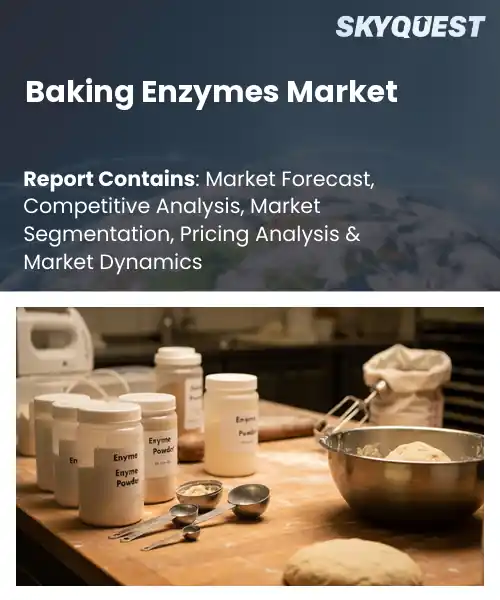
Baking Enzymes Market
Report ID: SQMIG15E3507
Report ID: SQMIG15E3507
[email protected]
USA +1 351-333-4748
Report ID:
SQMIG15E3507 |
Region:
Global |
Published Date: May, 2026
Pages:
157
|Tables:
94
|Figures:
76


Global Baking Enzymes Market size was valued at USD 869.1 Million in 2024 and is poised to grow from USD 916.9 Million in 2025 to USD 1407.15 Million by 2033, growing at a CAGR of 5.5% during the forecast period (2026-2033).
Sustaining baking enzymes market growth is the result of renewed focus on improved quality in producing bread as well as efficiency related to changing consumer trends and demands from the industry. Enzymes used in baking include amylases, proteases, xylanases, and lipases which modify dough characteristics; add length to the shelf life of products; and optimize production methods. Because they are biological catalysts, enzymes allow for the elimination of many of the chemical additives that are traditionally added to various baked goods and allow bakeries that produce significant amounts of products (in excess of three million pounds per month) reduce their costs associated with resources. In recent years, the use of enzymes has evolved from single-enzyme applications to a diverse selection of multi-enzyme blends and formulation services; a good example is how the leading suppliers of enzymes have formed partnerships with the bakers at retail to minimize the number of additives used while creating an excellent crumb structure and ensuring consistency between batches.
The second critical growth in baking enzymes market trends will be technological advancement in enzyme engineering, with customized enzymes providing the bagel maker with improved product quality, increased productivity, reduced energy usage, and decreased proof times. The use of optimised amylase and xylanase combinations can give lubricant users greater predictability in handling dough, which ultimately leads to minimising rejects due to poor management, decrease in price per pound for lubricants, and encourage more lubrication usage; in addition to creating Lubricant Benefits other than economic benefits, produces natural products that allow bagel makers to be compliant with regulation and meet demand by consumers for natural products from both artisanal and ready-to-eat categories. Examples from the industry include large bakeries using protease-based systems to minimise the use of preservatives; and frozen bakery manufacturers using enzymes to extend their shelf life, creating substantial commercial incentives for R&D investments.
How is AI Accelerating Innovation in the Baking Enzymes Market?
Innovative use of AI has accelerated growth in the baking enzyme market share. This transformation is significant because it enables research and development teams to better identify and optimize catalysts (enzymes) needed for baking dough performance and extending shelf life. Notable areas of disruption include using AI to design proteins; using predictive modeling to anticipate how enzymes will behave under real-world conditions; employing automated workflows to prioritize the most promising variants for further testing. The current baking enzyme marketplace is now focused on utilizing data-driven optimization (compared to traditional trial and error methods), which enables formulators to develop cleaner label and improved texture solutions in significantly less time. Examples of this technology include the following, generative models that provide recommendations for mutations; lab automation that speeds screening processes; and digital twin technology that reduces uncertainty associated with scaling up to commercial production.
In February 2026, dsm-firmenich established a Baking Innovation Center in Princeton New York that represents the baking industry's investment in applied research and development (R&D). The Baking Innovation Center aims to support product optimization while providing a more efficient scale-up and sustainable manufacturing process by combining pilot plant facilities with AI enabled formulation and predictive enzyme screening technology.
Market snapshot - (2026-2033)
Global Market Size
USD 869.1 Million
Largest Segment
Amylases
Fastest Growth
Xylanases and Hemicellulases
Growth Rate
5.5% CAGR
To get more insights on this market click here to Request a Free Sample Report
Global baking enzymes market is segmented by enzyme type, source, application and region. Based on enzyme type, the market is segmented into amylases, proteases, lipases, xylanases and hemicellulases and others. Based on source, the market is segmented into microbial, plant-derived and animal-derived. Based on application, the market is segmented into bread and buns, cakes and pastries, biscuits and cookies, tortillas and flatbreads and others. Based on region, the market is segmented into North America, Europe, Asia Pacific, Latin America, and Middle East & Africa.
Due to the fundamental starch conversion processes that amylases perform, amylases are leading the way forward. The presence of amylase drives improved fermentation, improved crumb structure, and improved sensory properties of a variety of baked products. By providing fermentable sugars for progressive yeast activity, preventing staling through progressively breaking down starch over time, and promoting positive crust color/softness, amylase is the first choice for many manufacturers who are looking to improve the reliability of their functional attributes and the consistency of their processes.
Proteases, on the other hand, are experiencing the fastest growth in segment expansion as a result of the targeted modifications to protein that proteases enable. This improved handling of dough allows for lower mixing speeds, relaxation of the gluten structure in the dough, and the creation of softer crumb without the need for emulsifiers, and has been made possible through both advances in enzyme engineering and increased demand for customized texture solutions. The rapid rate of growth is resulting in an increase in the number of applications utilizing proteases in premium and specialty baking and continues to create new formulation flexibility.
Microbial segment has a strong lead position relative to plant-derived segments due to the high-yield, consistent enzyme preparations produced from microbial sources; these enzymes can be engineered to meet processing requirements for activity profile and stability (in terms of processing, temperature, etc.) for industrial baking. Fermentation-based enzyme production allows for consistent quality (reproducible), changes in production volume (scalable), and low-cost options for formulating with robust enzyme blends that perform consistently in various types of dough systems and industrial process conditions.
On the other hand, the plant-derived segment is the fastest-growing segment of this market. The growth of the plant-derived segment is driven by the increasing consumer demand for clean label and naturally derived ingredients, as well as specific product certification claims. Increased extraction and purification capabilities of plant-derived enzymes and the growing demand for organic, and plant-based bakery products have led formulators to use plant-derived enzymes in their formulations, increasing the number of higher-end, niche segments and creating additional differentiation opportunities for products that contain these enzymes.
To get detailed segments analysis, Request a Free Sample Report
The Asia Pacific region has emerged as the top market for bakeable enzymes worldwide as a result of several factors such as increasing consumer demand for baked goods, innovative developments of baking ingredient suppliers, and much greater integrated supply chain capabilities. In addition, due to the large size of the industrial baking quantities, different dietary needs across the region, and rapid development cycles of products, enzyme technology will continue to be used in both retail and foodservice channels, since they are used multiple times in the product development cycle by baking manufacturers. By using their research capabilities and utilizing close partnerships between baking ingredient suppliers and bakers, manufacturers in the Asia Pacific region continue to provide customized solutions to their customers regarding the texture, shelf life, and nutritional attributes of baking products. In addition, manufacturers are also able to take advantage of the favorable business climate to support their expanded development and commercialization efforts.
Baking enzymes market outlook in Japan has sophisticated new product development, strict quality regulations and strong collaboration between enzyme suppliers and artisan bakers. Driven by an emphasis upon texture, freshness, and health-oriented formulation, demand for baking enzymes has risen rapidly. The focus of domestic manufacturers continues to be on precision application of enzyme products to support their premium baked goods and specialty diets. Baking enzyme innovation is supported by technical service and pilot facilities that aid in the refinement of recipes and the provision of reliable performance across all types of baked products.
Baking enzymes market forecast in South Korea consumers, there is a growing demand for convenient bakery items that incorporate high-quality ingredients. Bakers and manufacturers are looking to use enzymes that increase the softness, freshness, and texture of baked goods. Enzyme suppliers are working closely with food technologists to quickly develop new formulations using enzymes. The desire for clean label products and specific sensory characteristics is leading to an increase in the use of enzymes in bakery and food service operations.
The European baking enzyme market is rapidly growing due to increased demand from various types of bakeries, as well as a strong desire for differentiation of products. Both consumers and producers want "clean label" products (no chemical additives), natural claims (no artificial preservatives or colors), and healthier food products. To meet consumer demands and develop new markets for their products, enzyme manufacturers are developing multifunctional enzyme blends that will provide bakers with improved texture, fresher products, and less need for chemical additives to be used in their products. As regulations become more standardized for the use of enzymes, and there are more guidelines for quality of enzymes, this will further allow manufacturers to develop innovative applications that use refined enzyme products.
Baking enzymes market regional outlook in Germany is characterised by an industrial baking environment and a well-developed network of research-related activities that link ingredient suppliers to commercial bakers. The primary demand for enzyme systems is driven by the need for consistency, process efficiency, and compliance with strict quality regulations; however, manufacturers prefer to develop an enzyme system that simplifies dough handling, extends final product shelf life, and accommodates many different types of finished baked products. Moreover, the knowledge and expertise provided by technical support staff and the application of baking enzyme systems ensure that any new enzyme solution can be integrated into large-scale manufacturing operations while ensuring product consistency across all market channels.
Baking enzymes market regional forecast in United Kingdom indicates strong adoption of enzymes owing to the trend towards innovative products in premium and artisan baked goods and the availability of clean label products. Food service operators and retailers are investing in enzyme technology that provides improved freshness, texture and ease of use; supports natural claims; and enhances the consumer experience. Ingredient producers and food technology start-ups are working with bakers to test innovative enzyme blends that reflect local preferences. Technical expertise is assisting bakers to integrate new enzyme technology throughout their operations.
Baking enzymes market penetration in France is influenced by both the strong traditions of baking by hand and the increasing demand for clean, premium quality baking products. As a result, the use of enzymes that improve the final product's texture, crumb and quality will continue to grow. There is a collaboration between the local manufacturing sector and suppliers of baking ingredients to produce customized formulations that meet the needs of specialty bread and pastry items. With technical assistance and pilot testing programs available to assist craft bakeries and the expanding industrial baking segment, the future of enzyme usage will be determined based on how they meet the culinary expectations of the chef.
Baking enzymes in North America are on the rise due to ongoing collaborative innovation and strong industrial baking infrastructure with major manufacturers working closely with ingredient suppliers. With active enzyme technology research and development in addition to food tech entrepreneurs supporting weaponized pilot testing and commercialization of new blends these factors have created a solid foundation from which to grow the currently booming baking enzymes market across North America. A primary driver for developing multifunctional systems of enzymes used to bake bread and other products is being driven by retailer pressures for 'clean labels', health attributes and convenience which meet various formulation goals. Supply chains and technical service networks have been developed to enable rapid scaling from pilot to production, while goals for reducing waste and promoting sustainability drive enzyme selection toward those technologies that maintain freshness, increase resource efficiency and reduce overall waste.
Baking enzymes industry in United States that produces many baked goods and fresh and easy types of foods through bulk buying by grocery stores. The majority of bakeries in the U.S. place a priority on producing baked goods using enzymes that allow for longer shelf lives, easier handling of dough, and greater nutritional value all while adhering to customer expectations of “clean label.” There are many partnerships between ingredient suppliers and research and food technology companies to develop and bring to market enzyme-based products. There are also considerable amounts of technical services provided to bakeries and access to extensive supply chain resources to facilitate quick scaling-up and distribution of many types of products through a variety of market channels.
Baking enzymes market analysis in Canada applications complements a growing industrial capacity; but, skill level and preference for quality remain themes. Artisan baking firms look to enzyme solutions that enhance freshness, texture and support natural product positioning while responding to consumer trends towards healthful consumption. Enzyme applications will be created through collaborative efforts and industry best practice between ingredient suppliers, research institutions and processing facilities to meet the unique characteristics of regional specialty baked goods. Technical service and flexible supply chain options will provide support in integrating the baker's enzyme systems between small batch artisan bakeries and national commercial bakerys.
To know more about the market opportunities by region and country, click here to
Buy The Complete Report
Rising Demand For Clean Labels
Technological Advancements In Enzymes
Stringent Regulatory Approval Processes
Supply Chain And Cost Pressures
Request Free Customization of this report to help us to meet your business objectives.
Consolidation, mergers and diversification dominate the competitive landscape with the major suppliers competing to secure bakery accounts by pursuing mergers, divesting portfolios, application partnerships and developing new products. Forming new businesses like Novonesis and the growth of existing businesses like IFF's Enovera represent how M&A and product development will change how access to bakeries will take place and create new solutions and products to replace older formulations. The analytics market and AI developers of enzymes are providing tactical competition against each other with respect to how quickly they can develop products and guarantee quality.
Top Player’s Company Profile
Recent Developments in the Baking Enzymes Market
SkyQuest’s ABIRAW (Advanced Business Intelligence, Research & Analysis Wing) is our Business Information Services team that Collects, Collates, Correlates, and Analyses the Data collected by means of Primary Exploratory Research backed by robust Secondary Desk research.
As per SkyQuest analysis, improved bread production quality and efficiency drives growth in the baking enzymes market. Rapidly developing technology, such as AI-enabled discovery and enzyme engineering, serves as another factor impacting growth in this segment. The key challenge affecting this market is the length of the regulatory approval process, which affects speed to market and increases compliance costs. The Asia Pacific region is expected to account for the largest share of this market driven by significant demand for industrial baking and efficient supply chains. Within this overall market, amylases are the dominant enzyme type as they facilitate starch conversion, act in fermentation processes, and enhance the shelf life of baked goods. Near-term growth opportunities will be created through suppliers who are focused on providing custom enzyme blends and clean labeled products.
| Report Metric | Details |
|---|---|
| Market size value in 2024 | USD 869.1 Million |
| Market size value in 2033 | USD 1407.15 Million |
| Growth Rate | 5.5% |
| Base year | 2024 |
| Forecast period | (2026-2033) |
| Forecast Unit (Value) | USD Million |
| Segments covered |
|
| Regions covered | North America (US, Canada), Europe (Germany, France, United Kingdom, Italy, Spain, Rest of Europe), Asia Pacific (China, India, Japan, Rest of Asia-Pacific), Latin America (Brazil, Rest of Latin America), Middle East & Africa (South Africa, GCC Countries, Rest of MEA) |
| Companies covered |
|
| Customization scope | Free report customization with purchase. Customization includes:-
|
To get a free trial access to our platform which is a one stop solution for all your data requirements for quicker decision making. This platform allows you to compare markets, competitors who are prominent in the market, and mega trends that are influencing the dynamics in the market. Also, get access to detailed SkyQuest exclusive matrix.
Table Of Content
Executive Summary
Market overview
Parent Market Analysis
Market overview
Market size
KEY MARKET INSIGHTS
COVID IMPACT
MARKET DYNAMICS & OUTLOOK
Market Size by Region
KEY COMPANY PROFILES
Methodology
For the Baking Enzymes Market, our research methodology involved a mixture of primary and secondary data sources. Key steps involved in the research process are listed below:
1. Information Procurement: This stage involved the procurement of Market data or related information via primary and secondary sources. The various secondary sources used included various company websites, annual reports, trade databases, and paid databases such as Hoover's, Bloomberg Business, Factiva, and Avention. Our team did 45 primary interactions Globally which included several stakeholders such as manufacturers, customers, key opinion leaders, etc. Overall, information procurement was one of the most extensive stages in our research process.
2. Information Analysis: This step involved triangulation of data through bottom-up and top-down approaches to estimate and validate the total size and future estimate of the Baking Enzymes Market.
3. Report Formulation: The final step entailed the placement of data points in appropriate Market spaces in an attempt to deduce viable conclusions.
4. Validation & Publishing: Validation is the most important step in the process. Validation & re-validation via an intricately designed process helped us finalize data points to be used for final calculations. The final Market estimates and forecasts were then aligned and sent to our panel of industry experts for validation of data. Once the validation was done the report was sent to our Quality Assurance team to ensure adherence to style guides, consistency & design.
Analyst Support
Customization Options
With the given market data, our dedicated team of analysts can offer you the following customization options are available for the Baking Enzymes Market:
Product Analysis: Product matrix, which offers a detailed comparison of the product portfolio of companies.
Regional Analysis: Further analysis of the Baking Enzymes Market for additional countries.
Competitive Analysis: Detailed analysis and profiling of additional Market players & comparative analysis of competitive products.
Go to Market Strategy: Find the high-growth channels to invest your marketing efforts and increase your customer base.
Innovation Mapping: Identify racial solutions and innovation, connected to deep ecosystems of innovators, start-ups, academics, and strategic partners.
Category Intelligence: Customized intelligence that is relevant to their supply Markets will enable them to make smarter sourcing decisions and improve their category management.
Public Company Transcript Analysis: To improve the investment performance by generating new alpha and making better-informed decisions.
Social Media Listening: To analyze the conversations and trends happening not just around your brand, but around your industry as a whole, and use those insights to make better Marketing decisions.
REQUEST FOR SAMPLE
 REQUEST FREE CUSTOMIZATION
Global Baking Enzymes Market size was valued at USD 869.1 Million in 2024 and is poised to grow from USD 916.9 Million in 2025 to USD 1407.15 Million by 2033, growing at a CAGR of 5.5% during the forecast period (2026-2033).
Consolidation and technology differentiation dominate the competitive landscape as major suppliers pursue mergers, portfolio divestitures and application partnerships to secure bakery accounts. The formation of Novonesis and targeted product launches such as IFFs Enovera show M&A and product innovation reshaping access and formulation replacement strategies. Meanwhile analytics providers and AI enzyme designers are creating tactical competition around speed to market and quality assurance. 'Novozymes', 'DSM-Firmenich', 'DuPont', 'Associated British Foods', 'Kerry Group', 'Puratos Group', 'Lesaffre', 'SternEnzym', 'Amano Enzyme', 'Advanced Enzyme Technologies', 'Enzymatic Deinking Technologies', 'Biocatalysts Limited', 'Dyadic International', 'Maps Enzymes', 'Grozyl', 'Engrain', 'Muhlenchemie', 'Calidic', 'Antozyme Biotech', 'Advanced Enzymes'
Rising consumer interest in natural and transparent ingredients has prompted bakers and ingredient suppliers to favor enzymes that enable cleaner label claims. This preference encourages formulation adjustments to replace synthetic additives with enzyme based solutions that can improve texture, shelf life, and processing efficiency while preserving ingredient lists perceived as simpler and more wholesome. As manufacturers respond to market expectations, deployment of baking enzymes becomes an important means to achieve desirable product attributes without artificial components, thereby supporting adoption across product portfolios.
Clean Label Demand Surge: Consumers increasingly prioritize simple, recognizable ingredient lists and natural processing aids, prompting bakers and ingredient suppliers to replace chemical additives with enzyme based alternatives that deliver functionality without complex labeling. This shift is driving formulators to adopt enzymes that improve shelf life, crumb structure and moisture retention while enabling clear sourcing narratives. Manufacturers are responding with targeted communication, certification ready supply chains and product ranges that emphasize minimal processing and clean label claims to capture premium positioning and retailer interest.
Why does Asia Pacific Dominate the Global Baking Enzymes Market? |@12


Want to customize this report? This report can be personalized according to your needs. Our analysts and industry experts will work directly with you to understand your requirements and provide you with customized data in a short amount of time. We offer $1000 worth of FREE customization at the time of purchase.
Feedback From Our Clients


 USA (+1) 351-333-4748

