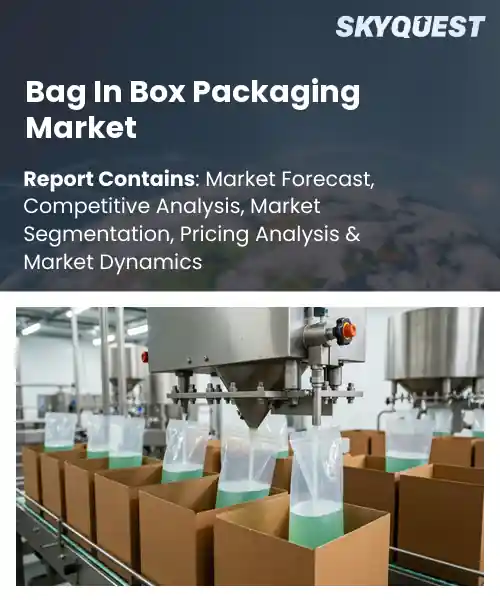
Bag In Box Packaging Market
Report ID: SQMIG15H2256
Report ID: SQMIG15H2256
[email protected]
USA +1 351-333-4748
Report ID:
SQMIG15H2256 |
Region:
Global |
Published Date: July, 2026
Pages:
157
|Tables:
181
|Figures:
79


Global Bag In Box Packaging Market size was valued at USD 4.8 Billion in 2024 and is poised to grow from USD 5.09 Billion in 2025 to USD 8.18 Billion by 2033, growing at a CAGR of 6.1% during the forecast period (2026-2033).
The bag in box packaging industry refers to flexible laminates that hold liquids inside a sealed inner bag, which is then placed in a rigid outer container for storage and dispensing. Its importance drives from the ability to preserve product freshness while reducing material waste compared to rigid bottles.
For example, a dairy producer switched from glass bottles to BiB cartons, cutting transport costs by 30 percent and extending shelf life by twelve days. Sustainability has become the catalyst propelling the global BiB packaging market forward, because consumers and regulators increasingly demand lower carbon footprints and reduced plastic waste. The lightweight construction of BiB units slashes transportation emissions by up to 40 percent relative to glass or PET bottles, which in turn lowers logistics expenses for manufacturers. Consequently, beverage firms such as a European wine consortium have adopted BiB for bulk shipments, enabling them to serve markets with minimal inventory loss. This shift opens opportunities for suppliers of high‑barrier laminates and for innovators designing smart dispensing taps that preserve product integrity while enhancing user convenience.
How is AI improving sustainability and cost-efficiency in the Bag in Box packaging market?
AI is reshaping bag in box packaging by turning data into actionable insight. Machine learning models analyze sensor streams from filling machines, spotting inefficiencies before they cause downtime. Predictive maintenance cuts spare‑part inventory and extends equipment life, while computer vision inspects seals to lower defect rates. Demand forecasting aligns production with real‑time market signals, reducing over‑production and waste. Optimization algorithms suggest thinner film structures that maintain barrier performance yet use less material. Together these capabilities lower operating costs, shrink carbon footprints, and make the supply chain more resilient, positioning the sector for sustainable growth.
In June 2024, a leading bag in box manufacturer announced an AI driven packaging line that cuts material waste and streamlines production, reinforcing market efficiency.
Market snapshot - (2026-2033)
Global Market Size
USD 4.8 Billion
Largest Segment
Above 20 Liters
Fastest Growth
Below 5 Liters
Growth Rate
6.1% CAGR
To get more insights on this market click here to Request a Free Sample Report
Global bag in box packaging market is segmented by capacity, material type, component, application, end-use industry, tap type and region. Based on capacity, the market is segmented into Below 5 Liters, 5–10 Liters, 10–20 Liters and Above 20 Liters. Based on material type, the market is segmented into Polyethylene, Ethylene Vinyl Alcohol (EVOH), Metallized Films, Multi-layer Laminates and Others. Based on component, the market is segmented into Bags, Boxes, Closures & Taps and Dispensing Systems. Based on application, the market is segmented into Beverages, Food Products, Industrial Liquids, Household & Cleaning Products and Others. Based on end-use industry, the market is segmented into Food & Beverage, Chemicals, Household Products, Pharmaceuticals, Personal Care and Others. Based on tap type, the market is segmented into Vitop Taps, Push-button Taps, Screw Caps and Aseptic Dispensing Taps. Based on region, the market is segmented into North America, Europe, Asia Pacific, Latin America and Middle East & Africa.
Below 5 Liters segment dominates with large bag in box packaging market share because it aligns with consumer preference for compact, single‑serve formats that fit easily in refrigerators and personal storage. The small volume enables cost‑effective shipping, reduces product waste, and meets the growing demand for convenience in beverages and food items. Its lightweight nature simplifies handling for distributors and enhances shelf‑life management, reinforcing its central role in the Bag In Box packaging ecosystem across retail channels.
As per bag in box packaging market outlook, 10–20 Liters segment is witnessing the strongest growth momentum as manufacturers target family‑size and hospitality applications that require larger volumes without sacrificing convenience. Innovative barrier technologies and scalable dispensing systems boost its appeal, driving broader adoption across beverage and industrial liquid categories and opening new avenues for market expansion.
As per bag in box packaging market forecast, polyethylene segment leads because it offers excellent flexibility, moisture resistance, and cost efficiency that meet the core performance criteria for bag‑in‑box constructions. Its ease of processing enables rapid scale‑up and integration with existing production lines, while the material’s inherent durability supports a wide range of fill liquids. This combination of affordability and functional reliability makes it the preferred choice for manufacturers across the market throughout product lifecycles and global supply chains.
Conversely, ethylene vinyl alcohol (EVOH) segment emerges as a high‑growth segment as rising consumer demand for extended shelf life drives interest in superior oxygen barrier performance. Advances in film extrusion lower cost barriers, enabling broader use in premium beverages and sensitive food products, which fuels accelerated market expansion and innovation opportunities.
To get detailed segments analysis, Request a Free Sample Report
The Asia Pacific region commands leadership in the bag‑in‑box sector through a combination of expansive consumer demand, sophisticated supply chains, and a cultural inclination toward convenience and sustainability. Manufacturers across the region have invested heavily in high‑performance barrier films and automated filling technologies, enabling cost‑effective production of premium‑grade cartons for liquids ranging from dairy to specialty beverages. Robust retail distribution networks and a strong presence of multinational food and beverage players accelerate market penetration, while government initiatives encouraging reduced packaging waste reinforce adoption. Additionally, a growing middle class with an appetite for on‑the‑go consumption fuels continual innovation, cementing the region’s position as the dominant force in global bag‑in‑box packaging. The region’s focus on integrating digital tracking and smart packaging solutions further differentiates its offerings and drives long‑term loyalty among brand owners.
As per bag in box packaging market regional outlook, Japan benefits from a consumer base that values space‑saving storage and premium product protection. Local manufacturers excel in precision engineering of barrier materials, meeting stringent quality expectations for dairy, wine, and ready‑to‑drink beverages. Collaborative efforts between packaging firms and major beverage brands foster continual refinement of dispensing mechanisms, while sustainability mandates encourage the shift toward recyclable and lightweight bag solutions, reinforcing Japan’s global leadership in innovation.
As per bag in box packaging market regional forecast, South Korea is propelled by a consumer segment that prizes convenience and product freshness. Domestic suppliers specialize in barrier technologies that support a wide range of beverages, including fermented drinks and functional juices. Strong partnerships with beverage conglomerates accelerate the introduction of dispensing valves, while government emphasis on economy principles drives the adoption of bag designs, positioning South Korea as a hub of packaging ingenuity.
The European bag in box market is expanding rapidly as manufacturers and brands converge on sustainability, convenience and premium product experience. Stringent EU directives on packaging waste incentivize the shift toward recyclable, lightweight cartons, while consumers increasingly prefer ready‑to‑drink formats that preserve freshness without the environmental footprint of rigid containers. Leading food‑and‑beverage manufacturers are investing in innovative barrier films and ergonomic dispensing solutions to meet expectations for quality and shelf‑life across categories such as wine, dairy and specialty nutrition. Collaborative research initiatives across the continent foster continuous improvement in material science, enabling higher barrier performance with reduced material usage. This regulatory and consumer‑driven momentum positions Europe as a hotbed for advanced bag‑in‑box technologies and market growth. Retail chains are also redesigning shelf layouts to showcase bag‑in‑box formats, further accelerating adoption across the region.
Germany is underpinned by an engineering base and a tradition of food and beverage production. German firms excel in precision manufacturing of barrier laminates and filling lines, delivering robust solutions for beverages ranging from craft beers to dairy. Close collaboration with sustainability initiatives encourages the use of recycled content and lightweight designs, while the presence of multinational brands drives continual refinement of dispensing technology.
United Kingdom is experiencing growth driven by a craft beverage scene and increasing demand for sustainable packaging among conscious consumers. British manufacturers focus on developing lightweight, high‑barrier films that meet strict quality standards for ales, ciders and juices. Collaborative projects between universities and industry accelerate innovation in dispensing systems, while government incentives for packaging reinforce the shift toward recyclable bag‑in‑box solutions across retail channels.
France is emerging as manufacturers respond to growing consumer preference for convenient, waste‑reduced beverage formats. French producers are investing in designed barrier films that support a portfolio of wines, sparkling beverages and flavored waters. Partnerships with agro‑food clusters encourage the integration of local raw materials, while regulatory encouragement for reduced single‑use plastics accelerates market acceptance of bag‑in‑box solutions in both hospitality and retail environments.
North America is reinforcing its role in the bag‑in‑box sector through a blend of scale, technological advancement and a strong emphasis on sustainability. The region’s extensive beverage landscape, encompassing dairy, wine, and ready‑to‑drink categories, creates a fertile environment for packaging solutions that deliver extended shelf life while reducing carbon footprints. Leading manufacturers invest in high‑efficiency filling equipment and advanced barrier materials, enabling brands to meet rigorous quality expectations without sacrificing convenience. Strategic partnerships across the supply chain between packaging firms and major retailers accelerate the rollout of innovative dispensing mechanisms that enhance user experience. Furthermore, regulatory encouragement for reduced single‑use packaging and growing consumer awareness of waste reduction drive broader acceptance of recyclable, lightweight bag‑in‑box formats across both commercial and household channels.
United States is shaped by a consumer base that values convenience, portability and responsible packaging. Domestic innovators lead in developing high‑performance barrier films and smart filling technologies that support a array of beverages, from craft sodas to spirits. Collaboration with leading retail chains accelerates adoption of bag‑in‑box dispensers, while sustainability initiatives encourage the use of recyclable materials and lighter weight across the supply chain.
Canada benefits from an emphasis on environmental stewardship and growing demand for convenient beverage solutions in urban and remote communities. Canadian suppliers develop barrier constructions that maintain product integrity for beverages such as protein drinks and brews. Partnerships with regional distributors enable efficient logistics for bag‑in‑box delivery, and government programs supporting circular packaging promote the adoption of recyclable sustainable bag systems across the market.
To know more about the market opportunities by region and country, click here to
Buy The Complete Report
Increasing Consumer Preference For Sustainability
Advancements In Flexible Packaging Technology
Higher Initial Capital Investment Required
Regulatory Compliance Complexity Increases
Request Free Customization of this report to help us to meet your business objectives.
The bag‑in‑box sector is shaped by established converters such as Smurfit Kappa Group, CDF Corporation, Liqui‑Box, DS Smith and Scholle IPN, which compete on sustainable design and supply chain efficiency. Recent strategic moves include Atlantic Packaging’s launch of a dedicated venture‑capital arm to back innovative packaging concepts, and the introduction of bark‑based, fully compostable bag solutions by emerging players, intensifying pressure on incumbents to accelerate eco‑friendly product development.
SkyQuest’s ABIRAW (Advanced Business Intelligence, Research & Analysis Wing) is our Business Information Services team that Collects, Collates, Correlates, and Analyses the Data collected by means of Primary Exploratory Research backed by robust Secondary Desk research.
As per SkyQuest analysis the global bag in box market growth is being propelled primarily by the rising consumer demand for sustainable packaging which pushes brands toward lightweight recyclable cartons that lower carbon footprints. A second driver is the rapid progress in flexible‑film technology and AI‑enhanced production lines that improve barrier performance while cutting waste and operating costs. The Asia Pacific region leads the market due to its large consumer base, advanced supply chains and strong governmental push for waste reduction. Within the product mix the below‑5‑liter capacity segment dominates because it matches the convenience preferences of retail shoppers. However, the need for expensive form‑fill‑seal equipment remains a key restraint that can slow adoption for smaller manufacturers. The global bag in box market trend driven by increasing demand for sustainable, lightweight, and cost-effective packaging solutions across the food and beverage, dairy, edible oil, wine, household products, and industrial liquids sectors.
| Report Metric | Details |
|---|---|
| Market size value in 2024 | USD 4.8 Billion |
| Market size value in 2033 | USD 8.18 Billion |
| Growth Rate | 6.1% |
| Base year | 2024 |
| Forecast period | (2026-2033) |
| Forecast Unit (Value) | USD Billion |
| Segments covered |
|
| Regions covered | North America (US, Canada), Europe (Germany, France, United Kingdom, Italy, Spain, Rest of Europe), Asia Pacific (China, India, Japan, Rest of Asia-Pacific), Latin America (Brazil, Rest of Latin America), Middle East & Africa (South Africa, GCC Countries, Rest of MEA) |
| Companies covered |
|
| Customization scope | Free report customization with purchase. Customization includes:-
|
To get a free trial access to our platform which is a one stop solution for all your data requirements for quicker decision making. This platform allows you to compare markets, competitors who are prominent in the market, and mega trends that are influencing the dynamics in the market. Also, get access to detailed SkyQuest exclusive matrix.
Table Of Content
Executive Summary
Market overview
Parent Market Analysis
Market overview
Market size
KEY MARKET INSIGHTS
COVID IMPACT
MARKET DYNAMICS & OUTLOOK
Market Size by Region
KEY COMPANY PROFILES
Methodology
For the Bag In Box Packaging Market, our research methodology involved a mixture of primary and secondary data sources. Key steps involved in the research process are listed below:
1. Information Procurement: This stage involved the procurement of Market data or related information via primary and secondary sources. The various secondary sources used included various company websites, annual reports, trade databases, and paid databases such as Hoover's, Bloomberg Business, Factiva, and Avention. Our team did 45 primary interactions Globally which included several stakeholders such as manufacturers, customers, key opinion leaders, etc. Overall, information procurement was one of the most extensive stages in our research process.
2. Information Analysis: This step involved triangulation of data through bottom-up and top-down approaches to estimate and validate the total size and future estimate of the Bag In Box Packaging Market.
3. Report Formulation: The final step entailed the placement of data points in appropriate Market spaces in an attempt to deduce viable conclusions.
4. Validation & Publishing: Validation is the most important step in the process. Validation & re-validation via an intricately designed process helped us finalize data points to be used for final calculations. The final Market estimates and forecasts were then aligned and sent to our panel of industry experts for validation of data. Once the validation was done the report was sent to our Quality Assurance team to ensure adherence to style guides, consistency & design.
Analyst Support
Customization Options
With the given market data, our dedicated team of analysts can offer you the following customization options are available for the Bag In Box Packaging Market:
Product Analysis: Product matrix, which offers a detailed comparison of the product portfolio of companies.
Regional Analysis: Further analysis of the Bag In Box Packaging Market for additional countries.
Competitive Analysis: Detailed analysis and profiling of additional Market players & comparative analysis of competitive products.
Go to Market Strategy: Find the high-growth channels to invest your marketing efforts and increase your customer base.
Innovation Mapping: Identify racial solutions and innovation, connected to deep ecosystems of innovators, start-ups, academics, and strategic partners.
Category Intelligence: Customized intelligence that is relevant to their supply Markets will enable them to make smarter sourcing decisions and improve their category management.
Public Company Transcript Analysis: To improve the investment performance by generating new alpha and making better-informed decisions.
Social Media Listening: To analyze the conversations and trends happening not just around your brand, but around your industry as a whole, and use those insights to make better Marketing decisions.
REQUEST FOR SAMPLE
 REQUEST FREE CUSTOMIZATION
Global Bag In Box Packaging Market size was valued at USD 4.8 Billion in 2024 and is poised to grow from USD 5.09 Billion in 2025 to USD 8.18 Billion by 2033, growing at a CAGR of 6.1% during the forecast period (2026-2033).
The bag‑in‑box sector is shaped by established converters such as Smurfit Kappa Group, CDF Corporation, Liqui‑Box, DS Smith and Scholle IPN, which compete on sustainable design and supply chain efficiency. Recent strategic moves include Atlantic Packaging’s launch of a dedicated venture‑capital arm to back innovative packaging concepts, and the introduction of bark‑based, fully compostable bag solutions by emerging players, intensifying pressure on incumbents to accelerate eco‑friendly product development. 'Smurfit Westrock', 'DS Smith', 'Liquibox', 'Scholle IPN', 'SIG Group', 'CDF Corporation', 'Optopack', 'Parish Manufacturing', 'Zacros Corporation', 'Aran Group', 'NordiQ Group', 'Pouchit', 'ICPG', 'TPS Rental Systems', 'VITOP', 'Rapak', 'Amcor', 'Goglio', 'Aspack Packaging', 'Qorpak'
The growing desire among consumers for environmentally responsible packaging drives manufacturers to adopt bag‑in‑box solutions, which reduce material waste and enable easier recycling, thereby aligning product offerings with sustainability expectations and enhancing brand perception; this alignment encourages purchase decisions, supports market expansion, and motivates suppliers to innovate packaging designs that meet ecological criteria, fostering a cycle of demand and supply that consistently propels market growth. It also reinforces regulatory compliance and encourages retailers to prioritize solutions, amplifying distribution channels and reinforcing the market trajectory toward adoption.
Sustainable Material Shift: The industry is rapidly moving toward recyclable and biodegradable bag-in-box materials as brands respond to consumer demand for eco‑friendly packaging. Manufacturers are reformulating liners and films using plant‑based polymers, reducing reliance on traditional plastics. This shift enhances brand perception, aligns with corporate sustainability goals, and mitigates waste‑stream pressures. Companies that adopt these alternatives gain competitive advantage by meeting regulatory expectations and tapping into markets that prioritize environmental stewardship and fostering long‑term customer loyalty through environmental commitments across the supply chain.
Why does Asia Pacific Dominate the Global Bag In Box Packaging Market? |@12


Want to customize this report? This report can be personalized according to your needs. Our analysts and industry experts will work directly with you to understand your requirements and provide you with customized data in a short amount of time. We offer $1000 worth of FREE customization at the time of purchase.
Feedback From Our Clients


 USA (+1) 351-333-4748

