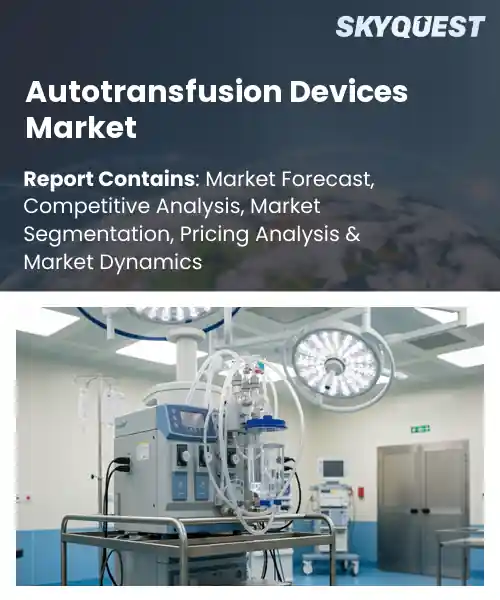
Autotransfusion Devices Market
Report ID: SQMIG35A3773
Report ID: SQMIG35A3773
[email protected]
USA +1 351-333-4748
Report ID:
SQMIG35A3773 |
Region:
Global |
Published Date: June, 2026
Pages:
157
|Tables:
92
|Figures:
76


Global Autotransfusion Devices Market size was valued at USD 546.5 Million in 2024 and is poised to grow from USD 580.38 Million in 2025 to USD 939.1 Million by 2033, growing at a CAGR of 6.2% during the forecast period (2026-2033).
Demand for safer, cost-effective blood management is the primary driver shaping the autotransfusion devices market, because hospitals seek to reduce reliance on donor blood while improving patient outcomes. Autotransfusion devices recover and reinfuse a patient’s own blood during or after procedures, which matters for minimizing transfusion-transmitted infections and inventory pressures and aligning with patient blood management protocols. The market evolved from basic collection reservoirs to automated centrifugation and washing systems that deliver higher hematocrit and lower contaminants. For example, adoption of intraoperative cell salvage in cardiac and orthopedic centers has increased as evidence showed fewer allogeneic transfusions and shorter stays.Building on the trend toward patient blood management, institutional adoption driven by clinical guidelines, reimbursement alignment and cost avoidance is the key growth factor that creates clear market opportunities. When societies endorse cell salvage and payers incentivize blood conservation, hospitals quantify lower transfusion-related costs and shorter stays, prompting capital purchases and staff training. In real use, joint replacement, cardiac, trauma and obstetric units deploy portable autotransfusion systems to control bleeding, which decreases allogeneic exposure and buffers against supply shortages. Vendors then introduce single-use kits and compact devices, enabling expansion into community hospitals and ambulatory surgical centers thereby sustaining market growth.
How is AI improving performance and adoption in the autotransfusion devices market?
AI is improving autotransfusion performance by adding smart sensing and decision support to devices. Key aspects include automated quality control of recovered blood, real time assessment of hematocrit and contamination, adaptive wash cycles that tailor processing to the patient, and analytics that predict transfusion need and streamline workflows. The current market is shifting from manual systems to automation friendly platforms because clinicians value consistent reinfusion quality and simpler operation. Examples of modern systems include Medtronic autoLog IQ, LivaNova Xtra, and the Same device which illustrate tighter integration of software driven controls and newer filtration approaches.Medtronic February 2026, Medtronic published updated reimbursement guidance for the autoLog IQ autotransfusion system which lowers administrative friction for hospitals and supports purchasing decisions. When paired with AI enabled automation and predictive monitoring the guidance helps accelerate adoption by aligning economic incentives with improved intraoperative efficiency and reinfusion quality.
Market snapshot - (2026-2033)
Global Market Size
USD 546.5 Million
Largest Segment
Autotransfusion Systems
Fastest Growth
Consumables & Accessories
Growth Rate
6.2% CAGR
To get more insights on this market click here to Request a Free Sample Report
Global autotransfusion devices market is segmented by product type, application, end-user and region. Based on product type, the market is segmented into Autotransfusion Systems, Consumables & Accessories and Others. Based on application, the market is segmented into Cardiovascular Surgeries, Orthopedic Surgeries, Neurological Surgeries, Obstetrics & Gynecological Surgeries and Others. Based on end-user, the market is segmented into Hospitals, Specialty Clinics and Others. Based on region, the market is segmented into North America, Europe, Asia Pacific, Latin America and Middle East & Africa.
Consumables & Accessories segment dominates because these items create the recurring, procedure-linked demand that sustains autotransfusion program economics and day-to-day clinical operations. Their single use nature and necessity across diverse procedures compel steady purchasing and strong supplier relationships, which incentivize manufacturers to expand portfolios and service offerings. Hospital procurement favors predictable supply chains and inventory models, driving purchasing patterns that prioritize consumables and reinforce market leadership.
However, Autotransfusion Systems are emerging as the most rapidly expanding product area as innovations in automation and portability make core devices more accessible. Improved user interfaces, system integration, and broader clinical indications accelerate hospital investment cycles and create opportunities for new entrants and differentiated offerings that drive future market expansion.
Cardiovascular Surgeries segment dominates because these procedures present a consistent clinical imperative for intraoperative blood conservation and have long-established transfusion protocols that favor autotransfusion adoption. The predictable occurrence of substantial blood loss and the critical need to minimize allogeneic transfusion risk drive clinical demand, shape procurement priorities, and spur targeted device enhancements and training that together anchor this procedure type as a primary market driver.
However, Orthopedic Surgeries are emerging as the most rapidly expanding application due to rising volumes of joint replacements and complex spine procedures that increase demand for blood management solutions. Tailored device adaptations for orthopedic workflows, growing surgeon awareness of autotransfusion benefits, and integration with perioperative blood management programs accelerate adoption and create new opportunities for manufacturers to deliver orthopedic focused solutions.
To get detailed segments analysis, Request a Free Sample Report
North America commands leadership in the autotransfusion devices market due to a combination of advanced clinical infrastructure, strong payer support, and concentrated innovation among manufacturers. High levels of clinician familiarity with blood conservation techniques, well established hospital procurement processes, and extensive adoption across surgical specialties reinforce consistent demand. Robust regulatory pathways and close collaboration between device developers and clinical stakeholders accelerate refinement and clinical validation of systems. Reimbursement frameworks that reward blood management and initiatives to reduce transfusion related risks further incentivize deployment. Market consolidation and strategic partnerships enable broad distribution and comprehensive service models. Together, these strengths create a reinforcing environment where technological iteration, clinical evidence generation, and timely market access maintain North America at the forefront of global autotransfusion adoption.
Autotransfusion Devices Market in United States benefits from dense network of tertiary care centers, strong clinical leadership in blood conservation, and close ties between device innovators and surgical teams, fostering rapid clinical evaluation and adoption. Well established procurement channels and focused training programs support consistent use across high volume procedures, while reimbursement practices and institutional quality initiatives further favor integration of autotransfusion solutions into standard perioperative pathways and ongoing collaboration.
Autotransfusion Devices Market in Canada is shaped by centralized health systems that emphasize cost effective blood management and procurement across hospitals, encouraging clinical pathways. Provincial programs promoting safety, combined with growing awareness among surgical specialists, support adoption in key centers. Collaboration between clinical leaders and device suppliers facilitates training and localized evidence collection, enabling expansion of autotransfusion use where institutional priorities align with efforts to reduce reliance on allogeneic transfusion.
Europe is experiencing rapid expansion in autotransfusion devices adoption driven by growing clinical emphasis on patient blood management, coordinated regional health initiatives, and strong engagement from surgical societies promoting transfusion minimization. Diverse reimbursement landscapes combined with proactive hospital procurement strategies encourage pilot programs and wider clinical integration. Leading medical centers generate localized evidence through collaborative studies, while manufacturers adapt offerings to meet interoperability and workflow preferences across varied hospital settings. Regulatory alignment and cross border knowledge exchange facilitate dissemination of best practices. The presence of specialized distributors and targeted training initiatives further supports scalable adoption, positioning Europe as a dynamic market with varied national priorities that collectively accelerate uptake and innovation. Stakeholder collaboration across public and private sectors also fosters tailored service models that build clinician confidence and institutional acceptance.
Autotransfusion Devices Market Germany benefits from advanced hospital networks, strong clinical research, and professional societies prioritizing blood conservation. High expectations for device performance and rigorous clinical evaluation encourage adoption in tertiary centers. Established procurement frameworks and distributor networks support market penetration, while collaborations between manufacturers and clinicians drive localized evidence and operational integration, reinforcing Germany role as reference market for autotransfusion practice in Europe and setting standards for regional adoption.
Autotransfusion Devices Market United Kingdom is characterized by accelerated uptake driven by national clinical initiatives, proactive hospital programs, and strong surgeon advocacy for blood conservation. Flexible procurement paths and public and private hospitals enable rapid evaluation of new systems. Focused training, targeted demonstrations, and early evidence collection build clinician confidence, while payer alignment and quality improvement priorities help translate pilots into broader adoption across surgical specialties and regional care networks.
Autotransfusion Devices Market France is emerging through targeted initiatives in leading hospitals and growing collaboration between clinicians and manufacturers to develop locally relevant protocols. Interest among surgical teams and blood management advocates is generating pilot programs that demonstrate operational benefits. Regional procurement bodies and supportive clinical networks facilitate rollout, while emphasis on evidence and cost effectiveness guides cautious expansion. Strengthened training and stakeholder engagement underpin gradual scaling across specialty centers.
Asia Pacific is reinforcing its role in the autotransfusion devices market through strategic investments in clinical capacity, targeted adoption within high volume surgical centers, and increasing participation in international clinical networks. Local manufacturers and global suppliers are adapting devices and service models to regional clinical workflows, while training programs and vendor led demonstrations raise clinician familiarity. Regulatory authorities are streamlining review processes and facilitating clinical partnerships that support localized evidence generation. Rising interest in blood conservation among surgical specialties and growing hospital prioritization of perioperative quality improvement are stimulating selective uptake. Enhanced distribution channels and service capabilities further enable scalable implementation across diverse healthcare systems in the region. Collaborations with academic centers and participation in regional conferences accelerate knowledge transfer, while tailored financing options and after sales support reduce barriers for hospitals.
Autotransfusion Devices Market Japan is driven by advanced clinical infrastructure, strong emphasis on surgical innovation, and close collaboration between academic centers to validate new devices. Hospitals prioritize procedural efficiency and patient safety, supporting integration of systems that align with perioperative workflows. Comprehensive after sales service and training from suppliers enhance clinician confidence, while strategic adoption in specialized centers and localized evidence generation position Japan as a market for autotransfusion solutions.
Autotransfusion Devices Market South Korea is propelled by strong hospital networks with early adopter clinicians, medical technology adoption, and active cooperation between domestic manufacturers and global suppliers. Hospitals value compact, workflow friendly systems that integrate into surgical environments, and supplier training programs support uptake. National emphasis on improving perioperative outcomes and pilot initiatives foster evidence collection. These factors enable steady expansion of autotransfusion use across specialty centers and tertiary hospitals.
To know more about the market opportunities by region and country, click here to
Buy The Complete Report
Increasing Adoption Of Autotransfusion
Technological Advancements In Devices
High Procedural And Maintenance Costs
Regulatory Complexity And Reimbursement Challenges
Request Free Customization of this report to help us to meet your business objectives.
Competitive dynamics in the global autotransfusion devices market are driven by consolidation, regulatory clearances and differentiated product innovation that alter procurement choices. Recent M&A moves and capital investments by incumbents and targeted software upgrades by market leaders, together with new CE marked entrants expanding into European hospital channels, are forcing competitors to pursue acquisitions, clinical partnerships and consumable tied business models to defend share.
Top Player’s Company Profile
Recent Developments
SkyQuest’s ABIRAW (Advanced Business Intelligence, Research & Analysis Wing) is our Business Information Services team that Collects, Collates, Correlates, and Analyses the Data collected by means of Primary Exploratory Research backed by robust Secondary Desk research. As per SkyQuest analysis, the global autotransfusion devices market is propelled primarily by rising demand for safer, cost‑effective blood management that reduces reliance on donor transfusions, while technological advancements in automation, portability and digital integration further accelerate adoption. Growth is anchored by the consumables and accessories segment, which generates recurring procedure‑linked demand, and North America remains the dominant regional market due to advanced clinical infrastructure and supportive reimbursement. However, high acquisition and ongoing maintenance costs for devices and disposables constrain uptake among budget‑limited facilities. Vendors that combine user‑friendly systems, robust consumable supply models and clear economic evidence will lead expansion across hospitals and specialty centers.
| Report Metric | Details |
|---|---|
| Market size value in 2024 | USD 546.5 Million |
| Market size value in 2033 | USD 939.1 Million |
| Growth Rate | 6.2% |
| Base year | 2024 |
| Forecast period | (2026-2033) |
| Forecast Unit (Value) | USD Million |
| Segments covered |
|
| Regions covered | North America (US, Canada), Europe (Germany, France, United Kingdom, Italy, Spain, Rest of Europe), Asia Pacific (China, India, Japan, Rest of Asia-Pacific), Latin America (Brazil, Rest of Latin America), Middle East & Africa (South Africa, GCC Countries, Rest of MEA) |
| Companies covered |
|
| Customization scope | Free report customization with purchase. Customization includes:-
|
To get a free trial access to our platform which is a one stop solution for all your data requirements for quicker decision making. This platform allows you to compare markets, competitors who are prominent in the market, and mega trends that are influencing the dynamics in the market. Also, get access to detailed SkyQuest exclusive matrix.
Table Of Content
Executive Summary
Market overview
Parent Market Analysis
Market overview
Market size
KEY MARKET INSIGHTS
COVID IMPACT
MARKET DYNAMICS & OUTLOOK
Market Size by Region
KEY COMPANY PROFILES
Methodology
For the Autotransfusion Devices Market, our research methodology involved a mixture of primary and secondary data sources. Key steps involved in the research process are listed below:
1. Information Procurement: This stage involved the procurement of Market data or related information via primary and secondary sources. The various secondary sources used included various company websites, annual reports, trade databases, and paid databases such as Hoover's, Bloomberg Business, Factiva, and Avention. Our team did 45 primary interactions Globally which included several stakeholders such as manufacturers, customers, key opinion leaders, etc. Overall, information procurement was one of the most extensive stages in our research process.
2. Information Analysis: This step involved triangulation of data through bottom-up and top-down approaches to estimate and validate the total size and future estimate of the Autotransfusion Devices Market.
3. Report Formulation: The final step entailed the placement of data points in appropriate Market spaces in an attempt to deduce viable conclusions.
4. Validation & Publishing: Validation is the most important step in the process. Validation & re-validation via an intricately designed process helped us finalize data points to be used for final calculations. The final Market estimates and forecasts were then aligned and sent to our panel of industry experts for validation of data. Once the validation was done the report was sent to our Quality Assurance team to ensure adherence to style guides, consistency & design.
Analyst Support
Customization Options
With the given market data, our dedicated team of analysts can offer you the following customization options are available for the Autotransfusion Devices Market:
Product Analysis: Product matrix, which offers a detailed comparison of the product portfolio of companies.
Regional Analysis: Further analysis of the Autotransfusion Devices Market for additional countries.
Competitive Analysis: Detailed analysis and profiling of additional Market players & comparative analysis of competitive products.
Go to Market Strategy: Find the high-growth channels to invest your marketing efforts and increase your customer base.
Innovation Mapping: Identify racial solutions and innovation, connected to deep ecosystems of innovators, start-ups, academics, and strategic partners.
Category Intelligence: Customized intelligence that is relevant to their supply Markets will enable them to make smarter sourcing decisions and improve their category management.
Public Company Transcript Analysis: To improve the investment performance by generating new alpha and making better-informed decisions.
Social Media Listening: To analyze the conversations and trends happening not just around your brand, but around your industry as a whole, and use those insights to make better Marketing decisions.
REQUEST FOR SAMPLE
 REQUEST FREE CUSTOMIZATION


Want to customize this report? This report can be personalized according to your needs. Our analysts and industry experts will work directly with you to understand your requirements and provide you with customized data in a short amount of time. We offer $1000 worth of FREE customization at the time of purchase.
Feedback From Our Clients


 USA (+1) 351-333-4748

