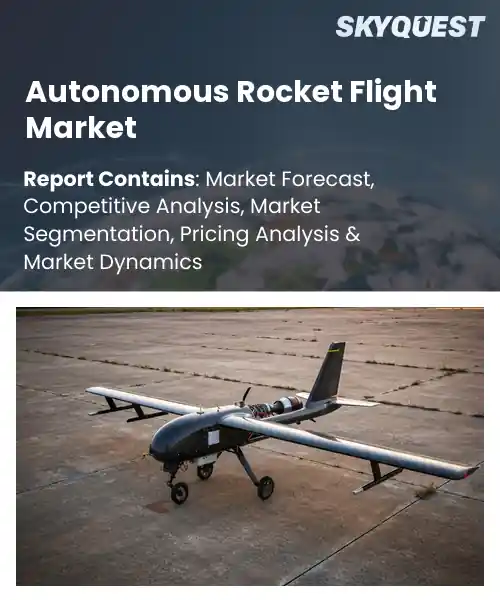
Autonomous Rocket Flight Market
Report ID: SQMIG20A2800
Report ID: SQMIG20A2800
[email protected]
USA +1 351-333-4748
Report ID:
SQMIG20A2800 |
Region:
Global |
Published Date: July, 2026
Pages:
157
|Tables:
145
|Figures:
78


Global Autonomous Rocket Flight Market size was valued at USD 874.5 Million in 2024 and is poised to grow from USD 1067.76 Million in 2025 to USD 5274.74 Million by 2033, growing at a CAGR of 22.1% during the forecast period (2026-2033).
The autonomous rocket flight market encompasses end‑to‑end systems that navigate launch vehicles without human piloting, integrating guidance, navigation, and control software with real‑time telemetry. Its relevance lies in reducing launch costs, enhancing safety, and enabling rapid deployment of payloads for commercial, scientific, and defense missions. The sector emerged in the early 2010s when private firms such as SpaceX and Rocket Lab demonstrated reusable boosters that relied on autonomous ascent and descent routines. Over the subsequent decade, advancements in AI‑driven trajectory optimization and on‑board sensor fusion have expanded capabilities, allowing high‑frequency launch cadence and precise orbital insertion for global communications constellations. Regulatory acceptance of autonomous flight envelopes represents the pivotal catalyst that converts technical readiness into market expansion because agencies now certify software‑controlled ascent and recovery as equivalent to crewed oversight. This shift accelerates investment in mission kits, evident in partnership between United Launch Alliance and NASA to certify autonomous launches for lunar cargo. The resulting confidence encourages satellite operators such as OneWeb to schedule rides, because autonomous trajectories reduce collision risk and lower insurance premiums. Consequently, manufacturers are scaling production of modular propulsion units designed for plug‑and‑play integration, unlocking revenue streams from orbital insertion services for global scientific customers alike.
How is AI enhancing safety and efficiency in the autonomous rocket flight market?
Artificial intelligence is reshaping autonomous rocket flight by turning raw sensor streams into actionable safety decisions. AI algorithms fuse data from accelerometers, lidar and video to predict structural loads and detect anomalies before they become critical. In the current market, reusable launch vehicles rely on AI‑guided landing gear that continuously adjusts thrust vectors and deploys shock absorbers in real time. Predictive models also optimise flight paths to avoid debris and weather hotspots, while machine‑learning diagnostics monitor engine health throughout ascent and descent. These capabilities not only protect hardware and crew but also compress turnaround cycles, making frequent flights economically viable.Rocket Lab July 2026, highlighted its AI‑driven autonomous landing gear as a core innovation that trims turnaround time and reduces landing risk. The system uses real‑time sensor fusion and adaptive control to adjust thrust and leg deployment, delivering precise touchdowns in variable wind and supporting faster launch cadence.
Market snapshot - (2026-2033)
Global Market Size
USD 874.5 Million
Largest Segment
Flight Control Systems
Fastest Growth
Flight Software
Growth Rate
22.1% CAGR
To get more insights on this market click here to Request a Free Sample Report
Global autonomous rocket flight market is segmented by component, application, autonomy level, end user, launch vehicle and region. Based on component, the market is segmented into Flight Control Systems, Navigation Systems, Avionics and Flight Software. Based on application, the market is segmented into Satellite Launch, Cargo Missions, Space Exploration and Defense Missions. Based on autonomy level, the market is segmented into Semi-Autonomous and Fully Autonomous. Based on end user, the market is segmented into Commercial Space Companies, Government Space Agencies and Defense Organizations. Based on launch vehicle, the market is segmented into Small Launch Vehicles, Medium Launch Vehicles and Heavy Launch Vehicles. Based on region, the market is segmented into North America, Europe, Asia Pacific, Latin America and Middle East & Africa.
Flight Control Systems segment dominates because it delivers the closed loop authority essential for maintaining vehicle stability during the dynamic ascent and descent phases, where precise thrust vectoring and attitude regulation are non negotiable. Industry investment in redundant hardware and fault tolerant algorithms has built a foundation that makes launch providers prioritize proven control loops for autonomous missions. Any deficiency in real time sensor fusion or actuator response threatens mission success, reinforcing reliance on mature control solutions.
However, Navigation Systems are witnessing the strongest growth momentum as autonomous rockets demand ever greater precision for orbit insertion and trajectory correction without ground intervention. Advances in GNSS integration, inertial measurement units, and AI driven path planning are lowering latency and expanding mission profiles, creating fresh opportunities for providers that can deliver ultra accurate, self reliant navigation capabilities.
Fully Autonomous segment leads because it eliminates the need for human intervention throughout the flight envelope, delivering consistent decision making that adapts instantly to sensor inputs and mission contingencies. This capability aligns with operators’ desire to reduce crew costs, minimize communication latency, and expand launch cadence, prompting investment in end to end AI pipelines and robust verification frameworks. The market therefore rewards platforms that can certify complete self governance, positioning full autonomy at the forefront of development priorities.
Conversely, Semi Autonomous is witnessing rapid expansion as launch customers seek incremental autonomy to mitigate risk while retaining limited manual oversight. Emerging sensor suites and modular software stacks enable developers to add autonomous functions stepwise, satisfying certification bodies and fostering earlier market entry; this pragmatic approach fuels investment and broadens adoption across emerging launch services.
To get detailed segments analysis, Request a Free Sample Report
North America maintains its lead through a blend of advanced aerospace infrastructure, deep engineering expertise, and robust private sector investment. The region benefits from a mature regulatory environment that balances safety with innovation, encouraging rapid prototyping and testing. Collaborative ecosystems linking universities, research institutes, and leading firms create a pipeline of talent and technology. Access to extensive launch facilities and a culture of risk‑taking further accelerates development cycles. Together, these factors foster a resilient market where new autonomous flight concepts are quickly validated and scaled.
Autonomous Rocket Flight Market in the United States thrives on a strong entrepreneurial spirit combined with legacy aerospace capabilities. Government agencies and commercial players collaborate extensively, sharing data and facilities to reduce development friction. Academic research centers contribute cutting‑edge algorithms and propulsion science, while venture capital fuels ambitious start‑ups. This confluence of support structures accelerates the translation of concepts into operational systems, positioning the United States as a hub for breakthrough autonomous missions.
Autonomous Rocket Flight Market in Canada leverages a supportive policy framework and a growing network of innovation clusters. Collaborative partnerships between federal research organizations and private enterprises encourage knowledge exchange and technology transfer. Indigenous expertise in cryogenic systems and satellite communications supplements broader aerospace capabilities. The emphasis on sustainable engineering and safety standards enhances confidence among stakeholders, allowing Canadian firms to contribute meaningfully to global autonomous flight advancements.
Europe’s expansion is propelled by coordinated research initiatives, strategic public funding, and a strong tradition of aerospace excellence across member states. Cross‑border collaborations enable pooling of resources and shared testing sites, reducing barriers to entry for emerging technologies. Regulatory harmonization across the bloc creates a predictable environment that attracts both established manufacturers and agile innovators. A focus on environmental responsibility and precision engineering aligns with consumer expectations and policy goals, reinforcing market momentum. Together these dynamics stimulate a fertile landscape for autonomous rocket solutions to flourish throughout the continent.
Autonomous Rocket Flight Market in Germany is emerging through a blend of engineering rigor and industrial partnerships. Federal research programs emphasize modular designs and reusable propulsion, encouraging start‑ups to adopt proven standards. Strong automotive and mechanical expertise translates into high‑performance flight components, while collaborative test ranges support iterative development. This ecosystem nurtures a pipeline of innovators poised to scale autonomous capabilities across a range of applications.
Autonomous Rocket Flight Market in the United Kingdom is experiencing the fastest growth due to an aggressive innovation agenda and vibrant venture ecosystem. Government incentives encourage private investment, while leading universities deliver cutting‑edge research in autonomy and AI. The presence of historic launch sites combined with modern regulatory reforms streamlines testing processes. This combination of financial support, academic excellence, and infrastructure accelerates the deployment of autonomous rocket technologies throughout the UK.
Autonomous Rocket Flight Market in France holds a dominant position thanks to its deep aerospace heritage and integrated supply chains. National space agencies collaborate closely with private firms, fostering a seamless transition from concept to flight. Advanced materials research and precision manufacturing capabilities underpin high‑performance vehicle development. A strong commitment to collaborative European projects further amplifies France’s influence, cementing its role as a central driver of autonomous rocket progress.
Asia Pacific advances its role by harnessing rapid industrial growth, strategic government initiatives, and a surge in technical talent. Nations within the region invest heavily in test facilities and encourage public‑private partnerships that accelerate technology transfer. Emphasis on modular design and cost‑effective production aligns with regional demand for versatile launch solutions. Collaborative networks across borders facilitate shared learning and joint missions, while a focus on resilience and safety builds stakeholder confidence. These combined efforts elevate the region’s contribution to the global autonomous rocket landscape.
Autonomous Rocket Flight Market in Japan benefits from a legacy of precision engineering and a disciplined approach to safety. Government agencies support pilot projects that integrate autonomous navigation with existing launch infrastructure. Partnerships between electronics manufacturers and aerospace start‑ups produce sophisticated sensor suites vital for autonomous operations. The cultural emphasis on reliability and meticulous testing ensures that Japanese contributions are highly regarded in the international arena.
Autonomous Rocket Flight Market in South Korea is reinforced by strong semiconductor expertise and aggressive innovation policies. Collaborative programs link universities with emerging aerospace firms, fostering rapid development of autonomous control algorithms. Investment in dedicated launch sites and test corridors reduces time to market for new systems. This focused environment positions South Korea as an emerging hub for autonomous rocket technology within the broader Asia Pacific region.
To know more about the market opportunities by region and country, click here to
Buy The Complete Report
Increasing Demand for Rapid Deployment
Advancements in Autonomous Navigation Systems
Regulatory Uncertainty Around Flight Permissions
High Development Costs and Complexity
Request Free Customization of this report to help us to meet your business objectives.
The competitive landscape is shaped by intense rivalry among emerging autonomous‑rocket firms that are accelerating development cycles through strategic M&A, joint ventures with satellite operators, and rapid iteration of reusable propulsion technologies; for example, Stoke Space’s recent partnership with a leading launch‑service provider and its acquisition of a small‑satellite dispenser company illustrate how players are consolidating capabilities to capture market share in autonomous flight operations.
Top Player’s Company Profile
Recent Developments
SkyQuest’s ABIRAW (Advanced Business Intelligence, Research & Analysis Wing) is our Business Information Services team that Collects, Collates, Correlates, and Analyses the Data collected by means of Primary Exploratory Research backed by robust Secondary Desk research. As per SkyQuest analysis the autonomous rocket flight market is propelled primarily by the growing demand for rapid deployment of payloads, which shortens launch lead times and lowers costs for commercial and defense users. A second driver is the breakthrough in autonomous navigation systems where AI‑fused sensor data enables precise, real‑time trajectory adjustments, boosting safety and mission flexibility. The dominant segment is flight control systems because they provide the closed‑loop authority essential for vehicle stability during ascent and descent. North America leads the market thanks to its mature aerospace ecosystem and supportive regulatory framework. However, regulatory uncertainty around flight permissions remains a restraint, slowing broader adoption.
| Report Metric | Details |
|---|---|
| Market size value in 2024 | USD 874.5 Million |
| Market size value in 2033 | USD 5274.74 Million |
| Growth Rate | 22.1% |
| Base year | 2024 |
| Forecast period | (2026-2033) |
| Forecast Unit (Value) | USD Million |
| Segments covered |
|
| Regions covered | North America (US, Canada), Europe (Germany, France, United Kingdom, Italy, Spain, Rest of Europe), Asia Pacific (China, India, Japan, Rest of Asia-Pacific), Latin America (Brazil, Rest of Latin America), Middle East & Africa (South Africa, GCC Countries, Rest of MEA) |
| Companies covered |
|
| Customization scope | Free report customization with purchase. Customization includes:-
|
To get a free trial access to our platform which is a one stop solution for all your data requirements for quicker decision making. This platform allows you to compare markets, competitors who are prominent in the market, and mega trends that are influencing the dynamics in the market. Also, get access to detailed SkyQuest exclusive matrix.
Table Of Content
Executive Summary
Market overview
Parent Market Analysis
Market overview
Market size
KEY MARKET INSIGHTS
COVID IMPACT
MARKET DYNAMICS & OUTLOOK
Market Size by Region
KEY COMPANY PROFILES
Methodology
For the Autonomous Rocket Flight Market, our research methodology involved a mixture of primary and secondary data sources. Key steps involved in the research process are listed below:
1. Information Procurement: This stage involved the procurement of Market data or related information via primary and secondary sources. The various secondary sources used included various company websites, annual reports, trade databases, and paid databases such as Hoover's, Bloomberg Business, Factiva, and Avention. Our team did 45 primary interactions Globally which included several stakeholders such as manufacturers, customers, key opinion leaders, etc. Overall, information procurement was one of the most extensive stages in our research process.
2. Information Analysis: This step involved triangulation of data through bottom-up and top-down approaches to estimate and validate the total size and future estimate of the Autonomous Rocket Flight Market.
3. Report Formulation: The final step entailed the placement of data points in appropriate Market spaces in an attempt to deduce viable conclusions.
4. Validation & Publishing: Validation is the most important step in the process. Validation & re-validation via an intricately designed process helped us finalize data points to be used for final calculations. The final Market estimates and forecasts were then aligned and sent to our panel of industry experts for validation of data. Once the validation was done the report was sent to our Quality Assurance team to ensure adherence to style guides, consistency & design.
Analyst Support
Customization Options
With the given market data, our dedicated team of analysts can offer you the following customization options are available for the Autonomous Rocket Flight Market:
Product Analysis: Product matrix, which offers a detailed comparison of the product portfolio of companies.
Regional Analysis: Further analysis of the Autonomous Rocket Flight Market for additional countries.
Competitive Analysis: Detailed analysis and profiling of additional Market players & comparative analysis of competitive products.
Go to Market Strategy: Find the high-growth channels to invest your marketing efforts and increase your customer base.
Innovation Mapping: Identify racial solutions and innovation, connected to deep ecosystems of innovators, start-ups, academics, and strategic partners.
Category Intelligence: Customized intelligence that is relevant to their supply Markets will enable them to make smarter sourcing decisions and improve their category management.
Public Company Transcript Analysis: To improve the investment performance by generating new alpha and making better-informed decisions.
Social Media Listening: To analyze the conversations and trends happening not just around your brand, but around your industry as a whole, and use those insights to make better Marketing decisions.
REQUEST FOR SAMPLE
 REQUEST FREE CUSTOMIZATION


Want to customize this report? This report can be personalized according to your needs. Our analysts and industry experts will work directly with you to understand your requirements and provide you with customized data in a short amount of time. We offer $1000 worth of FREE customization at the time of purchase.
Feedback From Our Clients


 USA (+1) 351-333-4748

