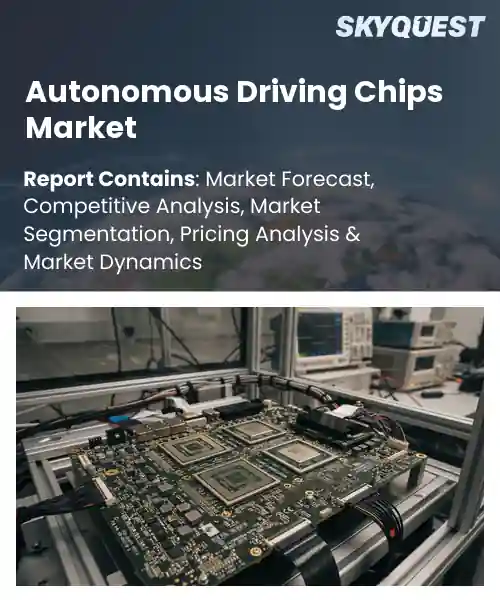
Autonomous Driving Chips Market
Report ID: SQMIG45O2258
Report ID: SQMIG45O2258
[email protected]
USA +1 351-333-4748
Report ID:
SQMIG45O2258 |
Region:
Global |
Published Date: September, 2026
Pages:
157
|Tables:
154
|Figures:
78


Global Autonomous Driving Chips Market size was valued at USD 24.22 Billion in 2024 and is poised to grow from USD 29.79 Billion in 2025 to USD 156.08 Billion by 2033, growing at a CAGR of 23.0% during the forecast period (2026-2033).
The global autonomous driving chips market supplies processors that enable perception, planning and control in self‑driving cars. Its importance lies in the potential for safer roads, lower congestion and emerging mobility services, prompting automakers and tech firms to fund silicon development. The market originated with neural‑network accelerators in early Waymo prototypes around 2015 and gained momentum after Nvidia introduced the Drive PX platform in 2016, proving that GPUs could handle sensor fusion. In the following years, declining chip costs and widespread adoption of lidar, radar and camera arrays expanded the addressable vehicle pool, moving the technology from niche to mainstream. The growth driver is the convergence of advanced driver‑assistance systems with autonomous platforms, which forces OEMs to adopt chip architectures that combine AI acceleration, safety‑critical microcontrollers and networking. As manufacturers integrate Level‑3 and Level‑4 functions, demand for chips that can process sensor data while meeting functional‑safety standards rises, pushing suppliers such as Intel’s Mobileye, Qualcomm and Chinese firms to expand design pipelines. This escalation creates opportunities in silicon foundries and radio interfaces, illustrated by Apollo platform deploying customized ASICs across its fleet in China, thereby shortening time‑to‑market and lowering per‑vehicle cost. The ripple effect accelerates ecosystem investment, reinforcing market expansion.
How are AI and IoT shaping the autonomous driving chips market?
AI and IoT are converging to redefine the autonomous‑driving chip landscape by embedding real‑time perception, decision‑making and connectivity directly into silicon. AI accelerates sensor fusion and deep‑learning inference, while IoT provides the data streams that keep vehicles aware of traffic, weather and infrastructure. Together they enable chips that process massive video feeds, lidar points and V2X messages without relying on external clouds, reducing latency and improving safety. Manufacturers are now designing heterogeneous architectures that combine CPUs, GPUs and dedicated neural‑processing units, creating platforms that can scale from assisted features to full self‑driving. This synergy is driving rapid innovation and attracting new entrants eager to capture market share.NVIDIA March 2023 introduced the Drive Atlan platform, a unified AI‑centric processor that merges perception, planning and V2X communication, illustrating how AI‑IoT integration fuels more capable and efficient autonomous driving solutions.
Market snapshot - (2026-2033)
Global Market Size
USD 24.22 Billion
Largest Segment
Application-Specific Integrated Circuits
Fastest Growth
Vision Processing Units
Growth Rate
23.0% CAGR
To get more insights on this market click here to Request a Free Sample Report
Global autonomous driving chips market is segmented by chip type, processing type, autonomy level, vehicle type, application and region. Based on chip type, the market is segmented into Application-Specific Integrated Circuits, System-on-Chip, Graphics Processing Units, Central Processing Units, Field-Programmable Gate Arrays, Vision Processing Units and Others. Based on processing type, the market is segmented into Computer Vision, Sensor Fusion, Artificial Intelligence and Machine Learning, High-Performance Computing and Others. Based on autonomy level, the market is segmented into Level 1, Level 2, Level 3, Level 4 and Level 5. Based on vehicle type, the market is segmented into Passenger Cars, Light Commercial Vehicles and Heavy Commercial Vehicles. Based on application, the market is segmented into Advanced Driver Assistance Systems, Autonomous Driving, Automated Parking, Vehicle Monitoring and Others. Based on region, the market is segmented into North America, Europe, Asia Pacific, Latin America and Middle East & Africa.
Vision Processing Units segment dominates because they are purpose built to handle massive image streams with ultra low latency, enabling real time perception essential for safe autonomous navigation. Their architecture integrates dedicated accelerators for convolutional layers, reducing power consumption while maintaining high accuracy, which aligns with automotive safety standards and OEM demand for compact, reliable compute solutions. These chips also simplify system integration by providing unified memory interfaces and robust thermal management, further encouraging their adoption across vehicle platforms.
However, Graphics Processing Units segment is witnessing the strongest growth momentum because their parallel processing capabilities are being leveraged for sensor fusion and AI workloads, attracting automotive engineers seeking flexible compute platforms. Emerging software stacks and cross industry collaborations accelerate GPU adoption, opening new avenues for high performance driving functions.
Vehicle Monitoring application stands out because it demands continuous data acquisition and processing from multiple subsystems, pushing chip designers to embed low power analytics and secure communication modules. The need for real time diagnostics, predictive maintenance, and over the air updates forces integration of specialized peripherals, fostering system on chip solutions that satisfy stringent automotive reliability and cost constraints. These requirements also stimulate the development of robust security enclaves and fault tolerant architectures, ensuring that the monitoring functions remain operational under extreme conditions.
Meanwhile, Automated Parking application emerges as the key high growth area because city regulations and consumer convenience are accelerating demand for precise maneuvering solutions. Chip makers are embedding ultra short range radar and vision modules into compact packages, unlocking new revenue streams and encouraging OEMs to integrate parking autonomy across model lineups.
To get detailed segments analysis, Request a Free Sample Report
Asia Pacific benefits from a dense ecosystem of automotive manufacturers, semiconductor innovators, and research institutions that collaborate closely on advanced driver assistance technologies. Strong governmental support for smart mobility initiatives encourages investment in high‑performance computing platforms tailored for autonomous functions. The region’s manufacturers leverage deep expertise in sensor integration and power‑efficient chip design, allowing rapid iteration and cost‑effective scaling. Moreover, a cultural emphasis on precision engineering and a history of leadership in electronics production create a competitive advantage that sustains leadership in autonomous driving chip development and deployment.
Autonomous Driving Chips Market in Japan thrives on long‑standing automotive heritage combined with cutting‑edge semiconductor capabilities. Domestic car makers partner with chip firms to co‑develop solutions that prioritize safety and reliability, reinforcing a reputation for meticulous engineering. Government policies promote connectivity and intelligent transport, fostering an environment where innovation in perception and decision‑making algorithms can be rapidly tested on public roads. This synergy fuels a robust pipeline of next‑generation chip architectures that cater to both domestic and export demands.
Autonomous Driving Chips Market in South Korea is propelled by a dynamic blend of world‑class electronics manufacturers and ambitious automotive startups. The country’s leadership in memory and logic technologies translates into high‑density, low‑latency processors essential for real‑time autonomous functions. Strategic collaborations between chip designers and vehicle producers accelerate the integration of advanced AI capabilities into commercial models. Strong emphasis on research funding and a forward‑looking regulatory framework further encourage the rapid commercialization of sophisticated autonomous driving solutions.
North America’s expansion is anchored by a vibrant ecosystem of technology innovators, venture capital, and leading automotive OEMs that prioritize autonomous mobility. The region’s strong focus on artificial intelligence research and high‑performance computing creates a fertile ground for developing chips that handle complex sensor fusion and decision‑making tasks. Collaborative pilots between automakers, tech firms, and municipalities provide real‑world validation, accelerating market readiness. Additionally, a regulatory environment that encourages testing and a consumer base receptive to advanced driver assistance features reinforce the momentum behind autonomous driving chip adoption across the continent.
Autonomous Driving Chips Market in the United States benefits from deep integration of Silicon Valley expertise with traditional automotive engineering. Prominent chip manufacturers collaborate with leading car makers to embed AI‑optimized processors that support extensive sensor arrays and high‑definition mapping. Robust R&D initiatives and extensive testing corridors enable rapid iteration of hardware platforms, while a culture of innovation drives the pursuit of ever‑more efficient and powerful computing solutions for autonomous vehicles.
Autonomous Driving Chips Market in Canada is shaped by a strong research community and supportive governmental programs that nurture clean‑technology ventures. Partnerships between Canadian universities, chip designers, and automotive firms focus on developing robust, climate‑resilient processors suited for diverse driving conditions. Emphasis on safety standards and collaborative pilot projects across urban and remote regions helps refine chip performance, positioning Canada as a growing contributor to the broader North American autonomous driving ecosystem.
Europe advances its position through coordinated policy frameworks, high‑quality engineering talent, and entrenched automotive heritage that emphasizes safety and sustainability. Collaborative research consortia bridge automotive manufacturers with semiconductor specialists, fostering the creation of chips optimized for energy efficiency and stringent regulatory compliance. Strong emphasis on standards harmonization and cross‑border testing facilities accelerates technology validation across multiple markets. Moreover, investment in next‑generation design tools and a commitment to environmental responsibility drive the development of chips that support both autonomous capabilities and low‑emission vehicle goals.
Autonomous Driving Chips Market in Germany leverages the nation’s precision engineering culture and deep automotive lineage. Partnerships between leading car makers and chip producers concentrate on high‑integrity processors that meet rigorous safety certifications. Focus on modular design and efficient power management aligns with Germany’s broader emphasis on performance and sustainability in vehicle technology.
Autonomous Driving Chips Market in the United Kingdom thrives on a vibrant tech startup scene combined with legacy automotive expertise. Collaborative ecosystems in research hubs enable rapid prototyping of AI‑centric chip architectures tailored for autonomous perception and control. Government incentives support scaling of innovative solutions that integrate seamlessly with emerging mobility services.
Autonomous Driving Chips Market in France benefits from strong state‑backed research institutions and a tradition of automotive excellence. Synergies between chip designers and vehicle manufacturers focus on creating secure, low‑power processors that align with France’s commitment to autonomous mobility and environmental stewardship.
To know more about the market opportunities by region and country, click here to
Buy The Complete Report
Advanced AI Processing Capabilities
Scalable Sensor Fusion Architectures
Stringent Regulatory Approval Processes
High Cost of Development and Integration
Request Free Customization of this report to help us to meet your business objectives.
The competitive landscape is shaped by aggressive M&A activity, strategic partnerships, and rapid technology innovation, with incumbents such as Nvidia acquiring Arm to strengthen AI‑compute capabilities, Intel’s Mobileye forming joint ventures with automotive OEMs to integrate vision‑based chips, and Qualcomm partnering with automotive suppliers to embed 5G‑enabled processing units, all driving intensified rivalry and accelerating product road‑maps.
Top Player’s Company Profile
Recent Developments
SkyQuest’s ABIRAW (Advanced Business Intelligence, Research & Analysis Wing) is our Business Information Services team that Collects, Collates, Correlates, and Analyses the Data collected by means of Primary Exploratory Research backed by robust Secondary Desk research. As per SkyQuest analysis, the autonomous driving chips market is being propelled primarily by advanced AI processing capabilities that enable real‑time perception and decision‑making, while scalable sensor‑fusion architectures provide the flexibility to integrate growing numbers of lidar, radar and camera inputs across vehicle models. The strongest growth restraint stems from stringent regulatory approval processes that lengthen development cycles and raise compliance costs. Asia Pacific leads the market, benefiting from a dense ecosystem of automakers, semiconductor innovators and supportive government initiatives. Within the segment landscape, vision processing units dominate because their low‑latency image handling meets safety‑critical automotive standards, reinforcing the region’s leadership.
| Report Metric | Details |
|---|---|
| Market size value in 2024 | USD 24.22 Billion |
| Market size value in 2033 | USD 156.08 Billion |
| Growth Rate | 23.0% |
| Base year | 2024 |
| Forecast period | (2026-2033) |
| Forecast Unit (Value) | USD Billion |
| Segments covered |
|
| Regions covered | North America (US, Canada), Europe (Germany, France, United Kingdom, Italy, Spain, Rest of Europe), Asia Pacific (China, India, Japan, Rest of Asia-Pacific), Latin America (Brazil, Rest of Latin America), Middle East & Africa (South Africa, GCC Countries, Rest of MEA) |
| Companies covered |
|
| Customization scope | Free report customization with purchase. Customization includes:-
|
To get a free trial access to our platform which is a one stop solution for all your data requirements for quicker decision making. This platform allows you to compare markets, competitors who are prominent in the market, and mega trends that are influencing the dynamics in the market. Also, get access to detailed SkyQuest exclusive matrix.
Table Of Content
Executive Summary
Market overview
Parent Market Analysis
Market overview
Market size
KEY MARKET INSIGHTS
COVID IMPACT
MARKET DYNAMICS & OUTLOOK
Market Size by Region
KEY COMPANY PROFILES
Methodology
For the Autonomous Driving Chips Market, our research methodology involved a mixture of primary and secondary data sources. Key steps involved in the research process are listed below:
1. Information Procurement: This stage involved the procurement of Market data or related information via primary and secondary sources. The various secondary sources used included various company websites, annual reports, trade databases, and paid databases such as Hoover's, Bloomberg Business, Factiva, and Avention. Our team did 45 primary interactions Globally which included several stakeholders such as manufacturers, customers, key opinion leaders, etc. Overall, information procurement was one of the most extensive stages in our research process.
2. Information Analysis: This step involved triangulation of data through bottom-up and top-down approaches to estimate and validate the total size and future estimate of the Autonomous Driving Chips Market.
3. Report Formulation: The final step entailed the placement of data points in appropriate Market spaces in an attempt to deduce viable conclusions.
4. Validation & Publishing: Validation is the most important step in the process. Validation & re-validation via an intricately designed process helped us finalize data points to be used for final calculations. The final Market estimates and forecasts were then aligned and sent to our panel of industry experts for validation of data. Once the validation was done the report was sent to our Quality Assurance team to ensure adherence to style guides, consistency & design.
Analyst Support
Customization Options
With the given market data, our dedicated team of analysts can offer you the following customization options are available for the Autonomous Driving Chips Market:
Product Analysis: Product matrix, which offers a detailed comparison of the product portfolio of companies.
Regional Analysis: Further analysis of the Autonomous Driving Chips Market for additional countries.
Competitive Analysis: Detailed analysis and profiling of additional Market players & comparative analysis of competitive products.
Go to Market Strategy: Find the high-growth channels to invest your marketing efforts and increase your customer base.
Innovation Mapping: Identify racial solutions and innovation, connected to deep ecosystems of innovators, start-ups, academics, and strategic partners.
Category Intelligence: Customized intelligence that is relevant to their supply Markets will enable them to make smarter sourcing decisions and improve their category management.
Public Company Transcript Analysis: To improve the investment performance by generating new alpha and making better-informed decisions.
Social Media Listening: To analyze the conversations and trends happening not just around your brand, but around your industry as a whole, and use those insights to make better Marketing decisions.
REQUEST FOR SAMPLE
 REQUEST FREE CUSTOMIZATION


Want to customize this report? This report can be personalized according to your needs. Our analysts and industry experts will work directly with you to understand your requirements and provide you with customized data in a short amount of time. We offer $1000 worth of FREE customization at the time of purchase.
Feedback From Our Clients


 USA (+1) 351-333-4748

