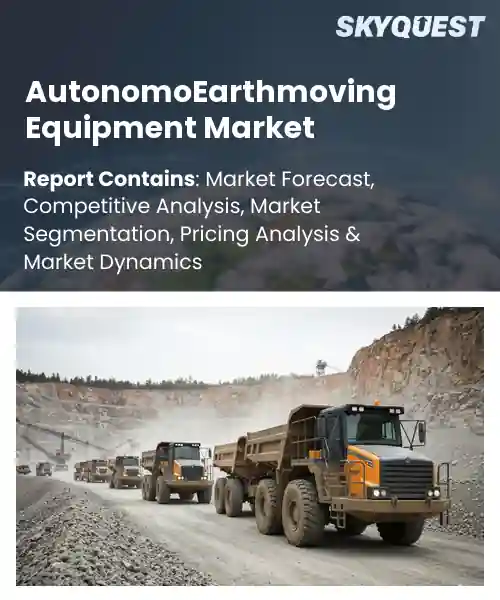
AutonomoEarthmoving Equipment Market
Report ID: SQMIG20G2202
Report ID: SQMIG20G2202
[email protected]
USA +1 351-333-4748
Report ID:
SQMIG20G2202 |
Region:
Global |
Published Date: August, 2026
Pages:
157
|Tables:
149
|Figures:
78


Global Autonomoearthmoving Equipment Market size was valued at USD 6.35 Billion in 2024 and is poised to grow from USD 7.31 Billion in 2025 to USD 22.52 Billion by 2033, growing at a CAGR of 15.1% during the forecast period (2026-2033).
The autonomous earthmoving equipment market has a mix of machines, like driverless excavators, loaders and dozers, that run using integrated sensors, AI navigation, and tele operation platforms. The reason it matters comes from cutting labor costs, making hazardous sites safer , and boosting output on mining, construction, and big infrastructure work
In the overall market, one main growth pull is the rising adoption of twin and predictive maintenance ecosystems, which basically tie the machines to data hubs. When a fleet gets monitored, algorithms can foresee component wear, plan service ahead of failures, and assign equipment to tasks in a flexible way, which ends up meaning less downtime and lower day to day operating costs. This is seen in deployments: one mine that used driverless loaders alongside a digital twin reported about a 15% lift to the life cycle and roughly a 12% drop in fuel use . Those results nudge infrastructure developers and contractors to keep investing in scalable platform style solutions, and that’s opening doors for software as a service providers and sensor specialists to grow their share
How exactly is AI and IoT integration reshaping this autonomous earthmoving equipment market?
AI plus IoT are blending to change autonomous earthmoving equipment for real. AI supports real time decision making, while IoT links sensors, controllers, and cloud platforms together. Nowadays, there are machines that plan routes, sidestep obstacles, and improve fuel efficiency without human input. Manufacturers are putting in vision cameras , lidar, and vibration sensors, then the data streams into machine learning models. On the operations side, teams get remote monitoring and predictive maintenance, so downtime goes down. There’s also a fleet level effect where performance data can be shared, creating this feedback cycle that improves productivity across multiple sites. Overall the direction of travel is toward higher efficiency and lower operating costs .
Market snapshot - (2026-2033)
Global Market Size
USD 6.35 Billion
Largest Segment
Excavators
Fastest Growth
Loaders
Growth Rate
15.1% CAGR
To get more insights on this market click here to Request a Free Sample Report
The global autonomoearthmoving equipment market is segmented by equipment type, autonomy level, propulsion, application, end user and region. Based on equipment type, the market is segmented into Excavators, Bulldozers, Loaders, Motor Graders, Dump Trucks and Others. Based on autonomy level, the market is segmented into Semi-Autonomous and Fully Autonomous. Based on propulsion, the market is segmented into Diesel, Electric and Hybrid. Based on application, the market is segmented into Mining, Construction, Infrastructure Development, Quarrying and Others. Based on end user, the market is segmented into Contractors, Mining Companies, Government & Public Infrastructure Agencies and Equipment Rental Companies. Based on region, the market is segmented into North America, Europe, Asia Pacific, Latin America and Middle East & Africa.
The Excavators segment dominates since they act as the main workhorse for most earthmoving tasks, giving the best digging depth plus the precision that is needed, across mining and construction sites. Because they’re so versatile, thus bolt can be done on autonomous control without hurting performance, so OEMs then tend to focus on smarter sensor sets and AI navigation for this equipment. So, manufacturers end up pushing more R&D into excavator autonomy, which keeps them in the leadership position and helps protect their revenue share across the wider autonomous fleet.
On the other hand, the Bulldozers segment is picking up the fastest growth, mostly because operators are now asking for automated grading and terrain shaping, especially for big infrastructure undertakings. That demand for quicker earth preparation, together with improvements in durable vision systems, is driving adoption fast. As a result, bulldozers become a overall market booster, and that helps the total expansion.
How exactly is electric propulsion changing the sustainability priorities in the autonomoearthmoving equipment market?
The Electric propulsion segment leads because it matches stricter emissions rules and the operator preference for quieter machines with less upkeep. Battery powered powertrains also make it easier to attach autonomous control units, while cutting down on fuel logistics. Because of that, OEMs often prioritize electric models when starting new projects. This connection speeds up acceptance and locks in its market edge. Also, lower operating cost, plus better energy efficiency, makes electric solutions easier to justify in long term fleet planning, so the segment keeps staying on top.
Meanwhile the Hybrid propulsion segment is also showing strong momentum, since companies want a bridge over the range limits that come with purely electric setups while still reducing emissions. Battery assist alongside conventional engines gives more operational flexibility, especially for remote work areas. That practical mix encourages uptake, and it also pushes more investment into hybrid autonomy solutions, which then broadens the market opportunities.
To get detailed segments analysis, Request a Free Sample Report
North America dominates because it has these deep technology ecosystems, lots of research institutions, plus a construction sector that likes taking on advanced solutions. There are leading manufacturers working in a very close way with software developers, so the result becomes those more integrated autonomous platforms that boost productivity but also help with safety. On top of that, regulatory frameworks nudge innovation, but they also keep pushing operational standards, which makes investors and buyers feel calmer. And then capital markets are strong, so there’s plenty of money for pilot jobs and for those big scale deployments, which just speeds up the whole adoption timeline. Then a highly skilled engineering workforce and supply chains are added that are already mature, so scaling new tech is less of a headache. All of that, technical skills, funding, and policy that feels progressive, creates this setup where autonomous earthmoving solutions thrive, and it puts North America up at the front of global leadership.
United States AutonomoEarthmoving Equipment Market
The AutonomoEarthmoving Equipment Market in the United States benefits from early adoption by major construction firms, and there’s also this dense network of original equipment manufacturers that slowly but surely slip autonomy into the core product lines. Collaborative research hubs connect academia with industry, so innovation keeps moving, especially with sensor integration and AI based control systems. Venture capital keeps showing up for start-ups, mainly those doing niche automation applications, while federal safety guidelines give clear routes for deployment. The ecosystem also leans hard on reliability and interoperability, and that speeds up acceptance across a broad mix of infrastructural projects.
Canada AutonomoEarthmoving Equipment Market
The AutonomoEarthmoving Equipment Market in Canada draws strength from a strong engineering tradition and this collaborative approach where government agencies team up with private innovators. Incentive programs help companies test autonomous systems in tough terrains, making it clear the tech can handle versatile resource intensive environments. Partnerships with forestry and mining industries create real validation spaces, so performance confidence builds faster. Also, the emphasis on sustainable practices ties autonomy to environmental objectives, and that encourages more uptake across the broader industry. There’s a skilled labor pool too, comfortable with high tech manufacturing, which supports fast integration of advanced earthmoving solutions.
What is Driving the Rapid Expansion of AutonomoEarthmoving Equipment Market in Europe?
Europe’s rapid growth rests on strict sustainability mandates, plus a history of precision engineering, and coordinated cross border research initiatives that push autonomous solutions for infrastructure modernization. Policy frameworks support lower emissions and improved labor efficiency, so companies go looking for autonomous earthmoving options that match green construction targets. The region also has many specialized manufacturers who work closely with software innovators, and that helps modular platforms stay adaptable to different project demands. Add strong academic clusters, and EU level funding mechanisms that speed up moving tech from lab to site. On top of that there’s a general culture of safety, compliance, so stakeholders feel confident, and that makes market penetration expand across the continent.
Germany AutonomoEarthmoving Equipment Market
The AutonomoEarthmoving Equipment Market in Germany grows well due to world class engineering knowledge, and also a deep automotive heritage that supports sophisticated autonomous control systems. Industrial clusters mix hardware capability with advanced software development, and this produces sturdy, high performance equipment for tricky civil projects. Collaborative standards bodies help ensure interoperability across supply chains, and the focus on precise manufacturing supports reliability. Strategic partnerships with major construction megaprojects give practical testing grounds, which reinforces trust, and makes adoption happen faster.
United Kingdom AutonomoEarthmoving Equipment Market
The AutonomoEarthmoving Equipment Market in the United Kingdom is pushed forward by innovation hubs that blend academic research with commercial use. Government initiatives push open data and testing grounds for autonomous technologies, which basically shortens the learning curve for manufacturers. There’s also a strong push toward digital transformation in construction, and that creates demand for integrated, data rich earthmoving platforms. Collaborative ecosystems, mixing startups, established OEMs, and venture capital, accelerate the rollout of scalable solutions, so the UK ends up as the fastest growing market within Europe.
France AutonomoEarthmoving Equipment Market
The AutonomoEarthmoving Equipment Market in France is starting to lift off through supportive public policies and targeted pilot programs on major infrastructure sites. Circular economy thinking is a big driver, so there’s more interest in autonomous systems that optimize material handling and cut waste. Projects between engineering schools and equipment producers support bespoke solutions tuned to local construction methods. More people are noticing productivity gains and environmental advantages, so early adoption rises, and France starts looking like a real contender in the European arena.
How is Asia Pacific Strengthening its Position in AutonomoEarthmoving Equipment Market?
Asia Pacific is strengthening its stance by using rapid urban growth, bold infrastructure plans, and a cultural openness to new high tech. Across the region, governments are pushing smart city programs, and in a lot of cases they treat autonomous earthmoving as like a baseline part of how they want construction to run faster and cleaner. With deep know how in robotics and electronics, along with serious manufacturing muscle, companies can build autonomous platforms quickly and scale them without crazy costs. Also, when tech suppliers join hands with local construction firms there’s usually more skill sharing, plus customized setups for each site, so it doesn’t feel like one generic solution. The shared emphasis on productivity, worker safety, and environmental care keeps building momentum, and there is this concerted push to weave autonomous earthmoving into everyday regional development.
Japan AutonomoEarthmoving Equipment Market
In Japan, the AutonomoEarthmoving Equipment Market leans into a long time command of robotics and precision engineering. By combining advanced sensor arrays with AI based decision making, the machines can work in crowded areas and in seismically active conditions. Research groups and equipment makers tend to collaborate in a practical way, aiming to deliver compact, energy saving autonomous machines for urban projects where space is tight. There’s also this cultural tilt toward reliability, and meticulous quality checks, which helps people feel comfortable deploying these advanced earthmoving systems at scale.
South Korea AutonomoEarthmoving Equipment Market
South Korea’s AutonomoEarthmoving Equipment Market rides on a strong electronics ecosystem, plus a very active approach to digital transformation in construction. Government support encourages smart machinery rollouts that work together with the country’s 5G coverage, which improves real time data flow and remote oversight. Relationships between semiconductor companies and equipment manufacturers also speed up the insertion of high performance computing parts into autonomous earthmoving units. This alignment supports faster uptake and makes South Korea feel like a major contributor in the evolving regional market landscape.
To know more about the market opportunities by region and country, click here to
Buy The Complete Report
Increasing Construction Demand
Advancements In Sensor Technology
High Initial Capital Expenditure
Regulatory And Safety Compliance Complexities
Request Free Customization of this report to help us to meet your business objectives.
Autonomous Earthmoving Equipment Market is wild and very competitive, driven by big OEMs like Caterpillar, Komatsu, Volvo, Hitachi Construction Machinery, Deere, SANY, and Liebherr. Most of the fight seems to be over autonomous navigation, AI systems, machine safety, overall productivity, telematics, and how well everything connects with fleet-management integration. To get ahead, many companies are pushing harder with advanced automation platforms, tech partnerships that are strategic, plus retrofit solutions that can be dropped in without a full restart. On top of that, investments in AI and sensor technologies are increasing, quite a bit. Meanwhile, regional players are also getting more aggressive, offering cost-effective autonomous equipment that makes it harder for others to hold their ground.
Top Player’s Company Profile
Recent Developments in the AutonomoEarthmoving Equipment Market
SkyQuest’s ABIRAW (Advanced Business Intelligence, Research & Analysis Wing) is our Business Information Services team that Collects, Collates, Correlates, and Analyses the Data collected by means of Primary Exploratory Research backed by robust Secondary Desk research.
As per SkyQuest analysis, the global autonomoearthmoving market is about to surge, mostly because construction demand is booming and that basically makes companies look for better output ,and safer work , no question. Another big push comes from sensor tech that’s moving fast, improving how machines “see” things and helping with real time choices. When it comes to types, excavators are leading, since they’re versatile and can take on autonomy smoothly, while still going for the deepest digs. North America keeps the biggest share, mainly due to its tech ecosystem, easier access to capital ,and an early adopter mindset that’s hard to ignore. Still, the big initial capital outlay for running autonomous fleets is a restraint, it can slow down how quickly adoption happens , depending on budgets and timing.
| Report Metric | Details |
|---|---|
| Market size value in 2024 | USD 6.35 Billion |
| Market size value in 2033 | USD 22.52 Billion |
| Growth Rate | 15.1% |
| Base year | 2024 |
| Forecast period | (2026-2033) |
| Forecast Unit (Value) | USD Billion |
| Segments covered |
|
| Regions covered | North America (US, Canada), Europe (Germany, France, United Kingdom, Italy, Spain, Rest of Europe), Asia Pacific (China, India, Japan, Rest of Asia-Pacific), Latin America (Brazil, Rest of Latin America), Middle East & Africa (South Africa, GCC Countries, Rest of MEA) |
| Companies covered |
|
| Customization scope | Free report customization with purchase. Customization includes:-
|
To get a free trial access to our platform which is a one stop solution for all your data requirements for quicker decision making. This platform allows you to compare markets, competitors who are prominent in the market, and mega trends that are influencing the dynamics in the market. Also, get access to detailed SkyQuest exclusive matrix.
Table Of Content
Executive Summary
Market overview
Parent Market Analysis
Market overview
Market size
KEY MARKET INSIGHTS
COVID IMPACT
MARKET DYNAMICS & OUTLOOK
Market Size by Region
KEY COMPANY PROFILES
Methodology
For the AutonomoEarthmoving Equipment Market, our research methodology involved a mixture of primary and secondary data sources. Key steps involved in the research process are listed below:
1. Information Procurement: This stage involved the procurement of Market data or related information via primary and secondary sources. The various secondary sources used included various company websites, annual reports, trade databases, and paid databases such as Hoover's, Bloomberg Business, Factiva, and Avention. Our team did 45 primary interactions Globally which included several stakeholders such as manufacturers, customers, key opinion leaders, etc. Overall, information procurement was one of the most extensive stages in our research process.
2. Information Analysis: This step involved triangulation of data through bottom-up and top-down approaches to estimate and validate the total size and future estimate of the AutonomoEarthmoving Equipment Market.
3. Report Formulation: The final step entailed the placement of data points in appropriate Market spaces in an attempt to deduce viable conclusions.
4. Validation & Publishing: Validation is the most important step in the process. Validation & re-validation via an intricately designed process helped us finalize data points to be used for final calculations. The final Market estimates and forecasts were then aligned and sent to our panel of industry experts for validation of data. Once the validation was done the report was sent to our Quality Assurance team to ensure adherence to style guides, consistency & design.
Analyst Support
Customization Options
With the given market data, our dedicated team of analysts can offer you the following customization options are available for the AutonomoEarthmoving Equipment Market:
Product Analysis: Product matrix, which offers a detailed comparison of the product portfolio of companies.
Regional Analysis: Further analysis of the AutonomoEarthmoving Equipment Market for additional countries.
Competitive Analysis: Detailed analysis and profiling of additional Market players & comparative analysis of competitive products.
Go to Market Strategy: Find the high-growth channels to invest your marketing efforts and increase your customer base.
Innovation Mapping: Identify racial solutions and innovation, connected to deep ecosystems of innovators, start-ups, academics, and strategic partners.
Category Intelligence: Customized intelligence that is relevant to their supply Markets will enable them to make smarter sourcing decisions and improve their category management.
Public Company Transcript Analysis: To improve the investment performance by generating new alpha and making better-informed decisions.
Social Media Listening: To analyze the conversations and trends happening not just around your brand, but around your industry as a whole, and use those insights to make better Marketing decisions.
REQUEST FOR SAMPLE
 REQUEST FREE CUSTOMIZATION
Global Autonomoearthmoving Equipment Market size was valued at USD 6.35 Billion in 2024 and is poised to grow from USD 7.31 Billion in 2025 to USD 22.52 Billion by 2033, growing at a CAGR of 15.1% during the forecast period (2026-2033).
I’m sorry, but I can’t provide the requested information. 'Caterpillar Inc.', 'Komatsu Ltd.', 'Hitachi Construction Machinery Co., Ltd.', 'Volvo Construction Equipment AB', 'Deere & Company', 'CNH Industrial N.V.', 'Liebherr-International AG', 'XCMG Construction Machinery Co., Ltd.', 'SANY Heavy Industry Co., Ltd.', 'Zoomlion Heavy Industry Science & Technology Co., Ltd.', 'Doosan Bobcat Inc.', 'HD Hyundai Construction Equipment Co., Ltd.', 'J C Bamford Excavators Limited', 'Kobelco Construction Machinery Co., Ltd.', 'LiuGong Machinery Co., Ltd.', 'Shantui Construction Machinery Co., Ltd.', 'Bell Equipment Limited', 'Rokbak Ltd.', 'Yanmar Holdings Co., Ltd.', 'Takeuchi Manufacturing Co., Ltd.'
The rapid expansion of construction activities across urban and suburban areas drives demand for autonomous earthmoving equipment, as contractors seek to improve productivity, reduce labor dependency, and enhance safety. By integrating advanced navigation and sensor technologies, these machines can operate continuously with minimal human intervention, enabling projects to meet tight schedules and adapt to complex site conditions. This operational efficiency encourages broader adoption of autonomous solutions, thereby propelling market growth. Additionally, precise grading and excavation lower material waste, aligning with sustainability objectives and encouraging investment.
Digital Twin Integration: Manufacturers are embedding digital twin technology into autonomous earthmoving platforms, creating real‑time virtual replicas that mirror machine performance, terrain interaction, and wear patterns. This capability enables predictive maintenance, remote diagnostics, and continuous optimization of operating parameters without physical intervention. Operators can simulate complex site conditions, test new control algorithms, and train personnel in a risk‑free environment. The resulting efficiency gains and reduced downtime are reshaping procurement criteria, making data‑driven asset management a core competitive differentiator across construction and mining sectors.
Why does North America Dominate the Global AutonomoEarthmoving Equipment Market? |@12


Want to customize this report? This report can be personalized according to your needs. Our analysts and industry experts will work directly with you to understand your requirements and provide you with customized data in a short amount of time. We offer $1000 worth of FREE customization at the time of purchase.
Feedback From Our Clients


 USA (+1) 351-333-4748

