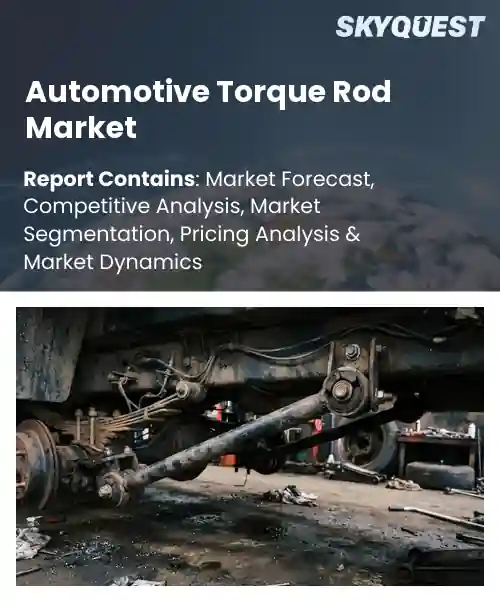
Automotive Torque Rod Market
Report ID: SQMIG25A2949
Report ID: SQMIG25A2949
[email protected]
USA +1 351-333-4748
Report ID:
SQMIG25A2949 |
Region:
Global |
Published Date: August, 2026
Pages:
157
|Tables:
144
|Figures:
78


Global Automotive Torque Rod Market size was valued at USD 4.82 Billion in 2024 and is poised to grow from USD 5.1 Billion in 2025 to USD 8.08 Billion by 2033, growing at a CAGR of 5.9% during the forecast period (2026-2033).
The automotive torque‑rod market comprises components that stabilize chassis and control wheel steer angles, essential for vehicle handling and safety. Its importance grew as manufacturers shifted from solid axles to independent suspension systems, demanding precise load‑transfer devices. Early adoption occurred in high‑performance sports cars during the 1990s, where manufacturers used steel rods to counteract torque‑induced dive. Over the past decade, lightweight aluminum and composite rods have entered mainstream models, driven by stricter fuel‑efficiency standards and consumer expectations for agile ride quality. Thus, the market evolved from niche performance parts to a core element of affordable mass‑market vehicles in worldwide markets. The principal growth factor driving the global automotive torque‑rod market is the adoption of electric‑drive architectures, which change torque distribution on front and rear axles. Because electric motors deliver instant peak torque, manufacturers must mitigate pronounced torque‑steer and chassis twist, and torque rods offer a compact, low‑cost countermeasure that fits modular platforms. Consequently, OEMs such as Tesla and BYD have integrated aluminum‑alloy rods into their Model 3 and Han EVs, achieving roughly a twelve‑percent gain in handling precision. This cause‑effect chain raises demand for lightweight rods, prompting investment in forging and additive‑manufacturing and opening opportunities in regions where EV adoption accelerates.
How is AI-driven design automation impacting the automotive torque rod market?
AI‑driven design automation is reshaping how torque rods are engineered, shortening concept cycles and enabling more precise stress analysis. Generative algorithms explore countless geometry variations, allowing engineers to balance weight, durability and cost without manual trial‑and‑error. The technology integrates sensor data from prototypes, feeding real‑time feedback into virtual models and improving reliability predictions. As OEMs push for lighter vehicles and higher performance, AI tools help suppliers meet tighter specifications while reducing material waste. This shift is fostering closer collaboration between design teams and manufacturing, accelerating the introduction of optimized components across the market.In April 2024, a leading automotive supplier announced the rollout of an AI‑enabled design platform for torque rods, highlighting faster iteration times and improved part efficiency, which is expected to bolster market growth.
Market snapshot - (2026-2033)
Global Market Size
USD 4.82 Billion
Largest Segment
Fixed Torque Rods
Fastest Growth
Hydraulic Torque Rods
Growth Rate
5.9% CAGR
To get more insights on this market click here to Request a Free Sample Report
Global automotive torque rod market is segmented by torque rod type, vehicle type, material, sales channel, application and region. Based on torque rod type, the market is segmented into Fixed Torque Rods, Adjustable Torque Rods, Rubber-Bushed Torque Rods and Hydraulic Torque Rods. Based on vehicle type, the market is segmented into Passenger Cars, Light Commercial Vehicles, Heavy Commercial Vehicles and Buses. Based on material, the market is segmented into Steel, Aluminum and Composite. Based on sales channel, the market is segmented into OEM and Aftermarket. Based on application, the market is segmented into Engine Mounting and Suspension System. Based on region, the market is segmented into North America, Europe, Asia Pacific, Latin America and Middle East & Africa.
Adjustable Torque Rods segment dominates because they provide tunable stiffness that accommodates varying engine vibration profiles, enabling manufacturers to fine tune ride comfort and NVH performance. Their adaptability aligns with modular vehicle platforms, allowing designers to reuse a single component across multiple models. This flexibility reduces development time and inventory complexity, driving widespread adoption in new vehicle programs. Additionally, the ability to adjust preload during assembly simplifies calibration procedures, further enhancing manufacturing efficiency.
Meanwhile, Rubber Bushed Torque Rods segment emerges as the most rapidly expanding area because automotive manufacturers are prioritizing acoustic comfort and vibration isolation in increasingly quiet cabins. The integration of elastomeric bushing reduces noise transmission and extends component lifespan, prompting broader adoption in premium and electric vehicle platforms, thereby fueling market growth.
Composite segment dominates because its high strength to weight ratio enables designers to significantly cut unsprung mass, improving handling dynamics and fuel efficiency. The material’s corrosion resistance extends service life under harsh environmental conditions, which aligns with manufacturers’ durability targets. Moreover, advances in manufacturing processes have lowered production complexity, encouraging its integration across diverse vehicle platforms. This weight advantage also contributes to lower emissions, supporting regulatory compliance and enhancing brand sustainability narratives, further driving adoption.
On the other hand, Aluminum segment is witnessing the strongest growth momentum because its cost effective lightweight properties meet the escalating demand for mass market efficiency. Manufacturers leverage established extrusion techniques to produce high precision rods, facilitating rapid scale up. The material’s recyclability resonates with circular economy initiatives, unlocking new supply chain opportunities and accelerating market expansion.
To get detailed segments analysis, Request a Free Sample Report
Asia Pacific dominance stems from a combination of advanced manufacturing capabilities, deep integration of torque rod components in high‑performance vehicle platforms, and a robust supplier ecosystem that emphasizes precision engineering. The region benefits from long‑standing expertise in steel processing and forging, supported by a culture of continuous improvement and strong collaboration between OEMs and tier‑one suppliers. Additionally, the rapid adoption of electrified powertrains and lightweight chassis designs in key markets drives demand for high‑quality torque rods. Government policies that encourage innovation and export orientation further reinforce the competitive advantage, allowing Asian manufacturers to set global benchmarks for reliability and cost efficiency. Consumer expectations for durability and low maintenance also align with the region’s focus on quality assurance, cementing its leadership position.
Automotive Torque Rod Market Japan is characterized by a legacy of precision engineering and strong ties between major automakers and component specialists. Japanese manufacturers prioritize high‑strength materials and rigorous testing protocols, ensuring torque rods meet demanding performance criteria for both conventional and hybrid models. The collaborative ecosystem fosters rapid prototyping and integration of innovative design features, reinforcing Japan’s reputation for reliability and technological leadership in this niche.
Automotive Torque Rod Market South Korea leverages a fast‑moving production network and a strategic focus on export‑oriented growth. Korean firms combine advanced metallurgy with lean manufacturing practices, delivering torque rods that balance strength and weight efficiency. Close alignment with domestic automakers accelerates the incorporation of new vehicle architectures, while partnerships with global suppliers expand access to cutting‑edge coating and surface‑treatment technologies, enhancing overall market competitiveness.
Europe’s rapid expansion is driven by stringent safety regulations, a strong emphasis on vehicle lightweighting, and a mature automotive engineering culture that values component durability. Leading automakers invest heavily in research to integrate torque rods into increasingly complex chassis systems, especially for premium and performance vehicles. The region’s well‑established network of specialized manufacturers benefits from deep expertise in high‑strength alloys and advanced surface‑treatment processes, providing solutions that meet both regulatory and consumer expectations. Collaborative initiatives between industry clusters and research institutions accelerate technology transfer, while a growing focus on electric mobility compels designers to re‑engineer suspension components, creating fresh demand for optimized torque rod designs across the continent.
Automotive Torque Rod Market Germany stands as the dominant force within Europe, anchored by a tradition of engineering excellence and a dense concentration of original equipment manufacturers. German suppliers excel in precision forging and additive manufacturing, delivering torque rods that meet rigorous performance and durability standards for luxury and high‑performance models. Integration of advanced simulation tools enables fine‑tuning of load‑bearing characteristics, reinforcing Germany’s reputation for cutting‑edge suspension solutions.
Automotive Torque Rod Market United Kingdom is recognized as the fastest‑growing segment, propelled by a thriving ecosystem of innovative startups and established suppliers. The focus on electric and autonomous vehicle development drives the need for lightweight, high‑strength torque rods that can accommodate new suspension geometries. Strong collaboration between universities, research hubs, and the automotive industry accelerates the adoption of novel materials and manufacturing techniques, positioning the United Kingdom as a dynamic hub for next‑generation torque rod technologies.
Automotive Torque Rod Market France is emerging as a notable contributor, leveraging its robust automotive heritage and increasing investment in advanced materials. French manufacturers are adopting high‑strength steel and aluminum alloys to produce torque rods that align with the country’s push toward greener, lighter vehicles. Partnerships with European research programs foster continuous improvement in design efficiency and corrosion resistance, helping France gain momentum in the broader continental market.
North America strengthens its position through a combination of extensive original equipment manufacturer demand, a focus on high‑performance and off‑road vehicle segments, and significant investments in advanced manufacturing technologies. The region’s engineering talent pool drives continuous improvement in torque rod design, emphasizing durability under diverse driving conditions and adaptability to emerging electric vehicle architectures. Close collaboration between tier‑one suppliers and automakers enables rapid integration of innovative material solutions, such as high‑strength alloys and lightweight composites. Moreover, a culture of regulatory compliance and safety testing ensures that North American torque rods meet rigorous standards, reinforcing the market’s reputation for reliability and performance across a broad spectrum of vehicle classes.
Automotive Torque Rod Market United States benefits from a vast network of original equipment manufacturers and a strong aftermarket presence that fuels ongoing demand. American suppliers prioritize robust design and extensive testing to satisfy the performance expectations of both consumer and commercial vehicles. The integration of cutting‑edge forging techniques and digital simulation tools enhances precision, while partnerships with research institutions promote the development of lightweight, high‑strength torque rod solutions tailored to the country’s diverse vehicle portfolio.
Automotive Torque Rod Market Canada leverages its expertise in metallurgy and a supportive industrial policy framework to contribute to the regional supply chain. Canadian manufacturers focus on high‑quality production processes and compliance with stringent safety standards, ensuring torque rods perform reliably in harsh climates and varied terrain. Collaboration with U.S. partners and participation in North American research consortia enable access to emerging technologies, strengthening Canada’s role in the overall market ecosystem.
To know more about the market opportunities by region and country, click here to
Buy The Complete Report
Increasing Demand for Lightweight Vehicles
Growing Adoption of Electric Powertrains
High Production Cost of Advanced Materials
Stringent Regulatory Safety Standards
Request Free Customization of this report to help us to meet your business objectives.
The competitive landscape of the global automotive torque rod market is shaped by intense rivalry among original equipment manufacturers and specialized component suppliers, driving rapid innovation in suspension technology. OEMs are securing strategic partnerships with niche suppliers to integrate lightweight, high‑strength torque rods, while recent M&A activity, such as the acquisition of a torque‑rod specialist by a leading chassis producer, accelerates product development cycles and expands market reach.
Top Player’s Company Profile
Recent Developments
SkyQuest’s ABIRAW (Advanced Business Intelligence, Research & Analysis Wing) is our Business Information Services team that Collects, Collates, Correlates, and Analyses the Data collected by means of Primary Exploratory Research backed by robust Secondary Desk research. As per SkyQuest analysis the global automotive torque rod market is being propelled primarily by the growing demand for lightweight vehicles which pushes manufacturers toward aluminum and composite rods while a second strong driver is the rapid adoption of electric powertrains that require precise torque‑steer management and adjustable rod designs. The adjustable torque rod segment leads the market because its tunable stiffness supports NVH optimization across modular platforms. Asia Pacific dominates overall thanks to its advanced manufacturing base and early EV roll‑out. However, high production costs for premium alloys and composites act as a restraint, limiting adoption in price‑sensitive segments and slowing broader market penetration.
| Report Metric | Details |
|---|---|
| Market size value in 2024 | USD 4.82 Billion |
| Market size value in 2033 | USD 8.08 Billion |
| Growth Rate | 5.9% |
| Base year | 2024 |
| Forecast period | (2026-2033) |
| Forecast Unit (Value) | USD Billion |
| Segments covered |
|
| Regions covered | North America (US, Canada), Europe (Germany, France, United Kingdom, Italy, Spain, Rest of Europe), Asia Pacific (China, India, Japan, Rest of Asia-Pacific), Latin America (Brazil, Rest of Latin America), Middle East & Africa (South Africa, GCC Countries, Rest of MEA) |
| Companies covered |
|
| Customization scope | Free report customization with purchase. Customization includes:-
|
To get a free trial access to our platform which is a one stop solution for all your data requirements for quicker decision making. This platform allows you to compare markets, competitors who are prominent in the market, and mega trends that are influencing the dynamics in the market. Also, get access to detailed SkyQuest exclusive matrix.
Table Of Content
Executive Summary
Market overview
Parent Market Analysis
Market overview
Market size
KEY MARKET INSIGHTS
COVID IMPACT
MARKET DYNAMICS & OUTLOOK
Market Size by Region
KEY COMPANY PROFILES
Methodology
For the Automotive Torque Rod Market, our research methodology involved a mixture of primary and secondary data sources. Key steps involved in the research process are listed below:
1. Information Procurement: This stage involved the procurement of Market data or related information via primary and secondary sources. The various secondary sources used included various company websites, annual reports, trade databases, and paid databases such as Hoover's, Bloomberg Business, Factiva, and Avention. Our team did 45 primary interactions Globally which included several stakeholders such as manufacturers, customers, key opinion leaders, etc. Overall, information procurement was one of the most extensive stages in our research process.
2. Information Analysis: This step involved triangulation of data through bottom-up and top-down approaches to estimate and validate the total size and future estimate of the Automotive Torque Rod Market.
3. Report Formulation: The final step entailed the placement of data points in appropriate Market spaces in an attempt to deduce viable conclusions.
4. Validation & Publishing: Validation is the most important step in the process. Validation & re-validation via an intricately designed process helped us finalize data points to be used for final calculations. The final Market estimates and forecasts were then aligned and sent to our panel of industry experts for validation of data. Once the validation was done the report was sent to our Quality Assurance team to ensure adherence to style guides, consistency & design.
Analyst Support
Customization Options
With the given market data, our dedicated team of analysts can offer you the following customization options are available for the Automotive Torque Rod Market:
Product Analysis: Product matrix, which offers a detailed comparison of the product portfolio of companies.
Regional Analysis: Further analysis of the Automotive Torque Rod Market for additional countries.
Competitive Analysis: Detailed analysis and profiling of additional Market players & comparative analysis of competitive products.
Go to Market Strategy: Find the high-growth channels to invest your marketing efforts and increase your customer base.
Innovation Mapping: Identify racial solutions and innovation, connected to deep ecosystems of innovators, start-ups, academics, and strategic partners.
Category Intelligence: Customized intelligence that is relevant to their supply Markets will enable them to make smarter sourcing decisions and improve their category management.
Public Company Transcript Analysis: To improve the investment performance by generating new alpha and making better-informed decisions.
Social Media Listening: To analyze the conversations and trends happening not just around your brand, but around your industry as a whole, and use those insights to make better Marketing decisions.
REQUEST FOR SAMPLE
 REQUEST FREE CUSTOMIZATION


Want to customize this report? This report can be personalized according to your needs. Our analysts and industry experts will work directly with you to understand your requirements and provide you with customized data in a short amount of time. We offer $1000 worth of FREE customization at the time of purchase.
Feedback From Our Clients


 USA (+1) 351-333-4748

