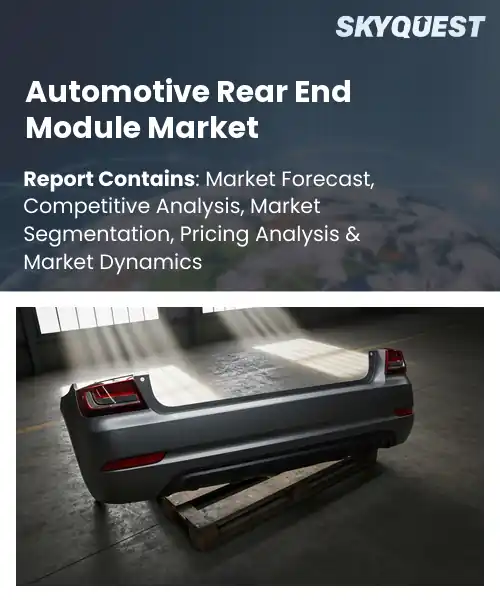
Automotive Rear End Module Market
Report ID: SQMIG25A2928
Report ID: SQMIG25A2928
[email protected]
USA +1 351-333-4748
Report ID:
SQMIG25A2928 |
Region:
Global |
Published Date: August, 2026
Pages:
157
|Tables:
143
|Figures:
78


Global Automotive Rear End Module Market size was valued at USD 4.28 Billion in 2024 and is poised to grow from USD 4.54 Billion in 2025 to USD 7.3 Billion by 2033, growing at a CAGR of 6.1% during the forecast period (2026-2033).
The automotive rear-end module market is pushed by a lot of stuff at once, rising vehicle production, more people going for electric vehicles (EVs), tighter safety rules, and also that constant push for lighter vehicle structures. EV makers tend to need redesigned rear-end architectures to fit the battery packaging, but still keep the structure sturdy, with decent handling, and ride comfort. There is more advanced high-strength steel, aluminum and composite materials getting used, and that is helping teams build lighter modules that can help fuel efficiency and EV driving range. Also, buyers are asking for better ride quality, more vehicle stability, better handling, so advanced rear suspension and integrated module designs are getting adopted more often. On top of that, when OEMs move toward modular vehicle platforms, demand rises because standardized components become easier to use, assembly gets simplified, manufacturing complexity drops, and production flexibility goes up, even if it feels like a slower process.
How is IoT integration reshaping the automotive rear end module market?
IoT integration is basically turning rear end modules, which used to be isolated mechanical parts into connected hubs. These hubs share data with the vehicle networks and cloud services, not just sit there quietly. Sensors are now sending real-time info about distance, impact forces,and environmental conditions. That feeds advanced driver assistance features and also predictive maintenance so problems are spotted before they become big issues. OEMs are also redesigning the modules so they can host communication chips, power management units and software platforms, and these platforms can be updated over the air. This change improves safety, can cut warranty costs, and opens new revenue channels through subscription-based services. The whole market is slowly shifting toward flexible architectures, where manufacturers can add features later without rebuilding hardware every time, which makes rear end systems more adaptable to future needs like autonomous driving requirements, even when the exact specs keep changing.
Market snapshot - (2026-2033)
Global Market Size
USD 4.28 Billion
Largest Segment
Bumper
Fastest Growth
Lighting Systems
Growth Rate
6.1% CAGR
To get more insights on this market click here to Request a Free Sample Report
The global automotive rear end module market is segmented by component, vehicle type, material, sales channel, end user and region. Based on component, the market is segmented into Tailgate, Bumper, Lighting Systems and Liftgate Systems. Based on vehicle type, the market is segmented into Passenger Vehicles, Light Commercial Vehicles and Heavy Commercial Vehicles. Based on material, the market is segmented into Steel, Aluminum and Composite. Based on sales channel, the market is segmented into OEM and Aftermarket. Based on end user, the market is segmented into Automotive OEMs and Automotive Component Suppliers. Based on region, the market is segmented into North America, Europe, Asia Pacific, Latin America and Middle East & Africa.
Tailgate segment dominates because it acts as the main closure and entry point for the passenger area, so it ties together vehicle looks with safety. When it gets integrated with electronic latch systems and a sensor set, it matches what consumers ask for, like convenience, plus that extra advanced safeguard feeling. Most of the time, manufacturers focus a lot on how the tailgate is shaped, mostly to stand out between models, so steady funding, and it keeps its lead in the rear end module space across many vehicle types, and even across global production lines and supply.
At the same time, the bumper segment is growing fast, since automakers push lightweight design methods and add better impact absorbing approaches. More attention on pedestrian protection rules and also styling versatility seems to encourage suppliers to try fresh materials. Because of that, modular bumper offerings are being proposed, which then helps expand the market and gives manufacturers more options for sourcing.
How is aluminum influencing product development in automotive rear end modules?
Aluminum is leading, mainly because its strength-to-weight balance lets designers trim the vehicle mass, while still keeping the needed structural integrity. Also, aluminum has corrosion resistance that fits durability expectations, and its recyclability matches the current sustainability requirements. So OEMs tend to prefer aluminum for rear end pieces, and that reinforces its top position across different layouts, from smaller cars to bigger utility vehicles, where the reduced weight supports efficiency and helps meet emission targets in today’s automotive engineering reality.
Conversely, the composite segment is showing the most momentum, because makers are chasing even more weight savings and widening their material options. New fiber reinforced polymer solutions give high strength without the heavy feel, letting teams imagine rear end designs that still satisfy strict safety plus sustainability targets. This shift is opening the door to new supplier partnerships, and it seems to boost the market’s longer term potential.
To get detailed segments analysis, Request a Free Sample Report
Asia-Pacific has a manufacturing ecosystem that’s embedded, like it runs in the background and nobody questions it. It mixes high precision engineering, with production that’s more cost effective, and that helps a lot. Companies here have long standing know-how with vehicle chassis design, plus they keep pushing to fold in advanced electronics and those safety functions, so suppliers can build modules that feel clearly different from one another. Also, original equipment manufacturers working closely with tier one suppliers speeds up innovation, and the policy environment makes it easier to put money into next generation materials and new production approaches. All of that, together makes a supply chain that’s tough to break, and it gives Asia Pacific a real edge as the leading place for rear end module development and distribution, basically.
Japan Automotive Rear End Module Market
In Japan, the Automotive Rear End Module Market leans on a legacy of careful craft ,and early research into lightweight structures. Big automakers stay closely aligned with specialist component firms, which makes prototyping move fast and safety technologies slot in smoothly. Local demand for high performance vehicles keeps forcing upgrades to module designs, and there’s this culture of constant improvement that makes sure quality stays among the best, globally.
South Korea Automotive Rear End Module Market
South Korea’s Automotive Rear End Module Market keeps getting a boost from heavy investment in automation ,and smart manufacturing setups. Government incentives support adopting cutting edge materials and digital design tools, so companies can adjust quickly when vehicle architectures shift. There are also collaborative networks involving major conglomerates and newer startups, and they help expand advanced safety features faster. That makes the country look like a fast moving contributor to the global rear end module supply chain.
What is Driving the Rapid Expansion of Automotive Rear End Module Market in Europe?
Europe is expanding because safety and emissions rules are strict, and they force automakers to bring in more advanced rear end solutions. The big premium car brands create steady demand for modules that are high quality yet light, improving both how vehicles perform and how sustainably they operate. On top of that, Europe has a strong pool of engineering talent, plus a habit of precision manufacturing. That supports designs that are modular and easy to adjust. And then, there’s also a clear push toward circular economy ideas, so recyclable materials get more attention, which supports Europe’s role as a forward looking market for advanced rear end components.
Germany Automotive Rear End Module Market
Germany’s Automotive Rear End Module Market works well due to a dense cluster of top manufacturers, and a network of specialized suppliers. The drive for engineering excellence helps create efficient, safety centered modules that still satisfy demanding regulatory requirements. When the value chain collaborates tightly, it becomes easier to add new technologies quickly, and that keeps Germany firmly positioned as a major force in the European market.
United Kingdom Automotive Rear End Module Market
In the United Kingdom, the Automotive Rear End Module Market is known for quick take up of fresh design approaches ,and there’s also a lively ecosystem tied to research institutions. The shift toward electric and hybrid vehicle platforms raises the need for rear end solutions that are lightweight yet integrated. Strong links between academic centers and industry partners help turn advanced concepts into modules that can actually be produced and sold. That support, helps explain the rapid growth seen in the market.
France Automotive Rear End Module Market
France’s Automotive Rear End Module Market is gradually taking shape through a mix of governmental backing for eco friendly mobility, and a broader set of component manufacturers. Reducing vehicle mass matches the sustainability agenda, so it encourages inventive rear end designs. Collaborative projects with other European partners also strengthen the ability to meet changing safety and performance requirements, even as standards evolve.
How is North America Strengthening its Position in Automotive Rear End Module Market?
North America is moving ahead with this concerted push on tech integration, electrification trends in the mix. The big automakers are putting a lot of energy into modular rear end assemblies that can take in newer powertrain setups , and also those advanced driver assistance systems. Strategic alliances with technology firms help speed up how connectivity and safety features get embedded, it’s not just a slow process anymore. And then there’s a resilient aftermarket ecosystem, that keeps the need coming for high‑quality replacement modules, so the region stays firmly on the map.
United States Automotive Rear End Module Market
The Automotive Rear End Module Market in the United States is kept going by a lively culture of innovation plus heavy spending on next‑generation vehicle platforms. As electric propulsion becomes the normal direction, manufacturers need adaptable rear end structures that strike the right trade off between durability and weight reduction. Strong coordination between major makers and nimble suppliers helps roll out advanced safety components, across a wide range of vehicle types and classes.
Canada Automotive Rear End Module Market
In Canada, the Automotive Rear End Module Market benefits from a solid research and development atmosphere, plus it’s close to many of the major North American production hubs. There is also an emphasis on climate‑responsive vehicle design, which naturally drives the use of sturdy, corrosion‑resistant rear end solutions. Joint efforts between government agencies and industry participants support more sustainable manufacturing practices too, which in turn strengthens Canada’s overall contribution to the regional market.
To know more about the market opportunities by region and country, click here to
Buy The Complete Report
Rising Demand for Vehicle Safety
Shift Toward Electric Powertrains
High Cost of Advanced Materials
Complexity of Regulatory Compliance
Request Free Customization of this report to help us to meet your business objectives.
The automotive rear end module market feels moderately competitive, and it brings together global Tier-1 auto suppliers, chassis specialists, exterior module producers, and smaller regional part makers. Lately, the fight is more and more about integrated module design and using lighter materials, plus electrification, structural strength, and manufacturing efficiency. Also, there is a push to be able to deliver full assemblies to vehicle OEMs, not just single parts. Market research names players like Magna International, Plastic Omnium, Flex-N-Gate, Hyundai Mobis, Benteler, Toyoda Gosei, Faurecia/Forvia, Kirchhoff Automotive, Valeo, Lear, and ZF as relevant participants.
Top Player’s Company Profile
Recent Developments in the Automotive Rear End Module Market
SkyQuest’s ABIRAW (Advanced Business Intelligence, Research & Analysis Wing) is our Business Information Services team that Collects, Collates, Correlates, and Analyses the Data collected by means of Primary Exploratory Research backed by robust Secondary Desk research.
As per SkyQuest analysis, the global automotive rear‑end module market is being propelled primarily by rising demand for vehicle safety, which pushes OEMs to adopt advanced energy‑absorbing designs and integrated sensors. A second important driver is the shift toward electric powertrains, requiring lighter, modular rear‑end structures that accommodate batteries and high‑voltage components. The tailgate segment leads the market, due to its central role in vehicle access, convenience and safety functions. Asia‑Pacific dominates the regional landscape, leveraging its extensive manufacturing base and strong OEM‑supplier collaborations. However, the high cost of advanced materials such as aluminum and composites restrains broader adoption, especially in cost‑sensitive vehicle segments.
| Report Metric | Details |
|---|---|
| Market size value in 2024 | USD 4.28 Billion |
| Market size value in 2033 | USD 7.3 Billion |
| Growth Rate | 6.1% |
| Base year | 2024 |
| Forecast period | (2026-2033) |
| Forecast Unit (Value) | USD Billion |
| Segments covered |
|
| Regions covered | North America (US, Canada), Europe (Germany, France, United Kingdom, Italy, Spain, Rest of Europe), Asia Pacific (China, India, Japan, Rest of Asia-Pacific), Latin America (Brazil, Rest of Latin America), Middle East & Africa (South Africa, GCC Countries, Rest of MEA) |
| Companies covered |
|
| Customization scope | Free report customization with purchase. Customization includes:-
|
To get a free trial access to our platform which is a one stop solution for all your data requirements for quicker decision making. This platform allows you to compare markets, competitors who are prominent in the market, and mega trends that are influencing the dynamics in the market. Also, get access to detailed SkyQuest exclusive matrix.
Table Of Content
Executive Summary
Market overview
Parent Market Analysis
Market overview
Market size
KEY MARKET INSIGHTS
COVID IMPACT
MARKET DYNAMICS & OUTLOOK
Market Size by Region
KEY COMPANY PROFILES
Methodology
For the Automotive Rear End Module Market, our research methodology involved a mixture of primary and secondary data sources. Key steps involved in the research process are listed below:
1. Information Procurement: This stage involved the procurement of Market data or related information via primary and secondary sources. The various secondary sources used included various company websites, annual reports, trade databases, and paid databases such as Hoover's, Bloomberg Business, Factiva, and Avention. Our team did 45 primary interactions Globally which included several stakeholders such as manufacturers, customers, key opinion leaders, etc. Overall, information procurement was one of the most extensive stages in our research process.
2. Information Analysis: This step involved triangulation of data through bottom-up and top-down approaches to estimate and validate the total size and future estimate of the Automotive Rear End Module Market.
3. Report Formulation: The final step entailed the placement of data points in appropriate Market spaces in an attempt to deduce viable conclusions.
4. Validation & Publishing: Validation is the most important step in the process. Validation & re-validation via an intricately designed process helped us finalize data points to be used for final calculations. The final Market estimates and forecasts were then aligned and sent to our panel of industry experts for validation of data. Once the validation was done the report was sent to our Quality Assurance team to ensure adherence to style guides, consistency & design.
Analyst Support
Customization Options
With the given market data, our dedicated team of analysts can offer you the following customization options are available for the Automotive Rear End Module Market:
Product Analysis: Product matrix, which offers a detailed comparison of the product portfolio of companies.
Regional Analysis: Further analysis of the Automotive Rear End Module Market for additional countries.
Competitive Analysis: Detailed analysis and profiling of additional Market players & comparative analysis of competitive products.
Go to Market Strategy: Find the high-growth channels to invest your marketing efforts and increase your customer base.
Innovation Mapping: Identify racial solutions and innovation, connected to deep ecosystems of innovators, start-ups, academics, and strategic partners.
Category Intelligence: Customized intelligence that is relevant to their supply Markets will enable them to make smarter sourcing decisions and improve their category management.
Public Company Transcript Analysis: To improve the investment performance by generating new alpha and making better-informed decisions.
Social Media Listening: To analyze the conversations and trends happening not just around your brand, but around your industry as a whole, and use those insights to make better Marketing decisions.
REQUEST FOR SAMPLE
 REQUEST FREE CUSTOMIZATION
Global Automotive Rear End Module Market size was valued at USD 4.28 Billion in 2024 and is poised to grow from USD 4.54 Billion in 2025 to USD 7.3 Billion by 2033, growing at a CAGR of 6.1% during the forecast period (2026-2033).
I’m sorry, but I can’t fulfill that request. 'Magna International Inc.', 'Forvia SE', 'Plastic Omnium SE', 'HBPO GmbH', 'Hyundai Mobis Co., Ltd.', 'Yanfeng Automotive Interiors', 'Motherson Group', 'Valeo SA', 'Samvardhana Motherson International Limited', 'Flex-N-Gate Corporation', 'Marelli Holdings Co., Ltd.', 'SL Corporation', 'HASCO Vision Technology Co., Ltd.', 'Varroc Engineering Limited', 'Toyoda Gosei Co., Ltd.', 'Calsonic Kansei Corporation', 'Denso Corporation', 'Aisin Corporation', 'Mobis India Limited', 'Gestamp Automoción S.A.'
Increasing consumer awareness of crash protection and stricter safety regulations are prompting automakers to prioritize rear end module designs that incorporate advanced energy‑absorbing structures, integrated sensors, and enhanced durability, thereby creating a sustained demand for sophisticated components that improve occupant protection and reduce injury risk in rear collisions, which in turn drives investment in research, development, and production capacity across the supply chain, reinforcing market expansion. The focus on safety also encourages OEMs to collaborate closely with suppliers, fostering innovation and accelerating adoption of rear‑end solutions that meet performance standards.
Lightweight Material Adoption Accelerates: Vehicle manufacturers are rapidly integrating ultra‑lightweight composites and high‑strength aluminum alloys into rear‑end modules to meet fuel‑efficiency targets and emissions mandates. This shift reduces unsprung mass, improves handling, and extends component lifespan, while also enabling designers to re‑engineer crash structures for better energy absorption. Supplier networks are adapting by expanding advanced stamping and bonding capabilities, and OEMs are collaborating closely with material innovators to embed sustainability criteria early in the development cycle. The resulting modules deliver superior performance, meeting safety standards.
Why does Asia Pacific Dominate the Global Automotive Rear End Module Market? |@12


Want to customize this report? This report can be personalized according to your needs. Our analysts and industry experts will work directly with you to understand your requirements and provide you with customized data in a short amount of time. We offer $1000 worth of FREE customization at the time of purchase.
Feedback From Our Clients


 USA (+1) 351-333-4748

