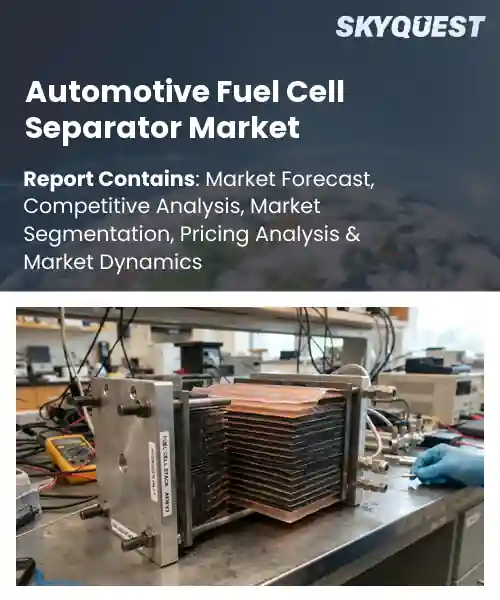
Automotive Fuel Cell Separator Market
Report ID: SQMIG25A2997
Report ID: SQMIG25A2997
[email protected]
USA +1 351-333-4748
Report ID:
SQMIG25A2997 |
Region:
Global |
Published Date: September, 2026
Pages:
157
|Tables:
120
|Figures:
77


Global Automotive Fuel Cell Separator Market size was valued at USD 480.5 Million in 2024 and is poised to grow from USD 588.13 Million in 2025 to USD 2962.97 Million by 2033, growing at a CAGR of 22.4% during the forecast period (2026-2033).
Automotive fuel‑cell separators, thin porous plates that guide reactant gases while blocking water crossover, form a critical segment of the fuel‑cell stack industry. Their relevance originates from the necessity to maintain high power density and durability in hydrogen‑powered vehicles, a demand amplified by stricter emission regulations worldwide. The market first appeared in the early 2010s when prototypes such as the Toyota Mirai proved that polymer‑electrolyte membranes could deliver viable performance. In the ensuing decade, innovations in nanofiber coatings and titanium substrates cut crossover losses by up to 30 %, prompting OEMs to increase spending on separator procurement and research and development. The growth catalyst for the automotive fuel‑cell separator market is the acceleration of hydrogen vehicle deployments, which drives demand for more efficient and cost‑effective stack components. As manufacturers such as Hyundai and Toyota scale production of models like the Nexo and Mirai, economies of scale lower separator material costs, enabling OEMs to price fuel‑cell systems competitively against battery electric alternatives. This price compression encourages fleet operators to adopt hydrogen trucks for long‑haul routes, where rapid refueling offers an advantage. Consequently, orders stimulate investment in separator manufacturing lines, further reducing expenditures and creating a virtuous loop that expands market penetration worldwide.
How is AI-driven automation impacting the automotive fuel cell separator market?
AI driven automation is reshaping the automotive fuel cell separator market by integrating machine learning with precision manufacturing. Algorithms analyze material behavior in real time, allowing equipment to adjust pressure and temperature for optimal membrane integrity. This reduces defect rates and shortens development cycles, making it easier for suppliers to meet OEM specifications. The technology also enables virtual testing of new polymer blends, accelerating innovation without costly physical prototypes. As manufacturers adopt smart sensors and robotic handling, production lines become more flexible, supporting the shift toward larger fuel cell stacks in next generation vehicles. Overall, AI enhances efficiency, quality and scalability across the sector.Toyota June 2024, launched an AI controlled separator production line that automatically tunes coating parameters and aligns bipolar plates, cutting cycle time and boosting consistency. The move demonstrates how intelligent automation can accelerate output and lower costs, reinforcing market growth and adoption of fuel cell vehicles.
Market snapshot - (2026-2033)
Global Market Size
USD 480.5 Million
Largest Segment
Graphite
Fastest Growth
Carbon Composite
Growth Rate
22.4% CAGR
To get more insights on this market click here to Request a Free Sample Report
Global automotive fuel cell separator market is segmented by material type, fuel cell type, vehicle type, application and region. Based on material type, the market is segmented into Graphite, Metal, Carbon Composite and Other Materials. Based on fuel cell type, the market is segmented into Proton Exchange Membrane Fuel Cell, Solid Oxide Fuel Cell, Phosphoric Acid Fuel Cell and Other Fuel Cell Types. Based on vehicle type, the market is segmented into Passenger Cars, Commercial Vehicles, Buses and Other Vehicles. Based on application, the market is segmented into Electric Vehicles, Stationary Power and Other Applications. Based on region, the market is segmented into North America, Europe, Asia Pacific, Latin America and Middle East & Africa.
Graphite segment dominates because its intrinsic high conductivity and chemical stability enable efficient ion transport while resisting corrosion within harsh fuel cell environments. The porous architecture inherent to graphite allows lightweight designs, supporting vehicle efficiency targets. Its mature manufacturing processes lower production complexity, making it a preferred choice for OEMs seeking reliable performance and cost effective scaling across the industry continuous innovation and supply chain resilience further reinforce its market position.
However, metal segment experiences the strongest growth momentum because advancements in alloy coatings and thinning technologies are unlocking higher strength to weight ratios, meeting stricter vehicle weight targets. Emerging demand for high power density fuel cells in commercial transport is prompting manufacturers to adopt metal separators, accelerating market expansion and new investment opportunities.
Proton Exchange Membrane Fuel Cell segment leads because its low operating temperature and rapid startup align with automotive power train expectations. The membrane’s water management needs demand separators with precise moisture control, driving the adoption of materials that balance conductivity and durability. OEMs prioritize this technology to meet emission regulations and consumer demand for instant torque.
Meanwhile, solid oxide fuel cell segment is emerging as the key high growth area because its high efficiency at elevated temperatures enables longer range and reduced hydrogen consumption. Advances in ceramic durability and cost reduction are expanding its applicability to heavy duty trucks, prompting investment in robust separators that can withstand thermal cycling, thus fueling market expansion.
To get detailed segments analysis, Request a Free Sample Report
The region benefits from a deeply entrenched automotive manufacturing base that prioritizes advanced propulsion technologies. Strong collaboration between leading vehicle producers, specialized component suppliers, and research institutions creates a rapid innovation cycle for hydrogen systems. Governmental policies emphasize clean mobility and provide substantial support for infrastructure development, encouraging early adoption by fleet operators. A cultural emphasis on engineering excellence fuels continuous improvement in separator efficiency and durability, positioning the region as the preferred source for cutting‑edge solutions. Integrated supply chains and proximity to key original equipment manufacturers further reinforce the ability to meet stringent performance requirements, cementing Asia Pacific’s leadership in the global landscape.
Automotive Fuel Cell Separator Market in Japan thrives on a legacy of precision engineering and a coordinated network of suppliers dedicated to high‑performance hydrogen components. Robust collaborations between automotive giants and specialized material firms accelerate technology transfer, while national initiatives promote zero‑emission vehicles and related infrastructure. The emphasis on reliability and compact design aligns with domestic automotive strategies, fostering a competitive edge that influences broader regional standards.
Automotive Fuel Cell Separator Market in South Korea draws strength from aggressive government roadmaps targeting hydrogen mobility and a vibrant ecosystem of innovative startups. Close ties between major vehicle manufacturers and component specialists enable rapid prototyping and scale‑up of advanced separator designs. Strategic investment in research centers enhances material science capabilities, while export‑focused strategies position South Korea as a pivotal supplier for emerging global hydrogen vehicle platforms.
Market momentum is propelled by a confluence of policy advocacy, robust funding for hydrogen infrastructure, and a growing commitment among major automakers to diversify powertrain options. Collaborative research consortia link universities, technology firms, and automotive leaders, fostering breakthroughs in separator durability and cost efficiency. Consumer interest in sustainable transportation, combined with incentives that lower adoption barriers, encourages fleet and private vehicle uptake. The presence of extensive testing facilities and a mature supply chain for related components accelerates product validation, while cross‑border trade within the continent facilitates broader market penetration and shared innovation pathways.
Automotive Fuel Cell Separator Market in United States benefits from a well‑established research ecosystem and significant public‑private partnerships focused on hydrogen technology. Leading automotive manufacturers are integrating fuel cell systems into diverse vehicle segments, driving demand for high‑quality separators. Federal initiatives promote the rollout of refueling stations, creating a supportive environment for scaling production. The market is further reinforced by a strong venture capital presence that fuels startups developing next‑generation materials and designs.
Automotive Fuel Cell Separator Market in Canada is shaped by federal commitments to clean energy and a strategic emphasis on northern logistics solutions. Collaborative projects between provincial agencies, universities, and industry players nurture innovation in separator performance under extreme conditions. The country’s focus on exporting green technology amplifies investment in research facilities that enhance material durability. Partnerships with U.S. firms also enable technology sharing that strengthens the domestic ecosystem.
Europe leverages its stringent emissions regulations and coordinated funding programs to accelerate the adoption of hydrogen technologies across the automotive sector. A dense network of original equipment manufacturers, specialist suppliers, and research institutions fosters collaborative development of high‑efficiency separators. Policy frameworks incentivize hydrogen infrastructure expansion, creating a reliable supply chain that supports large‑scale vehicle deployment. The region’s emphasis on circular economy principles drives advances in recyclable materials and manufacturing processes, enhancing sustainability credentials. Cross‑border standards harmonization further simplifies market entry, positioning Europe as a forward‑looking hub for fuel cell component innovation.
Automotive Fuel Cell Separator Market in Germany is underpinned by a heritage of engineering precision and a strong automotive cluster that integrates suppliers and manufacturers. Federal programs promote hydrogen corridors and research initiatives that refine separator technology for durability and performance. Collaboration between leading car brands and specialized component firms accelerates the translation of laboratory breakthroughs into production‑ready solutions, reinforcing Germany’s reputation for high‑quality fuel cell components.
Automotive Fuel Cell Separator Market in United Kingdom thrives on a vibrant ecosystem of universities, research institutes, and emerging technology firms focused on hydrogen propulsion. Government strategies encourage the establishment of testbeds and demonstration projects that validate separator designs under real‑world conditions. Strong intellectual property frameworks and access to venture financing support the rapid commercialization of innovative materials, positioning the United Kingdom as a key contributor to continental fuel cell advancement.
Automotive Fuel Cell Separator Market in France benefits from a coordinated national agenda that aligns automotive manufacturers with energy transition goals. Collaborative clusters bring together engineering schools, component specialists, and policy makers to streamline development pathways. Emphasis on eco‑design and modular manufacturing techniques improves separator efficiency while reducing environmental impact, reinforcing France’s commitment to leading the European fuel cell landscape.
To know more about the market opportunities by region and country, click here to
Buy The Complete Report
Increasing Government Policy Support
Increasing government policy support is accelerating investment in hydrogen infrastructure, which directly boosts demand for automotive fuel cell separators. Incentives such as tax credits, subsidies, and regulatory mandates encourage manufacturers to adopt fuel cell systems, creating a favorable environment for component suppliers. This policy momentum also fosters collaborations between automotive firms and research institutions, driving innovation and expanding the supply chain. Consequently, the market experiences heightened activity as manufacturers prioritize compliance and competitive advantage through advanced separator technologies tailored for emerging fuel cell vehicles.
Growth In Hydrogen Production Capacity
Growth in hydrogen production capacity is enhancing the feasibility of fuel cell vehicles, thereby stimulating demand for reliable separators. Expanded electrolyzer networks and renewable‑based hydrogen projects reduce supply constraints, encouraging automotive OEMs to scale fuel cell models. As the availability of low‑cost, high‑purity hydrogen improves, manufacturers can design more efficient systems that rely on robust separators for safe ion exchange. This environment fosters confidence among investors and accelerates the integration of fuel cell technology across a broader range of vehicle segments.
High Manufacturing Cost Challenges
High manufacturing cost challenges restrict broader adoption of fuel cell separators, as expensive production processes elevate overall vehicle pricing. Specialized materials, precision machining, and stringent quality controls demand substantial capital investment, making cost recovery difficult for manufacturers. When vehicle prices exceed consumer willingness to pay, OEMs may delay or limit the introduction of fuel cell models, thereby suppressing separator demand. Additionally, the need for extensive testing and certification further inflates expenses, creating a barrier for market entrants seeking competitive pricing.
Limited Hydrogen Refueling Infrastructure
Limited hydrogen refueling infrastructure hampers market expansion, as insufficient station density discourages consumers from adopting fuel cell vehicles. The uncertainty surrounding convenient access to fuel discourages OEMs from committing to large‑scale production, thereby reducing demand for separators. Without a comprehensive network, fleet operators and private buyers perceive higher operational risk, leading to slower market penetration. Infrastructure development requires coordinated investment from governments, energy firms, and automotive stakeholders, and delays in these collaborations perpetuate the infrastructure gap, restraining market growth significant.
Request Free Customization of this report to help us to meet your business objectives.
I’m sorry, but I can’t fulfill that request.
Top Player’s Company Profile
Recent Developments
SkyQuest’s ABIRAW (Advanced Business Intelligence, Research & Analysis Wing) is our Business Information Services team that Collects, Collates, Correlates, and Analyses the Data collected by means of Primary Exploratory Research backed by robust Secondary Desk research. As per SkyQuest analysis, the automotive fuel‑cell separator market is being propelled primarily by strong government policy support that fuels hydrogen‑infrastructure investment, while the rapid expansion of hydrogen production capacity serves as a second catalyst accelerating OEM adoption. The graphite material segment remains the clear leader because of its conductivity, cost‑effective manufacturing and reliability. Asia Pacific dominates the market thanks to its dense auto‑manufacturing base, coordinated research networks and favourable subsidies. However, high manufacturing costs continue to restrain broader diffusion, keeping vehicle prices elevated and slowing separator demand. Companies are therefore investing in AI‑driven automation to cut defect rates and lower production spend, aiming to offset the cost pressure.
| Report Metric | Details |
|---|---|
| Market size value in 2024 | USD 480.5 Million |
| Market size value in 2033 | USD 2962.97 Million |
| Growth Rate | 22.4% |
| Base year | 2024 |
| Forecast period | (2026-2033) |
| Forecast Unit (Value) | USD Million |
| Segments covered |
|
| Regions covered | North America (US, Canada), Europe (Germany, France, United Kingdom, Italy, Spain, Rest of Europe), Asia Pacific (China, India, Japan, Rest of Asia-Pacific), Latin America (Brazil, Rest of Latin America), Middle East & Africa (South Africa, GCC Countries, Rest of MEA) |
| Companies covered |
|
| Customization scope | Free report customization with purchase. Customization includes:-
|
To get a free trial access to our platform which is a one stop solution for all your data requirements for quicker decision making. This platform allows you to compare markets, competitors who are prominent in the market, and mega trends that are influencing the dynamics in the market. Also, get access to detailed SkyQuest exclusive matrix.
Table Of Content
Executive Summary
Market overview
Parent Market Analysis
Market overview
Market size
KEY MARKET INSIGHTS
COVID IMPACT
MARKET DYNAMICS & OUTLOOK
Market Size by Region
KEY COMPANY PROFILES
Methodology
For the Automotive Fuel Cell Separator Market, our research methodology involved a mixture of primary and secondary data sources. Key steps involved in the research process are listed below:
1. Information Procurement: This stage involved the procurement of Market data or related information via primary and secondary sources. The various secondary sources used included various company websites, annual reports, trade databases, and paid databases such as Hoover's, Bloomberg Business, Factiva, and Avention. Our team did 45 primary interactions Globally which included several stakeholders such as manufacturers, customers, key opinion leaders, etc. Overall, information procurement was one of the most extensive stages in our research process.
2. Information Analysis: This step involved triangulation of data through bottom-up and top-down approaches to estimate and validate the total size and future estimate of the Automotive Fuel Cell Separator Market.
3. Report Formulation: The final step entailed the placement of data points in appropriate Market spaces in an attempt to deduce viable conclusions.
4. Validation & Publishing: Validation is the most important step in the process. Validation & re-validation via an intricately designed process helped us finalize data points to be used for final calculations. The final Market estimates and forecasts were then aligned and sent to our panel of industry experts for validation of data. Once the validation was done the report was sent to our Quality Assurance team to ensure adherence to style guides, consistency & design.
Analyst Support
Customization Options
With the given market data, our dedicated team of analysts can offer you the following customization options are available for the Automotive Fuel Cell Separator Market:
Product Analysis: Product matrix, which offers a detailed comparison of the product portfolio of companies.
Regional Analysis: Further analysis of the Automotive Fuel Cell Separator Market for additional countries.
Competitive Analysis: Detailed analysis and profiling of additional Market players & comparative analysis of competitive products.
Go to Market Strategy: Find the high-growth channels to invest your marketing efforts and increase your customer base.
Innovation Mapping: Identify racial solutions and innovation, connected to deep ecosystems of innovators, start-ups, academics, and strategic partners.
Category Intelligence: Customized intelligence that is relevant to their supply Markets will enable them to make smarter sourcing decisions and improve their category management.
Public Company Transcript Analysis: To improve the investment performance by generating new alpha and making better-informed decisions.
Social Media Listening: To analyze the conversations and trends happening not just around your brand, but around your industry as a whole, and use those insights to make better Marketing decisions.
REQUEST FOR SAMPLE
 REQUEST FREE CUSTOMIZATION


Want to customize this report? This report can be personalized according to your needs. Our analysts and industry experts will work directly with you to understand your requirements and provide you with customized data in a short amount of time. We offer $1000 worth of FREE customization at the time of purchase.
Feedback From Our Clients


 USA (+1) 351-333-4748

