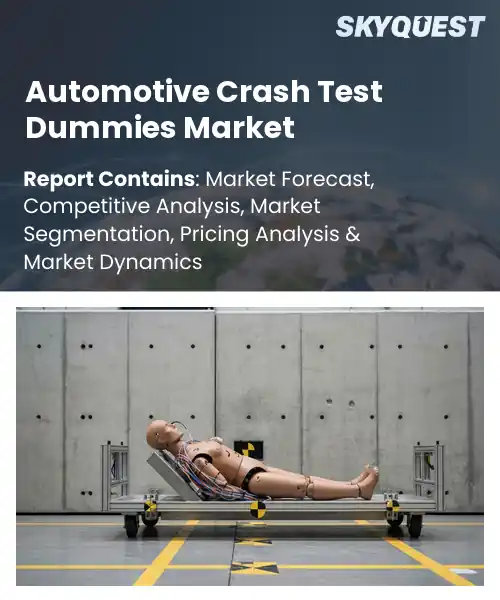
Automotive Crash Test Dummies Market
Report ID: SQMIG45J2566
Report ID: SQMIG45J2566
[email protected]
USA +1 351-333-4748
Report ID:
SQMIG45J2566 |
Region:
Global |
Published Date: June, 2026
Pages:
157
|Tables:
176
|Figures:
79


Global Automotive Crash Test Dummies Market size was valued at USD 292.4 Million in 2024 and is poised to grow from USD 309.51 Million in 2025 to USD 487.75 Million by 2033, growing at a CAGR of 5.85% during the forecast period (2026-2033).
Regulatory pressure and expectations for occupant safety are propelling growth in the global crash‑test dummy market. When authorities raise crash‑test thresholds, manufacturers must obtain finer biomechanical data, which drives investment in next‑generation dummies fitted with multi‑axis accelerometers and wireless telemetry; this data then fuels digital‑simulation tools that shorten development cycles. The recent Euro NCAP safety‑assist rating, requiring active‑braking performance verification, prompts suppliers to offer dummies capable of measuring neck‑torque in low‑speed impacts. As OEMs adopt these advanced devices to meet compliance and differentiate products, new revenue streams emerge and partnerships with sensor‑technology firms expand, including the emerging markets China and India.
How is AI-driven automation reshaping design and testing in the automotive crash test dummies market?
AI-based automation is changing the way crash test dummies are designed and evaluated. Now, machine-learning models are producing biomechanical designs that better imitate human response, and digital twins allow engineers to perform a multitude of virtual impacts before a physical prototype is built. These tools cut development time, material costs and safety insights, feeding a growing market as manufacturers seek stricter compliance and faster innovation cycles. By using sensor data and predictive analytics, we can simplify the post‑test analysis and convert raw crash data into design changes that can be acted upon. This creates a shorter feedback loop, which accelerates product readiness and helps meet the increasing demand for advanced safety testing.
The latest AI-enabled testing platforms have cut down the time it takes to produce prototypes, giving manufacturers the ability to try new dummy designs in weeks rather than months, boosting the efficiency of the market as a whole and helping to sustain growth.
Market snapshot - (2026-2033)
Global Market Size
USD 292.4 Million
Largest Segment
Adult Dummies
Fastest Growth
Pedestrian Dummies
Growth Rate
5.85% CAGR
To get more insights on this market click here to Request a Free Sample Report
Global automotive crash test dummies market is segmented by dummy type, technology type, component type, test application, end-use industry, vehicle type and region. Based on dummy type, the market is segmented into Adult Dummies, Child Dummies, Infant Dummies, Pedestrian Dummies and Others. Based on technology type, the market is segmented into Standard Dummies, Advanced Sensor-Equipped Dummies and Hybrid Dummies. Based on component type, the market is segmented into Dummy Body Structure, Sensors and Instrumentation, Data Acquisition Systems and Calibration and Maintenance Equipment. Based on test application, the market is segmented into Frontal Impact Testing, Side Impact Testing, Rear Impact Testing, Rollover Testing and Pedestrian Protection Testing. Based on end-use industry, the market is segmented into Original Equipment Manufacturers, Automotive Suppliers and Testing Labs, Government and Regulatory Bodies and Independent Research Institutions. Based on vehicle type, the market is segmented into Passenger Cars and Commercial Vehicles. Based on region, the market is segmented into North America, Europe, Asia Pacific, Latin America and Middle East & Africa.
The Adult Dummies segment is the largest as manufacturers concentrate on realistic anthropometric representation for the majority of vehicle occupants, thus ensuring that safety systems are calibrated to protect most common crash scenarios. The large volume of legacy data, robust validation processes and embeddedness in routine testing processes all contribute to their ubiquity, creating a steady demand across OEMs and testing houses alike, and inspiring further innovation in dummy engineering via collaborative research partnerships.
However, child dummy use is experiencing the strongest growth momentum with tighter child occupant protection standards by the regulators and expanded vehicle lines by automakers leading to increased investment in age specific injury biomechanics. This boom results in demand for more pediatric models, thus accelerating market growth and opening up new opportunities for specialized dummy makers.
The standard Dummies segment is dominant, as these models have long been the industry baseline and provide reliable mechanical fidelity in line with the established crash test protocols and regulatory expectations. Because of their long certification histories, low integration complexity and cost effective production they have seen wide adoption among OEMs, testing labs and safety agencies and as such remain very relevant. So they are the default for routine impact assessments and benchmark validations for global safety plans .
On the other hand, the fastest growth is being experienced by advanced sensor equipped dummies as vehicle safety technologies require high-resolution biomechanical data and time analytics. Sensor arrays can provide greater insight into occupant kinematics for developing active safety systems and meeting more demanding, data-rich regulations. This momentum creates market opportunities and pushes investment on edge dummy solutions.
To get detailed segments analysis, Request a Free Sample Report
North America Automotive Crash Test Dummies Market continued to dominate the market due to the presence of mature regulatory frameworks, advanced research institutions and a strong ecosystem of OEMs and safety suppliers. Government safety agencies and industry groups in the region have close ties. Over the years this has resulted in improvements in dummy design and test procedures. Large test facilities and high skill engineering talent enable rapid iteration and validation of new safety concepts. A major investment in innovation and a safety-first engineering culture is also driving the adoption of the most sophisticated dummy technologies across the continent and helping to reinforce its dominance on the global stage. The talent flow is further spurred by world-class academic programs in biomechanics, and strategic partnerships between testing labs which encourage sharing of best practices and accelerate product development cycles.
The U.S. automotive crash test dummy market is driven by the long-established federal safety standards mandating rigorous dummy testing and the vehicle manufacturers’ dedication to safety innovation. Collaborative research hubs link universities with industry leaders and create biofidelic models for rapid prototyping. World-class testing facilities cut validation cycles and a skilled engineering workforce continues to evolve products at a competitive world level.
Automotive crash test dummies market in Canada is propelled by strong government safety initiatives that involve dummy performance standards in vehicle approval processes and strong partnerships with North American research alliances. In the country multinational safety equipment companies run laboratories which draw on local expertise in biomechanics and materials science. The collaborative environment between academia, regulators and industry speeds up the adoption of dummy technologies, reinforcing Canada’s status as an innovation hub.
Europe is enjoying a bumper market for car crash test dummies, thanks to stringent safety directives, a proud tradition of engineering excellence and a cooperative industrial network that stretches across national borders. Regulatory bodies require testing protocols that force manufacturers to spend on research and development, as sophisticated dummy solutions are needed. The automotive engineering clusters can establish partnerships across borders to allow knowledge sharing in areas such as biomechanics, advanced sensor integration, and many more. In Europe, car safety is a consumer issue that is increasingly important, driving demand for more realistic dummies and making the continent a hotbed of safety innovation. Region’s leading auto makers are using dummy data analysis with AI and ML to predict injury outcome. Universities are teaming up with industry groups to develop next-generation anthropomorphic models that capture a broad range of population characteristics. Regulatory rigour, technological progress and collaborative research combine to provide fertile ground for continued market growth across Europe.
The German automotive crash test dummies market is supported by a strong engineering background and a cluster of leading automotive companies that appreciate advanced safety tests. The country has world class testing facilities with high precision sensor suites that allow for realistic injury assessments. Industry and research institutions are working together on programs to speed up the development of advanced anthropometric models, and tough national safety regulations are driving ever-better dummy performance standards across the market place.
The stringent safety legislations coupled with a strong ecosystem of niche suppliers focusing on dummy technologies is giving a boost to the United Kingdom Automotive Crash Test Dummies Market. The leading research universities are joining forces with the car companies to explore miniaturizing sensors and biofidelic materials to make dummies more realistic. Famous testing facilities attract OEMs that want to validate compliance. Industry clusters make it easier to exchange knowledge, improving the development of crash test solutions.
France Automotive Crash Test Dummies Market is gaining traction with evolution of safety norms in the country to match European standards and research centers engaged in dummy design with ergonomic approach. Partners from automotive suppliers and research laboratories are laying the ground work for the integration of sensor array and realistic torso articulations. France participates in the continental market within the scope of broader safety projects with more attention on occupant safety in vehicle classes with the possibility of lightweight, high-fidelity dummy solutions.
Asia Pacific bolsters its stake in the automotive crash test dummies market through enhanced manufacturing capacity, growing safety awareness, and strategic research investments. The region is upgrading test facilities for advanced dummy technologies and local OEMs are adopting global safety standards requiring advanced occupant protection testing. Universities, government agencies and industry work together to promote innovation in biofidelic materials and sensor integration, speeding up the development of region-specific dummy models. In addition, some of the key automotive manufacturers are establishing dedicated R&D centres to develop next-generation dummies that represent the anthropometric diversity of the Asian population. Government incentive programs motivate the use of state-of-the-art testing equipment International collaborations bring expertise from established markets Again, technology transfer is accelerated. In summary, the aggregation of local demand, policy support and knowledge sharing is transforming Asia Pacific into an emerging hub of advanced crash test dummy development.
Japan’s Automotive Crash Test Dummies Market is driven by a culture of engineering tradition and dedication to safety standards that go beyond requirements. The country’s testing laboratories have dummy systems to carry out impact analysis. The collaboration between automotive manufacturers and research institutes in developing sensor technologies and highly realistic anthropometric models, alongside improvements to testing protocols resulting from government safety programmes, has cemented Japan’s reputation as a leader in dummy innovation.
South Korea Automotive Crash Test Dummies Market: Growth of the Automotive Industry and Government Safety Campaigns to Promote the Use of Dummy Testing Drive the Market The country’s research centers are collaborating with carmakers to improve sensor integration and biomechanical realism. With the adoption of safety standards on the rise, the need for dummy solutions is growing, and academic collaborations are speeding up the development of adapted models, which are turning South Korea into an emerging force in crash safety technology.
To know more about the market opportunities by region and country, click here to
Buy The Complete Report
Growing Emphasis on Safety
Advancements In Simulation Technologies
High Cost Of Dummy Production
Stringent Certification Requirements
Request Free Customization of this report to help us to meet your business objectives.
The global automotive crash test dummies market is quite competitive and is marked by the presence of a number of legacy manufacturers as well as the emerging players in sensor integration. It is pushed by regulatory pressure for higher safety standards. Companies are looking for M&A and partnerships with automotive OEMs to gain access to advanced biomechanics technologies for the co-development of next-generation dummies. The goal of these initiatives is to accelerate product innovation and grow market share.
Recent Developments
SkyQuest’s ABIRAW (Advanced Business Intelligence, Research & Analysis Wing) is our Business Information Services team that Collects, Collates, Correlates and Analyses the Data collected by means of Primary Exploratory Research supported by strong Secondary Desk research.
The market is primarily driven by a rising focus on safety, which leads to large investments by manufacturers in high-fidelity crash test dummies, says SkyQuest analysis. The secondary driver is improvements in simulation technologies, which connect data from physical dummies with AI-based virtual testing to accelerate development cycles. The adult dummy is the dominant choice, as it represents the majority of vehicle occupants and has a substantial legacy data set. North America dominates the market attributed to matured regulatory frameworks, advanced research institutions and dense OEM ecosystem. However, the high cost of dummy production makes it difficult to be widely adopted, especially for smaller test labs that have to balance safety requirements with their budgets.
| Report Metric | Details |
|---|---|
| Market size value in 2024 | USD 292.4 Million |
| Market size value in 2033 | USD 487.75 Million |
| Growth Rate | 5.85% |
| Base year | 2024 |
| Forecast period | (2026-2033) |
| Forecast Unit (Value) | USD Million |
| Segments covered |
|
| Regions covered | North America (US, Canada), Europe (Germany, France, United Kingdom, Italy, Spain, Rest of Europe), Asia Pacific (China, India, Japan, Rest of Asia-Pacific), Latin America (Brazil, Rest of Latin America), Middle East & Africa (South Africa, GCC Countries, Rest of MEA) |
| Companies covered |
|
| Customization scope | Free report customization with purchase. Customization includes:-
|
To get a free trial access to our platform which is a one stop solution for all your data requirements for quicker decision making. This platform allows you to compare markets, competitors who are prominent in the market, and mega trends that are influencing the dynamics in the market. Also, get access to detailed SkyQuest exclusive matrix.
Table Of Content
Executive Summary
Market overview
Parent Market Analysis
Market overview
Market size
KEY MARKET INSIGHTS
COVID IMPACT
MARKET DYNAMICS & OUTLOOK
Market Size by Region
KEY COMPANY PROFILES
Methodology
For the Automotive Crash Test Dummies Market, our research methodology involved a mixture of primary and secondary data sources. Key steps involved in the research process are listed below:
1. Information Procurement: This stage involved the procurement of Market data or related information via primary and secondary sources. The various secondary sources used included various company websites, annual reports, trade databases, and paid databases such as Hoover's, Bloomberg Business, Factiva, and Avention. Our team did 45 primary interactions Globally which included several stakeholders such as manufacturers, customers, key opinion leaders, etc. Overall, information procurement was one of the most extensive stages in our research process.
2. Information Analysis: This step involved triangulation of data through bottom-up and top-down approaches to estimate and validate the total size and future estimate of the Automotive Crash Test Dummies Market.
3. Report Formulation: The final step entailed the placement of data points in appropriate Market spaces in an attempt to deduce viable conclusions.
4. Validation & Publishing: Validation is the most important step in the process. Validation & re-validation via an intricately designed process helped us finalize data points to be used for final calculations. The final Market estimates and forecasts were then aligned and sent to our panel of industry experts for validation of data. Once the validation was done the report was sent to our Quality Assurance team to ensure adherence to style guides, consistency & design.
Analyst Support
Customization Options
With the given market data, our dedicated team of analysts can offer you the following customization options are available for the Automotive Crash Test Dummies Market:
Product Analysis: Product matrix, which offers a detailed comparison of the product portfolio of companies.
Regional Analysis: Further analysis of the Automotive Crash Test Dummies Market for additional countries.
Competitive Analysis: Detailed analysis and profiling of additional Market players & comparative analysis of competitive products.
Go to Market Strategy: Find the high-growth channels to invest your marketing efforts and increase your customer base.
Innovation Mapping: Identify racial solutions and innovation, connected to deep ecosystems of innovators, start-ups, academics, and strategic partners.
Category Intelligence: Customized intelligence that is relevant to their supply Markets will enable them to make smarter sourcing decisions and improve their category management.
Public Company Transcript Analysis: To improve the investment performance by generating new alpha and making better-informed decisions.
Social Media Listening: To analyze the conversations and trends happening not just around your brand, but around your industry as a whole, and use those insights to make better Marketing decisions.
REQUEST FOR SAMPLE
 REQUEST FREE CUSTOMIZATION
Global Automotive Crash Test Dummies Market size was valued at USD 292.4 Million in 2024 and is poised to grow from USD 309.51 Million in 2025 to USD 487.75 Million by 2033, growing at a CAGR of 5.85% during the forecast period (2026-2033).
The global automotive crash test dummies market is shaped by intense competition among established manufacturers and emerging sensor‑integration specialists. Regulatory pressure for higher safety standards drives demand, prompting firms to pursue M&A to acquire advanced biomechanics technologies and form partnerships with automotive OEMs for co‑development of next‑generation dummies. These moves aim to accelerate product innovation and capture market share. 'Humanetics Innovative Solutions', 'Kistler Group', 'Cellbond', 'MESSRING GmbH', 'Diversified Technical Systems Inc.', 'Jasti Co. Ltd.', 'Calspan Corporation', 'TASS International', 'Dynamic Research Inc.', 'Ensco Inc.', 'Applied Biomechanics Inc.', 'Dallas Engineering Inc.', 'Knaus GmbH', 'ATD LabTech GmbH', 'mg sensor GmbH', 'Aeronautical Systems Engineering', 'Sinteg', 'SGS S.A.', 'Intertek Group plc', 'Eurofins Scientific SE'
The automotive industry’s intensifying focus on occupant protection drives manufacturers to validate vehicle structures through rigorous crash testing, creating a sustained need for high‑fidelity dummies. As regulatory bodies and consumers demand ever‑higher safety performance, OEMs invest in comprehensive testing programs that rely on anthropomorphic test devices to replicate human responses. This strategic prioritization of safety ensures continuous procurement of advanced crash test dummies, fostering market expansion as manufacturers seek to demonstrate compliance and differentiate their vehicles through superior protective features.
Ai‑Driven Crash Simulation: Manufacturers are increasingly pairing physical crash test dummies with sophisticated AI‑driven simulation platforms, allowing virtual assessments to complement real‑world testing. This hybrid approach accelerates development cycles, reduces reliance on extensive physical prototypes, and enables rapid iteration of safety designs. By feeding sensor data from dummies into machine‑learning models, engineers can predict injury outcomes under diverse impact scenarios, enhancing the precision of safety engineering while cutting overall program costs. The workflow also fosters stronger collaboration between design teams and regulators, streamlining compliance.
Why does North America Dominate the Global Automotive Crash Test Dummies Market? |@12


Want to customize this report? This report can be personalized according to your needs. Our analysts and industry experts will work directly with you to understand your requirements and provide you with customized data in a short amount of time. We offer $1000 worth of FREE customization at the time of purchase.
Feedback From Our Clients


 USA (+1) 351-333-4748

