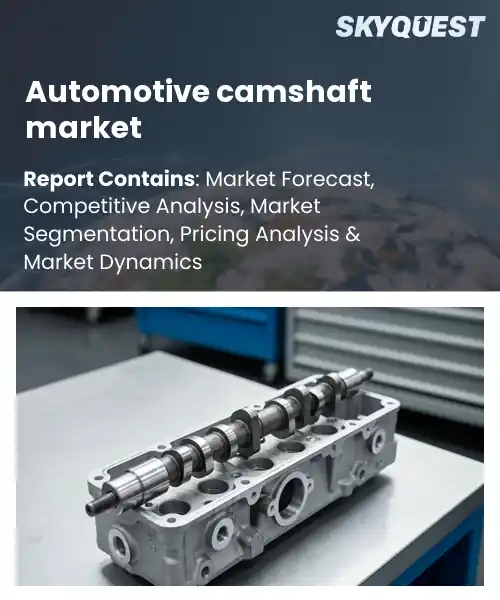
Automotive camshaft market
Report ID: SQMIG25A2762
Report ID: SQMIG25A2762
[email protected]
USA +1 351-333-4748
Report ID:
SQMIG25A2762 |
Region:
Global |
Published Date: June, 2026
Pages:
157
|Tables:
178
|Figures:
79


Global Automotive Camshaft Market size was valued at USD 3.9 Billion in 2024 and is poised to grow from USD 4.04 Billion in 2025 to USD 5.41 Billion by 2033, growing at a CAGR of 3.7% during the forecast period (2026-2033).
The global automotive camshaft industry comprises manufacturers of camshafts that control valve timing in internal‑combustion engines, a component critical for performance, emissions compliance, and fuel efficiency. Over the past two decades the market has expanded as automakers shifted from simple cast iron designs to high‑strength forged alloys and, more recently, to lightweight aluminium configurations. This evolution was driven by stricter emission standards and consumer demand for lower fuel consumption, prompting original equipment manufacturers to adopt variable valve‑timing systems that rely on more sophisticated camshaft architectures. As a result, demand for machining and coating technologies has risen, reinforcing the market’s importance.
One pivotal factor shaping the global automotive camshaft market is the penetration of powertrains, which creates demand for camshaft solutions that balance efficiency and performance. As hybrid models require integration of gasoline engines and electric motors, manufacturers develop camshafts with reduced inertia and enhanced durability, enabling smoother start‑stop cycles and better fuel savings. This requirement drives investments in forging, R&D, and partnerships with suppliers, illustrated by an OEM collaborating with a firm to improve wear resistance. Consequently, regions with automotive production China, India, and Eastern Europe offer aftermarket opportunities as fleet operators seek retrofits that meet regulatory standards and extend
How is AI-driven automation influencing design and production efficiency in the automotive camshaft market?
AI driven automation is reshaping camshaft design by using generative algorithms that explore thousands of geometry variations in minutes, allowing engineers to select shapes that balance strength, weight and noise reduction. In production, machine learning models predict tool wear and optimize cutting parameters, which shortens cycle times and reduces scrap. Digital twins simulate assembly forces, catching issues before physical prototypes are built. These capabilities align with the market’s push for lighter, more efficient powertrains and help manufacturers meet rising demand without expanding labor intensive processes. The result is a tighter design to manufacture loop that fuels faster innovation and cost control.
In July 2025, a leading camshaft manufacturer announced the integration of AI driven CNC machining to streamline production, cutting setup time and improving part consistency, which directly supports the market’s expanding demand for efficient, high performance components. The move showcases how digital automation can lower waste, accelerate delivery and align with stricter emissions standards across vehicle lines.
Market snapshot - (2026-2033)
Global Market Size
USD 3.9 Billion
Largest Segment
Cast Camshafts
Fastest Growth
Variable Valve Timing (VVT) Camshafts
Growth Rate
3.7% CAGR
To get more insights on this market click here to Request a Free Sample Report
Global automotive camshaft market is segmented by product type, vehicle type, material type, engine type, application, manufacturing process and region. Based on product type, the market is segmented into Cast Camshafts, Forged Camshafts, Assembled Camshafts, Hollow Camshafts, Variable Valve Timing (VVT) Camshafts and Performance Camshafts. Based on vehicle type, the market is segmented into Passenger Cars, Light Commercial Vehicles, Heavy Commercial Vehicles, Hybrid Vehicles and Off-Highway Vehicles. Based on material type, the market is segmented into Cast Iron, Chilled Cast Iron, Steel, Alloy Steel and Lightweight Composite Materials. Based on engine type, the market is segmented into Gasoline Engines, Diesel Engines and Hybrid Powertrains. Based on application, the market is segmented into OEM, Aftermarket and High-Performance & Racing. Based on manufacturing process, the market is segmented into Casting, Forging and Machining & Assembly. Based on region, the market is segmented into North America, Europe, Asia Pacific, Latin America and Middle East & Africa.
Cast camshafts segment dominates with large automotive camshaft market share because manufacturers favour it for its cost effective production and reliable dimensional stability, which align with high volume demands of mainstream vehicles. The longstanding casting technology offers excellent material uniformity and ease of integration into existing supply chains, reducing lead times. Consequently, OEMs prioritize cast camshafts to balance performance and affordability, reinforcing its central position in the overall market as well as supporting stringent emission standards.
As per automotive camshaft market outlook, variable valve timing camshafts segment is witnessing the strongest growth momentum because electrified powertrains and efficiency regulations drive demand for precise valve control. Advanced VVT designs enable reduced fuel consumption and lower emissions, attracting OEMs seeking to meet sustainability targets. This innovation fuels rapid market expansion and new opportunity creation.
As per automotive camshaft market analysis, passenger cars segment leads because the majority of global vehicle production resides in this category, prompting camshaft suppliers to prioritize designs that meet diverse performance, fuel efficiency, and emission targets. Engineers focus on optimizing lift profiles and timing to suit a wide range of engine displacements, ensuring compatibility with compact packaging constraints. This concentration of demand drives extensive R&D investment, sustaining the segment's pivotal role in shaping camshaft technology.
Meanwhile, hybrid vehicles segment emerges as the fastest growing because electrified architectures require camshafts that balance traditional combustion with electric assist, prompting innovative dual mode designs. Manufacturers are integrating lightweight materials and adaptive timing to improve efficiency, aligning with rising consumer demand for greener mobility. This surge creates new engineering opportunities and expands the market scope.
To get detailed segments analysis, Request a Free Sample Report
The region benefits from a deep engineering heritage that emphasizes precision manufacturing and continuous innovation in engine technology. A dense network of original equipment manufacturers and a robust supply chain of specialized component producers foster rapid adoption of advanced camshaft designs. Strong collaborative ties between automotive giants and research institutions accelerate development cycles, while cost‑effective production capabilities support both domestic demand and export ambitions. Together, these factors create a virtuous cycle of demand, investment, and technological leadership that sustains the region’s leading position.
As per automotive camshaft market regional outlook, Japan is anchored by long‑standing expertise in high‑performance engine components and a culture of meticulous quality control. Domestic manufacturers leverage sophisticated machining techniques and close proximity to major vehicle assemblers, enabling swift integration of design improvements. Continuous focus on fuel efficiency and emissions performance drives refinement of camshaft geometry, while a well‑established supplier ecosystem ensures reliable sourcing of raw materials and precision tooling.
As per automotive camshaft market regional forecast, South Korea is propelled by aggressive investment in smart manufacturing and a strategic emphasis on electric‑hybrid powertrains. Leading firms combine advanced metallurgy with digital simulation to enhance durability and performance. Close cooperation with global automotive brands encourages rapid technology transfer, while government initiatives support research into lightweight and high‑efficiency camshaft solutions. This synergy reinforces the country’s reputation as a hub for innovative engine component production.
The market is energized by a strong focus on performance optimization and stringent emissions standards that compel manufacturers to refine valve timing strategies. High consumer expectations for power and efficiency stimulate demand for sophisticated camshaft configurations. A vibrant ecosystem of tier‑one suppliers, advanced machining facilities, and collaborative engineering networks accelerates product development. Additionally, the integration of digital design tools and additive manufacturing techniques enhances customization capabilities, reinforcing the region’s dynamic growth trajectory.
As per automotive camshaft industry analysis, United States benefits from a vast network of original equipment manufacturers and a highly skilled manufacturing base. Emphasis on cutting‑edge research and development encourages the adoption of novel materials and surface treatments that improve durability. Close alignment with regulatory bodies drives continuous improvement in fuel‑efficiency and emissions performance, while strong demand for high‑output engines fuels ongoing innovation in camshaft design and production processes.
Canada draws strength from a focused supply chain that emphasizes precision engineering and sustainable manufacturing practices. Collaborative projects with major automotive assemblers foster the development of camshaft solutions tailored to diverse vehicle platforms. Environmental regulations promote the exploration of lightweight alloys and advanced coating technologies, while a supportive innovation ecosystem encourages the integration of digital twin modeling to enhance design accuracy and reduce time‑to‑market.
European stakeholders are advancing the market through a blend of high‑tech engineering, rigorous standards, and a commitment to sustainability. Emphasis on lightweight construction and low‑emission powertrains drives the evolution of camshaft designs that balance performance with environmental goals. Strong collaboration between research institutions, OEMs, and specialist suppliers fuels the adoption of precision casting and machining techniques. Continuous investment in digitalization and modular production further enhances flexibility, allowing the region to respond swiftly to shifting market demands.
Germany is distinguished by world‑class engineering expertise and a tradition of precision manufacturing. Integration of advanced simulation tools with high‑speed machining enables the production of highly optimized camshaft profiles. Close ties between automotive manufacturers and specialized component firms promote rapid iteration and technology transfer, while a focus on durability and efficiency aligns with stringent regulatory expectations across the continent.
United Kingdom benefits from a strong research ecosystem and a legacy of innovative engine development. Collaborative ventures between universities and industry accelerate the exploration of novel materials and coating processes. The emphasis on high‑performance and low‑emission engines drives continuous refinement of camshaft geometry, supported by a flexible manufacturing base that adapts quickly to evolving vehicle architectures.
France is driven by a commitment to eco‑efficient engine solutions and a robust network of component manufacturers. Emphasis on lightweight design and emission reduction shapes the development of advanced camshaft configurations. Close cooperation with automotive assemblers ensures that camshaft technologies are seamlessly integrated into a range of powertrains, while investment in digital manufacturing tools enhances precision and reduces development cycles.
To know more about the market opportunities by region and country, click here to
Buy The Complete Report
Rising Demand for Fuel Efficiency
Adoption of Advanced Valve Timing
Stringent Emission Regulations
High Production Cost Complexity
Request Free Customization of this report to help us to meet your business objectives.
The competitive landscape is shaped by intense rivalry among tier‑1 camshaft manufacturers, with recent strategic moves such as cross‑licensing agreements to share advanced surface‑coating technologies and joint ventures that combine precision machining expertise with digital twin platforms, accelerating product development cycles and enhancing supply‑chain resilience. Companies are also pursuing targeted acquisitions of niche specialty‑tool firms to broaden their material‑science capabilities and secure proprietary manufacturing processes, reinforcing market positioning amid evolving power‑train demands.
SkyQuest’s ABIRAW (Advanced Business Intelligence, Research & Analysis Wing) is our Business Information Services team that Collects, Collates, Correlates, and Analyses the Data collected by means of Primary Exploratory Research backed by robust Secondary Desk research.
As per SkyQuest analysis, the global automotive camshaft market growth is being propelled primarily by the rising demand for fuel efficiency, which pushes manufacturers toward lightweight materials and precision designs, while a second driver, the widespread adoption of variable valve timing systems, further fuels growth by delivering better performance and lower emissions. The market’s growth is tempered by stringent emission regulations that increase development complexity and cost, acting as a notable restraint. Asia‑Pacific dominates the landscape due to its extensive manufacturing base and strong OEM network, and the cast camshaft segment remains the largest due to its cost‑effective production and reliable performance for high‑volume vehicles. The global automotive camshaft market trend supported by continued demand for internal combustion engine (ICE) and hybrid vehicle production despite the long-term shift toward electrification.
| Report Metric | Details |
|---|---|
| Market size value in 2024 | USD 3.9 Billion |
| Market size value in 2033 | USD 5.41 Billion |
| Growth Rate | 3.7% |
| Base year | 2024 |
| Forecast period | (2026-2033) |
| Forecast Unit (Value) | USD Billion |
| Segments covered |
|
| Regions covered | North America (US, Canada), Europe (Germany, France, United Kingdom, Italy, Spain, Rest of Europe), Asia Pacific (China, India, Japan, Rest of Asia-Pacific), Latin America (Brazil, Rest of Latin America), Middle East & Africa (South Africa, GCC Countries, Rest of MEA) |
| Companies covered |
|
| Customization scope | Free report customization with purchase. Customization includes:-
|
To get a free trial access to our platform which is a one stop solution for all your data requirements for quicker decision making. This platform allows you to compare markets, competitors who are prominent in the market, and mega trends that are influencing the dynamics in the market. Also, get access to detailed SkyQuest exclusive matrix.
Table Of Content
Executive Summary
Market overview
Parent Market Analysis
Market overview
Market size
KEY MARKET INSIGHTS
COVID IMPACT
MARKET DYNAMICS & OUTLOOK
Market Size by Region
KEY COMPANY PROFILES
Methodology
For the Automotive camshaft market, our research methodology involved a mixture of primary and secondary data sources. Key steps involved in the research process are listed below:
1. Information Procurement: This stage involved the procurement of Market data or related information via primary and secondary sources. The various secondary sources used included various company websites, annual reports, trade databases, and paid databases such as Hoover's, Bloomberg Business, Factiva, and Avention. Our team did 45 primary interactions Globally which included several stakeholders such as manufacturers, customers, key opinion leaders, etc. Overall, information procurement was one of the most extensive stages in our research process.
2. Information Analysis: This step involved triangulation of data through bottom-up and top-down approaches to estimate and validate the total size and future estimate of the Automotive camshaft market.
3. Report Formulation: The final step entailed the placement of data points in appropriate Market spaces in an attempt to deduce viable conclusions.
4. Validation & Publishing: Validation is the most important step in the process. Validation & re-validation via an intricately designed process helped us finalize data points to be used for final calculations. The final Market estimates and forecasts were then aligned and sent to our panel of industry experts for validation of data. Once the validation was done the report was sent to our Quality Assurance team to ensure adherence to style guides, consistency & design.
Analyst Support
Customization Options
With the given market data, our dedicated team of analysts can offer you the following customization options are available for the Automotive camshaft market:
Product Analysis: Product matrix, which offers a detailed comparison of the product portfolio of companies.
Regional Analysis: Further analysis of the Automotive camshaft market for additional countries.
Competitive Analysis: Detailed analysis and profiling of additional Market players & comparative analysis of competitive products.
Go to Market Strategy: Find the high-growth channels to invest your marketing efforts and increase your customer base.
Innovation Mapping: Identify racial solutions and innovation, connected to deep ecosystems of innovators, start-ups, academics, and strategic partners.
Category Intelligence: Customized intelligence that is relevant to their supply Markets will enable them to make smarter sourcing decisions and improve their category management.
Public Company Transcript Analysis: To improve the investment performance by generating new alpha and making better-informed decisions.
Social Media Listening: To analyze the conversations and trends happening not just around your brand, but around your industry as a whole, and use those insights to make better Marketing decisions.
REQUEST FOR SAMPLE
 REQUEST FREE CUSTOMIZATION
Global Automotive Camshaft Market size was valued at USD 3.9 Billion in 2024 and is poised to grow from USD 4.04 Billion in 2025 to USD 5.41 Billion by 2033, growing at a CAGR of 3.7% during the forecast period (2026-2033).
The competitive landscape is shaped by intense rivalry among tier‑1 camshaft manufacturers, with recent strategic moves such as cross‑licensing agreements to share advanced surface‑coating technologies and joint ventures that combine precision machining expertise with digital twin platforms, accelerating product development cycles and enhancing supply‑chain resilience. Companies are also pursuing targeted acquisitions of niche specialty‑tool firms to broaden their material‑science capabilities and secure proprietary manufacturing processes, reinforcing market positioning amid evolving power‑train demands. 'Musashi Seimitsu Industry', 'MAHLE', 'thyssenkrupp', 'Linamar Corporation', 'Precision Camshafts Limited (PCL)', 'Bharat Forge', 'ESTAS Camshaft', 'Schleicher Fahrzeugteile', 'Kautex Textron CVS', 'Tenneco', 'Aichi Forge', 'Riken Corporation', 'Shadbolt Cams', 'Newman Cams', 'Camshaft Machine Company', 'Piper Cams', 'Engine Power Components (EPC)', 'LACO Technologies', 'NSI Crankshaft', 'Elgin Industries'
Consumer preference for lower fuel consumption is prompting automakers to prioritize camshaft designs that enhance combustion efficiency, thereby extending vehicle range and reducing operational costs. Manufacturers respond by integrating lightweight materials and precision engineering, which improve engine performance while meeting sustainability expectations. This focus drives demand for advanced camshaft solutions, encouraging suppliers to expand production capacities and invest in research, ultimately expanding the market as manufacturers seek components that support these efficiency objectives. It also encourages joint development programs that accelerate new camshaft technologies.
Advanced Materials Adoption: Automakers are increasingly incorporating lightweight alloys and composite materials into camshaft designs to meet performance and efficiency targets. These advanced materials reduce inertial mass, improve engine responsiveness, and support higher compression ratios without compromising durability. Suppliers are expanding R&D capabilities to produce metallurgical solutions that resist wear under elevated temperatures, while collaborating with OEMs to validate component life cycles. The shift enhances vehicle fuel economy and aligns with broader sustainability goals, positioning camshaft manufacturers as key enablers of next‑generation powertrains.
Why does Asia Pacific Dominate the Global Automotive camshaft market? |@12


Want to customize this report? This report can be personalized according to your needs. Our analysts and industry experts will work directly with you to understand your requirements and provide you with customized data in a short amount of time. We offer $1000 worth of FREE customization at the time of purchase.
Feedback From Our Clients


 USA (+1) 351-333-4748

