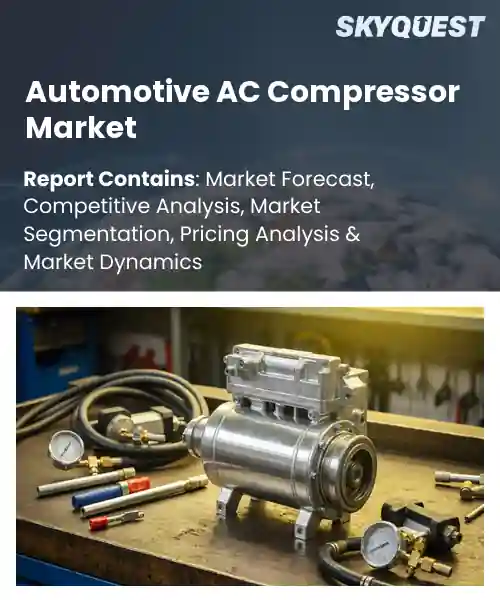
Automotive AC Compressor Market
Report ID: SQMIG25A2703
Report ID: SQMIG25A2703
[email protected]
USA +1 351-333-4748
Report ID:
SQMIG25A2703 |
Region:
Global |
Published Date: June, 2026
Pages:
157
|Tables:
118
|Figures:
72


Global Automotive AC Compressor Market size was valued at USD 22.52 Billion in 2024 and is poised to grow from USD 23.92 Billion in 2025 to USD 38.85 Billion by 2033, growing at a CAGR of 6.22% during the forecast period (2026-2033).
The automotive AC compressor market is being driven by two major factors. First, rising global temperatures are increasing the demand for effective in-vehicle cooling systems, while the growing preference for luxury vehicles is further boosting the adoption of advanced air-conditioning technologies. Second, the increasing penetration of hybrid and electric vehicles is driving demand for electric AC compressors. These compressors operate independently of the engine, enabling more efficient cooling, improving energy efficiency, and enhancing overall fuel economy
The electric vehicle (EV) market is expected to grow rapidly over the next few years. As this occurs, the demand for efficient electric AC compressors will also increase. This creates opportunities to innovate with advanced control electronics and heat pumps in the production of automotive AC compressors. As manufacturers transition from traditional to battery powered and hybrid/electric powertrains, AC compressor design and operation will need to become independent of the engine. As a result, there will be increased investment in brushless DC motors and inverter-based control systems and variable capacity (R-60) AC compressor designs to achieve maximum energy efficiency and extend the distance a battery powered vehicle can be driven before needing to be recharged. For example, integrating heat pumps in cold-weather EVs demonstrably improves winter range, which boosts buyer acceptance and opens aftermarket retrofit and fleet upgrade markets.
How is IoT Improving Performance Monitoring in the Automotive AC Compressor Market?
Automotive AC compressors are now able to continuously monitor performance through IoT technology by providing continuous transmission of sensor telemetry, onboard diagnostics and cloud analytics. Vibration and temperature sensors, refrigerant pressure measurement and usage pattern logs are a few of the methods that enable edge computing to identify anomaly detection. Suppliers and shops are beginning to utilize cloud-based connected diagnostics to improve their time to isolate faults, predictive maintenance, decrease their unplanned downtime and warranty expenses and identify enhancements in design. Current market trends are pushing for electrification and improved thermal management; thus creating the need for smart compressors.
The market is also leaning toward diagnostic suites from suppliers or third party platforms that collect the compressor data for fleet-wide insight or remote software tuning. DENSO in March 2026 is expanding its line of AC compressor and sensor products that exemplify the transition of suppliers towards integrated and connected components. IoT-enabled sensors that connect to vehicle telematics and cloud analytics provide data for predictive maintenance, energy efficiency and accelerate aftermarket service.
Market snapshot - (2026-2033)
Global Market Size
USD 22.52 Billion
Largest Segment
Variable Displacement Compressors
Fastest Growth
Electric Compressors
Growth Rate
6.22% CAGR
To get more insights on this market click here to Request a Free Sample Report
Global automotive AC compressor market is segmented by type, vehicle type, sales channel and region. Based on type, the market is segmented into Fixed Displacement Compressors, Variable Displacement Compressors and Electric Compressors. Based on vehicle type, the market is segmented into Passenger Cars, Light Commercial Vehicles, Heavy Commercial Vehicles and Electric Vehicles. Based on sales channel, the market is segmented into OEM and Aftermarket. Based on region, the market is segmented into North America, Europe, Asia Pacific, Latin America and Middle East & Africa.
As per automotive AC compressor market analysis, the Variable Displacement Compressors sector is the leader in terms of manufacturers’ emphasis on creating balanced systems for operator comfort and improved operational efficiency. Variable displacement compressing machines modulate cooling power based on the amount of load, thus minimizing coolant and thermal cycling. This gives vehicle owners greater control over temperature changes and helps reduce overall fuel consumption. In addition to providing operational flexibility to accommodate manufacturers’ packaging, noise vibration harshness (NVH), and ease of integration into automotive thermal management systems, the widespread use of variable displacement compressors in both conventional and hybrid powertrains has been driven by clear causal connections between these attributes and the benefits that they provide.
As per automotive AC compressor market outlook, Electric Compressors will see rapid growth due to the removal of the belt-driven electric power compressor constraint from a vehicle and the use of it, independent from other vehicle loads. Electric Compressors will have significant compatibility and utility related to vehicle battery thermal management and heat pumps, allowing for an entirely new class of vehicle architectures and aftermarket retrofit applications to be developed, thereby rapidly accelerating the pace of innovation and investment among suppliers across the industry.
The predominant segment of the automotive industry is Passenger Cars since manufacturers mainly target their research and development efforts toward producing vehicles that can be sold at high volumes to the mass market, where the primary drivers for selecting components are cost, package, and occupant comfort. In support of these efforts, the combined effect of high consumer expectations for cabin thermal management encourages original equipment manufacturers (OEM) to use common and reliable architecture when developing compressors across their product line and thus create a consistent demand, stable engineering roadmaps, and ultimately reduce production costs through the optimization of manufacturing scale for component suppliers.
As per automotive AC compressor market forecast, Electric Vehicle (EV) technology-based applications are developing quickly given specific thermal management needs associated with cooling batteries and providing cabin thermal comfort without the benefit of waste heat generated from an internal combustion engine. As such, the use of electrical driven compressors and the use of heat pump technology for EV applications will generate a significant amount of innovation in the component industry as well as new supplier relationships and potentially new markets for EV technology will result from increased strategic investments by the component manufacturers in both development and production of products for these applications.
To get detailed segments analysis, Request a Free Sample Report
The Asia Pacific region is the world leader in the global automotive AC compressor market. This market shares a mix of being the biggest automobile manufacturing region, the largest concentration of auto parts suppliers, and the largest pool of mechanical engineering talent focused on thermal systems (also known as heating, ventilation, and air conditioning [HVAC] or air conditioning). Additionally, the local supply chain of the Asia Pacific region is more localized, requiring less supply chain friction and allowing for lower-cost production. The established companies/C tier suppliers have established robust R&D capabilities and a collaborative relationship with their customers, providing them with timely delivery of the latest advanced compressor technologies and refrigerant-compatible products. The market has achieved maturity, and consumers expect high levels of cabin comfort within their vehicle, supported by mature aftermarket service networks and specialized manufacturing clusters serving both OEM-level production. Government incentives for green mobility and battery-powered vehicle powertrains, along with cross-border joint venture partnerships, foster an environment in which innovation, scale, and competitive cost together continue to create a dominant position in the market. The location of raw materials to appliance manufacturers and flexible manufacturing systems enhances the ability of manufacturers to respond quickly to changes in the supply or demand for their product.
The Japan automotive AC compressor market is characterized by high levels of technology, collaboration between OEMs and suppliers, and a strong emphasis on energy-efficient thermal management solutions. Domestic compressor manufacturers are developing compact compressors that deliver maximum performance, and are integrated with the latest electrified vehicle platforms. With a well-established after-market and a local production ecosystem, compressor manufacturers can quickly iterate their products. And manufacturers continue to employ high levels of quality control and precision during the manufacturing process, which supports their premium positioning in regional and global supply chains, and fosters long-term supplier partnerships throughout the market.
The South Korean automotive AC compressor market benefits from high levels of electronics integration expertise, flexible manufacturing capabilities, and a close relationship with leading automotive OEMs. In addition, the market has an increasing focus on lightweight components and thermal efficiency, which drives the development of specific compressor solutions that can adapt to various vehicle configurations. In addition, collaborative R&D facilities and supplier clusters allow for fast time-to-market development cycles; while a strong OEM emphasis on cab comfort and system integration helps to increase the profile of local suppliers in larger regional supply chains and export markets.
Rapid expansion in North America stems from a combination of increasing consumer demand for in-cabin comfort across diverse vehicle segments, robust aftermarket development, and significant investment in vehicle electrification that reshapes compressor requirements. OEMs and suppliers are investing in adaptable compressor platforms suited for both conventional and electrified drivetrains, while technology partnerships accelerate integration of advanced control and refrigerant technologies. Strong supplier networks, a focus on domestic production resilience, and strategic collaborations with research institutions support innovation. Market dynamics are further influenced by heightened emphasis on energy efficiency, modular component architectures, and the need for reliable thermal management systems across a growing fleet of vehicle types, reinforcing the region as an important growth focus. Policy support for industrial innovation and supply chain diversification also encourages local capacity building.
Automotive AC Compressor Market in United States is characterized by strong OEM demand for versatile compressor solutions, extensive aftermarket channels, and ongoing integration with vehicle electrification strategies. Suppliers emphasize flexible manufacturing, advanced control systems, and compatibility with multiple refrigerant types. Collaboration between industry and research institutions accelerates development of efficiency driven designs, while emphasis on domestic supply resilience guides sourcing and supports innovation broadly across passenger and commercial vehicle segments.
Automotive AC Compressor Market in Canada reflects supplier alignment with diverse vehicle manufacturing needs, emphasis on efficient thermal systems for varied climates, and growing collaboration with technology partners. Manufacturers prioritize modular compressor platforms, durability, and integration with hybrid and electric powertrains. Strong focus on supply chain adaptability and service support fosters resilient aftermarket channels, while cross-border trade relationships and investments in component testing and validation strengthen regional supplier competitiveness significantly.
Europe is strengthening its role through coordinated emphasis on efficiency, stringent quality standards, and intensive investment in advanced thermal management research. The region has strong OEM presence and dense engineering networks that support development of innovative compressor technologies tailored to electrified and premium vehicle segments. Suppliers benefit from highly skilled talent pools, specialized manufacturing clusters, and collaborative testing facilities that expedite validation of new designs. Emphasis on sustainability and compatibility with evolving refrigerant approaches encourages next generation compressor solutions. Cross-border supply integration, partnerships between industry and academic institutions, and a focus on modular, scalable platforms further enhance capacity to deliver high performance, reliable, and compliant components to domestic and international vehicle makers. Coordinated regulatory frameworks and rigorous testing regimes for diverse operating conditions complement aftermarket service capabilities and support international supply relationships.
Automotive AC Compressor Market in Germany is driven by precision engineering, strong automotive manufacturing clusters, and a focus on high performance and durable compressor solutions. Suppliers emphasize integration with premium vehicle architectures, stringent testing, and compliance with regional standards. Close collaboration between OEMs and specialized component manufacturers accelerates innovation in thermal management and modular designs, while established export channels and engineering talent support positioning in domestic and international supply networks.
Automotive AC Compressor Market in United Kingdom emphasizes flexible manufacturing, strong research collaborations, and supplier agility to serve mixed vehicle portfolios. Local firms focus on innovative control strategies, lightweight designs, and integration with electrified systems. Academic partnerships and testing facilities support validation across varied operating conditions, while aftermarket service networks and strategic export relationships enable suppliers to respond to diverse global requirements and maintain competitiveness within European and international markets.
Automotive AC Compressor Market in France is shaped by strong engineering capabilities, focus on system integration, and presence of specialized suppliers serving premium vehicle makers. Emphasis on compact, efficient compressor architectures and compatibility with alternative refrigerants supports diverse application requirements. Collaborative research clusters and testing infrastructure underpin product validation, while export channels and networks enable translation of innovation of innovation to scalable production and strengthen regional and global supply chains through collaboration.
To know more about the market opportunities by region and country, click here to
Buy The Complete Report
Growing Vehicle Cabin Comfort Demand
Electrification Of Vehicle Architectures
High Compressor Production Costs
Supply Chain Material Constraints
Request Free Customization of this report to help us to meet your business objectives.
Competition in the global automotive AC compressor market is intensifying as electrification shifts demand toward e-compressors and integrated thermal modules. Established suppliers pursue acquisitions, system-level contracts and targeted product launches to secure OEM platform wins; examples include MAHLE’s large e-compressor order intake, Modine’s EVantage electric compressor launch and Garrett’s fuel-cell compressor collaboration with BMW.
SkyQuest’s ABIRAW (Advanced Business Intelligence, Research & Analysis Wing) is our Business Information Services team that Collects, Collates, Correlates, and Analyses the Data collected by means of Primary Exploratory Research backed by robust Secondary Desk research.
As per SkyQuest analysis, the global automotive AC compressor market is driven primarily by vehicle electrification that raises demand for electrically driven, efficient compressors and integrated heat pump systems, while growing consumer demand for in-cabin comfort further supports adoption. High production costs for advanced e-compressors remain a key restraint that could slow uptake across price sensitive segments. Asia Pacific leads the market due to large manufacturing hubs, localized supply chains and strong OEM-supplier ecosystems. Variable displacement compressors remain the dominant product segment thanks to their efficiency and integration benefits in conventional and hybrid platforms. Suppliers are investing in compact motors, power electronics and connected diagnostics to capture EV and retrofit opportunities.
| Report Metric | Details |
|---|---|
| Market size value in 2024 | USD 22.52 Billion |
| Market size value in 2033 | USD 38.85 Billion |
| Growth Rate | 6.22% |
| Base year | 2024 |
| Forecast period | (2026-2033) |
| Forecast Unit (Value) | USD Billion |
| Segments covered |
|
| Regions covered | North America (US, Canada), Europe (Germany, France, United Kingdom, Italy, Spain, Rest of Europe), Asia Pacific (China, India, Japan, Rest of Asia-Pacific), Latin America (Brazil, Rest of Latin America), Middle East & Africa (South Africa, GCC Countries, Rest of MEA) |
| Companies covered |
|
| Customization scope | Free report customization with purchase. Customization includes:-
|
To get a free trial access to our platform which is a one stop solution for all your data requirements for quicker decision making. This platform allows you to compare markets, competitors who are prominent in the market, and mega trends that are influencing the dynamics in the market. Also, get access to detailed SkyQuest exclusive matrix.
Table Of Content
Executive Summary
Market overview
Parent Market Analysis
Market overview
Market size
KEY MARKET INSIGHTS
COVID IMPACT
MARKET DYNAMICS & OUTLOOK
Market Size by Region
KEY COMPANY PROFILES
Methodology
For the Automotive AC Compressor Market, our research methodology involved a mixture of primary and secondary data sources. Key steps involved in the research process are listed below:
1. Information Procurement: This stage involved the procurement of Market data or related information via primary and secondary sources. The various secondary sources used included various company websites, annual reports, trade databases, and paid databases such as Hoover's, Bloomberg Business, Factiva, and Avention. Our team did 45 primary interactions Globally which included several stakeholders such as manufacturers, customers, key opinion leaders, etc. Overall, information procurement was one of the most extensive stages in our research process.
2. Information Analysis: This step involved triangulation of data through bottom-up and top-down approaches to estimate and validate the total size and future estimate of the Automotive AC Compressor Market.
3. Report Formulation: The final step entailed the placement of data points in appropriate Market spaces in an attempt to deduce viable conclusions.
4. Validation & Publishing: Validation is the most important step in the process. Validation & re-validation via an intricately designed process helped us finalize data points to be used for final calculations. The final Market estimates and forecasts were then aligned and sent to our panel of industry experts for validation of data. Once the validation was done the report was sent to our Quality Assurance team to ensure adherence to style guides, consistency & design.
Analyst Support
Customization Options
With the given market data, our dedicated team of analysts can offer you the following customization options are available for the Automotive AC Compressor Market:
Product Analysis: Product matrix, which offers a detailed comparison of the product portfolio of companies.
Regional Analysis: Further analysis of the Automotive AC Compressor Market for additional countries.
Competitive Analysis: Detailed analysis and profiling of additional Market players & comparative analysis of competitive products.
Go to Market Strategy: Find the high-growth channels to invest your marketing efforts and increase your customer base.
Innovation Mapping: Identify racial solutions and innovation, connected to deep ecosystems of innovators, start-ups, academics, and strategic partners.
Category Intelligence: Customized intelligence that is relevant to their supply Markets will enable them to make smarter sourcing decisions and improve their category management.
Public Company Transcript Analysis: To improve the investment performance by generating new alpha and making better-informed decisions.
Social Media Listening: To analyze the conversations and trends happening not just around your brand, but around your industry as a whole, and use those insights to make better Marketing decisions.
REQUEST FOR SAMPLE
 REQUEST FREE CUSTOMIZATION
Global Automotive Ac Compressor Market size was valued at USD 22.52 Billion in 2024 and is poised to grow from USD 23.92 Billion in 2025 to USD 38.85 Billion by 2033, growing at a CAGR of 6.22% during the forecast period (2026-2033).
Competition in the global automotive AC compressor market is intensifying as electrification shifts demand toward e-compressors and integrated thermal modules. Established suppliers pursue acquisitions, system-level contracts and targeted product launches to secure OEM platform wins; examples include MAHLE’s large e-compressor order intake, Modine’s EVantage electric compressor launch and Garrett’s fuel-cell compressor collaboration with BMW. 'Sanden Holdings', 'Denso Corporation', 'Delphi Technologies', 'Valeo SA', 'Hanon Systems', 'MAHLE GmbH', 'Panasonic Corporation', 'Zhejiang Yinlun Machinery', 'Highly Marelli', 'HELLA GmbH', 'Bitzer Kühlmaschinenbau', 'Tecumseh Products', 'NanJing TICA Thermal Technology', 'CALSONIC KANSEI (Marelli)', 'Toyota Industries Corporation'
Personalized Cabin Climate: Automakers and suppliers prioritize occupant centric HVAC systems that adjust temperature, airflow and air quality to individual preferences using sensor arrays and user profiles. Integration with seat controls, steering wheel zones and mobile applications enables comfort for each occupant while conserving energy by conditioning only occupied areas. Connectivity supports over the air refinement of control algorithms and interfaces, creating recurring revenue opportunities through feature packages and software updates that increase perceived value and differentiate models by delivering superior cabin comfort.
Why does Asia Pacific Dominate the Global Automotive AC Compressor Market? |@12


Want to customize this report? This report can be personalized according to your needs. Our analysts and industry experts will work directly with you to understand your requirements and provide you with customized data in a short amount of time. We offer $1000 worth of FREE customization at the time of purchase.
Feedback From Our Clients


 USA (+1) 351-333-4748

