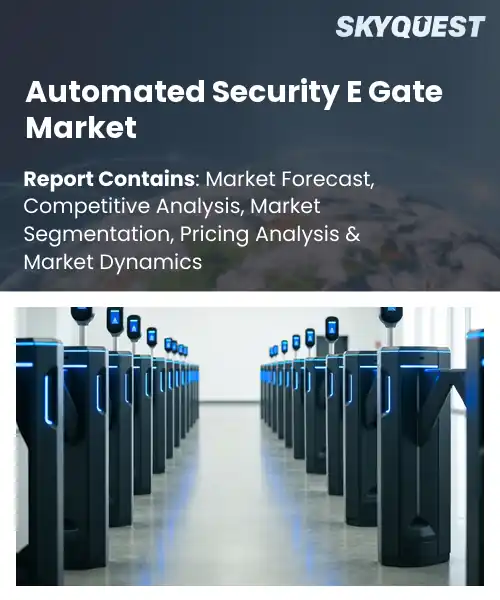
Automated Security E Gate Market
Report ID: SQMIG45J2606
Report ID: SQMIG45J2606
[email protected]
USA +1 351-333-4748
Report ID:
SQMIG45J2606 |
Region:
Global |
Published Date: July, 2026
Pages:
157
|Tables:
91
|Figures:
75


Global Automated Security E Gate Market size was valued at USD 1.32 Billion in 2024 and is poised to grow from USD 1.56 Billion in 2025 to USD 5.82 Billion by 2033, growing at a CAGR of 17.9% during the forecast period (2026-2033).
The automated security e gate market trends features biometric turnstiles and facial-recognition portals that substitute traditional ticket checks at airports, stadiums and corporate campuses. Its importance is driven by the need to speed up passenger flow while tightening access control, a demand that is amplified by rising global travel volumes and heightened security alerts. Originally available only for high-security facilities in the early 2000s, the technology proliferated after the introduction of cheap iris scanners and cloud-based verification platforms, allowing mid-sized venues to adopt the solution. One European airport, for example, found that e-gates slashed queue times by 35%, a good example of how efficiency gains drive wider adoption across industries.
One of these forces shaping the global automated security e gate market growth is regulatory mandates for identity verification that act as a catalyst that forces organizations to upgrade checkpoints. Operators are required to demonstrate compliance in the face of tightening border‑control statutes, and so invest in e‑gate systems that provide audit trails and data handling. This pressure has a ripple effect, leading vendors to incorporate AI analytics that identify fraudulent attempts in real-time. Airlines, for instance, have witnessed a 22% reduction in boarding-gate violations by embedding AI-enhanced facial matching. On the other hand, the intersection of legal mandates and analytics opens up revenue streams including subscription-based verification services for multinational corporations aspiring to world-class security standards.
How is AI-driven Automation Enhancing the Scalability of the Automated Security E‑gate Market?
AI-powered automation is changing the automated security e gate market share by making passenger flow more efficient and reducing the need for manual supervision. Smart vision systems are now able to identify faces and travel documents in real time, giving the gates the ability to adapt the speed of processing to demand. Machine-learning algorithms forecast peak periods and assign resources flexibly, thereby expanding capacity without adding hardware. Operators can achieve lower error rates and a faster onboarding of new terminals, making large scale deployments more feasible. The technology also allows for remote monitoring with a single control center monitoring dozens of sites, further increasing scalability and operational efficiency.
In July 2025, a leading security solutions provider launched an AI-enhanced e-gate system, increasing throughput and reducing staffing needs, demonstrating how AI automation is driving market growth.
Market snapshot - (2026-2033)
Global Market Size
USD 1.32 Billion
Largest Segment
Hardware
Fastest Growth
Services
Growth Rate
17.9% CAGR
To get more insights on this market click here to Request a Free Sample Report
Global automated security e gate market is segmented by component, application, end user and region. Based on component, the market is segmented into hardware, software and services. Based on application, the market is segmented into automated e-gates for border control and automated e-gates for critical infrastructure. Based on end user, the market is segmented into airports, government border agencies, seaports, railway stations and corporate & secure facilities. Based on region, the market is segmented into North America, Europe, Asia Pacific, Latin America and Middle East & Africa.
What Role Does Hardware Play in Advancing the Automated Security E Gate Market?
The hardware segment dominates as it provides the physical backbone that allows for rapid identity verification, biometric capture and integration with existing access control points. Its reliability and durability meet the high throughput demands of border and airport environments, providing operators with confidence. The continuous advancements in sensor precision, ruggedization, and modular design further enhance its appeal and influence procurement decisions. The dominance of automated security e gate market is affirmed as organizations emphasize on seamless traveller experience.
However, the software segment is witnessing the strongest growth momentum owing to cloud based analytics, AI driven threat detection, and over the air updates that accelerate functionality without hardware replacement. Its flexibility is attractive to operators seeking fast upgrades, promoting ecosystem growth and creating new revenue streams that drive market expansion across a range of operational contexts and stakeholder groups.
How are Automated E‑Gates for Critical Infrastructure Shaping Market Growth?
The automated e gates for critical infrastructure segment is expected to hold the largest market share as it protects high value assets like power plants, data centers, and transportation hubs where security breaches can have serious economic and safety implications. Combining sophisticated biometric verification and real time threat analytics, it delivers unmatched protection, leading stakeholders to prioritize deployment and invest big budgets, establishing its market leadership. They also provide centralized monitoring, compliance reporting, and quick incident response, which increases their strategic value.
Meanwhile, automated e gates for border control segment is emerging as the key high growth area as governments are digitizing entry processes, harnessing facial recognition and passport scanning to speed up clearance while ensuring security. Growing traveler numbers and collaboration creates demand, driving manufacturers to innovate and increase production, which in turn drives market growth and opens up partnership opportunities.
To get detailed segments analysis, Request a Free Sample Report
North America leads the automated security e gate market, due to its mature technology ecosystem, favorable investment climate, and widespread security infrastructure in transportation centers. The region is also home to leading research institutions and a cooperative environment that helps fast-track the development of biometric and electronic verification solutions. High security standards are underpinned by robust regulatory frameworks, driving rapid deployment across critical infrastructure. Moreover, the presence of major manufacturers and solution providers guarantees a constant flow of innovative products and services. Customer demand for touchless, seamless access control and a culture of safety and efficiency fuel the market’s depth and our continued leadership. The ecosystem also fosters cross-border collaboration, allowing for technology transfer and shared best practices that enhance the overall sophistication of the market.
Automated security e gate market outlook in United States reflects a convergence of research, pilot deployments, and public‑private partnerships. Stakeholders prioritize integration of artificial intelligence and cloud‑based analytics to enhance threat detection and streamline user experience. The emphasis on compliance with rigorous safety standards drives refinement of hardware and software components. Leading enterprises and government agencies collaborate to create scalable solutions that address evolving security challenges across airports, ports, and corporate campuses.
Automated security e gate market forecast in Canada benefits from a collaborative innovation network linking universities, technology incubators, and government research bodies. Emphasis on privacy‑preserving biometric solutions aligns with national data protection values, encouraging adoption in public facilities and financial institutions. The market leverages cross‑border expertise to integrate advanced sensor arrays and machine‑learning algorithms. Stakeholders pursue interoperable platforms that support seamless scaling across border checkpoints, transportation hubs, and critical infrastructure sites.
Europe automated security e gate market is growing at a rapid pace due to strict regulations, cross border movement focus and huge number of innovators in technology. Collaborative frameworks between sovereign states help to harmonize standards, enabling the smooth deployment of biometric and electronic verification solutions in airports, seaports and high-traffic public venues. Investment in research by leading academic institutions is continuously improving sensor precision and data analytics capabilities. Consumers want frictionless journeys, while governments want more security and data protection – so integrated access-control platforms are being adopted fast. A key element of the region’s sustainability drive is energy-efficient hardware, which supports its role as a vibrant growth hub for advanced security gate solutions.
Automated security e gate market regional outlook in Germany stands as a benchmark for precision engineering and regulatory alignment. The country’s deep industrial base supports development of high‑performance hardware, while policy frameworks promote interoperability across federal and private sectors. Collaborative projects between automotive leaders and security firms accelerate integration of identification technologies. Emphasis on data privacy drives adoption of processing methods, positioning Germany as a dominant force in the European security gateway landscape.
Automated security e gate market regional forecast in United Kingdom is accelerating through initiatives that prioritize travel and border protection. The sector benefits from collaboration between fintech innovators and security specialists, fostering rapid deployment of biometric verification at transport hubs. Regulatory emphasis on user consent and data stewardship enhances confidence, encouraging broader acceptance across commercial and public domains. Investment in cloud platforms enables solutions that adapt to threat landscapes, propelling United Kingdom to the forefront of European market growth.
Automated security e gate market penetration in France is emerging as a focal point for integration of authentication within infrastructure. Pilots between government agencies and providers explore contactless verification at railway stations and municipal buildings. The regulatory climate encourages data handling and prompts rollout across transportation and civic sectors. Focus on hardware designs facilitates retrofitting of entry points, positioning France as a growing contributor to the European security gate ecosystem.
Asia Pacific is expanding its footprint in automated security e gate through a combination of rapid technology adoption, smart government initiatives, and growing infrastructure in populous urban centers. The region is pushing digital transformation, leading to the integration of advanced biometric and AI-enabled verification in airports, seaports and high-traffic commercial complexes. They create cooperative ecosystems that connect manufacturers, software developers, and public agencies to accelerate product innovation and time to market. Increasing awareness of security threats and the need for efficient passenger flow is driving investment in scalable energy-efficient gate solutions. Moreover, the cultural openness to contactless experiences among consumers is driving consumer acceptance, making Asia Pacific a dynamic catalyst for next-generation access control technologies. Regional trade agreements also encourage cross-border standardization, allowing manufacturers to cover several markets with one platform. In addition, more and more schools are providing specialized courses that train the workforce to maintain and improve these complex systems.
Automated security e gate market analysis in Japan is characterized by precision engineering and integration with transportation networks. Collaboration between leading electronics firms and railway operators drives deployment of high‑throughput biometric gates at major stations. Regulatory focus on privacy and reliability ensures rigorous testing, while government incentives support adoption of energy‑efficient hardware. Emphasis on user experience leads to seamless, contactless flow, reinforcing Japan’s reputation as a benchmark for sophisticated security gate solutions.
Automated security e gate industry in South Korea benefits from support and an electronics manufacturing sector. Partnerships between security solution providers and planners accelerate rollout of biometric gates in airports and public transit hubs. Emphasis on fast processing and robust encryption aligns with priorities for data protection. Investment in AI research enhances threat detection capabilities, positioning South Korea as a player in the regional advancement of automated security gate technologies.
To know more about the market opportunities by region and country, click here to
Buy The Complete Report
Growing Demand For Seamless Access
Adoption Of AI‑Driven Analytics
High Initial Capital Expenditure
Complex Integration With Legacy Systems
Request Free Customization of this report to help us to meet your business objectives.
The market’s competitive landscape is shaped by intensive M&A activity, strategic partnerships with airport operators, and rapid tech innovation such as AI‑driven biometric verification and contactless scanning; recent examples include a leading gate manufacturer’s acquisition of a facial‑recognition startup and a joint venture between a security hardware firm and a major airline to deploy next‑gen e‑gates across European hubs.
Top Player’s Company Profile
Recent Developments in the Automated Security E Gate Market
SkyQuest’s ABIRAW (Advanced Business Intelligence, Research & Analysis Wing) is our Business Information Services team that Collects, Collates, Correlates, and Analyses the Data collected by means of Primary Exploratory Research backed by robust Secondary Desk research. As per SkyQuest analysis, the global automated security e-gate market is driven mainly by increasing demand for frictionless access, which is prompting companies to replace manual checkpoints with quick, touchless verification, according to SkyQuest’s analysis. The second strong driver is the adoption of AI-driven analytics that facilitate predictive threat detection and real-time operational adjustments, which further widen the market’s appeal. The hardware segment continues to be the dominant player, providing the necessary sensors and rugged enclosures to enable reliable biometric capture. AI-enabled software is the segment with the highest growth momentum. North America market is led by the mature technology ecosystem and the strong regulatory push, but the high initial capital expenditure is still limiting the wider adoption.
| Report Metric | Details |
|---|---|
| Market size value in 2024 | USD 1.32 Billion |
| Market size value in 2033 | USD 5.82 Billion |
| Growth Rate | 17.9% |
| Base year | 2024 |
| Forecast period | (2026-2033) |
| Forecast Unit (Value) | USD Billion |
| Segments covered |
|
| Regions covered | North America (US, Canada), Europe (Germany, France, United Kingdom, Italy, Spain, Rest of Europe), Asia Pacific (China, India, Japan, Rest of Asia-Pacific), Latin America (Brazil, Rest of Latin America), Middle East & Africa (South Africa, GCC Countries, Rest of MEA) |
| Companies covered |
|
| Customization scope | Free report customization with purchase. Customization includes:-
|
To get a free trial access to our platform which is a one stop solution for all your data requirements for quicker decision making. This platform allows you to compare markets, competitors who are prominent in the market, and mega trends that are influencing the dynamics in the market. Also, get access to detailed SkyQuest exclusive matrix.
Table Of Content
Executive Summary
Market overview
Parent Market Analysis
Market overview
Market size
KEY MARKET INSIGHTS
COVID IMPACT
MARKET DYNAMICS & OUTLOOK
Market Size by Region
KEY COMPANY PROFILES
Methodology
For the Automated Security E Gate Market, our research methodology involved a mixture of primary and secondary data sources. Key steps involved in the research process are listed below:
1. Information Procurement: This stage involved the procurement of Market data or related information via primary and secondary sources. The various secondary sources used included various company websites, annual reports, trade databases, and paid databases such as Hoover's, Bloomberg Business, Factiva, and Avention. Our team did 45 primary interactions Globally which included several stakeholders such as manufacturers, customers, key opinion leaders, etc. Overall, information procurement was one of the most extensive stages in our research process.
2. Information Analysis: This step involved triangulation of data through bottom-up and top-down approaches to estimate and validate the total size and future estimate of the Automated Security E Gate Market.
3. Report Formulation: The final step entailed the placement of data points in appropriate Market spaces in an attempt to deduce viable conclusions.
4. Validation & Publishing: Validation is the most important step in the process. Validation & re-validation via an intricately designed process helped us finalize data points to be used for final calculations. The final Market estimates and forecasts were then aligned and sent to our panel of industry experts for validation of data. Once the validation was done the report was sent to our Quality Assurance team to ensure adherence to style guides, consistency & design.
Analyst Support
Customization Options
With the given market data, our dedicated team of analysts can offer you the following customization options are available for the Automated Security E Gate Market:
Product Analysis: Product matrix, which offers a detailed comparison of the product portfolio of companies.
Regional Analysis: Further analysis of the Automated Security E Gate Market for additional countries.
Competitive Analysis: Detailed analysis and profiling of additional Market players & comparative analysis of competitive products.
Go to Market Strategy: Find the high-growth channels to invest your marketing efforts and increase your customer base.
Innovation Mapping: Identify racial solutions and innovation, connected to deep ecosystems of innovators, start-ups, academics, and strategic partners.
Category Intelligence: Customized intelligence that is relevant to their supply Markets will enable them to make smarter sourcing decisions and improve their category management.
Public Company Transcript Analysis: To improve the investment performance by generating new alpha and making better-informed decisions.
Social Media Listening: To analyze the conversations and trends happening not just around your brand, but around your industry as a whole, and use those insights to make better Marketing decisions.
REQUEST FOR SAMPLE
 REQUEST FREE CUSTOMIZATION
Global Automated Security E Gate Market size was valued at USD 1.32 Billion in 2024 and is poised to grow from USD 1.56 Billion in 2025 to USD 5.82 Billion by 2033, growing at a CAGR of 17.9% during the forecast period (2026-2033).
The market’s competitive landscape is shaped by intensive M&A activity, strategic partnerships with airport operators, and rapid tech innovation such as AI‑driven biometric verification and contactless scanning; recent examples include a leading gate manufacturer’s acquisition of a facial‑recognition startup and a joint venture between a security hardware firm and a major airline to deploy next‑gen e‑gates across European hubs. 'Thales Group', 'IDEMIA France SAS', 'NEC Corporation', 'Gunnebo AB', 'Atos SE', 'HID Global Corporation', 'SITA', 'Indra Sistemas SA', 'Cognitec Systems GmbH', 'RTX Corporation (Collins Aerospace)', 'secunet Security Networks AG', 'In Groupe', 'DERMALOG Systems GmbH', 'COMINFO a.s.', 'E Gates Technologies Pvt. Ltd.', 'Magnetic Autocontrol GmbH', 'Giesecke+Devrient GmbH', 'Wanzl GmbH & Co. KGaA', 'Viisage Technology Inc.'
Enterprises increasingly require frictionless entry to secure facilities, prompting investment in automated e‑gate solutions that eliminate bottlenecks and enhance user experience. Organizations view seamless access as a strategic asset that supports productivity, visitor management, and compliance with safety protocols. By reducing manual verification steps, automated gates improve operational efficiency while maintaining high security standards. This shift toward uninterrupted flow directly fuels market expansion as vendors innovate to meet expectations for speed, reliability, and integration with digital identity platforms through advanced analytics.
Ai-Driven Threat Prediction: Companies are increasingly deploying advanced artificial intelligence and machine learning models within e‑gate systems to anticipate security breaches before they occur. These algorithms analyze vast streams of sensor data, facial biometrics, and historical incident patterns to identify anomalous behavior in real time. By shifting from reactive to predictive security, operators can allocate resources more efficiently, reduce false alarms, and enhance passenger confidence, positioning automated e‑gates as a proactive safeguard within high‑traffic hubs and streamline airport operations globally.
Why does North America Dominate the Global Automated Security E Gate Market? |@12


Want to customize this report? This report can be personalized according to your needs. Our analysts and industry experts will work directly with you to understand your requirements and provide you with customized data in a short amount of time. We offer $1000 worth of FREE customization at the time of purchase.
Feedback From Our Clients


 USA (+1) 351-333-4748

