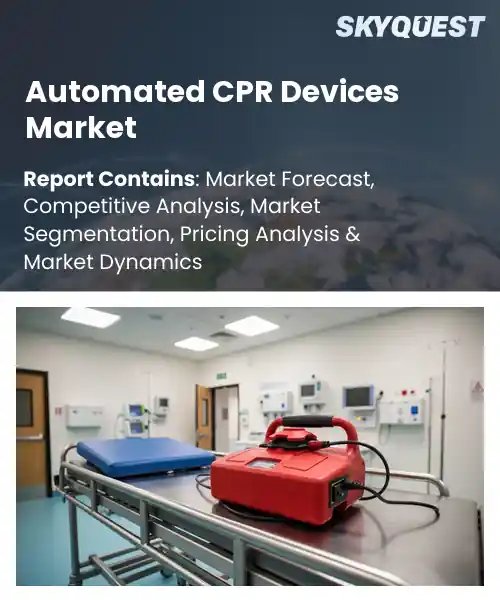
Automated CPR Devices Market
Report ID: SQMIG35A3736
Report ID: SQMIG35A3736
[email protected]
USA +1 351-333-4748
Report ID:
SQMIG35A3736 |
Region:
Global |
Published Date: June, 2026
Pages:
157
|Tables:
91
|Figures:
76


Global Automated Cpr Devices Market size was valued at USD 214.58 Million in 2024 and is poised to grow from USD 237.54 Million in 2025 to USD 535.7 Million by 2033, growing at a CAGR of 10.7% during the forecast period (2026-2033).
The automated CPR devices market growth is driven by the idea that during cardiac arrest, chest compressions have to stay consistently high quality, and not like, drift around because a person is tired or the rhythm slips. In a lot of places, variability in manual CPR has shown gaps in the survival chain, plus out of hospital arrest rates continue to rise, so people started looking harder at mechanical solutions. The market includes mechanical piston and band setups, which deliver uninterrupted compressions, and it matters because these systems can improve compression depth and rate, while also reducing rescuer fatigue. They also help enable advanced interventions. Over the last two decades, adoption moved from experimental hospital use to routine deployment in ambulances and catheterization labs, due to regulatory clearances, expanding clinical protocols, and integration into emergency medical services routines, plus broader payer recognition in many regions globally.
The main growth driver is clinical evidence together with product innovation, and the combo basically pushes policy and purchasing decisions. Randomized studies and registry reviews indicating steadier chest compression performance have led guideline groups and EMS leaders to treat mechanical support as a priority. Then, procurement budgets shift toward these devices, which lets manufacturers spend more on lighter units with better battery efficiency, and also build in integrated monitoring. That lowers operational friction a bit, and expands the range of use cases. For instance, ambulance crews use automated compressors to maintain compression quality during longer transport times, and cath lab teams rely on them to sustain perfusion during complicated procedures, so opportunities show up across EMS modernization, hospital protocol upgrades, and even emerging market reach.
AI is improving efficacy and decision-making by adding more sensing layers, real time feedback loops, and “smart” guidance that works alongside human rescuers. One core part is continuous physiologic monitoring, then immediate quality feedback to help keep compression depth and rate closer to the target, and decision support that can flag when advanced actions are needed or when transport should be escalated. In the current state, more devices are integrating analytics and cloud connectivity, so data can be shared with care teams and quality programs. Overall market interest keeps climbing, because hospitals and EMS organizations want dependable resuscitation performance, not just “good enough.” Vendors are also validating these features clinically, to show improvements in process measures and also practical usability examples like ZOLL Real CPR Help and Accuvent.
Market snapshot - (2026-2033)
Global Market Size
USD 214.58 Million
Largest Segment
Mechanical Piston Devices
Fastest Growth
Mechanical Piston Devices
Growth Rate
10.7% CAGR
To get more insights on this market click here to Request a Free Sample Report
The global automated cpr devices market is segmented by type, power source, end-user and region. Based on type, the market is segmented into Mechanical Piston Devices, Load-Distributing Band Devices and Others. Based on power source, the market is segmented into Pneumatic Driven, Battery Driven and Others. Based on end-user, the market is segmented into Hospitals, Emergency Medical Services, Ambulatory Surgical Centers and Others. Based on region, the market is segmented into North America, Europe, Asia Pacific, Latin America and Middle East & Africa.
As per the automated CPR devices market analysis, the Mechanical Piston Devices segment dominated the market because these systems provide steady targeted compression depth and rate that clinicians count on for predictable hemodynamic support , so it just fits clinical preference and then pushes institutional procurement. Their design is straightforward too, which helps with training, maintenance, and also the way they plug in with monitoring equipment. That ends up reinforcing hospital , and emergency protocols. Then the well-established clinical evidence plus manufacturer support builds trust with providers, and that keeps the purchasing decisions going , eventually these devices get embedded into resuscitation pathways and purchasing budgets , like by default.
Whereas the Load-Distributing Band Devices are showing up as the fastest expanding area. This is mostly due to their ability to generate uniform thoracic compression, which can support organ perfusion while also lowering focal injury risk. There is ongoing device innovation, and favorable clinical exploration plus more attention from prehospital teams. All of that accelerates adoption , it also opens new use cases and it even helps stimulate manufacturer investment.
According to the automated CPR devices market forecast, the Battery Driven segment leads because portable power lets teams deploy the units quickly in clinical and prehospital environments without being dependent on fixed utilities. So the devices can keep running during patient transfer , and across longer resuscitations too. Battery chemistry improvements and better management systems have boosted runtime , and reliability while also making maintenance simpler. It also lowers the logistical burden for providers. That operational flexibility is what moves procurement, especially for emergency services and facility planners who want performance that holds up under different transport and care conditions.
However, pneumatic-driven systems are still gaining the most momentum. Innovation is making the overall setup smaller and the system footprint more compact, while control precision gets better. That makes them appealing for intensive care and surgical environments where sustained high force compressions are needed. Also, regulatory clarity is helping, and emerging clinical protocols that lean toward long duration mechanical support are giving pneumatic systems another boost. So, new procurement pathways start forming , and specialized device manufacturers get more opportunities in that space.
To get detailed segments analysis, Request a Free Sample Report
As per the automated CPR devices market regional forecast, North America is leading the market globally, mostly because the healthcare setup is advanced , plus clinicians are more willing to adopt new tools, and also because the industry players are clustered there. In payer settings and the emergency medical service routines, they tend to lean toward integrating mechanical resuscitation tools into both clinical and prehospital tasks. There are also strong regulatory routes , and a bunch of clinical advocacy that pushes hospitals and ambulance services to buy more units. On top of that, well established reimbursement patterns plus lots of clinical investigations create a level of certainty for buyers, while connected supply chains and centralized purchasing help make deployment way easier at scale. Even the growth in emergency medical services training , partnering with academic centers to shape protocols and the focus on survival metrics keeps automated devices favored inside resuscitation pathways.
United States Automated CPR Devices Market
In the United States, the automated CPR devices sector is shaped by early clinical take up, a dense mix of tertiary hospitals, and emergency medical services that already blend mechanical resuscitation into routine protocols. Manufacturers work closely with academic centers , so device validation and training can happen more smoothly. Favorable procurement structures and the attention to quality measurements push institutions to purchase. Plus ongoing technological tuning and clinician learning programs keep acceptance strong across emergency departments and prehospital routes.
Canada Automated CPR Devices Market
Canada’s automated CPR devices market shows coordinated buying across connected health systems , and there is more and more emphasis on standardized emergency response protocols. Provincial healthcare administrators collaborate with suppliers to line up device deployment with regional EMS abilities. Portability matters here , so portability and ease of use support adoption in remote areas and also community settings. With collaboration from clinical leaders and training pushes, paramedics and emergency clinicians are more likely to accept the resuscitation solutions , and that supports wider scalability.
Europe is seeing quick growth in automated CPR devices because healthcare systems are prioritizing better emergency reaction , plus standardized cardiac arrest procedures across both acute and prehospital environments. Regulatory alignment is getting stronger , and that, together with more clinical endorsement and collaborations between hospitals and emergency services, speeds up procurement and implementation. In major national markets, resuscitation results and quality benchmarks are emphasized , which encourages device adoption. Also, investment in training , public access defibrillation efforts , and cross border learning among clinical societies are supporting broader acceptance. Manufacturers are adjusting their offerings to fit regional procurement models, and to match service delivery needs, while partnerships with EMS organizations and academic centers help with local validation and practical operational integration. Policy discussions and multi stakeholder involvement keep adding momentum to the market.
Germany Automated CPR Devices Market
The German automated CPR devices industry is fueled by a sturdy hospital framework, established emergency medical services, and solid clinical interest in mechanized resuscitation technologies. Hospital purchasing plans, and regional trauma networks, tend to favor standardized pathways that include automated systems. Cooperation between manufacturers and clinical research centers supports local validation and education. And the emphasis on measurable outcomes, plus quality improvement programs , encourages sustained investment and nationwide rollouts across both hospital and prehospital care.
United Kingdom Automated CPR Devices Market
In the United Kingdom, the automated CPR devices market is expanding quickly due to clinical pilots that are more targeted, centralized health service procurement strategies , and a rising focus on improving out of hospital cardiac arrest results. Emergency services and academic partners are actively involved, which helps refine protocols and supports localized validation. Public health visibility is increasing , and training programs aimed at paramedics push broader uptake. Manufacturer partnerships with service providers also enable deployment across different service settings.
France Automated CPR Devices Market
France’s automated CPR devices market is getting traction through pilot programs that are fairly focused , along with rising clinical advocacy for standardized resuscitation methods. Regional hospital groups and emergency medical services are testing mechanized solutions to support manual efforts, and they are emphasizing interoperability, plus operator training. Collaborative activities involving manufacturers, clinical societies , and EMS providers support local validation and better guideline alignment. Procurement interest is stronger in urban centers and training infrastructure is improving, so the national market uptake is gradually picking up.
Asia Pacific is strengthening its place in the automated CPR devices market, by putting money into emergency care modernization, and then pushing for wider clinical acceptance , plus local manufacturers are actively involved, they want tailored solutions for the regional service models. A lot of buyers lean toward interoperability with the prehospital systems that are already in use and also prefer devices that are easy to operate across many clinical environments. That pressure keeps driving innovation in the device shape and the daily operational workflows. Some hospital, EMS agency and academic groups run collaborative programs so that protocols can line up better, and device validation becomes smoother. Then, government health initiatives and procurement reforms in key areas help deployments scale up. On top of that, regional clinical advocacy together with supplier partnerships improves training and integration, which overall lifts the region’s influence in global automated resuscitation technology adoption. More expanded clinical research collaborations, plus manufacturers focusing on localization of training and support, are also making the market feel more ready across different healthcare systems.
Japan Automated CPR Devices Market
The Automated CPR Devices Market in Japan is helped by a technology driven healthcare setup, strong hospital networks, and a tighter focus on emergency medical service integration. Local manufacturers plus research institutions team up to adapt devices for the way operations run, and also to keep interoperability smooth. There’s a noticeable emphasis on clinician training programs and protocol standardization, which supports institutional acceptance. When integration happens with advanced monitoring systems, and there’s a continued commitment to quality outcomes, adoption tends to grow across major medical centers and coordinated prehospital emergency response frameworks.
South Korea Automated CPR Devices Market
The Automated CPR Devices Market in South Korea looks like it’s powered by fast technology adoption. There is strong collaboration between device innovators and clinicians, plus coordinated emergency response systems that support deployment. A big focus is on compact design, connectivity, and intuitive interfaces, these map well to national priorities for efficient prehospital care. Partnerships involving hospitals and EMS agencies help with training, validation, and protocol integration. Government-related, and local procurement mechanisms enable a strategic rollout across healthcare networks, while service support stays in place.
To know more about the market opportunities by region and country, click here to
Buy The Complete Report
Rising Incidence Of Cardiac Arrests
Technological Advancements In Devices
High Upfront Acquisition Costs
Regulatory and Reimbursement Challenges
Request Free Customization of this report to help us to meet your business objectives.
Competitive pressure in the automated CPR devices market revolves around a consolidation, acquisitions, field collaborations and then quick product iteration, not in a clean way but still, everyone is pushing hard. Big incumbents have been doing M&A and OEM arrangements like ZOLL’s buys of Cardiac Science and Itamar Medical, plus Stryker stitching in Physio-Control’s LUCAS platform. At the same time, vendor integrations with dispatch networks and resuscitation startups keep gaining momentum, which helps speed up system level adoption and makes platform partnerships feel more, well, immediate.
Top Player’s Company Profile
Recent Developments in the Automated CPR Devices Market
SkyQuest’s ABIRAW (Advanced Business Intelligence, Research & Analysis Wing) is our Business Information Services team that Collects, Collates, Correlates, and Analyses the Data collected by means of Primary Exploratory Research backed by robust Secondary Desk research.
As per SkyQuest analysis, the global automated CPR devices market, is propelled by a main driver , the clinical need for consistent high-quality chest compressions during cardiac arrest. A second driver is the ongoing technological progress—things like AI-enabled feedback, and improved battery portability—that broaden the operational footprint and strengthen reliability in practice. A notable restraint is the high upfront acquisition cost , which can limit adoption in smaller hospitals and in resource constrained emergency services. North America is still leading overall, mainly because it has advanced healthcare infrastructure and procurement frameworks that tend to be supportive. Within that region, mechanical piston devices remain the dominating segment, largely due to predictable performance, easier integration, and a long-standing level of clinical trust.
| Report Metric | Details |
|---|---|
| Market size value in 2024 | USD 214.58 Million |
| Market size value in 2033 | USD 535.7 Million |
| Growth Rate | 10.7% |
| Base year | 2024 |
| Forecast period | (2026-2033) |
| Forecast Unit (Value) | USD Million |
| Segments covered |
|
| Regions covered | North America (US, Canada), Europe (Germany, France, United Kingdom, Italy, Spain, Rest of Europe), Asia Pacific (China, India, Japan, Rest of Asia-Pacific), Latin America (Brazil, Rest of Latin America), Middle East & Africa (South Africa, GCC Countries, Rest of MEA) |
| Companies covered |
|
| Customization scope | Free report customization with purchase. Customization includes:-
|
To get a free trial access to our platform which is a one stop solution for all your data requirements for quicker decision making. This platform allows you to compare markets, competitors who are prominent in the market, and mega trends that are influencing the dynamics in the market. Also, get access to detailed SkyQuest exclusive matrix.
Table Of Content
Executive Summary
Market overview
Parent Market Analysis
Market overview
Market size
KEY MARKET INSIGHTS
COVID IMPACT
MARKET DYNAMICS & OUTLOOK
Market Size by Region
KEY COMPANY PROFILES
Methodology
For the Automated CPR Devices Market, our research methodology involved a mixture of primary and secondary data sources. Key steps involved in the research process are listed below:
1. Information Procurement: This stage involved the procurement of Market data or related information via primary and secondary sources. The various secondary sources used included various company websites, annual reports, trade databases, and paid databases such as Hoover's, Bloomberg Business, Factiva, and Avention. Our team did 45 primary interactions Globally which included several stakeholders such as manufacturers, customers, key opinion leaders, etc. Overall, information procurement was one of the most extensive stages in our research process.
2. Information Analysis: This step involved triangulation of data through bottom-up and top-down approaches to estimate and validate the total size and future estimate of the Automated CPR Devices Market.
3. Report Formulation: The final step entailed the placement of data points in appropriate Market spaces in an attempt to deduce viable conclusions.
4. Validation & Publishing: Validation is the most important step in the process. Validation & re-validation via an intricately designed process helped us finalize data points to be used for final calculations. The final Market estimates and forecasts were then aligned and sent to our panel of industry experts for validation of data. Once the validation was done the report was sent to our Quality Assurance team to ensure adherence to style guides, consistency & design.
Analyst Support
Customization Options
With the given market data, our dedicated team of analysts can offer you the following customization options are available for the Automated CPR Devices Market:
Product Analysis: Product matrix, which offers a detailed comparison of the product portfolio of companies.
Regional Analysis: Further analysis of the Automated CPR Devices Market for additional countries.
Competitive Analysis: Detailed analysis and profiling of additional Market players & comparative analysis of competitive products.
Go to Market Strategy: Find the high-growth channels to invest your marketing efforts and increase your customer base.
Innovation Mapping: Identify racial solutions and innovation, connected to deep ecosystems of innovators, start-ups, academics, and strategic partners.
Category Intelligence: Customized intelligence that is relevant to their supply Markets will enable them to make smarter sourcing decisions and improve their category management.
Public Company Transcript Analysis: To improve the investment performance by generating new alpha and making better-informed decisions.
Social Media Listening: To analyze the conversations and trends happening not just around your brand, but around your industry as a whole, and use those insights to make better Marketing decisions.
REQUEST FOR SAMPLE
 REQUEST FREE CUSTOMIZATION
Global Automated Cpr Devices Market size was valued at USD 214.58 Million in 2024 and is poised to grow from USD 237.54 Million in 2025 to USD 535.7 Million by 2033, growing at a CAGR of 10.7% during the forecast period (2026-2033).
Competitive pressure in the automated CPR devices market centers on consolidation through acquisitions, field partnerships, and rapid product innovation. Major incumbents have pursued M&A and OEM deals such as ZOLL’s purchases of Cardiac Science and Itamar Medical and Stryker’s integration of Physio-Control’s LUCAS platform, while vendor integrations with dispatch networks and resuscitation startups are accelerating system-level adoption and platform partnerships. 'Asahi Kasei', 'Stryker', 'Medtronic', 'Schiller', 'Vyaire Medical', 'Michigan Instruments', 'Ambu', 'Brunswick Biomedical', 'Zoll Medical', 'Physio-Control', 'Defibtech', 'Nihon Kohden', 'HeartSine Technologies', 'Progetti Medical', 'SunLife Science', 'Weil Institute', 'LUCAS', 'AutoPulse', 'Resuscitation International', 'Innosonian'
An increase in the frequency of sudden cardiac events has heightened clinical urgency and prompted healthcare providers to invest in automated CPR devices that deliver consistent compressions and reduce provider fatigue. Awareness among emergency services and hospital administrators about the value of mechanical chest compression in improving workflow during transport and in prolonged resuscitations encourages procurement. As a result, organizations prioritize technologies that standardize care, support protocol adherence, and enable rapid deployment, thereby expanding demand and creating a stable market pull for automated CPR solutions.
Integration With Emergency Systems: Wider integration of automated CPR devices into emergency response networks is driving adoption by enabling seamless coordination between first responders, dispatch centers, and hospital teams. Interoperability with communication platforms, patient monitoring systems, and electronic health records improves continuity of care and situational awareness. Greater focus on shared protocols and training alignment ensures faster deployment and cohesive workflows during resuscitation events. This convergence supports more predictable procurement decisions by health services and encourages manufacturers to prioritize connectivity and standardized interfaces industrywide.
Why does North America Dominate the Global Automated CPR Devices Market? |@12


Want to customize this report? This report can be personalized according to your needs. Our analysts and industry experts will work directly with you to understand your requirements and provide you with customized data in a short amount of time. We offer $1000 worth of FREE customization at the time of purchase.
Feedback From Our Clients


 USA (+1) 351-333-4748

