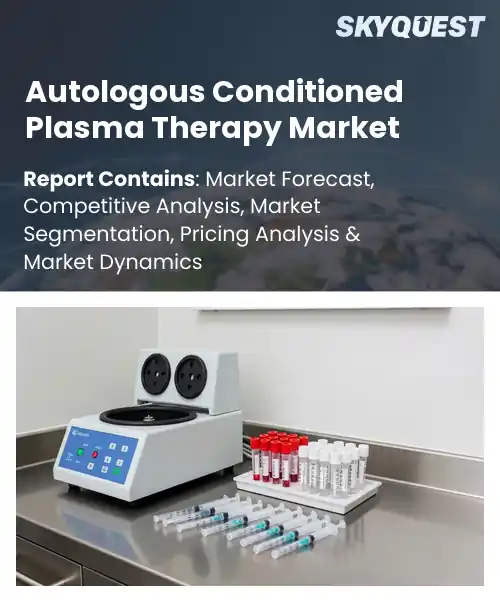
Autologous Conditioned Plasma Therapy Market
Report ID: SQMIG35J2249
Report ID: SQMIG35J2249
[email protected]
USA +1 351-333-4748
Report ID:
SQMIG35J2249 |
Region:
Global |
Published Date: March, 2026
Pages:
157
|Tables:
116
|Figures:
77


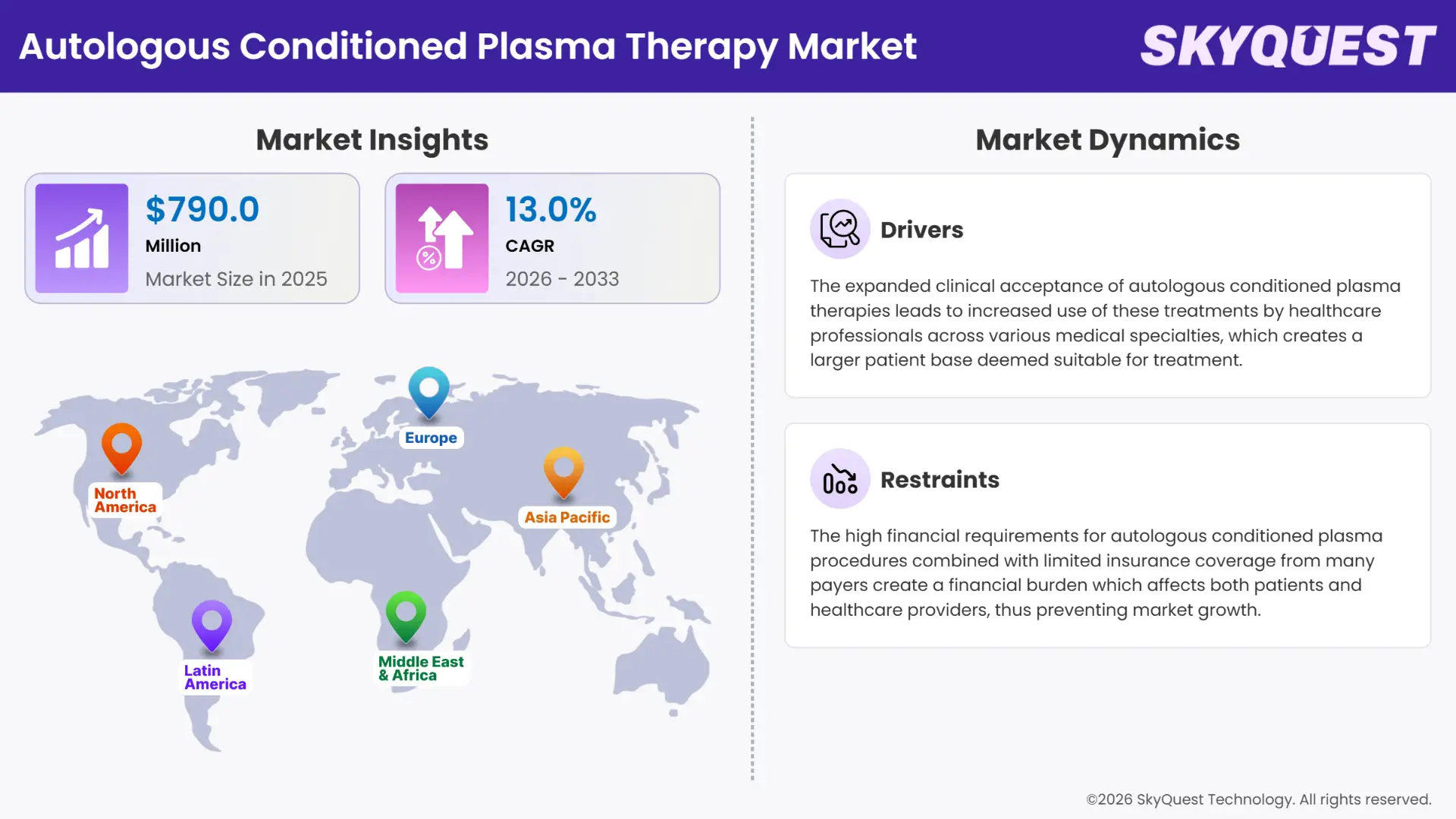
Global Autologous Conditioned Plasma Therapy Market size was valued at USD 700.0 Million in 2024 and is poised to grow from USD 790.0 Million in 2025 to USD 2100.0 Million by 2033, growing at a CAGR of 13.0% during the forecast period (2026-2033).
Key Takeaways: Market Trends & Insights
The global autologous conditioned plasma therapy market growth is driven through clinical proof and physician usage. The medical field recognizes autologous conditioned plasma because it provides patients with a plasma concentrate that contains growth factors which help to heal their tissues and relieve their pain through a less invasive method than surgery that treats both musculoskeletal and cosmetic issues. The market began with initial platelet rich plasma studies which evolved into sophisticated processing technologies and point of care testing equipment and multiple research centers conducting clinical trials. The clinics in orthopedics use ACP treatment to treat knee osteoarthritis while sports teams use ACP to speed up their recovery from tendon injuries.
Moreover, the global autologous conditioned plasma therapy market penetration depends on ACP preparation systems, but technological standardization remains the primary modal factor because it enables constant production which improves output consistency and speeds up the process for regulatory bodies to approve ACP technology. When devices deliver reliable concentrations, clinicians generate comparable outcomes and high-quality trials follow, which persuades insurers to consider reimbursement. Point of care clinics use this setup to treat knee osteoarthritis and rotator cuff repair and aesthetic hair restoration, which leads to increased investment by manufacturers who expand their production capacity. The market expansion through this cause-and-effect cycle generates new business opportunities while it increases patient access and creates new business opportunities through combination therapies that use other biologic products.
How is AI Enhancing Patient Selection and Outcome Prediction in the Autologous Conditioned Plasma Therapy Market?
Autologous conditioned plasma therapy uses a patient s own blood to concentrate platelets and growth factors for tissue repair. AI improves patient selection and outcome forecasting through its ability to create predictive models which combine clinical notes with laboratory trends and imaging results and procedural variables. The models extract digital biomarkers and risk patterns which clinicians use to select patients who will gain the most benefit and create personalized treatment protocols to enhance patient recovery. The medical field has started to use these technologies in orthopedics and wound management and aesthetic practices although their implementation across different facilities remains inconsistent. Vendors and research groups are building decision support tools and digital twin approaches to standardize selection and reduce unnecessary treatments while improving clinician confidence and consistency.
Spectral AI will launch its DeepView predictive diagnostic for wound healing solution in March 2026 which uses AI to conduct patient triage for identifying potential responders to autologous therapies while streamlining patient referrals to healthcare facilities. The capability enables improved prediction of patient outcomes and better operational performance of clinics while it aids in driving market expansion and facilitates targeted ACP resource allocation.
To get more insights on this market click here to Request a Free Sample Report
The global autologous conditioned plasma therapy market is segmented based on plasma composition, clinical application, preparation system, end-user, and region. In terms of plasma composition, the market includes pure platelet-rich plasma (PRP), leukocyte-rich PRP, and platelet-rich fibrin. Based on clinical application, it is categorized into orthopedics and sports medicine, dermatology and medical aesthetics, as well as dental and maxillofacial surgery. By preparation system, the market is divided into point-of-care centrifuge kits and automated separation systems. In terms of end users, the segmentation covers specialty orthopedic clinics, hospitals and trauma centers, and aesthetic and plastic surgery centers. Geographically, the market is segmented into North America, Europe, Asia Pacific, Latin America, and the Middle East & Africa.
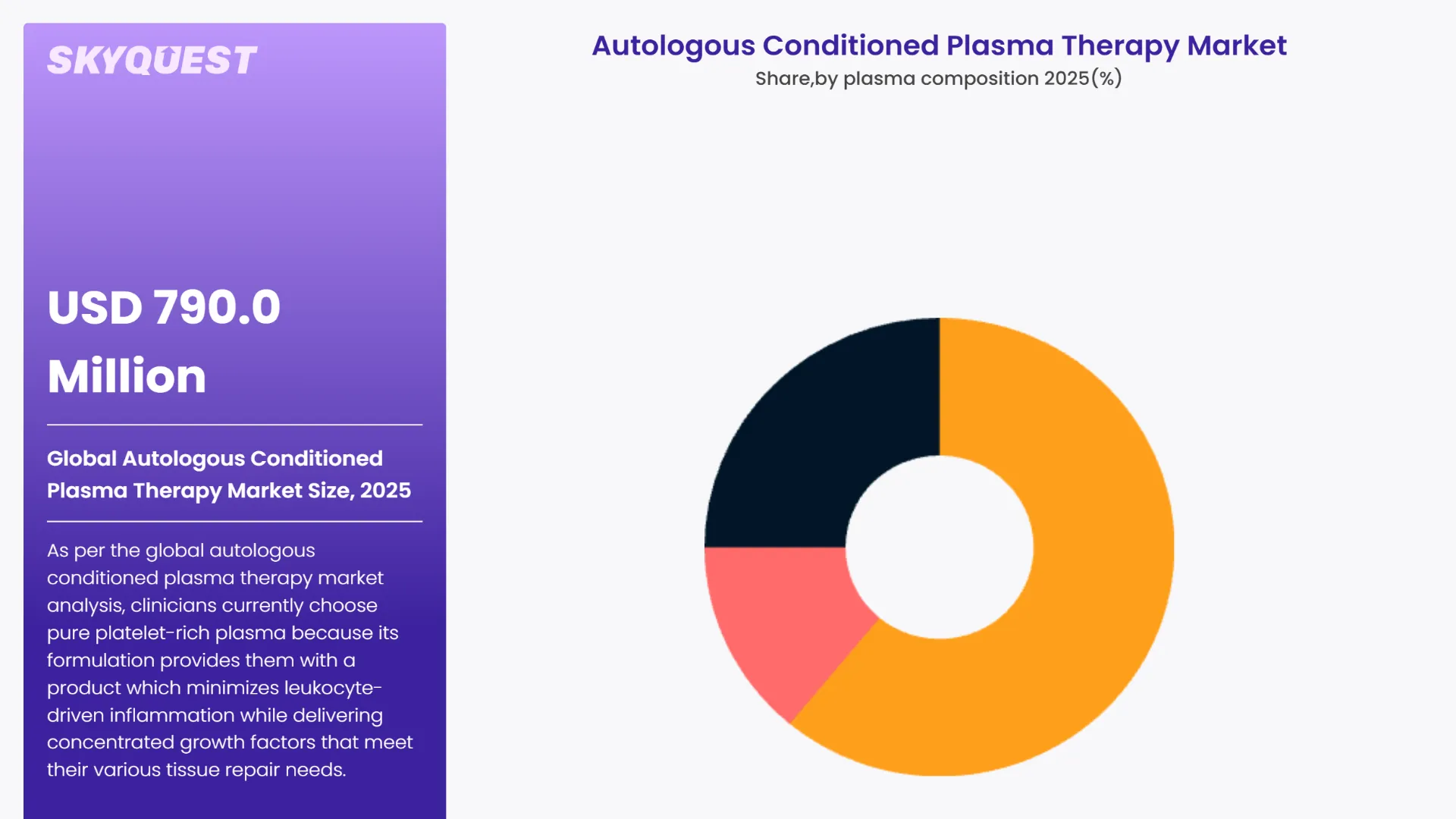
As per the global autologous conditioned plasma therapy market analysis, clinicians currently choose pure platelet-rich plasma because its formulation provides them with a product which minimizes leukocyte-driven inflammation while delivering concentrated growth factors that meet their various tissue repair needs. The autologous therapy system has become the standard method for orthopedics and aesthetics because it's simple preparation process and existing clinic compatibility and broad doctor knowledge make it the primary choice for medical professionals.
However, the platelet-rich fibrin has become the leading choice for medical professionals because it uses its natural fibrin scaffold to release growth factors which sustain their activity while building extracellular matrix tissues that dentists and soft tissue specialists need for their work. Clinicians are adopting biologic scaffolds for their work because new methods for preparing biologics have become easier and doctors want to use scaffolds in more treatments which has created new business opportunities in this market.
According to the global autologous conditioned plasma therapy market forecast, the point-of-care centrifuge kits market segment leads the industry because its systems enable clinics to perform quick and portable patient preparation which suits their outpatient needs while reducing their initial costs. The straightforward nature of their procedures combined with their low expense for institutions and their ability to work with different plasma types enables specialty providers to use the system in multiple locations which establishes a strong presence in the market for standard daily use of autologous therapy.
Whereas the automated separation systems is predicted to have the largest autologous conditioned plasma therapy market share because their automatic processes create consistent results which produce standard quantities of cells and proteins that meet the latest institutional quality control standards for advanced clinical applications. The healthcare field adopts new technologies through three factors which include ongoing vendor product development, regulatory laws which permit closed system operations, and laboratory systems which connect with hospital and medical center workflows.
To get detailed segments analysis, Request a Free Sample Report
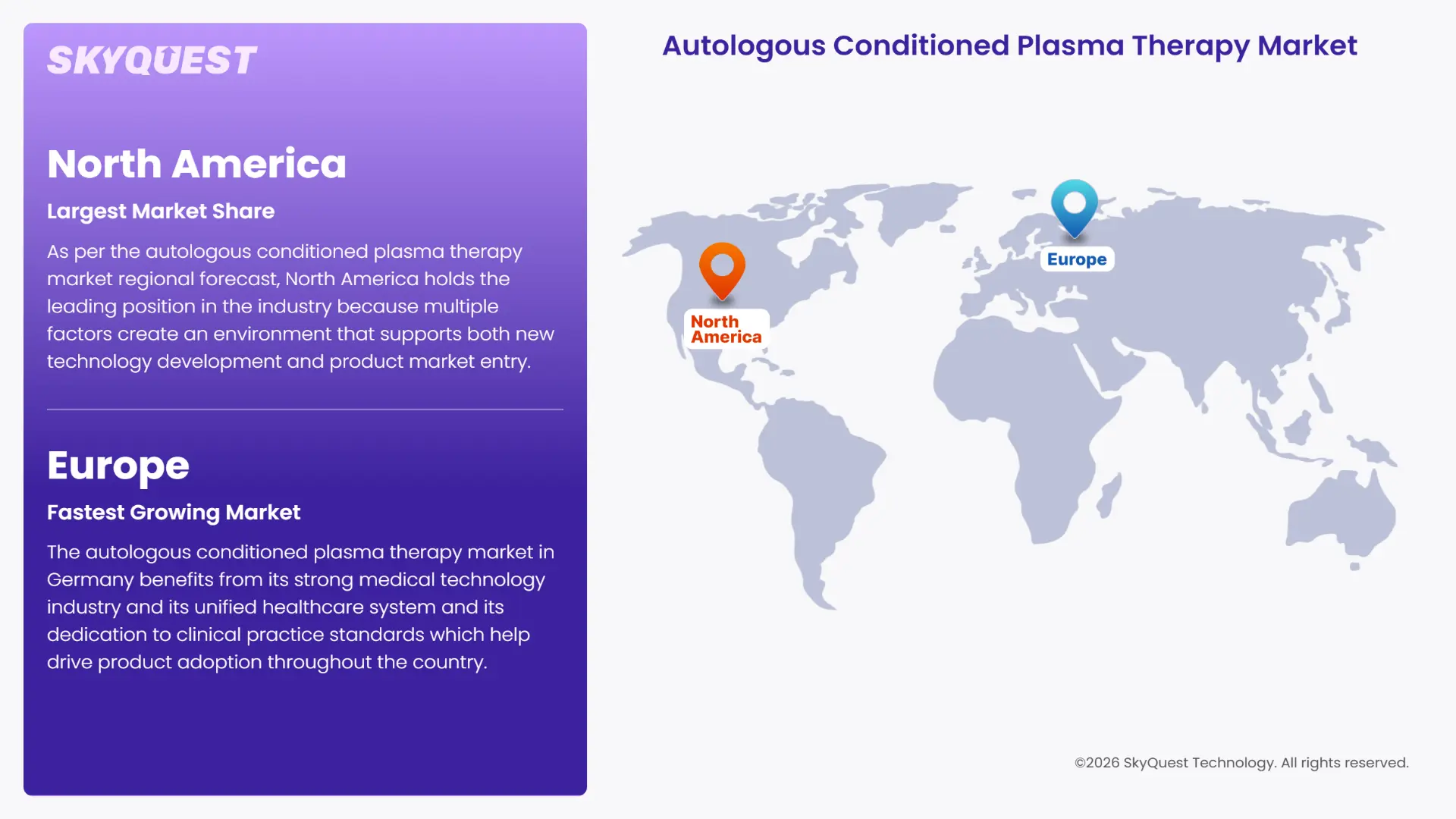
As per the autologous conditioned plasma therapy market regional forecast, North America holds the leading position in the industry because multiple factors create an environment that supports both new technology development and product market entry. Advanced clinical facilities and dedicated treatment centers allow medical professionals to use conditioned plasma therapies in their regular orthopedic and sports medicine and aesthetic procedures. The existence of precise legal regulations together with the dedicated participation of payers and private healthcare organizations creates a smoother path for hospitals to start clinical trials. The combination of strong research networks with academic institutions and device manufacturers and clinical practices enables organizations to produce evidence while developing standard operating procedures. The combination of high patient awareness and strong supply chain capabilities together with many trained medical professionals enables rapid adoption of medical treatments which venture, and corporate funding supports through ongoing product development activities.
The United States autologous conditioned plasma therapy market shows advanced clinical adoption which exists because the country possesses extensive research facilities and specialized treatment networks and efficient commercial systems. The existence of clear regulatory requirements together with established payment systems makes it easier for orthopedic and aesthetic medical practitioners to use their services. The close cooperation between academic research institutions and medical device companies and healthcare facilities enables fast development of treatment procedures while patient knowledge of new regenerative therapies maintains treatment requirements in various health environments.
The autologous conditioned plasma therapy industry in Canada experiences development through its public healthcare system which provides various degrees of funding and reimbursement for different medical services. Academic hospitals, together with specialty clinics, drive research partnerships with industry to create treatment guidelines and scientific proof. The adoption process requires all medical establishments to conduct comprehensive clinical evaluations which verify that their operations meet established clinical practice standards. Medical organizations allocate resources on environmental conditions which create different patient access levels during their outreach and implementation programs.
The European autologous conditioned plasma therapy sector is currently in a phase of rapid development because its medical procedures have become more accepted and its reimbursement systems have become stronger together with its regulatory frameworks which now create fewer barriers for market entry. The extensive network of specialty clinics together with academic institutions enables international knowledge sharing between organizations, which leads to collaborative research projects that enhance treatment standards. The established medical device manufacturing ecosystems together with competent distributors enable businesses to establish their presence in new markets while maintaining continuous delivery of their goods. The demand from patients in public and private healthcare facilities is increasing because doctors are now using regenerative methods to treat both body movement problems and cosmetic concerns. The commercial landscape becomes more predictable for investors and local innovators because both policymakers and professional organizations take part in developing clinical guidelines and educating healthcare practitioners. The collaborative programs between the healthcare industry and clinical organizations lead to faster implementation of new medical procedures.
The autologous conditioned plasma therapy market in Germany benefits from its strong medical technology industry and its unified healthcare system and its dedication to clinical practice standards which help drive product adoption throughout the country. University hospitals, together with specialty clinics, conduct extensive testing to create standardized treatment procedures. The close partnership between manufacturers and clinical researchers enables fast development of both medical products and healthcare professional education programs. The reimbursement systems in primary treatment centers allow healthcare professionals to deliver their services throughout their region while specialized medical centers support cross-disciplinary patient treatment.
The autologous conditioned plasma therapy market in the United Kingdom operates through active private clinic networks which facilitate medical procedures while regulatory bodies work to advance innovation in healthcare services. The practice of translational research together with multicenter clinical programs produces scientific evidence which guides medical treatment decisions. The healthcare system provides multiple options for patients to receive treatment through both private healthcare channels and public healthcare pilot programs. The growth of industry spending on practitioner education together with the development of specialist medical organizations will boost adoption of medical procedures while creating standard treatment methods.
The autologous conditioned plasma therapy market in France is developing through increasing medical interest that originates from academic research centers and specialist clinics who create scientific proof. Health authorities assess medical services to create clinical guidelines which maintain high standards of medical care. The collaboration between medical device companies and healthcare professionals enables them to create treatment guidelines through their education programs. The initial adoption of new technologies happens mainly in urban regions and private medical practices. The clinical programs which medical facilities provide aim to improve patient access to services throughout their local healthcare systems.
Asia Pacific enhances its autologous conditioned plasma therapy development through dedicated investments into clinical studies and regulatory improvements while establishing more treatment centers which provide advanced treatment. The advanced healthcare systems located in major markets support the early clinical testing process and the development of treatment protocols while the active medical device manufacturing centers enable companies to grow their production capabilities and shift their technology. Local companies establish cross-border partnerships with international firms which speed up their process of sharing knowledge and deploying their products into markets. The combination of increasing clinician expertise and specific training programs plus growing patient interest in regenerative methods results in wider usage of these methods in clinical settings. The region develops into a more significant global role because various governments and health institutions from multiple markets invest in translational research programs and infrastructure improvements which enhance research access and support local innovation development.
The autologous conditioned plasma therapy market in Japan derives advantages from its advanced hospital systems which enable medical manufacturing functions and its research ecosystem that supports clinical validation processes. University hospitals and specialty clinics work with industry to refine protocols and deliver clinician training. The establishment of regulatory frameworks together with quality control standards permits researchers to conduct controlled clinical studies while domestic product development can proceed. The combination of patient interest in regenerative therapies and evidence-based practice standards promotes treatment of adoption in both orthopedic and aesthetic care environments.
The South Korean autologous conditioned plasma therapy market expands through its biotechnology sector which develops medical devices and conducts clinical studies while private clinics begin using regenerative treatment methods. Companies use their international partnerships to achieve technology transfer and commercial success. Health system initiatives and professional training support protocol standardization, while consumer interest in aesthetic and orthopedic uses stimulates clinic demand. Public and private funding functions as the foundation which drives innovation while it improves access to clinical services throughout the country.
To know more about the market opportunities by region and country, click here to
Buy The Complete Report
Increased Clinical Acceptance
Technological Advancements in Processing
High Treatment Costs Limit Access
Regulatory Complexity Across Jurisdictions
Request Free Customization of this report to help us to meet your business objectives.
The autologous conditioned plasma therapy market experiences its main competition from device manufacturers and regenerative biotechnology companies and clinic networks which use mergers and acquisitions and partnerships and technological advancements as their competitive strategies. BioLife Solutions acquired Sexton Biotechnologies which represents a recent acquisition activity. The Arthrex ACP system shows how manufacturers create unique products through their partnerships and their implementation of PRP systems at medical facilities. The market competition exists because companies use their proprietary processing technology and formal clinical partnerships and supply chain and data registry mergers to create competitive advantages.
SkyQuest’s ABIRAW (Advanced Business Intelligence, Research & Analysis Wing) is our Business Information Services team that Collects, Collates, Correlates, and Analyses the Data collected by means of Primary Exploratory Research backed by robust Secondary Desk research.
As per SkyQuest analysis, the global autologous conditioned plasma therapy market trends are currently expanding because of increased clinical endorsement of ACP as a minimally invasive regenerative treatment, which has been furthered by standardization of preparation systems that enhance reproduction of results while expanding reimbursement and institutional acceptance. The treatment costs require high payment while the insurance companies restrict coverage, which prevents patients from accessing services and hinders expansion of the service. North America currently dominates the market because the region possesses strong clinical infrastructure together with research networks and commercial channels. The dominant market segment of pure platelet-rich plasma exists because clinicians prefer its predictable low-inflammatory formula that works well with current outpatient treatment methods.
| Report Metric | Details |
|---|---|
| Market size value in 2024 | USD 700.0 Million |
| Market size value in 2033 | USD 2100.0 Million |
| Growth Rate | 13.0% |
| Base year | 2024 |
| Forecast period | 2026-2033 |
| Forecast Unit (Value) | USD Million |
| Segments covered |
|
| Regions covered | North America (US, Canada), Europe (Germany, France, United Kingdom, Italy, Spain, Rest of Europe), Asia Pacific (China, India, Japan, Rest of Asia-Pacific), Latin America (Brazil, Rest of Latin America), Middle East & Africa (South Africa, GCC Countries, Rest of MEA) |
| Companies covered |
|
| Customization scope | Free report customization with purchase. Customization includes:-
|
To get a free trial access to our platform which is a one stop solution for all your data requirements for quicker decision making. This platform allows you to compare markets, competitors who are prominent in the market, and mega trends that are influencing the dynamics in the market. Also, get access to detailed SkyQuest exclusive matrix.
Table Of Content
Executive Summary
Market overview
Parent Market Analysis
Market overview
Market size
KEY MARKET INSIGHTS
COVID IMPACT
MARKET DYNAMICS & OUTLOOK
Market Size by Region
KEY COMPANY PROFILES
Methodology
For the Autologous Conditioned Plasma Therapy Market, our research methodology involved a mixture of primary and secondary data sources. Key steps involved in the research process are listed below:
1. Information Procurement: This stage involved the procurement of Market data or related information via primary and secondary sources. The various secondary sources used included various company websites, annual reports, trade databases, and paid databases such as Hoover's, Bloomberg Business, Factiva, and Avention. Our team did 45 primary interactions Globally which included several stakeholders such as manufacturers, customers, key opinion leaders, etc. Overall, information procurement was one of the most extensive stages in our research process.
2. Information Analysis: This step involved triangulation of data through bottom-up and top-down approaches to estimate and validate the total size and future estimate of the Autologous Conditioned Plasma Therapy Market.
3. Report Formulation: The final step entailed the placement of data points in appropriate Market spaces in an attempt to deduce viable conclusions.
4. Validation & Publishing: Validation is the most important step in the process. Validation & re-validation via an intricately designed process helped us finalize data points to be used for final calculations. The final Market estimates and forecasts were then aligned and sent to our panel of industry experts for validation of data. Once the validation was done the report was sent to our Quality Assurance team to ensure adherence to style guides, consistency & design.
Analyst Support
Customization Options
With the given market data, our dedicated team of analysts can offer you the following customization options are available for the Autologous Conditioned Plasma Therapy Market:
Product Analysis: Product matrix, which offers a detailed comparison of the product portfolio of companies.
Regional Analysis: Further analysis of the Autologous Conditioned Plasma Therapy Market for additional countries.
Competitive Analysis: Detailed analysis and profiling of additional Market players & comparative analysis of competitive products.
Go to Market Strategy: Find the high-growth channels to invest your marketing efforts and increase your customer base.
Innovation Mapping: Identify racial solutions and innovation, connected to deep ecosystems of innovators, start-ups, academics, and strategic partners.
Category Intelligence: Customized intelligence that is relevant to their supply Markets will enable them to make smarter sourcing decisions and improve their category management.
Public Company Transcript Analysis: To improve the investment performance by generating new alpha and making better-informed decisions.
Social Media Listening: To analyze the conversations and trends happening not just around your brand, but around your industry as a whole, and use those insights to make better Marketing decisions.
REQUEST FOR SAMPLE
 REQUEST FREE CUSTOMIZATION
Global Autologous Conditioned Plasma Therapy Market size was valued at USD 0.7 Billion in 2024 and is poised to grow from USD 0.79 Billion in 2025 to USD 2.1 Billion by 2033, growing at a CAGR of 13.0% during the forecast period (2026-2033).
Competition in the autologous conditioned plasma market centers on device makers, regenerative biotech and clinic networks deploying M&A, partnerships and technology innovation. Recent examples include BioLife Solutions acquisition of Sexton Biotechnologies. Manufacturer collaborations and point of care PRP rollouts such as the Arthrex ACP system illustrate device driven differentiation. Market drivers tied to competition include proprietary processing technology, strategic clinical partnerships and consolidation to secure supply chains and data registries. 'Arthrex Inc.', 'Takeda', 'Zimmer Biomet', 'Stryker', 'DePuy Synthes', 'Terumo BCT', 'Grifols', 'CSL Limited', 'Croma-Pharma', 'Bio Products Laboratory', 'Biotest AG', 'Octapharma', 'Kedrion Biopharma', 'ADMA Biologics', 'Regen Lab', 'EmCyte Corporation', 'Apex Biologics', 'Estar Medical', 'GLOFIN', 'Glo PRP'
Increased clinical acceptance of autologous conditioned plasma therapies by clinicians and healthcare institutions has led to broader adoption across specialties, fostering a larger pool of patients considered appropriate for treatment. As more practitioners integrate ACP into routine practice and treatment pathways, clinicians gain experience and confidence, which encourages peer-to-peer recommendations and institutional support. This creates a reinforcing cycle where demand and availability expand, prompting suppliers and service providers to enhance accessibility, training, and logistical support, further enabling market expansion and normalization of the therapy.
Decentralized Point Of Care: Shifting therapy delivery toward clinic and bedside settings is driving uptake as simplified preparation systems and standardized kits enable on-site autologous plasma processing. This trend emphasizes convenience, faster treatment cycles, and closer physician oversight, reducing reliance on centralized laboratories. It encourages service-based business models, cross-disciplinary collaboration, and training programs for outpatient providers. Manufacturers can capitalize by offering turnkey solutions and support services that address operational consistency and quality control, thereby widening patient access and embedding therapies within routine care pathways.
North America Dominate the Global Autologous Conditioned Plasma Therapy Market.
The Leukocyte-Rich PRP segment currently accounts for the largest share of the market due to its widespread use in orthopedic and sports medicine applications and its enhanced healing properties.
The therapy is widely used in orthopedics, sports injury treatment, wound healing, aesthetic medicine, tendon repair, ligament injuries, and osteoarthritis management. Orthopedic applications remain a major revenue-generating segment.
AI is helping clinicians improve patient selection, predict treatment outcomes, analyze imaging and clinical data, and optimize therapy protocols, leading to more personalized and effective treatment approaches.


Want to customize this report? This report can be personalized according to your needs. Our analysts and industry experts will work directly with you to understand your requirements and provide you with customized data in a short amount of time. We offer $1000 worth of FREE customization at the time of purchase.
Feedback From Our Clients


 USA (+1) 351-333-4748

