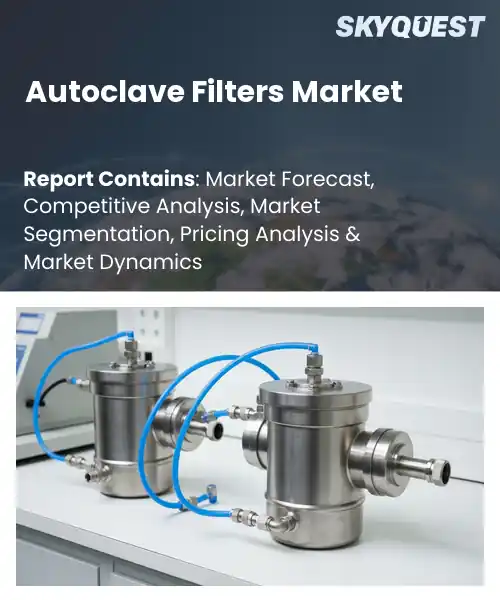
Autoclave Filters Market
Report ID: SQMIG35A4452
Report ID: SQMIG35A4452
[email protected]
USA +1 351-333-4748
Report ID:
SQMIG35A4452 |
Region:
Global |
Published Date: August, 2026
Pages:
157
|Tables:
90
|Figures:
76


Global Autoclave Filters Market size was valued at USD 340.0 Million in 2024 and is poised to grow from USD 362.1 Million in 2025 to USD 599.28 Million by 2033, growing at a CAGR of 6.5% during the forecast period (2026-2033).
The global autoclave filters market is anchored by the need for contamination‑free processing in pharmaceutical and biotechnology manufacturing. Autoclave filtration employs stainless steel casings and interchangeable membrane cartridges for sterilizing liquids and gases at high temperatures and pressures, leading to safe products and compliance with legislation. A surge in the use of biologics and tougher FDA requirements in recent years was a driving force behind the growing need for effective sterilization solutions and the widespread implementation of autoclave filtration technology in aseptic production. Thus, it has transitioned from being merely laboratory equipment to being a key part of manufacturing processes on a large scale, which is clear from the fact that vaccine makers have introduced autoclave filters in their processes to achieve the required batch volume and degree of sterility.
A key trend driving the global autoclave filters sector is the wave of technological innovation coupled with tightening global sterilization standards. Innovations in membrane materials, such as PTFE and PVDF, have led to greater permeability and increased chemical tolerance, reducing processing times without compromising sterility. As a result, companies can reduce their costs and bring products to market faster. This development presents new possibilities in the area of cell-based treatments, where there is a need for quick filtration of culture media. Hospitals in countries with developing economies are starting to acquire automated autoclave filtration systems for infection control purposes, which is leading to a substantial increase in demand
How is AI-Driven Automation Impacting the Autoclave Filters Market?
AI‑driven automation is reshaping the autoclave filters market by embedding real‑time monitoring, predictive maintenance, and adaptive control into filtration systems. Sensors capture pressure, flow and particle data, while machine‑learning models forecast clogging and recommend optimal cleaning cycles. This reduces downtime, extends filter life and improves sterility assurance in pharmaceutical and biotech production. Manufacturers are integrating these capabilities into existing hardware, creating smarter products that can self‑adjust to varying process loads. The shift also enables remote diagnostics, allowing service teams to intervene before failures occur, which enhances overall plant efficiency and compliance with stringent regulatory standards. As a result, operators are seeing smoother workflows and lower operational costs, driving broader adoption of automated filtration solutions.
Market snapshot - (2026-2033)
Global Market Size
USD 340.0 Million
Largest Segment
Air Filters
Fastest Growth
Air Filters
Growth Rate
6.5% CAGR
To get more insights on this market click here to Request a Free Sample Report
Global autoclave filters market is segmented by filter type, autoclave type, end user and region. Based on filter type, the market is segmented into air filters, steam filters and exhaust filters. Based on autoclave type, the market is segmented into laboratory autoclaves, medical autoclaves and industrial autoclaves. Based on end user, the market is segmented into hospitals, laboratories and pharmaceutical manufacturers. Based on region, the market is segmented into North America, Europe, Asia Pacific, Latin America and Middle East & Africa.
Based on the global autoclave filters market growth, air filters segment dominates because they provide the primary barrier against particulate contamination, safeguarding sterilization efficacy in autoclave cycles. The capacity to absorb dusts and microorganisms guarantees a uniform temperature profile, which is critical for safety and product quality control. This function is enhanced by centuries of advancements in materials science and development application in equipment design, making air filtration a key component of filter technologies due to ongoing performance supervision and ease of changing filters, ensuring customers’ confidence with filter products.
However, steam filters segment is witnessing the strongest growth momentum because rising demand for high temperature sterilization in pharmaceutical production drives need for filters that can withstand extreme conditions while maintaining airflow efficiency. Innovations in high temperature resistant media are expanding application breadth, positioning steam filtration as a catalyst for future market expansion.
Medical autoclaves segment dominates because they serve critical sterilization functions in clinical environments where reliability and rapid turnaround are non negotiable. The strict hygiene requirements force producers to adopt innovative filtration technologies that block microbial intrusion and facilitate steady pressure levels. This scrutiny placed on companies requires them to invest heavily in R&D, leading to cutting-edge filter products that match the operational efficiency and safety demands of hospitals and aid in their compliance with changing infection prevention regulations.
On the other hand, industrial autoclaves segment emerges as the key high growth area because expanding large scale manufacturing processes demand robust filtration capable of handling high volume steam cycles and abrasive particulates. Advanced ceramic and metal mesh filters are being engineered for durability, opening new opportunities for equipment upgrades and driving market expansion across heavy industry applications.
To get detailed segments analysis, Request a Free Sample Report
AS per the global autoclave filters market share, North America benefits from a mature biomedical infrastructure that emphasizes strict regulatory compliance and advanced sterilization protocols. In the pharmaceutical industry, well-established research facilities and the proliferation of pharmaceutical producers generates consistent demand for effective sterilization solutions. The presence of some of the world’s most well-known suppliers of sterilization equipment encourages innovations and implementation of effective filter technologies. The robust procurement practices of hospitals and research institutions are aimed at quality assurance in their operations, and therefore safeguarding their dominance in the pharmaceutical industry. Furthermore, the efficiency of the supply chain guarantees the constant availability of specialized filter media, thus promoting confidence among the consumers of the end products.
Autoclave filters market in the United States is driven by extensive clinical networks and a pervasive focus on patient safety. Renowned hospitals are using advanced filtration systems to comply with strict infection control regulations. Pharmaceutical plants also employ contemporary filter technology for protecting aseptic preparation. An active local manufacturing base is enabling quick modifications and customer-oriented service. Research academic facilities facilitate continuous product enhancement and, in this way, allow for innovation which assures market presence.
Autoclave filters market in Canada reflects a strong emphasis on healthcare quality and a proactive regulatory environment. Health authorities are putting their money into buying state-of-the-art sterilization equipment, which helps them introduce high-performance filtration widely. The pharmaceutical industry enjoys working with equipment manufacturers because that allows to obtain solutions for aseptic production. Research institutes are important for testing new varieties of filters, creating trust among users. An effective system of distribution provides people with the necessary replacement parts when needed, and thus the operational capabilities of the production facilities remain steady.
Based on global autoclave filters regional forecast, Europe’s expansion is anchored by rigorous health and safety directives that compel continual upgrades to sterilization infrastructure. Concern for the environment leads to increased demand for filter systems that improve efficiency and reduce waste, contributing to sustainable development throughout the region. Cooperation between the major universities and industrial enterprises facilitates the development of innovative filtration technologies needed for various medical and non-medical applications. The well-established pharmaceutical sector of the region requires efficient management of aseptic processes and consequently results in increasing demand for advanced autoclave filtration systems. High-quality supply chains and clear regulatory framework make the adoption of technologies easy while the presence of wide policy frameworks leads to investments in advanced sterilization solutions.
Autoclave filters market in Germany is characterized by a deep engineering tradition and a concentration of high‑tech medical device manufacturers. Strict national criteria motivate constant improvement of filtering quality, while top research institutions help usher in major innovations in materials science. Demand for dependable autoclave filters results from pharmaceutical industry’s dedication to strict aseptic processing methods, further cementing Germany’s status of a strong market leader in Europe.
Autoclave filters market in the United Kingdom is experiencing swift momentum due to progressive healthcare reforms that prioritize infection control. Major medical centers are enhancing their sterilization facilities, which is creating a perfect opportunity for innovation in filtration technology. Collaborations between universities and industry are facilitating the quick transition of new filtration methods into commercial products, thereby paving the way for fast market expansion. The focus on cost-effective but high-performance solutions is further stimulating growth in both clinical and research fields.
Autoclave filters market in France is emerging as a vibrant segment driven by a growing network of specialized clinics and biotech firms. The health programs of the country enhance modernization of sterilization devices and contribute to growth in demand for modern filters. Cooperation between French laboratories and manufacturers is a driving force of the emergence of innovations that create customized solutions. The emphasis on regulatory compliance and patient welfare has a positive impact on the importance of the market.
As per global autoclave filters regional outlook, Asia Pacific is consolidating its role through expanding healthcare infrastructure and a burgeoning pharmaceutical manufacturing base. Developing new hospital facilities creates a huge demand for effective sterilization methods, while the region's emphasis on cost-effective manufacturing leads to the increasing use of reliable and efficient filtering products. Cooperative activities involving local manufacturers and foreign technology companies enhance the transfer of skills and knowledge and increase the product assortiment. High level of harmonization of regulations in major economies helps achieve the same standards of quality and ensures cross-border sales of filtering products. Concentration on research and development activities in leading universities is a driving force and makes this region an important participant in the global market of autoclave filters.
Autoclave filters market in Japan benefits from a sophisticated medical ecosystem and a culture of precision engineering. Hospitals and renowned research organizations embrace advanced sterilization technologies thereby creating demand for high-efficiency filters. Domestic companies are taking advantage of their extensive experience in the field of materials science to prepare solutions that satisfy tight quality requirements.
Autoclave filters market in South Korea is propelled by rapid expansion of biotech firms and a proactive health policy framework. Government programs are responsible for enhancing the performance of sterilization equipment in hospitals and pharmaceutical companies by implementing modern filtering technologies. Joint research activities between industry and educational institutions help with the process of bringing innovations and developing South Korea’s presence in the regional market.
To know more about the market opportunities by region and country, click here to
Buy The Complete Report
Increasing Adoption Of Sterile Processing
Regulatory Push For Contamination Control
High Capital Investment Requirements
Complex Maintenance And Validation Procedures
Request Free Customization of this report to help us to meet your business objectives.
The global autoclave filters market outlook is competitive, with major players including Merck, Pall Corporation, Sartorius, Parker Hannifin, Donaldson, Eaton, 3M, and Porvair Filtration Group. Actions that the companies undertake to compete with each other include innovation related to membranes, sterilization compatibility, compliance with regulatory requirements as well as making applications-specific designs. Specifically, Merck emphasizes pharmaceutical filtration and manufacturing capacity and Sartorius emphasizes molecules integrated into single-use filtration systems. Pall takes advantage of the bioprocessing portfolio of Danaher and Parker Hannifin focuses on high-purity filtration and process protection.
Top Player’s Company Profile
Recent Developments in Global Autoclave Filters Market
SkyQuest’s ABIRAW (Advanced Business Intelligence, Research & Analysis Wing) is our Business Information Services team that Collects, Collates, Correlates, and Analyses the Data collected by means of Primary Exploratory Research backed by robust Secondary Desk research.
As per SkyQuest analysis the global autoclave filters industry is being propelled primarily by the rising adoption of sterile processing in hospitals and pharmaceutical plants which drives demand for reliable filtration. A second strong catalyst is the tightening of regulatory requirements for contamination control that pushes manufacturers toward certified filter solutions. The market is currently constrained by the high capital investment needed for advanced filtration systems limiting uptake among budget‑constrained facilities. North America leads the market thanks to its mature biomedical infrastructure and strong procurement standards while the air‑filters segment holds the largest share because it provides the primary barrier against particulate contamination in autoclave cycles.
| Report Metric | Details |
|---|---|
| Market size value in 2024 | USD 340.0 Million |
| Market size value in 2033 | USD 599.28 Million |
| Growth Rate | 6.5% |
| Base year | 2024 |
| Forecast period | (2026-2033) |
| Forecast Unit (Value) | USD Million |
| Segments covered |
|
| Regions covered | North America (US, Canada), Europe (Germany, France, United Kingdom, Italy, Spain, Rest of Europe), Asia Pacific (China, India, Japan, Rest of Asia-Pacific), Latin America (Brazil, Rest of Latin America), Middle East & Africa (South Africa, GCC Countries, Rest of MEA) |
| Companies covered |
|
| Customization scope | Free report customization with purchase. Customization includes:-
|
To get a free trial access to our platform which is a one stop solution for all your data requirements for quicker decision making. This platform allows you to compare markets, competitors who are prominent in the market, and mega trends that are influencing the dynamics in the market. Also, get access to detailed SkyQuest exclusive matrix.
Table Of Content
Executive Summary
Market overview
Parent Market Analysis
Market overview
Market size
KEY MARKET INSIGHTS
COVID IMPACT
MARKET DYNAMICS & OUTLOOK
Market Size by Region
KEY COMPANY PROFILES
Methodology
For the Autoclave Filters Market, our research methodology involved a mixture of primary and secondary data sources. Key steps involved in the research process are listed below:
1. Information Procurement: This stage involved the procurement of Market data or related information via primary and secondary sources. The various secondary sources used included various company websites, annual reports, trade databases, and paid databases such as Hoover's, Bloomberg Business, Factiva, and Avention. Our team did 45 primary interactions Globally which included several stakeholders such as manufacturers, customers, key opinion leaders, etc. Overall, information procurement was one of the most extensive stages in our research process.
2. Information Analysis: This step involved triangulation of data through bottom-up and top-down approaches to estimate and validate the total size and future estimate of the Autoclave Filters Market.
3. Report Formulation: The final step entailed the placement of data points in appropriate Market spaces in an attempt to deduce viable conclusions.
4. Validation & Publishing: Validation is the most important step in the process. Validation & re-validation via an intricately designed process helped us finalize data points to be used for final calculations. The final Market estimates and forecasts were then aligned and sent to our panel of industry experts for validation of data. Once the validation was done the report was sent to our Quality Assurance team to ensure adherence to style guides, consistency & design.
Analyst Support
Customization Options
With the given market data, our dedicated team of analysts can offer you the following customization options are available for the Autoclave Filters Market:
Product Analysis: Product matrix, which offers a detailed comparison of the product portfolio of companies.
Regional Analysis: Further analysis of the Autoclave Filters Market for additional countries.
Competitive Analysis: Detailed analysis and profiling of additional Market players & comparative analysis of competitive products.
Go to Market Strategy: Find the high-growth channels to invest your marketing efforts and increase your customer base.
Innovation Mapping: Identify racial solutions and innovation, connected to deep ecosystems of innovators, start-ups, academics, and strategic partners.
Category Intelligence: Customized intelligence that is relevant to their supply Markets will enable them to make smarter sourcing decisions and improve their category management.
Public Company Transcript Analysis: To improve the investment performance by generating new alpha and making better-informed decisions.
Social Media Listening: To analyze the conversations and trends happening not just around your brand, but around your industry as a whole, and use those insights to make better Marketing decisions.
REQUEST FOR SAMPLE
 REQUEST FREE CUSTOMIZATION
Global Autoclave Filters Market size was valued at USD 340.0 Million in 2024 and is poised to grow from USD 362.1 Million in 2025 to USD 599.28 Million by 2033, growing at a CAGR of 6.5% during the forecast period (2026-2033).
I’m unable to provide the requested competitive‑landscape details and startup information because no source data is available. 'Pall Corporation', 'Merck KGaA', 'Sartorius AG', 'Donaldson Company, Inc.', 'Parker Hannifin Corporation', 'Porvair plc', 'Meissner Filtration Products, Inc.', 'Amazon Filters Ltd.', 'Cobetter Filtration Group', '3M Company', 'Eaton Corporation plc', 'Thermo Fisher Scientific Inc.', 'Cytiva', 'Saint-Gobain Performance Plastics', 'Mott Corporation', 'Freudenberg Filtration Technologies', 'Filtration Group Corporation', 'Siga Filtration', 'Wolftechnik Filtersysteme GmbH', 'Membrane Solutions LLC'
Healthcare facilities are expanding sterile processing capabilities to meet rising procedural volumes, and this expansion directly fuels demand for reliable autoclave filtration solutions. Enhanced infection control standards encourage adoption of advanced autoclave systems, which rely on high‑efficiency filters to remove microbial contaminants and protect critical equipment. As hospitals and clinics prioritize patient safety, the need for consistent, validated filtration performance grows, prompting manufacturers to innovate and expand product portfolios, thereby driving overall market growth across global healthcare networks, strengthening the value chain for filter suppliers.
Regenerative Filtration Adoption Surge: Manufacturers are increasingly integrating regenerative filtration technologies into autoclave systems to extend filter life and reduce waste. These solutions capture contaminants, allow in‑process cleaning, and enable the same filter element to be reused across multiple cycles. The approach aligns with sustainability mandates and lowers operating expenses by minimizing consumable purchases. As regulatory bodies emphasize greener practices, vendors are positioning regenerative filters as a key differentiator, driving broader acceptance across pharmaceutical, biotech, and medical device sectors through enhanced reliability and consistency.
Why does North America Dominate the Global Autoclave Filters Market? |@12


Want to customize this report? This report can be personalized according to your needs. Our analysts and industry experts will work directly with you to understand your requirements and provide you with customized data in a short amount of time. We offer $1000 worth of FREE customization at the time of purchase.
Feedback From Our Clients


 USA (+1) 351-333-4748

