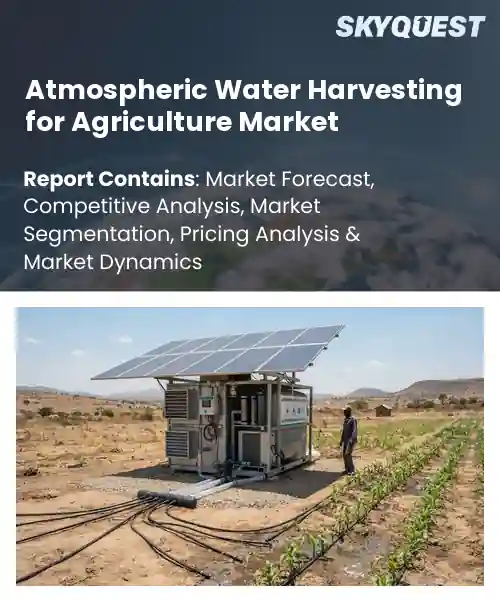
Atmospheric Water Harvesting for Agriculture Market

Report ID: SQMIG20H2153

[email protected]
USA +1 351-333-4748

Atmospheric Water Harvesting for Agriculture Market Size, Share, and Growth Analysis

Atmospheric Water Harvesting for Agriculture Market

Atmospheric Water Harvesting for Agriculture Market By Technology (Cooling & Condensation, Desiccant-Based Systems, Hybrid Systems), By System Type (Standalone Systems, Containerized Systems, Integrated Irrigation Systems), By Water Application, By Energy Source, By Farm Type, By Region - Industry Forecast 2026-2033


Report ID: SQMIG20H2153 | Region: Global | Published Date: October, 2026
Pages: 157 |Tables: 145 |Figures: 78

Format - word format excel data power point presentation

Atmospheric Water Harvesting for Agriculture Market Insights

Global Atmospheric Water Harvesting For Agriculture Market size was valued at USD 140.0 Million in 2024 and is poised to grow from USD 167.72 Million in 2025 to USD 711.61 Million by 2033, growing at a CAGR of 19.8% during the forecast period (2026-2033).

The atmospheric water harvesting for agriculture market captures technologies that condense moisture from air to supply irrigation in water‑scarce regions. Its relevance stems from mounting pressure on freshwater supplies, intensified by climate‑driven droughts and expanding cultivated land. Early prototypes appeared in the 1990s, yet only after the 2010s did commercial systems emerge, driven by falling solar‑panel costs and smarter dehumidification units. For instance, a pilot in Rajasthan, India, demonstrated that a 5‑kW solar‑powered condenser could deliver 200 liters per day, enough for a small pepper field. This evolution illustrates how declining energy prices and heightened food‑security concerns have propelled market formation.The growth catalyst is the alignment of renewable‑energy incentives with precision‑agriculture subsidies, which together shrink capital costs and increase profitability. When solar grants lower the price of atmospheric condensers, the cost of harvested water drops beneath that of diesel‑pumped groundwater, prompting farmers to replace sources. This shift sparked deployment in Israel’s Negev desert, where a 10‑kW unit now irrigates 1.2 hectares of lettuce, delivering yields 15 % higher while cutting water use by 30 %. As resilience targets become embedded in agricultural policy across Africa and Latin America, the market will broaden, creating revenue for firms and enhancing food security for regions.

How is AI enhancing atmospheric water harvesting efficiency for agricultural applications?

AI boosts atmospheric water harvesting for agriculture by integrating predictive analytics, sensor networks, and adaptive control systems. Machine‑learning models analyze humidity trends, temperature fluctuations, and wind patterns to forecast optimal condensation windows, allowing harvesters to operate precisely when conditions are most favorable. Real‑time IoT sensors feed data into cloud platforms where algorithms adjust fan speeds, cooling cycles, and surface materials, minimizing energy waste while maximizing water yield. This intelligent orchestration transforms passive condensers into dynamic systems that respond to micro‑climatic changes across fields, supporting growers in water‑scarce regions and reducing reliance on traditional irrigation sources. The market is seeing growing interest as climate variability drives demand for resilient, low‑input water solutions, and early adopters report more reliable water supplies for crops such as lettuce, tomatoes, and beans.In June 2024, WaterGen announced a new AI‑driven atmospheric water generator for farms, highlighting how predictive modeling and automated flow control increase harvest efficiency and support sustainable agricultural practices.

Market snapshot - (2026-2033)

Global Market Size

USD 140.0 Million

Largest Segment

Cooling & Condensation

Fastest Growth

Hybrid Systems

Growth Rate

19.8% CAGR

Atmospheric Water Harvesting for Agriculture Market ($ Mn)
Country Share for Asia Pacific Region (%)

To get more insights on this market click here to Request a Free Sample Report

Atmospheric Water Harvesting for Agriculture Market Segments Analysis

Global atmospheric water harvesting for agriculture market is segmented by technology, system type, water application, energy source, farm type and region. Based on technology, the market is segmented into Cooling & Condensation, Desiccant-Based Systems and Hybrid Systems. Based on system type, the market is segmented into Standalone Systems, Containerized Systems and Integrated Irrigation Systems. Based on water application, the market is segmented into Crop Irrigation, Greenhouse Irrigation, Livestock Water Supply and Agricultural Processing. Based on energy source, the market is segmented into Grid-Powered, Solar-Powered and Hybrid Renewable Energy. Based on farm type, the market is segmented into Small & Medium Farms, Large Commercial Farms and Greenhouses & Controlled-Environment Agriculture. Based on region, the market is segmented into North America, Europe, Asia Pacific, Latin America and Middle East & Africa.

What role does cooling & condensation play in atmospheric water harvesting for agriculture?

Cooling & Condensation segment dominates because it directly leverages ambient temperature differentials to produce water, a principle that aligns with the simple physics of most agricultural settings. Its proven reliability, low maintenance requirements, and ease of scaling make it the preferred choice for farmers seeking immediate water supply. The technology’s compatibility with existing irrigation infrastructure further fuels its market leadership, especially in regions where water scarcity intensifies seasonal stress.

Meanwhile, Hybrid Systems segment is witnessing the strongest growth momentum because it blends cooling condensation with desiccant technology, delivering higher water yields under diverse climatic conditions. This innovation attracts farms aiming to mitigate weather variability, and its modular design encourages rapid adoption across both smallholder and large‑scale operations, accelerating market expansion.

how is solar-powered technology addressing energy challenges in atmospheric water harvesting for agriculture?

Solar-Powered segment dominates because it aligns with the agricultural sector's push toward sustainable energy, allowing water harvesting units to operate off‑grid and reduce operating costs. Photovoltaic integration capitalizes on abundant sunlight in many farming regions, delivering consistent power without fuel logistics. This autonomy enhances system reliability, encourages farmer adoption, and dovetails with eco‑friendly certification programs, solidifying its leadership in the market, particularly during peak irrigation periods when energy demand spikes.

Conversely, Hybrid Renewable Energy segment is emerging as the key high‑growth area because it combines solar with wind or battery storage, ensuring continuous power despite variable sunlight. This resilience meets the needs of farms operating in fluctuating climates, spurring investment in more sophisticated harvesting units and unlocking new market niches.

Atmospheric Water Harvesting for Agriculture Market By Technology

To get detailed segments analysis, Request a Free Sample Report

Atmospheric Water Harvesting for Agriculture Market Regional Insights

Why does Asia Pacific Dominate the Global Atmospheric Water Harvesting for Agriculture Market?

The region benefits from a combination of abundant atmospheric moisture and a strong tradition of agricultural innovation. Nations in this area have integrated advanced water‑capture technologies with precision farming practices, creating highly efficient systems that address both water scarcity and productivity challenges. Government frameworks encourage sustainable resource use, while private sector investment fuels research and deployment of cutting‑edge solutions. The convergence of supportive policy, technological expertise, and a pressing need for resilient water sources positions Asia Pacific as the leading hub for atmospheric water harvesting in agriculture.

Japan Atmospheric Water Harvesting for Agriculture Market

Atmospheric Water Harvesting for Agriculture Market in Japan is driven by a focus on high‑tech solutions that address water limitations in mountainous and arid zones. Collaborative efforts between research institutes and agribusinesses promote compact, energy‑efficient devices suited for small‑scale farms. Government incentives prioritize climate‑resilient practices, encouraging adoption among growers seeking to enhance yields while conserving limited water supplies.

South Korea Atmospheric Water Harvesting for Agriculture Market

Atmospheric Water Harvesting for Agriculture Market in South Korea leverages strong national emphasis on smart agriculture and renewable technologies. Innovation clusters develop modular systems that integrate seamlessly with vertical farming and greenhouse operations. Public funding supports pilot projects that demonstrate the viability of atmospheric water sources, fostering rapid uptake among progressive producers aiming to reduce dependence on traditional irrigation.

What is Driving the Rapid Expansion of Atmospheric Water Harvesting for Agriculture Market in Europe?

European momentum stems from heightened environmental commitments and a growing awareness of water stress across diverse climatic zones. Policy frameworks promote circular water use and incentivize low‑impact farming methods, creating fertile ground for atmospheric water solutions. Collaborative research networks across the continent accelerate technology refinement, while strong agritech ecosystems facilitate commercialization. The blend of regulatory support, sustainability goals, and a proactive market culture propels Europe’s swift expansion in this sector.

Germany Atmospheric Water Harvesting for Agriculture Market

Atmospheric Water Harvesting for Agriculture Market in Germany benefits from world‑class research institutions that pioneer efficient condensation technologies. Integration with renewable energy sources aligns with the country’s broader green agenda, encouraging farmers to adopt water‑independent irrigation. Industry partnerships and robust funding mechanisms ensure that innovative prototypes transition to scalable field applications.

United Kingdom Atmospheric Water Harvesting for Agriculture Market

Atmospheric Water Harvesting for Agriculture Market in the United Kingdom experiences rapid growth through a vibrant ecosystem of startups and academic collaborations. Pilot installations across varied agricultural settings showcase the technology’s adaptability, while government programs reward sustainable water management practices. This supportive environment accelerates market penetration and drives continuous improvement.

France Atmospheric Water Harvesting for Agriculture Market

Atmospheric Water Harvesting for Agriculture Market in France is emerging as a strategic response to water challenges in Mediterranean and inland regions. Collaborative initiatives between regional authorities and agritech firms focus on developing cost‑effective solutions tailored to local crop needs. Growing interest among growers reflects a broader shift toward resilient, water‑wise farming practices.

How is North America Strengthening its Position in Atmospheric Water Harvesting for Agriculture Market?

North America advances its role through a combination of expansive agricultural landscapes and a proactive approach to resource sustainability. Diverse climate zones create a natural laboratory for testing and refining atmospheric water technologies, while strong venture capital ecosystems fund innovative startups. Cross‑border collaborations enhance knowledge sharing, and policy incentives encourage adoption among large‑scale producers seeking to mitigate irrigation pressures. This dynamic environment fosters continuous advancement and broader market acceptance.

United States Atmospheric Water Harvesting for Agriculture Market

Atmospheric Water Harvesting for Agriculture Market in the United States thrives on a culture of entrepreneurial innovation and extensive research networks. Integration with precision farming platforms enables large producers to incorporate atmospheric water sources into existing operations, reducing reliance on conventional water supplies. Private investment and state‑level support programs accelerate deployment across varied agricultural regions.

Canada Atmospheric Water Harvesting for Agriculture Market

Atmospheric Water Harvesting for Agriculture Market in Canada aligns with national priorities on water stewardship and northern agricultural development. Research institutions focus on cold‑climate adaptations, creating systems that function efficiently in diverse environmental conditions. Government initiatives promote pilot projects that demonstrate the technology’s potential to support sustainable growth in remote farming communities.

Atmospheric Water Harvesting for Agriculture Market By Geography
  • Largest
  • Fastest

To know more about the market opportunities by region and country, click here to
Buy The Complete Report

Atmospheric Water Harvesting for Agriculture Market Dynamics

Drivers

Rising Water Scarcity Fuels Demand

  • Rising water scarcity across arid and semi‑arid regions creates a pressing need for reliable supplemental irrigation sources, prompting farmers to explore atmospheric water harvesting technologies that capture moisture directly from the air, thereby reducing dependence on dwindling groundwater and erratic rainfall. This shift enhances crop resilience, supports stable yields, and aligns with sustainability goals, encouraging investment and adoption of innovative harvesting systems, which in turn accelerates market expansion and drives broader acceptance within the agricultural sector through collaborative research initiatives and policy incentives.

Advancements In Condensation Technology

  • Recent advancements in condensation and heat‑exchange technologies have significantly improved the efficiency and scalability of atmospheric water harvesters, enabling them to operate effectively under a broader range of humidity and temperature conditions. Enhanced material science, low‑energy compressors, and smart control systems reduce operational costs and simplify integration with existing irrigation infrastructure. These technical gains increase the attractiveness of such solutions for diverse farming operations, fostering wider deployment, encouraging research funding, and supporting sustained market growth across both smallholder and commercial agricultural contexts.

Restraints

High Capital Investment Requirements

  • The initial capital outlay for atmospheric water harvesting systems, including specialized collectors, energy units, and storage infrastructure, remains substantial, deterring many farmers, especially those operating on limited budgets or in developing regions. This financial barrier restricts widespread adoption, as growers must allocate significant resources before realizing any return on investment, often leading to reliance on traditional water sources. Consequently, market penetration progresses slowly, and the overall growth trajectory is moderated by the need for cost‑reduction strategies and financing mechanisms globally.

Regulatory and Policy Uncertainty

  • Regulatory frameworks governing atmospheric water extraction and usage vary widely across jurisdictions, creating uncertainty for investors and technology providers. In some regions, ambiguous water rights, permitting processes, and environmental impact assessments can delay project implementation or increase compliance costs. This lack of standardized policies hampers strategic planning and discourages long‑term commitments, as stakeholders must navigate complex legal landscapes before deploying systems at scale. Consequently, market expansion is constrained until clearer guidelines and supportive legislation are established to facilitate consistent adoption across diverse agricultural markets.

Request Free Customization of this report to help us to meet your business objectives.

Atmospheric Water Harvesting for Agriculture Market Competitive Landscape

The atmospheric water harvesting market for agriculture is intensifying as firms vie to secure scarce water resources for farms. Watergen’s partnership with the UN World Food Programme to deploy generators in drought zones, Zero Mass Water’s joint research with IWMI on hydropanel irrigation, and Skywater’s acquisition of a fog‑harvesting technology startup illustrate how M&A, collaborations and tech innovation drive competitive advantage.

  • HydroHarvest: Established in 2020, their main objective is to provide low‑cost atmospheric water generators tailored for smallholder farms in arid regions. Recent development: the company secured Series A funding from AgriTech Ventures, introduced a solar‑powered fog‑harvesting unit designed for field deployment, and initiated pilot projects across Kenya and the southwestern United States, demonstrating scalable water production for irrigation. The solution incorporates IoT sensors for real‑time performance tracking, and the firm plans regional expansion to additional drought‑prone markets in South Asia and Latin America.
  • AquaVitae: Established in 2021, their main objective is to develop modular atmospheric water harvesting systems that can be directly coupled with drip‑irrigation networks for high‑value crops. Recent development: the startup completed a strategic partnership with irrigation equipment leader Netafim to co‑design a hybrid unit, secured seed investment from GreenGrowth Capital, and rolled out its first commercial installation on a greenhouse farm in Spain, showcasing seamless integration and reduced reliance on groundwater.

Top Player’s Company Profile

  • Watergen Ltd.
  • SOURCE Global, PBC
  • Aquaria Technologies, Inc.
  • Air2Water LLC
  • Island Sky Corporation
  • Majik Water
  • EcoloBlue, Inc.
  • Drinkable Air Technologies LLC
  • Planets Water
  • GENNY
  • Aqua Sciences, Inc.
  • SkyH2O, Inc.
  • WaterMaker India Pvt. Ltd.
  • AirOWater
  • Atoco Inc.
  • Kumulus Water
  • H2O Innovation Inc.
  • AWG International
  • Atmospheric Water Generator Ltd.
  • Clean Water Wave

Recent Developments

  • Watergen Ltd. announced deployment of its newest solar-powered atmospheric water generator system across 200 hectares of almond orchards in California in July 2026, integrating IoT sensors for real-time moisture monitoring and automated water delivery, improving water use efficiency and reducing reliance on groundwater. The design allows scalability for diverse crop types and supports irrigation scheduling across the farm network.
  • SOURCE Global partnered with a leading Chinese agribusiness in March 2026 to co‑develop large‑scale atmospheric water harvesting units for rice paddies, employing its proprietary hydrogel technology that captures ambient moisture and delivers it directly to root zones, enhancing crop yields while minimizing energy consumption and reducing dependence on traditional irrigation sources.
  • Aquaria Technologies secured an $80 million investment round led by AgriVentures in November 2025 to accelerate rollout of its portable atmospheric water harvesters for smallholder farms across sub‑Saharan Africa, integrating solar power and mobile analytics that optimize collection schedules, improving food security and farmer resilience. The initiative includes training modules and community support to ensure sustainable adoption.

Atmospheric Water Harvesting for Agriculture Key Market Trends

Atmospheric Water Harvesting for Agriculture Market SkyQuest Analysis

SkyQuest’s ABIRAW (Advanced Business Intelligence, Research & Analysis Wing) is our Business Information Services team that Collects, Collates, Correlates, and Analyses the Data collected by means of Primary Exploratory Research backed by robust Secondary Desk research. As per SkyQuest analysis, the market is propelled foremost by rising water scarcity that compels farmers to seek reliable supplemental irrigation, while recent breakthroughs in condensation and heat‑exchange technology serve as a second catalyst by lowering energy use and expanding applicability across climate zones. The cooling‑and‑condensation segment remains dominant because of its proven reliability and easy integration with existing farms. However, high upfront capital costs continue to deter many smallholders, tempering overall adoption rates. Geographic momentum is strongest in the Asia‑Pacific region, where abundant atmospheric moisture, supportive policies and strong agritech investment create a fertile environment for rapid deployment and scale‑up.

Report Metric Details
Market size value in 2024 USD 140.0 Million
Market size value in 2033 USD 711.61 Million
Growth Rate 19.8%
Base year 2024
Forecast period (2026-2033)
Forecast Unit (Value) USD Million
Segments covered
  • Technology
    • Cooling & Condensation
    • Desiccant-Based Systems
    • Hybrid Systems
  • System Type
    • Standalone Systems
    • Containerized Systems
    • Integrated Irrigation Systems
  • Water Application
    • Crop Irrigation
    • Greenhouse Irrigation
    • Livestock Water Supply
    • Agricultural Processing
  • Energy Source
    • Grid-Powered
    • Solar-Powered
    • Hybrid Renewable Energy
  • Farm Type
    • Small & Medium Farms
    • Large Commercial Farms
    • Greenhouses & Controlled-Environment Agriculture
Regions covered North America (US, Canada), Europe (Germany, France, United Kingdom, Italy, Spain, Rest of Europe), Asia Pacific (China, India, Japan, Rest of Asia-Pacific), Latin America (Brazil, Rest of Latin America), Middle East & Africa (South Africa, GCC Countries, Rest of MEA)
Companies covered
  • Watergen Ltd.
  • SOURCE Global, PBC
  • Aquaria Technologies, Inc.
  • Air2Water LLC
  • Island Sky Corporation
  • Majik Water
  • EcoloBlue, Inc.
  • Drinkable Air Technologies LLC
  • Planets Water
  • GENNY
  • Aqua Sciences, Inc.
  • SkyH2O, Inc.
  • WaterMaker India Pvt. Ltd.
  • AirOWater
  • Atoco Inc.
  • Kumulus Water
  • H2O Innovation Inc.
  • AWG International
  • Atmospheric Water Generator Ltd.
  • Clean Water Wave
Customization scope

Free report customization with purchase. Customization includes:-

  • Segments by type, application, etc
  • Company profile
  • Market dynamics & outlook
  • Region

To get a free trial access to our platform which is a one stop solution for all your data requirements for quicker decision making. This platform allows you to compare markets, competitors who are prominent in the market, and mega trends that are influencing the dynamics in the market. Also, get access to detailed SkyQuest exclusive matrix.

Table Of Content

Executive Summary

Market overview

  • Exhibit: Executive Summary – Chart on Market Overview
  • Exhibit: Executive Summary – Data Table on Market Overview
  • Exhibit: Executive Summary – Chart on Atmospheric Water Harvesting for Agriculture Market Characteristics
  • Exhibit: Executive Summary – Chart on Market by Geography
  • Exhibit: Executive Summary – Chart on Market Segmentation
  • Exhibit: Executive Summary – Chart on Incremental Growth
  • Exhibit: Executive Summary – Data Table on Incremental Growth
  • Exhibit: Executive Summary – Chart on Vendor Market Positioning

Parent Market Analysis

Market overview

Market size

  • Market Dynamics
    • Exhibit: Impact analysis of DROC, 2021
      • Drivers
      • Opportunities
      • Restraints
      • Challenges
  • SWOT Analysis

KEY MARKET INSIGHTS

  • Technology Analysis
    • (Exhibit: Data Table: Name of technology and details)
  • Pricing Analysis
    • (Exhibit: Data Table: Name of technology and pricing details)
  • Supply Chain Analysis
    • (Exhibit: Detailed Supply Chain Presentation)
  • Value Chain Analysis
    • (Exhibit: Detailed Value Chain Presentation)
  • Ecosystem Of the Market
    • Exhibit: Parent Market Ecosystem Market Analysis
    • Exhibit: Market Characteristics of Parent Market
  • IP Analysis
    • (Exhibit: Data Table: Name of product/technology, patents filed, inventor/company name, acquiring firm)
  • Trade Analysis
    • (Exhibit: Data Table: Import and Export data details)
  • Startup Analysis
    • (Exhibit: Data Table: Emerging startups details)
  • Raw Material Analysis
    • (Exhibit: Data Table: Mapping of key raw materials)
  • Innovation Matrix
    • (Exhibit: Positioning Matrix: Mapping of new and existing technologies)
  • Pipeline product Analysis
    • (Exhibit: Data Table: Name of companies and pipeline products, regional mapping)
  • Macroeconomic Indicators

COVID IMPACT

  • Introduction
  • Impact On Economy—scenario Assessment
    • Exhibit: Data on GDP - Year-over-year growth 2016-2022 (%)
  • Revised Market Size
    • Exhibit: Data Table on Atmospheric Water Harvesting for Agriculture Market size and forecast 2021-2027 ($ million)
  • Impact Of COVID On Key Segments
    • Exhibit: Data Table on Segment Market size and forecast 2021-2027 ($ million)
  • COVID Strategies By Company
    • Exhibit: Analysis on key strategies adopted by companies

MARKET DYNAMICS & OUTLOOK

  • Market Dynamics
    • Exhibit: Impact analysis of DROC, 2021
      • Drivers
      • Opportunities
      • Restraints
      • Challenges
  • Regulatory Landscape
    • Exhibit: Data Table on regulation from different region
  • SWOT Analysis
  • Porters Analysis
    • Competitive rivalry
      • Exhibit: Competitive rivalry Impact of key factors, 2021
    • Threat of substitute products
      • Exhibit: Threat of Substitute Products Impact of key factors, 2021
    • Bargaining power of buyers
      • Exhibit: buyers bargaining power Impact of key factors, 2021
    • Threat of new entrants
      • Exhibit: Threat of new entrants Impact of key factors, 2021
    • Bargaining power of suppliers
      • Exhibit: Threat of suppliers bargaining power Impact of key factors, 2021
  • Skyquest special insights on future disruptions
    • Political Impact
    • Economic impact
    • Social Impact
    • Technical Impact
    • Environmental Impact
    • Legal Impact

Market Size by Region

  • Chart on Market share by geography 2021-2027 (%)
  • Data Table on Market share by geography 2021-2027(%)
  • North America
    • Chart on Market share by country 2021-2027 (%)
    • Data Table on Market share by country 2021-2027(%)
    • USA
      • Exhibit: Chart on Market share 2021-2027 (%)
      • Exhibit: Market size and forecast 2021-2027 ($ million)
    • Canada
      • Exhibit: Chart on Market share 2021-2027 (%)
      • Exhibit: Market size and forecast 2021-2027 ($ million)
  • Europe
    • Chart on Market share by country 2021-2027 (%)
    • Data Table on Market share by country 2021-2027(%)
    • Germany
      • Exhibit: Chart on Market share 2021-2027 (%)
      • Exhibit: Market size and forecast 2021-2027 ($ million)
    • Spain
      • Exhibit: Chart on Market share 2021-2027 (%)
      • Exhibit: Market size and forecast 2021-2027 ($ million)
    • France
      • Exhibit: Chart on Market share 2021-2027 (%)
      • Exhibit: Market size and forecast 2021-2027 ($ million)
    • UK
      • Exhibit: Chart on Market share 2021-2027 (%)
      • Exhibit: Market size and forecast 2021-2027 ($ million)
    • Rest of Europe
      • Exhibit: Chart on Market share 2021-2027 (%)
      • Exhibit: Market size and forecast 2021-2027 ($ million)
  • Asia Pacific
    • Chart on Market share by country 2021-2027 (%)
    • Data Table on Market share by country 2021-2027(%)
    • China
      • Exhibit: Chart on Market share 2021-2027 (%)
      • Exhibit: Market size and forecast 2021-2027 ($ million)
    • India
      • Exhibit: Chart on Market share 2021-2027 (%)
      • Exhibit: Market size and forecast 2021-2027 ($ million)
    • Japan
      • Exhibit: Chart on Market share 2021-2027 (%)
      • Exhibit: Market size and forecast 2021-2027 ($ million)
    • South Korea
      • Exhibit: Chart on Market share 2021-2027 (%)
      • Exhibit: Market size and forecast 2021-2027 ($ million)
    • Rest of Asia Pacific
      • Exhibit: Chart on Market share 2021-2027 (%)
      • Exhibit: Market size and forecast 2021-2027 ($ million)
  • Latin America
    • Chart on Market share by country 2021-2027 (%)
    • Data Table on Market share by country 2021-2027(%)
    • Brazil
      • Exhibit: Chart on Market share 2021-2027 (%)
      • Exhibit: Market size and forecast 2021-2027 ($ million)
    • Rest of South America
      • Exhibit: Chart on Market share 2021-2027 (%)
      • Exhibit: Market size and forecast 2021-2027 ($ million)
  • Middle East & Africa (MEA)
    • Chart on Market share by country 2021-2027 (%)
    • Data Table on Market share by country 2021-2027(%)
    • GCC Countries
      • Exhibit: Chart on Market share 2021-2027 (%)
      • Exhibit: Market size and forecast 2021-2027 ($ million)
    • South Africa
      • Exhibit: Chart on Market share 2021-2027 (%)
      • Exhibit: Market size and forecast 2021-2027 ($ million)
    • Rest of MEA
      • Exhibit: Chart on Market share 2021-2027 (%)
      • Exhibit: Market size and forecast 2021-2027 ($ million)

KEY COMPANY PROFILES

  • Competitive Landscape
    • Total number of companies covered
      • Exhibit: companies covered in the report, 2021
    • Top companies market positioning
      • Exhibit: company positioning matrix, 2021
    • Top companies market Share
      • Exhibit: Pie chart analysis on company market share, 2021(%)

Methodology

For the Atmospheric Water Harvesting for Agriculture Market, our research methodology involved a mixture of primary and secondary data sources. Key steps involved in the research process are listed below:

1. Information Procurement: This stage involved the procurement of Market data or related information via primary and secondary sources. The various secondary sources used included various company websites, annual reports, trade databases, and paid databases such as Hoover's, Bloomberg Business, Factiva, and Avention. Our team did 45 primary interactions Globally which included several stakeholders such as manufacturers, customers, key opinion leaders, etc. Overall, information procurement was one of the most extensive stages in our research process.

2. Information Analysis: This step involved triangulation of data through bottom-up and top-down approaches to estimate and validate the total size and future estimate of the Atmospheric Water Harvesting for Agriculture Market.

3. Report Formulation: The final step entailed the placement of data points in appropriate Market spaces in an attempt to deduce viable conclusions.

4. Validation & Publishing: Validation is the most important step in the process. Validation & re-validation via an intricately designed process helped us finalize data points to be used for final calculations. The final Market estimates and forecasts were then aligned and sent to our panel of industry experts for validation of data. Once the validation was done the report was sent to our Quality Assurance team to ensure adherence to style guides, consistency & design.

Analyst Support

Customization Options

With the given market data, our dedicated team of analysts can offer you the following customization options are available for the Atmospheric Water Harvesting for Agriculture Market:

Product Analysis: Product matrix, which offers a detailed comparison of the product portfolio of companies.

Regional Analysis: Further analysis of the Atmospheric Water Harvesting for Agriculture Market for additional countries.

Competitive Analysis: Detailed analysis and profiling of additional Market players & comparative analysis of competitive products.

Go to Market Strategy: Find the high-growth channels to invest your marketing efforts and increase your customer base.

Innovation Mapping: Identify racial solutions and innovation, connected to deep ecosystems of innovators, start-ups, academics, and strategic partners.

Category Intelligence: Customized intelligence that is relevant to their supply Markets will enable them to make smarter sourcing decisions and improve their category management.

Public Company Transcript Analysis: To improve the investment performance by generating new alpha and making better-informed decisions.

Social Media Listening: To analyze the conversations and trends happening not just around your brand, but around your industry as a whole, and use those insights to make better Marketing decisions.

$5,300

REQUEST FOR SAMPLE

Please verify that you're not a robot to proceed!
Want to customize this report? REQUEST FREE CUSTOMIZATION

FAQs

Global Atmospheric Water Harvesting For Agriculture Market size was valued at USD 140.0 Million in 2024 and is poised to grow from USD 167.72 Million in 2025 to USD 711.61 Million by 2033, growing at a CAGR of 19.8% during the forecast period (2026-2033).

The atmospheric water harvesting market for agriculture is intensifying as firms vie to secure scarce water resources for farms. Watergen’s partnership with the UN World Food Programme to deploy generators in drought zones, Zero Mass Water’s joint research with IWMI on hydropanel irrigation, and Skywater’s acquisition of a fog‑harvesting technology startup illustrate how M&A, collaborations and tech innovation drive competitive advantage. 'Watergen Ltd.', 'SOURCE Global, PBC', 'Aquaria Technologies, Inc.', 'Air2Water LLC', 'Island Sky Corporation', 'Majik Water', 'EcoloBlue, Inc.', 'Drinkable Air Technologies LLC', 'Planets Water', 'GENNY', 'Aqua Sciences, Inc.', 'SkyH2O, Inc.', 'WaterMaker India Pvt. Ltd.', 'AirOWater', 'Atoco Inc.', 'Kumulus Water', 'H2O Innovation Inc.', 'AWG International', 'Atmospheric Water Generator Ltd.', 'Clean Water Wave'

Rising water scarcity across arid and semi‑arid regions creates a pressing need for reliable supplemental irrigation sources, prompting farmers to explore atmospheric water harvesting technologies that capture moisture directly from the air, thereby reducing dependence on dwindling groundwater and erratic rainfall. This shift enhances crop resilience, supports stable yields, and aligns with sustainability goals, encouraging investment and adoption of innovative harvesting systems, which in turn accelerates market expansion and drives broader acceptance within the agricultural sector through collaborative research initiatives and policy incentives.

Fog Capture Gains Traction: Farmers in arid and semi‑arid regions are increasingly deploying low‑cost fog‑net systems that condense atmospheric moisture, turning previously unusable land into productive fields. This shift is driven by rising awareness of climate variability, the need for water‑independent irrigation, and supportive community initiatives that demonstrate rapid payback and scalability. As these installations prove reliable, agribusinesses are integrating fog capture into their portfolio of water‑sourcing strategies, reinforcing supply resilience without reliance on traditional groundwater or surface water.

Why does Asia Pacific Dominate the Global Atmospheric Water Harvesting for Agriculture Market? |@12
AGC3x.webp
Aisin3x.webp
ASKA P Co. LTD3x.webp
BD3x.webp
BILL & MELIDA3x.webp
BOSCH3x.webp
CHUNGHWA TELECOM3x.webp
DAIKIN3x.webp
DEPARTMENT OF SCIENCE & TECHNOLOGY3x.webp
ETRI3x.webp
Fiti Testing3x.webp
GERRESHEIMER3x.webp
HENKEL3x.webp
HITACHI3x.webp
HOLISTIC MEDICAL CENTRE3x.webp
Institute for information industry3x.webp
JAXA3x.webp
JTI3x.webp
Khidi3x.webp
METHOD.3x.webp
Missul E&S3x.webp
MITSUBISHI3x.webp
MIZUHO3x.webp
NEC3x.webp
Nippon steel3x.webp
NOVARTIS3x.webp
Nttdata3x.webp
OSSTEM3x.webp
PALL3x.webp
Panasonic3x.webp
RECKITT3x.webp
Rohm3x.webp
RR KABEL3x.webp
SAMSUNG ELECTRONICS3x.webp
SEKISUI3x.webp
Sensata3x.webp
SENSEAIR3x.webp
Soft Bank Group3x.webp
SYSMEX3x.webp
TERUMO3x.webp
TOYOTA3x.webp
UNDP3x.webp
Unilever3x.webp
YAMAHA3x.webp
Yokogawa3x.webp

Want to customize this report? This report can be personalized according to your needs. Our analysts and industry experts will work directly with you to understand your requirements and provide you with customized data in a short amount of time. We offer $1000 worth of FREE customization at the time of purchase.

Feedback From Our Clients


