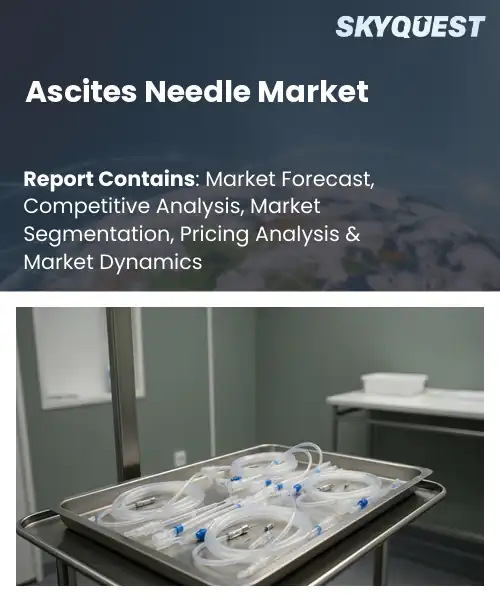
Ascites Needle Market
Report ID: SQMIG35A4253
Report ID: SQMIG35A4253
[email protected]
USA +1 351-333-4748
Report ID:
SQMIG35A4253 |
Region:
Global |
Published Date: July, 2026
Pages:
157
|Tables:
147
|Figures:
78


Global Ascites Needle Market size was valued at USD 842.60 Million in 2024 and is poised to grow from USD 904.95 Million in 2025 to USD 1602.00 Million by 2033, growing at a CAGR of 7.4% during the forecast period (2026-2033).
The ascites needle market growth is segmented on the basis of the specialization of catheter systems used for the drainage of fluid accumulation in the peritoneal cavity, which is often associated with liver cirrhosis, malignancy and heart failure. The significance of this arises from the direct impact on patient comfort, the risk of infection, and the overall success of treatments, therefore making the availability of reliable, minimally invasive devices a clinical imperative. The market has evolved in the past decade from simple trocar-based tools to ultra-thin, ergonomically designed needles with safety-lock mechanisms, spurred by heightened awareness of procedural complications and the growth of outpatient paracentesis programs. Polyurethane coating of needles has reduced iatrogenic trauma by about 30 % in liver clinics of North America.
Such incremental technical advances have changed the demand profiles and established the importance of the ascites needle market share in current hepatology practice. The next phase of growth is largely driven by the global increase in chronic liver disease and the expanding scope of ambulatory care, which together have created an unmet need for cost-effective, high-performance drainage solutions. As the trend towards day-case procedures takes hold across more health systems, manufacturers that include antimicrobial coatings and needle-less extraction ports benefit from a competitive edge, as both can directly reduce sepsis rates and shorten patient turnover time. In real-world use within European tertiary centers, smart-feedback needles that notify clinicians of excessive negative pressure have shown a 15% reduction in procedural aborts, translating technological refinement into concrete operational savings. Thus, investors are putting money into R&D pipelines for reusable needle platforms, betting that regulators will reward waste reduction, and hospitals are increasingly focused on devices that fit bundled-payment models, creating a self-reinforcing cycle of demand, innovation and market growth.
How is AI-driven Automation Impacting the Ascites Needle Market?
AI-driven automation is transforming the ascites needle market trends through enhanced production efficiency, improved needle precision, and decreased procedural inconsistency. Machine-learning algorithms control robotic assembly lines to ensure consistent quality and faster scale-up of sterile components. Integrated sensors provide real-time feedback during insertion and help clinicians to achieve optimal fluid drainage with less patient discomfort. They also allow for predictive maintenance of manufacturing equipment which reduces downtime and lowers costs. As hospitals adopt smarter workflow solutions, the demand for needles that operate in conjunction with automated diagnostic and therapeutic platforms is growing, and AI is acting as a catalyst for product development and operational efficiency.
In June 2024, B. Braun introduced an AI-enhanced ascites needle system to showcase how automation can improve insertion accuracy and reduce procedure time, supporting market growth.
Market snapshot - (2026-2033)
Global Market Size
USD 842.6 Million
Largest Segment
Disposable Ascites Needles
Fastest Growth
Safety Ascites Needles
Growth Rate
7.4% CAGR
To get more insights on this market click here to Request a Free Sample Report
Global ascites needle market is segmented by product type, needle size, application, end user, distribution channel and region. Based on product type, the market is segmented into disposable ascites needles, reusable ascites needles, safety ascites needles and others. Based on needle size, the market is segmented into 14G, 16G, 18G and others. Based on application, the market is segmented into diagnostic paracentesis, therapeutic paracentesis and others. Based on end user, the market is segmented into hospitals, ambulatory surgical centers, specialty clinics and others. Based on distribution channel, the market is segmented into direct sales, medical device distributors and others. Based on region, the market is segmented into North America, Europe, Asia Pacific, Latin America and Middle East & Africa.
Disposable ascites needles segment dominates because healthcare providers prioritize sterility, cost effectiveness, and ease of inventory management. Single use designs eliminate cross contamination risk, aligning with infection control protocols, while simplifying procurement cycles and waste handling. Clinicians favor these needles for routine paracentesis, as they remove the need for reprocessing, thereby reducing procedural turnaround time and supporting high volume outpatient settings. Additionally manufacturers can produce them at scale using standard molding techniques, ensuring consistent performance across facilities.
Meanwhile safety ascites needles segment is witnessing the strongest growth momentum because regulatory bodies are tightening needlestick injury standards, prompting hospitals to adopt engineered protection features. Integrated sheaths and retractable mechanisms enhance clinician confidence, fostering broader acceptance across procedural specialties and creating new revenue streams for manufacturers focused on innovative safety designs.
18G segment dominates because it provides an optimal balance between lumen capacity and patient comfort, making it the preferred choice for both diagnostic and therapeutic paracentesis. The larger bore facilitates efficient fluid removal while minimizing procedure time, which is critical in high throughput settings. Clinicians appreciate its versatility across varying fluid viscosities, and manufacturers can standardize production, ensuring reliable performance and widespread acceptance among practitioners throughout diverse care environments worldwide.
On the other hand 16G segment is emerging as the key high growth area because clinicians seeking reduced patient discomfort and enhanced imaging visibility are increasingly opting for slimmer needles during diagnostic paracentesis. This shift drives manufacturers to innovate with refined tip geometry, expanding market appeal and opening new opportunities in minimally invasive procedural portfolios.
To get detailed segments analysis, Request a Free Sample Report
Developed healthcare infrastructure, strong research ecosystems and high adoption of minimally invasive therapeutic technologies continue to drive North America’s dominance. There are also existing clinical guidelines that cover this area and emphasize accurate fluid management, hence the widespread use of specialized needles. The academic institutions working with device manufacturers speed up product innovation and reimbursement frameworks enable broader access. Further, the high concentration of specialized oncology and hepatology centers also adds to steady demand and further fortifies the market leadership.
Ascites needle market outlook in the United States is propelled by extensive clinical networks that emphasize early intervention for fluid accumulation. Strong emphasis on evidence‑based practice fuels continual refinement of needle designs, aligning with practitioner preferences for safety and efficiency. Investment in translational research bridges laboratory advances with bedside application, fostering a pipeline of next‑generation devices. Reimbursement mechanisms and insurance coverage further enhance adoption across hospitals and outpatient settings.
Ascites needle market forecast in Canada reflects a commitment to patient‑centered care supported by universal health coverage that encourages equitable access to advanced medical devices. Integration of national clinical protocols harmonizes practice standards, promoting consistent utilization of specialized needles across provinces. Collaborative partnerships between Canadian research institutes and global manufacturers stimulate innovation tailored to local clinical needs. Emphasis on training and competency development ensures high procedural quality, reinforcing market stability.
Rapid growth is driven by harmonized regulatory pathways, a strong focus on clinical efficacy and a multi-country collaborative research environment in Europe. Continuous improvements in needle technology are being driven by leading medical universities and specialized treatment centers, and cross-border collaborations are accelerating knowledge exchange. Market growth is driven by the preference for advanced devices that offer clear patient benefits in cost-effective health systems. Supportive reimbursement climates benefit both new market entrants and established manufacturers, and help to promote wider deployment in a variety of clinical settings.
Ascites needle market regional outlook in Germany is characterized by a dominant position facilitated by rigorous clinical standards and a tradition of engineering excellence. German healthcare providers prioritize precision tools that align with stringent safety protocols, driving demand for high‑quality needle solutions. Strong ties between research hospitals and device innovators accelerate product refinement, ensuring alignment with practitioner expectations. Reimbursement policies that reward effective fluid management further embed these devices within routine care pathways.
Ascites needle market regional forecast in the United Kingdom is the fastest growing segment, propelled by proactive healthcare policies that encourage adoption of minimally invasive techniques. NHS frameworks that emphasize patient outcomes support expedited integration of advanced needles into clinical practice. Collaborative research initiatives between academic centers and industry foster rapid prototyping and validation, enhancing market responsiveness. Continuous professional development programs ensure clinicians remain adept with evolving technologies, sustaining growth momentum.
Ascites needle market analysis in France is emerging as a notable segment, buoyed by increasing awareness of targeted fluid drainage strategies in oncology and liver disease management. French clinical guidelines endorse the use of specialized needles, creating a foundation for broader market penetration. Partnerships between French biotech firms and international manufacturers enable localization of device designs to meet specific therapeutic contexts. Growing emphasis on patient comfort and procedural efficiency drives acceptance across hospital networks.
Asia Pacific is leveraging its position with strategic investments in healthcare modernization, expanded clinical expertise and technologies tailored to diverse patient populations. The region’s fast-growing medical infrastructure is driving the adoption of advanced devices that improve procedural safety and efficacy. Market integration is driven by strong government support for innovation and growing demand for high-quality oncology care. The region is increasingly relevant, with collaborative ecosystems linking local research institutions with global manufacturers to address regional clinical nuances enabling customisation of needle solutions.
Ascites needle market penetration in Japan is driven by a culture of meticulous clinical practice and a commitment to integrating cutting‑edge medical technologies. Japanese hospitals prioritize devices that offer reliability and precision, aligning with national standards for patient safety. Ongoing collaboration between Japanese research universities and device firms fuels iterative improvements, ensuring that needle designs meet stringent performance criteria. Reimbursement structures that recognize therapeutic value support widespread clinical uptake.
Ascites needle industry in South Korea benefits from a dynamic healthcare system that embraces rapid technological adoption and continuous medical education. Strong emphasis on training and skill development equips clinicians with proficiency in using specialized needles for fluid management. Partnerships between Korean biotech startups and established medical device companies encourage innovation tailored to local disease patterns. Government initiatives that promote advanced therapeutic solutions further embed these devices within standard care protocols.
To know more about the market opportunities by region and country, click here to
Buy The Complete Report
Increasing Demand for Minimally Invasive Procedures
Advancements in Needle Design Technology
Stringent Regulatory Approval Processes
High Cost of Specialized Devices
Request Free Customization of this report to help us to meet your business objectives.
The competitive landscape is shaped by a handful of specialized players that are actively expanding distribution networks, forging strategic partnerships with hospital groups, and investing in needle‑delivery technology to improve patient comfort and procedural efficiency; recent M&A activity includes PharmaIN’s acquisition of a niche catheter maker, while BioVie has entered a joint development agreement with a major imaging firm to integrate real‑time monitoring into ascites drainage procedures.
Top Player’s Company Profile
Recent Developments in the Ascites Needle Market
SkyQuest’s ABIRAW (Advanced Business Intelligence, Research & Analysis Wing) is our Business Information Services team that Collects, Collates, Correlates, and Analyses the Data collected by means of Primary Exploratory Research backed by robust Secondary Desk research. As per SkyQuest analysis, the global ascites needle market is being propelled primarily by the rising demand for minimally invasive procedures, which drives hospitals and outpatient centers to adopt needle‑based fluid drainage as a standard of care. A second catalyst is the rapid advancement of needle design, including AI‑enhanced manufacturing and safety‑lock features that improve accuracy and lower complication rates. The market is led by North America, where robust reimbursement and research ecosystems sustain strong uptake. Disposable ascites needles dominate the segment mix because they offer sterility, cost‑effectiveness, and simple inventory management. Nevertheless, stringent regulatory approval processes pose a restraint, extending time‑to‑market and increasing development costs for manufacturers.
| Report Metric | Details |
|---|---|
| Market size value in 2024 | USD 842.6 Million |
| Market size value in 2033 | USD 1602.0 Million |
| Growth Rate | 7.4% |
| Base year | 2024 |
| Forecast period | (2026-2033) |
| Forecast Unit (Value) | USD Million |
| Segments covered |
|
| Regions covered | North America (US, Canada), Europe (Germany, France, United Kingdom, Italy, Spain, Rest of Europe), Asia Pacific (China, India, Japan, Rest of Asia-Pacific), Latin America (Brazil, Rest of Latin America), Middle East & Africa (South Africa, GCC Countries, Rest of MEA) |
| Companies covered |
|
| Customization scope | Free report customization with purchase. Customization includes:-
|
To get a free trial access to our platform which is a one stop solution for all your data requirements for quicker decision making. This platform allows you to compare markets, competitors who are prominent in the market, and mega trends that are influencing the dynamics in the market. Also, get access to detailed SkyQuest exclusive matrix.
Table Of Content
Executive Summary
Market overview
Parent Market Analysis
Market overview
Market size
KEY MARKET INSIGHTS
COVID IMPACT
MARKET DYNAMICS & OUTLOOK
Market Size by Region
KEY COMPANY PROFILES
Methodology
For the Ascites Needle Market, our research methodology involved a mixture of primary and secondary data sources. Key steps involved in the research process are listed below:
1. Information Procurement: This stage involved the procurement of Market data or related information via primary and secondary sources. The various secondary sources used included various company websites, annual reports, trade databases, and paid databases such as Hoover's, Bloomberg Business, Factiva, and Avention. Our team did 45 primary interactions Globally which included several stakeholders such as manufacturers, customers, key opinion leaders, etc. Overall, information procurement was one of the most extensive stages in our research process.
2. Information Analysis: This step involved triangulation of data through bottom-up and top-down approaches to estimate and validate the total size and future estimate of the Ascites Needle Market.
3. Report Formulation: The final step entailed the placement of data points in appropriate Market spaces in an attempt to deduce viable conclusions.
4. Validation & Publishing: Validation is the most important step in the process. Validation & re-validation via an intricately designed process helped us finalize data points to be used for final calculations. The final Market estimates and forecasts were then aligned and sent to our panel of industry experts for validation of data. Once the validation was done the report was sent to our Quality Assurance team to ensure adherence to style guides, consistency & design.
Analyst Support
Customization Options
With the given market data, our dedicated team of analysts can offer you the following customization options are available for the Ascites Needle Market:
Product Analysis: Product matrix, which offers a detailed comparison of the product portfolio of companies.
Regional Analysis: Further analysis of the Ascites Needle Market for additional countries.
Competitive Analysis: Detailed analysis and profiling of additional Market players & comparative analysis of competitive products.
Go to Market Strategy: Find the high-growth channels to invest your marketing efforts and increase your customer base.
Innovation Mapping: Identify racial solutions and innovation, connected to deep ecosystems of innovators, start-ups, academics, and strategic partners.
Category Intelligence: Customized intelligence that is relevant to their supply Markets will enable them to make smarter sourcing decisions and improve their category management.
Public Company Transcript Analysis: To improve the investment performance by generating new alpha and making better-informed decisions.
Social Media Listening: To analyze the conversations and trends happening not just around your brand, but around your industry as a whole, and use those insights to make better Marketing decisions.
REQUEST FOR SAMPLE
 REQUEST FREE CUSTOMIZATION
Global Ascites Needle Market size was valued at USD 842.6 Million in 2024 and is poised to grow from USD 904.95 Million in 2025 to USD 1602.0 Million by 2033, growing at a CAGR of 7.4% during the forecast period (2026-2033).
The competitive landscape is shaped by a handful of specialized players that are actively expanding distribution networks, forging strategic partnerships with hospital groups, and investing in needle‑delivery technology to improve patient comfort and procedural efficiency; recent M&A activity includes PharmaIN’s acquisition of a niche catheter maker, while BioVie has entered a joint development agreement with a major imaging firm to integrate real‑time monitoring into ascites drainage procedures. 'Becton, Dickinson and Company', 'Cook Medical LLC', 'Merit Medical Systems, Inc.', 'Argon Medical Devices, Inc.', 'Teleflex Incorporated', 'B. Braun SE', 'Boston Scientific Corporation', 'Cardinal Health, Inc.', 'Vygon SAS', 'Smiths Medical', 'Medtronic plc', 'Suru International Pvt. Ltd.', 'Romsons Group', 'Well Lead Medical Co., Ltd.', 'Create Medic Co., Ltd.', 'UROMED Kurt Drews KG', 'Galt Medical Corp.', 'Laborie Medical Technologies', 'Advin Health Care', 'Angiplast Pvt. Ltd.'
Healthcare providers are increasingly preferring minimally invasive approaches for fluid management, which positions ascites needles as essential tools for safe and efficient drainage. The ease of insertion, reduced patient discomfort, and lower complication rates associated with these needles support broader acceptance across clinical settings. Consequently, hospitals and outpatient centers are integrating such devices into standard protocols, driving consistent demand and encouraging manufacturers to expand their product offerings to meet evolving therapeutic requirements. This trend also enhances training programs that emphasize needle-based interventions, further solidifying market growth.
Minimally Invasive Preference Surge: Healthcare providers are increasingly favoring minimally invasive techniques for ascites management, driven by patient demand for reduced procedural discomfort and faster recovery. The adoption of thin‑walled, flexible needles facilitates bedside drainage, decreasing reliance on operating‑room resources. Clinicians value the ability to perform repeated taps with minimal tissue trauma, which aligns with broader moves toward outpatient care models. This preference accelerates demand for needle systems that combine ergonomic design, reliable sealing mechanisms, and compatibility with diverse drainage catheters in routine practice.
Why does North America Dominate the Global Ascites Needle Market? |@12


Want to customize this report? This report can be personalized according to your needs. Our analysts and industry experts will work directly with you to understand your requirements and provide you with customized data in a short amount of time. We offer $1000 worth of FREE customization at the time of purchase.
Feedback From Our Clients


 USA (+1) 351-333-4748

