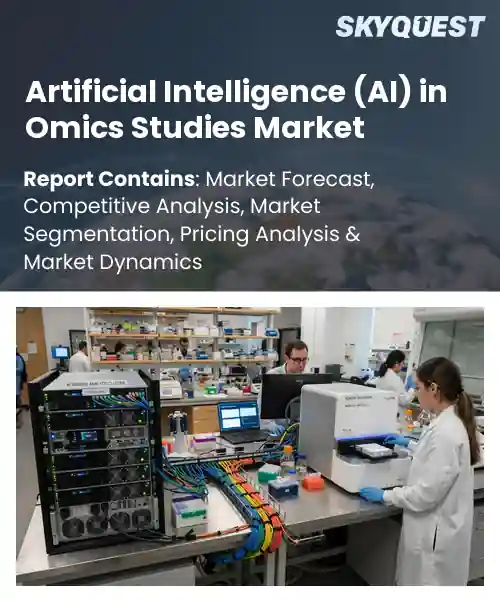
Artificial Intelligence (AI) in Omics Studies Market
Report ID: SQMIG35J2849
Report ID: SQMIG35J2849
[email protected]
USA +1 351-333-4748
Report ID:
SQMIG35J2849 |
Region:
Global |
Published Date: October, 2026
Pages:
157
|Tables:
149
|Figures:
78


Global Artificial Intelligence (Ai) In Omics Studies Market size was valued at USD 1.65 Billion in 2024 and is poised to grow from USD 2.12 Billion in 2025 to USD 15.66 Billion by 2033, growing at a CAGR of 28.4% during the forecast period (2026-2033).
Regulatory endorsement of AI‑derived diagnostics stands as the key catalyst propelling market expansion, because guidance translates innovation into reimbursable clinical products. When the FDA granted Breakthrough Device designation to AI‑enhanced liquid biopsy platforms such as GRAIL’s Galleri, insurers began to cover tests that can detect cancers from blood, prompting hospitals to adopt the technology at scale. This adoption fuels demand for data‑curation pipelines, inference engines, and standards, creating an ecosystem for vendors like DNAnexus and Seven Bridges. Significant investment inflows have surged, enabling startups to accelerate algorithm refinement, integrate multi‑omics layers, and deliver personalized treatment recommendations that improve patient outcomes.
How is AI-powered automation reshaping the omics studies market?
AI-powered automation is redefining omics by linking rapid data generation with intelligent interpretation. Machine‑learning models now sort raw reads, call variants and annotate pathways without manual input, while robotics handle library preparation and sample plating. Cloud‑based pipelines stitch together genomics, transcriptomics and proteomics, creating unified views that accelerate hypothesis testing. Companies such as Illumina, 10x Genomics and DNAnexus embed these capabilities into their platforms, allowing researchers to move from tissue to insight in days rather than weeks. This seamless flow reduces error, cuts cost and opens large‑scale studies that were previously impractical, making the market more dynamic and accessible.DeepMind, July 2023, launched a scaled AlphaFold pipeline that automatically predicts protein structures for entire proteomes, giving proteomics teams instant structural insight and eliminating years of manual modeling, thereby speeding discovery and expanding market adoption of AI‑driven omics workflows across research institutions worldwide and pharmaceutical pipelines enhancing speed and reproducibility.
Market snapshot - (2026-2033)
Global Market Size
USD 1.65 Billion
Largest Segment
Genomics
Fastest Growth
Multi-Omics
Growth Rate
28.4% CAGR
To get more insights on this market click here to Request a Free Sample Report
Global artificial intelligence (ai) in omics studies market is segmented by omics type, ai technology, application, deployment, end user and region. Based on omics type, the market is segmented into Genomics, Transcriptomics, Proteomics, Metabolomics and Multi-Omics. Based on ai technology, the market is segmented into Machine Learning, Deep Learning, Generative AI and Natural Language Processing. Based on application, the market is segmented into Biomarker Discovery, Drug Discovery & Development, Disease Diagnosis, Precision Medicine and Drug Response Prediction. Based on deployment, the market is segmented into Cloud-Based, On-Premise and Hybrid. Based on end user, the market is segmented into Pharmaceutical & Biotechnology Companies, Academic & Research Institutions and Hospitals & Healthcare Providers. Based on region, the market is segmented into North America, Europe, Asia Pacific, Latin America and Middle East & Africa.
Machine Learning segment dominates because its algorithmic flexibility enables rapid preprocessing, feature extraction, and predictive modeling across diverse omics datasets. Researchers favor it for its interpretability, which facilitates validation of biological hypotheses and accelerates iterative experiment cycles. The abundance of labeled data in genomics and transcriptomics further fuels adoption, while open source libraries lower entry barriers, reinforcing its central position in the AI in omics studies market.
However, Deep Learning segment emerges as the fastest growing because its capacity to model hierarchical patterns unlocks insights from high dimensional multi omics data. Advances in GPU acceleration and novel architecture designs attract biotech firms seeking end to end pipelines, expanding market reach and creating new opportunities for integrated AI driven discovery.
Biomarker Discovery segment dominates because it directly translates AI derived patterns into clinically actionable targets, satisfying urgent needs for early detection and therapeutic monitoring. AI algorithms excel at sifting through massive genomic and proteomic recordings to pinpoint disease specific signatures, shortening validation timelines. This utility drives substantial investment from pharmaceutical players and research consortia, cementing its leadership in the AI in omics studies market.
Meanwhile, Precision Medicine segment is witnessing the strongest growth momentum as personalized treatment plans demand integrative AI analyses across multiple omics layers. Regulatory frameworks encourage data sharing, while patient centric models push for real time predictive tools, spurring adoption. These dynamics amplify market expansion, positioning precision medicine as a key catalyst for future AI enabled omics innovations.
To get detailed segments analysis, Request a Free Sample Report
North America leads the global Artificial Intelligence (AI) in Omics Studies Market through a confluence of advanced research ecosystems, substantial private investment, and a mature healthcare infrastructure. The region hosts world‑renowned academic centers and biotech hubs that continuously generate high‑quality multi‑omics data, providing fertile ground for AI algorithm development. Robust funding streams from venture capital and large pharmaceutical corporations accelerate translation of AI‑driven discoveries into commercial solutions. In addition, a regulatory framework that balances innovation with patient safety encourages rapid adoption of AI tools across precision medicine, drug discovery, and clinical diagnostics. Strong computational infrastructure, including cloud services and high‑performance computing clusters, further empowers researchers to process complex omics datasets at scale, reinforcing North America’s dominant position.
Artificial Intelligence (AI) in Omics Studies Market in the United States benefits from a dense concentration of leading universities, biotech startups, and major pharmaceutical firms that collaborate closely on data‑intensive projects. The ecosystem is supported by extensive funding mechanisms and a culture of entrepreneurial risk‑taking, which accelerates the commercialization of AI‑enabled diagnostic platforms. Integrated health‑record systems and a proactive regulatory environment further encourage rapid integration of AI solutions into clinical practice.
Artificial Intelligence (AI) in Omics Studies Market in Canada is bolstered by strong public research institutions and government‑backed innovation programs that emphasize translational genomics. Collaborative networks linking academic labs with health agencies foster the development of AI models tailored to population‑specific genetic diversity. Investment in cloud infrastructure and a commitment to ethical data governance create a supportive environment for deploying AI tools in personalized medicine and public health initiatives across the country.
Europe’s rapid expansion of the Artificial Intelligence (AI) in Omics Studies Market is driven by coordinated research funding, cross‑border collaborative frameworks, and a strong clinical genomics landscape. The European Union promotes large‑scale data sharing initiatives that unify diverse omics datasets, enabling AI developers to train more robust models. Public‑private partnerships between biotech clusters, research hospitals, and technology firms accelerate translation of AI insights into therapeutic and diagnostic applications. A regulatory approach that emphasizes data privacy while encouraging innovation supports adoption in both academic and commercial settings. Moreover, a skilled multidisciplinary workforce and a growing emphasis on sustainable health solutions position Europe as a fertile ground for AI‑enabled omics research.
Artificial Intelligence (AI) in Omics Studies Market in Germany is anchored by world‑class research universities and a dense network of biotech enterprises that specialize in proteomics and metabolomics. Government‑driven funding programs prioritize AI integration within precision medicine projects, fostering collaborations between hospitals and technology providers. Strong industrial expertise in pharmaceuticals complements academic research, leading to the development of AI‑based drug target identification tools. An emphasis on data security and interoperability further reinforces Germany’s leading role in the European landscape.
Artificial Intelligence (AI) in Omics Studies Market in the United Kingdom experiences accelerated growth through thriving life‑science hubs and a vibrant startup ecosystem focused on AI‑driven health solutions. Strategic national initiatives promote the convergence of genomics databases with advanced machine‑learning platforms, enabling rapid prototyping of diagnostic applications. Partnerships between NHS trusts, academic institutions, and tech companies ensure real‑world validation of AI models. A progressive regulatory stance that balances patient safety with innovation expedites market entry for novel AI‑enabled omics services.
Artificial Intelligence (AI) in Omics Studies Market in France is emerging as a dynamic sector supported by strong governmental investment in digital health and genomics research. Collaborative consortia linking biotech firms with leading research institutes drive the creation of AI algorithms for disease biomarker discovery. Emphasis on open science and data sharing facilitates the training of machine‑learning models across diverse population datasets. Growing expertise in bioinformatics and a favorable policy environment encourage the translation of AI insights into clinical practice.
The Asia Pacific region is strengthening its position in the Artificial Intelligence (AI) in Omics Studies Market through strategic government initiatives, rapid industrialization of biotech, and expanding digital health infrastructures. Nations are investing heavily in national genomics programs that generate large‑scale omics repositories, providing rich training grounds for AI models. Close collaboration between leading technology firms and pharmaceutical companies accelerates the development of AI‑powered drug discovery pipelines. Growing expertise in data science, coupled with a cultural emphasis on rapid technology adoption, facilitates swift integration of AI tools into clinical and research settings. Regional conferences and cross‑border partnerships further enhance knowledge exchange, positioning Asia Pacific as an emerging leader in AI‑driven omics innovation.
Artificial Intelligence (AI) in Omics Studies Market in Japan benefits from a long‑standing commitment to precision medicine and advanced robotics. National research agencies fund large‑scale genomic projects that are combined with AI research centers to develop predictive health models. Collaboration between multinational pharmaceutical corporations and local AI startups accelerates the translation of omics insights into therapeutic candidates. Strong data privacy frameworks and a focus on integrating AI tools within hospital information systems support widespread clinical adoption across the country.
Artificial Intelligence (AI) in Omics Studies Market in South Korea is propelled by ambitious government roadmaps that link genomics data generation with AI innovation clusters. The country’s high‑tech manufacturing base provides sophisticated hardware for high‑throughput sequencing and AI computation. Partnerships between leading universities, biotech firms, and global tech giants foster the creation of AI algorithms for personalized medicine and biomarker identification. A supportive regulatory environment encourages rapid testing and deployment of AI‑enhanced omics platforms within both research institutions and commercial healthcare providers.
To know more about the market opportunities by region and country, click here to
Buy The Complete Report
Advancements in Deep Learning Algorithms
Increasing Adoption of Cloud Platforms
Limited Availability of Labeled Datasets
Regulatory Concerns Over Data Privacy
Request Free Customization of this report to help us to meet your business objectives.
Illumina’s 2020 acquisition of GRAIL, Thermo Fisher’s 2022 partnership with Microsoft Azure for AI‑enabled cloud genomics, and DeepMind’s AlphaFold 2 release in 2021 have intensified competition, driving rapid integration of AI into omics pipelines and prompting rivals to accelerate tech innovation, strategic alliances and portfolio expansion.
Top Player’s Company Profile
Recent Developments
SkyQuest’s ABIRAW (Advanced Business Intelligence, Research & Analysis Wing) is our Business Information Services team that Collects, Collates, Correlates, and Analyses the Data collected by means of Primary Exploratory Research backed by robust Secondary Desk research. As per SkyQuest analysis the global AI in omics market is expanding rapidly, driven primarily by regulatory endorsement of AI‑derived diagnostics that turn breakthrough designations into reimbursable tests, while a second major catalyst is the surge in cloud‑based platforms that give researchers scalable compute and collaborative workflows. The market is tempered by the limited availability of high‑quality labelled datasets, which slows model training and validation. North America remains the dominant region thanks to deep research ecosystems, strong venture funding and mature health‑care infrastructure. At the segment level machine‑learning leads, favored for its flexibility and interpretability across genomics and proteomics applications, reinforcing its central role in market growth.
| Report Metric | Details |
|---|---|
| Market size value in 2024 | USD 1.65 Billion |
| Market size value in 2033 | USD 15.66 Billion |
| Growth Rate | 28.4% |
| Base year | 2024 |
| Forecast period | (2026-2033) |
| Forecast Unit (Value) | USD Billion |
| Segments covered |
|
| Regions covered | North America (US, Canada), Europe (Germany, France, United Kingdom, Italy, Spain, Rest of Europe), Asia Pacific (China, India, Japan, Rest of Asia-Pacific), Latin America (Brazil, Rest of Latin America), Middle East & Africa (South Africa, GCC Countries, Rest of MEA) |
| Companies covered |
|
| Customization scope | Free report customization with purchase. Customization includes:-
|
To get a free trial access to our platform which is a one stop solution for all your data requirements for quicker decision making. This platform allows you to compare markets, competitors who are prominent in the market, and mega trends that are influencing the dynamics in the market. Also, get access to detailed SkyQuest exclusive matrix.
Table Of Content
Executive Summary
Market overview
Parent Market Analysis
Market overview
Market size
KEY MARKET INSIGHTS
COVID IMPACT
MARKET DYNAMICS & OUTLOOK
Market Size by Region
KEY COMPANY PROFILES
Methodology
For the Artificial Intelligence (AI) in Omics Studies Market, our research methodology involved a mixture of primary and secondary data sources. Key steps involved in the research process are listed below:
1. Information Procurement: This stage involved the procurement of Market data or related information via primary and secondary sources. The various secondary sources used included various company websites, annual reports, trade databases, and paid databases such as Hoover's, Bloomberg Business, Factiva, and Avention. Our team did 45 primary interactions Globally which included several stakeholders such as manufacturers, customers, key opinion leaders, etc. Overall, information procurement was one of the most extensive stages in our research process.
2. Information Analysis: This step involved triangulation of data through bottom-up and top-down approaches to estimate and validate the total size and future estimate of the Artificial Intelligence (AI) in Omics Studies Market.
3. Report Formulation: The final step entailed the placement of data points in appropriate Market spaces in an attempt to deduce viable conclusions.
4. Validation & Publishing: Validation is the most important step in the process. Validation & re-validation via an intricately designed process helped us finalize data points to be used for final calculations. The final Market estimates and forecasts were then aligned and sent to our panel of industry experts for validation of data. Once the validation was done the report was sent to our Quality Assurance team to ensure adherence to style guides, consistency & design.
Analyst Support
Customization Options
With the given market data, our dedicated team of analysts can offer you the following customization options are available for the Artificial Intelligence (AI) in Omics Studies Market:
Product Analysis: Product matrix, which offers a detailed comparison of the product portfolio of companies.
Regional Analysis: Further analysis of the Artificial Intelligence (AI) in Omics Studies Market for additional countries.
Competitive Analysis: Detailed analysis and profiling of additional Market players & comparative analysis of competitive products.
Go to Market Strategy: Find the high-growth channels to invest your marketing efforts and increase your customer base.
Innovation Mapping: Identify racial solutions and innovation, connected to deep ecosystems of innovators, start-ups, academics, and strategic partners.
Category Intelligence: Customized intelligence that is relevant to their supply Markets will enable them to make smarter sourcing decisions and improve their category management.
Public Company Transcript Analysis: To improve the investment performance by generating new alpha and making better-informed decisions.
Social Media Listening: To analyze the conversations and trends happening not just around your brand, but around your industry as a whole, and use those insights to make better Marketing decisions.
REQUEST FOR SAMPLE
 REQUEST FREE CUSTOMIZATION


Want to customize this report? This report can be personalized according to your needs. Our analysts and industry experts will work directly with you to understand your requirements and provide you with customized data in a short amount of time. We offer $1000 worth of FREE customization at the time of purchase.
Feedback From Our Clients


 USA (+1) 351-333-4748

