Artificial Intelligence in Construction Market
Report ID: SQMIG45E2431
Report ID: SQMIG45E2431
[email protected]
USA +1 351-333-4748
Report ID:
SQMIG45E2431 |
Region:
Global |
Published Date: August, 2025
Pages:
195
|Tables:
93
|Figures:
71


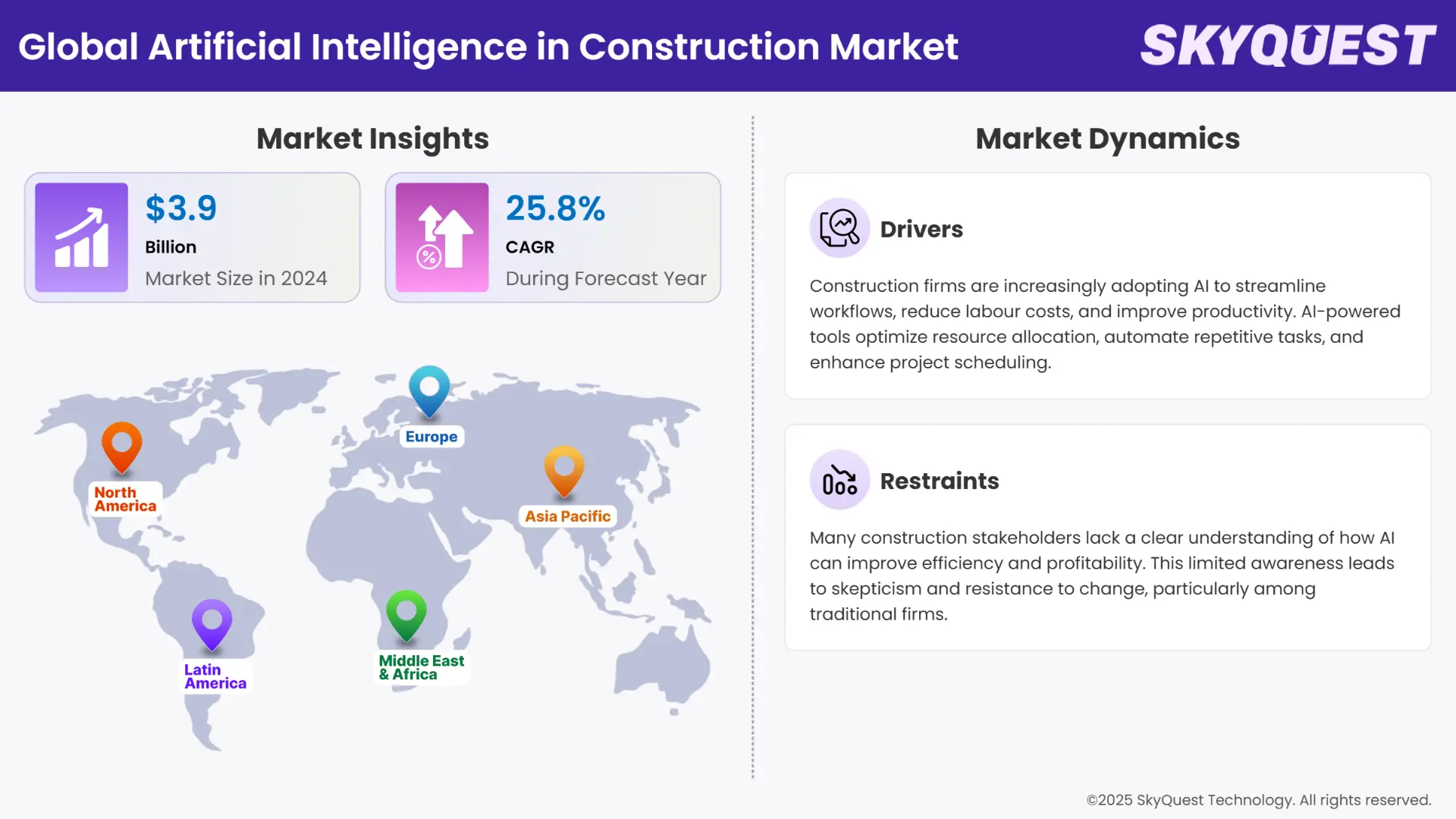
Global Artificial Intelligence in Construction Market size was valued at USD 3.9 Billion in 2024 poised to grow between USD 4.91 Billion in 2025 to USD 30.77 Billion by 2033, growing at a CAGR of 25.8% in the forecast period (2026–2033).
The construction industry is increasingly embracing automation and robotics, driven by persistent labour shortages, high accident rates, and the pressure to complete projects faster. AI-powered machines such as autonomous bulldozers, robotic arms, and drones reduce human intervention in dangerous or repetitive tasks. This results in improved worker safety, minimized downtime, and accelerated project execution. Additionally, automation ensures greater accuracy and consistency in operations, lowering material waste and operational costs. These tangible benefits create a strong business case for AI adoption. Consequently, construction companies are actively investing in AI technologies to enhance productivity, address workforce challenges, and remain competitive in a rapidly evolving market.
The construction sector generates vast volumes of data from diverse sources—BIM models, IoT-enabled equipment, GPS trackers, and site cameras. AI technologies enable seamless integration of this data to generate actionable insights through visual analytics, predictive modeling, and real-time dashboards. This empowers project managers to anticipate potential delays, optimize resource allocation, and detect safety hazards early. AI's ability to analyze patterns across complex datasets results in smarter scheduling, better cost control, and risk mitigation. As projects become increasingly data-driven, the demand for AI tools that transform raw data into strategic decisions grows—positioning data integration and analytics as a key enabler in AI-driven construction transformation.
How do Predictive Modeling and Digital Twins Contribute to Construction Efficiency?
Artificial Intelligence is directly transforming the construction industry by automating design, planning, and on-site monitoring processes. As firms face rising labor shortages and project delays, AI-enabled tools like predictive modeling, autonomous machinery, and digital twins offer real-time insights and streamlined workflows. This causes faster project completion, enhanced safety, and reduced costs. Indirectly, AI integration is encouraging regulatory bodies and investors to support tech-forward infrastructure projects. A recent example includes Cuby Technologies’ AI-driven modular housing, which reduces build time by 50%. This success increases trust in AI-based solutions, causing broader adoption and accelerating growth in the global AI in construction market.
In 2025, U.S.-based startup Bild AI secured .1 million in seed funding to develop AI tools for automating blueprint analysis and cost estimation. This advancement enhances project accuracy and reduces planning time, encouraging faster adoption of AI technologies in construction and contributing to greater efficiency and affordability in global projects.
To get more insights on this market click here to Request a Free Sample Report
The global artificial intelligence in construction market is segmented based on product, distribution channel, distribution channel, and region. In terms of product, the market is bifurcated into hard and conventional. Based on distribution channel, the market is divided into on-trade and off-trade. Based on distribution channel, the market is bifurcated into store based and non-store based. Based on region, the market is segmented into North America, Europe, Asia-Pacific, Central & South America and the Middle East & Africa.
How does Scalability Factor into the Preference for Solution Offerings in Construction AI?
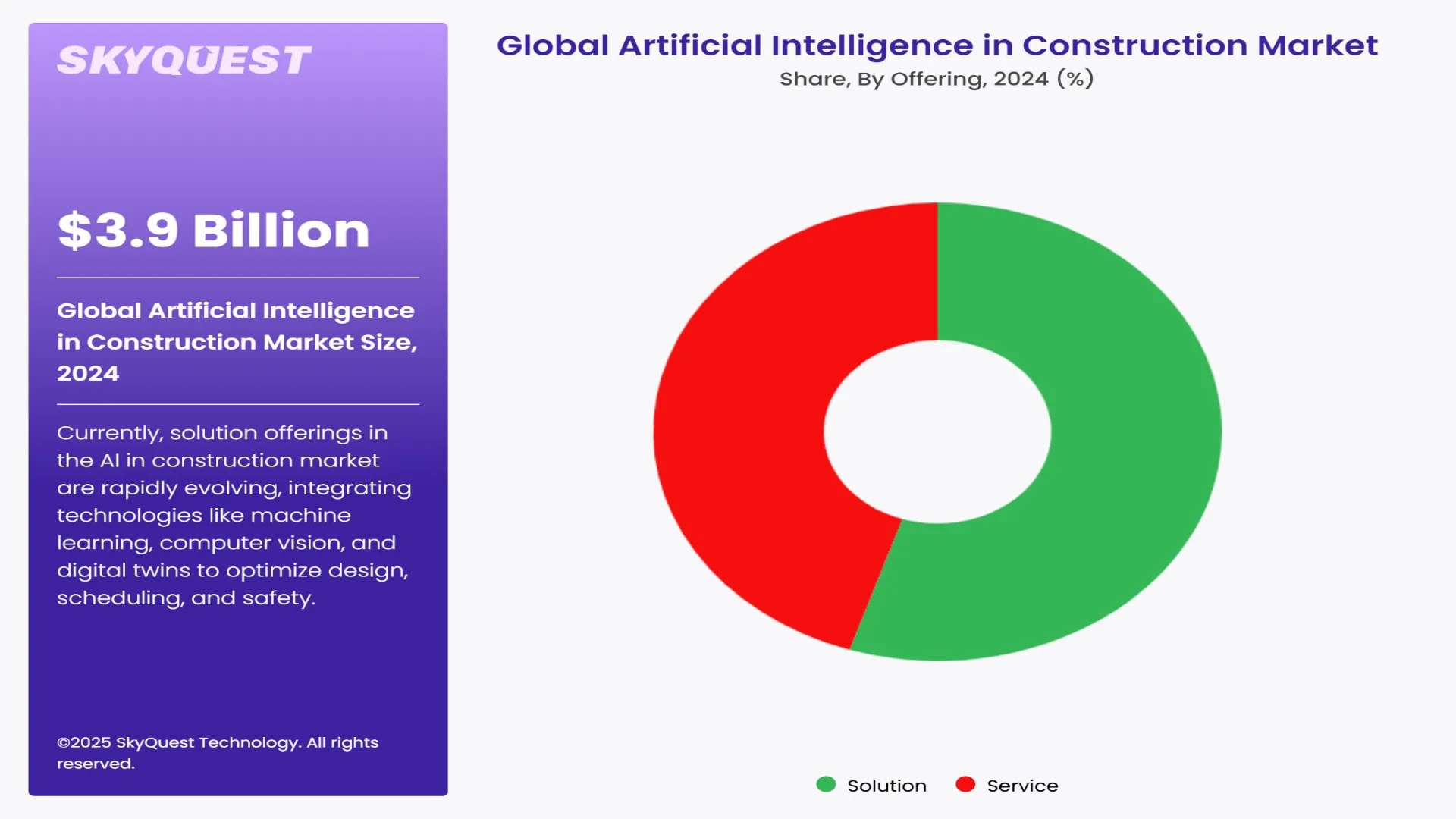
Currently, solution offerings in the AI in construction market are rapidly evolving, integrating technologies like machine learning, computer vision, and digital twins to optimize design, scheduling, and safety. These solutions enable real-time analytics, predictive maintenance, and automation, significantly improving productivity. Solution offerings dominate the market because they provide comprehensive, customizable platforms tailored to specific construction needs, offering immediate value and scalability compared to standalone services or hardware components.
Service offering is projected to be the fastest-growing segment due to the increasing need for AI integration, training, and support across construction firms lacking in-house expertise. As AI solutions become more complex, demand rises for consulting, system customization, and maintenance services—driving rapid growth in the global AI in construction services market.
Which AI Innovations are Commonly Used in Construction Project Management?
Project management applications dominate the AI in construction market due to their ability to streamline scheduling, budgeting, and resource allocation. AI innovations such as predictive analytics, digital twins, and real-time progress tracking optimize project workflows and reduce delays. These tools enhance collaboration, minimize risks, and improve decision-making across teams. As construction projects grow in complexity, the demand for AI-driven project management solutions continues to rise, solidifying their leading market position.
Risk Management applications will be the fastest-growing segment in the global AI in construction market because they proactively identify safety hazards, cost overruns, and scheduling risks using predictive analytics. As firms prioritize risk mitigation, demand rises for AI tools that forecast delays, prevent accidents, and ensure compliance—driving swift adoption and growth.
To get detailed segments analysis, Request a Free Sample Report
Why is North America Considered a Key Hub for Innovation in AI-Driven Construction Solutions?
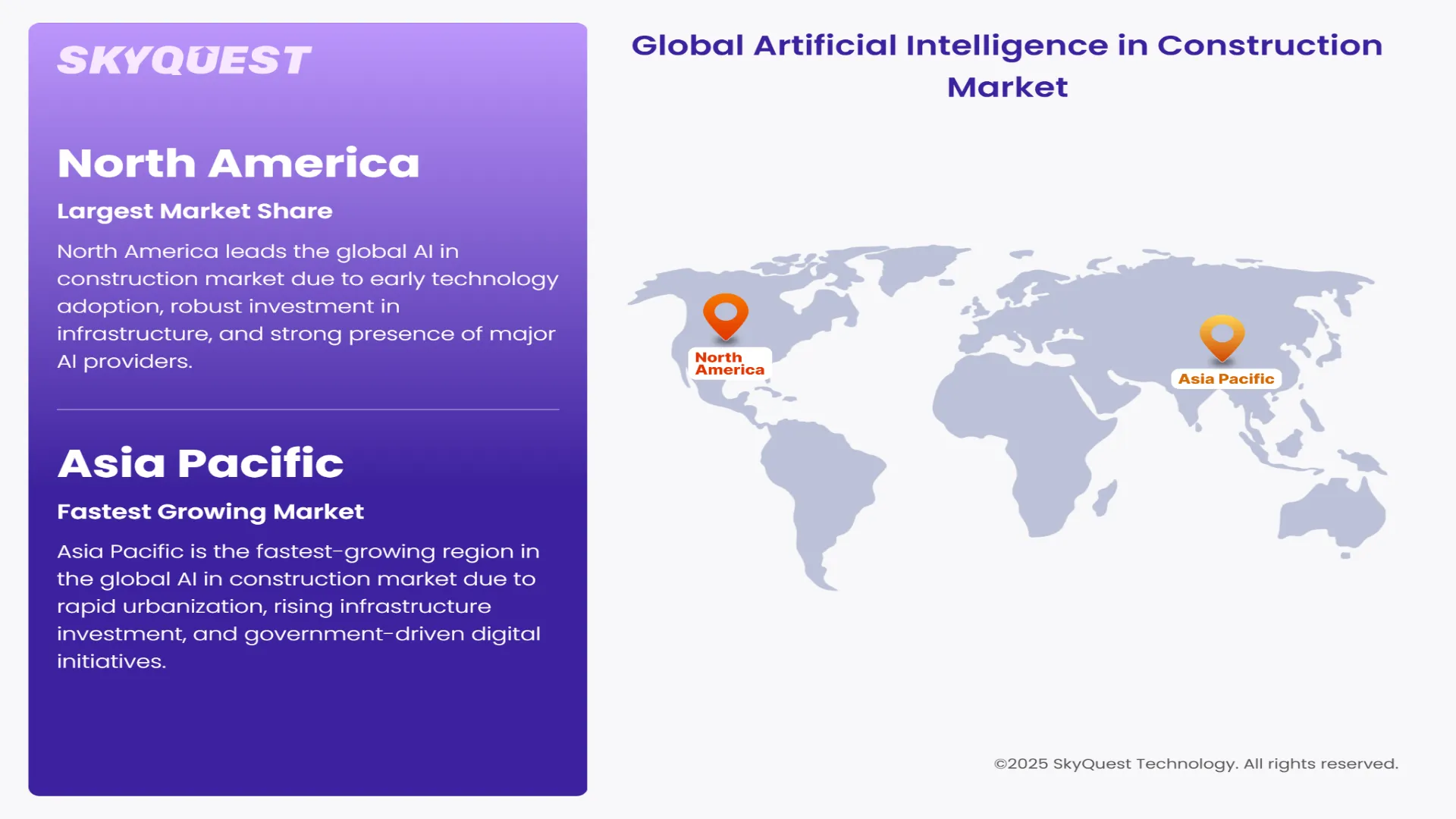
North America leads the global AI in construction market due to early technology adoption, robust investment in infrastructure, and strong presence of major AI providers. The U.S. and Canada are actively integrating AI for project planning, risk assessment, and safety management. Government initiatives promoting smart city development and digital transformation further drive growth, positioning the region as a key hub for innovation and expansion in AI-driven construction solutions.
US Artificial Intelligence in Construction Market
The United States leads North America’s AI in construction market due to strong investment in infrastructure, advanced technology adoption, and the presence of major AI solution providers. The country leverages AI for project planning, risk mitigation, and automation in large-scale construction projects. Government initiatives and funding further support AI integration, while collaboration between construction firms and tech companies accelerates innovation and enhances productivity across commercial and residential construction sectors.
Canada Artificial Intelligence in Construction Market
Canada significantly contributes to the regional market through growing AI research hubs and innovation-driven construction practices. Government support and funding for AI development have accelerated its adoption in construction, especially in modular building and robotics. Canadian firms increasingly use AI for site monitoring, cost estimation, and workforce optimization. Strong academic-industry collaboration and a focus on sustainable, tech-enabled infrastructure are propelling Canada’s AI-driven construction capabilities and overall market growth.
Why is Predictive Maintenance Important for the Construction Industry in Asia Pacific?
Asia Pacific is the fastest-growing region in the global AI in construction market due to rapid urbanization, rising infrastructure investment, and government-driven digital initiatives. Countries like China, Japan, India, and South Korea are adopting AI for smart city development, project automation, and predictive maintenance. The region’s strong construction pipeline, expanding tech ecosystem, and increasing demand for efficient, sustainable building practices are driving accelerated AI adoption across both public and private construction sectors.
Japan Artificial Intelligence in Construction Market
Japan contributes significantly to the global AI in construction market through its advanced use of robotics, automation, and smart construction technologies. Companies like Komatsu and Shimizu Corporation utilize AI for autonomous equipment, safety monitoring, and project optimization. Government initiatives under Society 5.0 promote digital transformation across infrastructure. With a strong focus on addressing labor shortages and improving efficiency, Japan is emerging as a leader in AI-driven construction innovation and smart site deployment.
South Korea Artificial Intelligence in Construction Market
South Korea plays a vital role in the AI in construction market by integrating AI with robotics, smart sensors, and modular building systems. Leading firms like Hyundai E&C use AI-powered robots and drones for site inspection and hazard detection. Government support for digital construction initiatives and smart city development accelerates AI adoption. South Korea’s emphasis on safety, efficiency, and prefabrication strengthens its position in the global AI-driven construction landscape.
How are EU-Backed Funding Programs Influencing AI Adoption in Construction?
Europe holds a strong position in the global AI in construction market due to rising demand for sustainable building practices and digital transformation. Countries like Germany, the UK, and France are actively adopting AI for project planning, energy efficiency, and compliance management. EU-backed funding and smart city initiatives are accelerating AI deployment. The region’s strong regulatory framework and focus on innovation continue to drive growth and adoption across diverse construction applications.
Germany Artificial Intelligence in Construction Market
Germany significantly contributes to the global AI in construction market through its strong emphasis on digitalization and Industry 4.0. The country mandates BIM for public infrastructure projects and actively integrates AI for project planning, robotics, and energy efficiency. Government initiatives and partnerships with technology firms support AI-based solutions, while smart city development and sustainable construction practices further drive AI adoption, positioning Germany as a technological leader in construction innovation.
France Artificial Intelligence in Construction Market
France plays a key role in the global AI in construction market by investing in digital infrastructure, cloud computing, and AI research. Government-backed funding and strategic partnerships are driving the development of AI tools for sustainable design, urban planning, and real-time risk management. France’s focus on reducing carbon emissions and enhancing energy efficiency promotes the integration of AI into smart building solutions, contributing to the market’s overall growth.
UK Artificial Intelligence in Construction Market
The United Kingdom contributes to the AI in construction market through early adoption of BIM standards, advanced regulatory frameworks, and strong collaboration between public and private sectors. AI is used to enhance productivity, automate project management, and improve energy performance in buildings. Ongoing investments in smart infrastructure and digital twins further support AI deployment, making the UK a regional leader in driving AI-based transformation in the construction industry.
To know more about the market opportunities by region and country, click here to
Buy The Complete Report
Artificial Intelligence in Construction Market Drivers
Rising Demand for Productivity and Cost Efficiency
Growing Need for Safety and Risk Management
Artificial Intelligence in Construction Market Restraints
Limited Awareness and Understanding of AI Benefits
Inconsistent Data Quality and Availability
Request Free Customization of this report to help us to meet your business objectives.
The competitive landscape of the global AI in construction market features major players like Autodesk Inc., IBM Corporation, Oracle Corporation, Trimble Inc., and Procore Technologies. These companies focus on strategic partnerships, cloud-based AI integration, and product innovation. For example, Autodesk leverages AI in BIM tools, while Oracle enhances project analytics. Procore integrates AI-driven risk analysis. Such strategies help these firms strengthen market presence and address evolving construction challenges through intelligent solutions.
The global Artificial Intelligence in Construction market is witnessing an influx of startups focusing on automation, analytics, and safety. These emerging companies leverage AI to streamline project planning, risk detection, and progress monitoring. Their agility allows faster deployment of innovative solutions like drone inspections, real-time scheduling, and blueprint parsing. Backed by venture capital, these startups are reshaping traditional workflows by offering scalable, cost-effective tools, thus attracting global attention and driving digital transformation across the sector.
Top Player’s Company Profiles
Recent Developments in Artificial Intelligence in Construction Market
SkyQuest’s ABIRAW (Advanced Business Intelligence, Research & Analysis Wing) is our Business Information Services team that Collects, Collates, Correlates, and Analyses the Data collected by means of Primary Exploratory Research backed by robust Secondary Desk research.
As per SkyQuest analysis, the Global Artificial Intelligence in Construction Market is undergoing rapid transformation, driven by increasing demand for automation, data integration, and risk management. AI's ability to enhance productivity, safety, and cost-efficiency makes it an essential tool for modern construction practices. Market leaders and startups alike are advancing AI-powered solutions—ranging from blueprint analysis to modular construction—that are reshaping project planning and execution.
Regional markets such as North America and Asia-Pacific are spearheading growth due to strong tech infrastructure and supportive government initiatives. Solution offerings dominate due to their flexibility and scalability, while services are emerging as a high-growth segment to support AI integration. With consistent innovation and expanding use cases, AI is set to redefine the construction industry's future on a global scale.
| Report Metric | Details |
|---|---|
| Market size value in Construction | USD 3.9 Billion |
| Market size value in 2033 | USD 30.77 Billion |
| Growth Rate | 25.8% |
| Base year | 2024 |
| Forecast period | 2026-2033 |
| Forecast Unit (Value) | USD Billion |
| Segments covered |
|
| Regions covered | North America (US, Canada), Europe (Germany, France, United Kingdom, Italy, Spain, Rest of Europe), Asia Pacific (China, India, Japan, Rest of Asia-Pacific), Latin America (Brazil, Rest of Latin America), Middle East & Africa (South Africa, GCC Countries, Rest of MEA) |
| Companies covered |
|
| Customization scope | Free report customization with purchase. Customization includes:-
|
To get a free trial access to our platform which is a one stop solution for all your data requirements for quicker decision making. This platform allows you to compare markets, competitors who are prominent in the market, and mega trends that are influencing the dynamics in the market. Also, get access to detailed SkyQuest exclusive matrix.
Table Of Content
Executive Summary
Market overview
Parent Market Analysis
Market overview
Market size
KEY MARKET INSIGHTS
COVID IMPACT
MARKET DYNAMICS & OUTLOOK
Market Size by Region
KEY COMPANY PROFILES
Methodology
For the Artificial Intelligence in Construction Market, our research methodology involved a mixture of primary and secondary data sources. Key steps involved in the research process are listed below:
1. Information Procurement: This stage involved the procurement of Market data or related information via primary and secondary sources. The various secondary sources used included various company websites, annual reports, trade databases, and paid databases such as Hoover's, Bloomberg Business, Factiva, and Avention. Our team did 45 primary interactions Globally which included several stakeholders such as manufacturers, customers, key opinion leaders, etc. Overall, information procurement was one of the most extensive stages in our research process.
2. Information Analysis: This step involved triangulation of data through bottom-up and top-down approaches to estimate and validate the total size and future estimate of the Artificial Intelligence in Construction Market.
3. Report Formulation: The final step entailed the placement of data points in appropriate Market spaces in an attempt to deduce viable conclusions.
4. Validation & Publishing: Validation is the most important step in the process. Validation & re-validation via an intricately designed process helped us finalize data points to be used for final calculations. The final Market estimates and forecasts were then aligned and sent to our panel of industry experts for validation of data. Once the validation was done the report was sent to our Quality Assurance team to ensure adherence to style guides, consistency & design.
Analyst Support
Customization Options
With the given market data, our dedicated team of analysts can offer you the following customization options are available for the Artificial Intelligence in Construction Market:
Product Analysis: Product matrix, which offers a detailed comparison of the product portfolio of companies.
Regional Analysis: Further analysis of the Artificial Intelligence in Construction Market for additional countries.
Competitive Analysis: Detailed analysis and profiling of additional Market players & comparative analysis of competitive products.
Go to Market Strategy: Find the high-growth channels to invest your marketing efforts and increase your customer base.
Innovation Mapping: Identify racial solutions and innovation, connected to deep ecosystems of innovators, start-ups, academics, and strategic partners.
Category Intelligence: Customized intelligence that is relevant to their supply Markets will enable them to make smarter sourcing decisions and improve their category management.
Public Company Transcript Analysis: To improve the investment performance by generating new alpha and making better-informed decisions.
Social Media Listening: To analyze the conversations and trends happening not just around your brand, but around your industry as a whole, and use those insights to make better Marketing decisions.
REQUEST FOR SAMPLE
 REQUEST FREE CUSTOMIZATION


Want to customize this report? This report can be personalized according to your needs. Our analysts and industry experts will work directly with you to understand your requirements and provide you with customized data in a short amount of time. We offer $1000 worth of FREE customization at the time of purchase.
Feedback From Our Clients


 USA (+1) 351-333-4748

