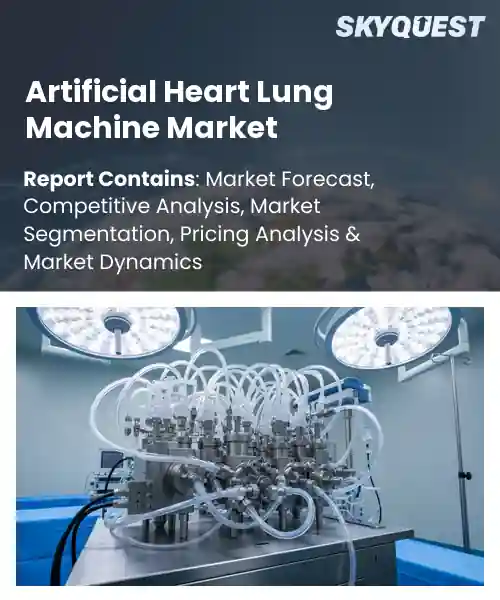
Artificial Heart Lung Machine Market
Report ID: SQMIG35A4158
Report ID: SQMIG35A4158
[email protected]
USA +1 351-333-4748
Report ID:
SQMIG35A4158 |
Region:
Global |
Published Date: July, 2026
Pages:
157
|Tables:
179
|Figures:
79


Global Artificial Heart Lung Machine Market size was valued at USD 440.0 Million in 2024 and is poised to grow from USD 462.88 Million in 2025 to USD 694.38 Million by 2033, growing at a CAGR of 5.2% during the forecast period (2026-2033).
The artificial heart lung machine industry encompasses extracorporeal membrane oxygenation (ECMO) systems that temporarily replace both cardiac and pulmonary function during severe cardio‑respiratory failure. Its importance stems from the growing burden of heart disease, an aging population, and the increasing complexity of cardiac surgeries that demand reliable support.
Key growth in the global artificial heart lung machine market is driven by expanding clinical use of ECMO for adult heart failure and pediatric respiratory distress, conditions whose incidence has risen sharply. When hospitals adopt ECMO within cardiac surgery suites, intensive‑care stays shorten, lowering overall costs and prompting further capital allocation. For instance, leading European cardiac centers have introduced hybrid operating rooms equipped with portable ECMO units, allowing circulatory support to begin within minutes of patient admission. This rapid response improves survival, stimulates demand for remote monitoring and analytics, and creates new revenue streams for global device manufacturers and service firms.
How is AI-driven automation improving efficiency in the artificial heart lung machine market?
AI‑driven automation is reshaping artificial heart lung machines by integrating real‑time data analytics, predictive algorithms, and closed‑loop control. Sensors now feed blood flow, pressure, and oxygenation metrics into machine‑learning models that anticipate patient needs and adjust pump speed or gas exchange without manual input. This reduces operator workload, shortens setup time, and minimizes human error during complex cardiac surgeries. The technology also enables remote monitoring, allowing clinicians to oversee multiple operating rooms from a central hub and intervene only when the system flags anomalies. As hospitals seek to improve operating‑room efficiency and patient outcomes, manufacturers are embedding AI modules into next‑generation devices, making perfusion more precise and reliable.
In March 2026, a leading heart‑lung machine supplier introduced an AI‑controlled perfusion system, streamlining circuit management and cutting procedure time, which directly supports the market’s push toward higher efficiency and broader adoption.
Market snapshot - (2026-2033)
Global Market Size
USD 440.0 Million
Largest Segment
Heart-Lung Machines
Fastest Growth
Portable Perfusion Systems
Growth Rate
5.2% CAGR
To get more insights on this market click here to Request a Free Sample Report
Global artificial heart lung machine market is segmented by product type, component, application, end user, patient type, technology and region. Based on product type, the market is segmented into Heart-Lung Machines, Cardiopulmonary Bypass (CPB) Systems, Extracorporeal Circulation Systems, Portable Perfusion Systems and Integrated Perfusion Workstations. Based on component, the market is segmented into Console Systems, Pumps, Oxygenators, Reservoirs, Monitoring Systems and Tubing & Disposable Sets. Based on application, the market is segmented into Coronary Artery Bypass Grafting (CABG), Heart Valve Surgery, Congenital Heart Surgery, Heart Transplantation, Lung Transplantation and Other Open-heart Procedures. Based on end user, the market is segmented into Hospitals, Cardiac Specialty Centers and Academic Medical Centers. Based on patient type, the market is segmented into Adult, Pediatric and Neonatal. Based on technology, the market is segmented into Conventional CPB Systems, Miniaturized CPB Systems and Integrated Perfusion Platforms. Based on region, the market is segmented into North America, Europe, Asia Pacific, Latin America and Middle East & Africa.
Integrated perfusion workstations segment dominates because they combine console control, pump management, and oxygenation monitoring into a single user friendly interface, reducing setup time and minimizing human error. Clinicians prefer this holistic solution as it streamlines workflow, improves procedural safety, and aligns with hospital initiatives to increase operating room efficiency. The convergence of multiple functions into one platform also lowers capital expenditures, encouraging procurement in both large and medium cardiac programs.
However, portable perfusion systems segment emerges as the fastest growing because clinicians seek lightweight modular solutions that can be deployed in limited space operating rooms and mobile cardiac units. Their flexibility supports emerging minimally invasive procedures and expands access to circulatory support, driving broader adoption and opening revenue avenues for manufacturers.
Oxygenators segment dominates because they are the critical interface that enables blood gas exchange, directly influencing patient survival during cardiopulmonary bypass. Manufacturers continually improve membrane technology to enhance efficiency and biocompatibility, meeting surgeon demand for reliable oxygen transfer and reduced inflammatory response. Their central clinical importance secures sustained investment, making oxygenators the cornerstone of artificial heart lung machine configurations across procedures. Additionally, regulatory pathways prioritize validated oxygenator designs, speeding market adoption and reinforcing their leadership.
Meanwhile, monitoring systems segment experiences the strongest growth momentum because real time data analytics and wireless connectivity are essential for precision perfusion management. Advances in sensor accuracy and integration with hospital networks enable clinicians to detect anomalies instantly, improving safety and outcomes, which fuels demand for sophisticated monitoring solutions and expands market opportunities.
To get detailed segments analysis, Request a Free Sample Report
North America leads the artificial heart lung machine market through a combination of sophisticated healthcare infrastructure, extensive research and development capabilities, and a mature regulatory environment that accelerates product introduction. The region benefits from a concentration of leading medical device manufacturers that collaborate closely with top academic institutions and clinical centers, fostering continuous innovation. Reimbursement frameworks are well‑established, encouraging hospitals to adopt advanced circulatory support technologies. Additionally, a highly skilled workforce and strong physician expertise drive demand for cutting‑edge solutions, while robust supply‑chain logistics ensure timely delivery and service support across the market. The presence of major research hospitals that serve as early adopters further amplifies market momentum, and collaborative partnerships between industry and government agencies promote the translation of emerging technologies into clinical practice.
As per artificial heart lung machine market regional outlook, United States is propelled by a network of leading manufacturers and a culture of clinical research that accelerates product validation. The reimbursement environment provides clear pathways for adoption, while academic hospitals serve as testing grounds for emerging technologies. Skilled clinicians and supply‑chain logistics ensure rapid deployment and service support across cardiac surgery centers. This ecosystem sustains high demand for advanced circulatory support solutions.
As per artificial heart lung machine market regional forecast, Canada benefits from collaboration between government health agencies and research institutions that streamline clinical adoption. Reimbursement policies are designed to encourage cost‑effective integration of advanced circulatory support, while a network of cardiac centers provides a platform for evaluation. Experienced clinicians and supply chains enable timely installation and maintenance of equipment across provincial hospitals. This approach drives sustained interest and utilization of cutting‑edge heart‑lung technologies.
Europe’s market expands rapidly due to a confluence of harmonized regulatory frameworks, strong clinical research ecosystems, and a collaborative environment that links manufacturers with leading academic hospitals. The region benefits from well‑established reimbursement pathways that reduce financial barriers for hospitals adopting sophisticated circulatory support devices. A concentration of innovative firms in key economies with advanced engineering capabilities fuels continuous product improvement, while cross‑border clinical trials accelerate evidence generation. Growing awareness of cardiac and pulmonary disease management, combined with an emphasis on value‑based care, drives demand across public and private health systems. Together these factors position Europe as a dynamic hub for technology adoption and market growth. Regulatory agencies also promote innovation through streamlined approval pathways that encourage early market entry of next‑generation devices.
As per artificial heart lung machine industry analysis, Germany is driven by an engineering base and ties between device manufacturers and university hospitals that facilitate rapid prototyping and clinical validation. Reimbursement structures support adoption in tertiary care centers, while health programs emphasize outcomes that favor advanced circulatory support. Experienced cardiac surgeons and supply networks ensure efficient installation and maintenance across the country. This environment sustains high demand for innovative heart‑lung solutions.
United Kingdom experiences rapid growth fueled by a regulatory agency that encourages early adoption of circulatory support technologies. Strong collaboration between biotech firms and NHS research trusts accelerates clinical trials and evidence generation. Reimbursement incentives prioritize cost‑effective solutions, while a skilled pool of cardiac specialists drives adoption in teaching hospitals. Integrated logistics and after‑sales service networks further reinforce market expansion across the region.
France is gaining traction through government initiatives that support innovation in life‑saving medical devices and a reimbursement system that eases hospital investment. Partnerships between leading manufacturers and cardiac research centers enable rapid clinical validation and technology transfer. A network of specialized cardiac units across public and private hospitals ensures patient access. Supply chain management and these factors drive continual demand for heart‑lung support solutions.
Asia Pacific’s market is strengthening its position through expanding healthcare infrastructure, rising demand for advanced cardiac support, and proactive government policies that encourage medical technology adoption. Countries in the region are investing heavily in modernizing hospitals and establishing specialized cardiac centers, creating a fertile environment for the introduction of sophisticated circulatory devices. Local manufacturers increasingly collaborate with global innovators, accelerating technology transfer and fostering home‑grown expertise. Growing clinician awareness of extracorporeal support benefits, combined with reimbursement initiatives that lower financial barriers, further fuels market uptake. These dynamics across the region position Asia Pacific as a pivotal growth engine for next‑generation heart‑lung support solutions. Increasing participation in international clinical trials and the establishment of regional regulatory harmonization further streamline product approvals, enabling faster market entry and broader patient access.
Japan benefits from a mature medical device ecosystem and strong government programs that fund research on advanced circulatory support. Collaboration between leading manufacturers and cardiac institutes accelerates clinical adoption and technology refinement. Reimbursement policies favor therapies, encouraging hospitals to integrate heart‑lung systems. A reliable supply chain and skilled technical workforce ensure installation and maintenance across the nation. This environment drives demand for support solutions.
South Korea is propelled by national health initiatives that prioritize cardiac care and provide reimbursement pathways for extracorporeal devices. Cooperation between domestic manufacturers and leading university hospitals accelerates product development and clinical validation. A skilled clinical workforce embraces new therapies, while efficient logistics networks guarantee rapid equipment delivery and service. These factors create a market environment that sustains growing demand for heart‑lung support technologies.
To know more about the market opportunities by region and country, click here to
Buy The Complete Report
Rising Demand For Life‑Saving Support
Adoption leveraging Innovative Biomaterials
High Cost Of Advanced Systems
Regulatory Hurdles Delay Market Entry
Request Free Customization of this report to help us to meet your business objectives.
The market is dominated by established medtech giants such as Medtronic, Sorin Group, Getinge, LivaNova and Terumo, each accelerating product pipelines and forming strategic alliances to capture emerging clinical demand; Medtronic’s recent integration of advanced ECMO technology, Getinge’s partnership with hospital networks for modular perfusion platforms, and LivaNova’s AI‑driven monitoring solutions illustrate how competition fuels rapid innovation and drives adoption across cardiac surgery centers.
SkyQuest’s ABIRAW (Advanced Business Intelligence, Research & Analysis Wing) is our Business Information Services team that Collects, Collates, Correlates, and Analyses the Data collected by means of Primary Exploratory Research backed by robust Secondary Desk research.
As per SkyQuest analysis, the artificial heart lung machine market growth is being propelled primarily by the rising demand for life‑saving circulatory support in severe cardiac and respiratory failure, while AI‑driven automation that offers real‑time analytics and predictive flow control serves as a second powerful catalyst; however, the high capital cost of advanced systems restrains adoption, especially in resource‑constrained settings. North America dominates the market due to its sophisticated healthcare infrastructure, strong R&D ecosystem and supportive reimbursement, and within the product mix the integrated perfusion workstations segment leads, combining console, pump and oxygenation functions into a single user‑friendly platform that drives procurement across hospitals and specialty centers. The global artificial heart lung machine market trend is driven by the increasing number of cardiovascular surgeries, rising prevalence of coronary artery disease and congenital heart defects, and expanding access to advanced cardiac care.
| Report Metric | Details |
|---|---|
| Market size value in 2024 | USD 440.0 Million |
| Market size value in 2033 | USD 694.38 Million |
| Growth Rate | 5.2% |
| Base year | 2024 |
| Forecast period | (2026-2033) |
| Forecast Unit (Value) | USD Million |
| Segments covered |
|
| Regions covered | North America (US, Canada), Europe (Germany, France, United Kingdom, Italy, Spain, Rest of Europe), Asia Pacific (China, India, Japan, Rest of Asia-Pacific), Latin America (Brazil, Rest of Latin America), Middle East & Africa (South Africa, GCC Countries, Rest of MEA) |
| Companies covered |
|
| Customization scope | Free report customization with purchase. Customization includes:-
|
To get a free trial access to our platform which is a one stop solution for all your data requirements for quicker decision making. This platform allows you to compare markets, competitors who are prominent in the market, and mega trends that are influencing the dynamics in the market. Also, get access to detailed SkyQuest exclusive matrix.
Table Of Content
Executive Summary
Market overview
Parent Market Analysis
Market overview
Market size
KEY MARKET INSIGHTS
COVID IMPACT
MARKET DYNAMICS & OUTLOOK
Market Size by Region
KEY COMPANY PROFILES
Methodology
For the Artificial Heart Lung Machine Market, our research methodology involved a mixture of primary and secondary data sources. Key steps involved in the research process are listed below:
1. Information Procurement: This stage involved the procurement of Market data or related information via primary and secondary sources. The various secondary sources used included various company websites, annual reports, trade databases, and paid databases such as Hoover's, Bloomberg Business, Factiva, and Avention. Our team did 45 primary interactions Globally which included several stakeholders such as manufacturers, customers, key opinion leaders, etc. Overall, information procurement was one of the most extensive stages in our research process.
2. Information Analysis: This step involved triangulation of data through bottom-up and top-down approaches to estimate and validate the total size and future estimate of the Artificial Heart Lung Machine Market.
3. Report Formulation: The final step entailed the placement of data points in appropriate Market spaces in an attempt to deduce viable conclusions.
4. Validation & Publishing: Validation is the most important step in the process. Validation & re-validation via an intricately designed process helped us finalize data points to be used for final calculations. The final Market estimates and forecasts were then aligned and sent to our panel of industry experts for validation of data. Once the validation was done the report was sent to our Quality Assurance team to ensure adherence to style guides, consistency & design.
Analyst Support
Customization Options
With the given market data, our dedicated team of analysts can offer you the following customization options are available for the Artificial Heart Lung Machine Market:
Product Analysis: Product matrix, which offers a detailed comparison of the product portfolio of companies.
Regional Analysis: Further analysis of the Artificial Heart Lung Machine Market for additional countries.
Competitive Analysis: Detailed analysis and profiling of additional Market players & comparative analysis of competitive products.
Go to Market Strategy: Find the high-growth channels to invest your marketing efforts and increase your customer base.
Innovation Mapping: Identify racial solutions and innovation, connected to deep ecosystems of innovators, start-ups, academics, and strategic partners.
Category Intelligence: Customized intelligence that is relevant to their supply Markets will enable them to make smarter sourcing decisions and improve their category management.
Public Company Transcript Analysis: To improve the investment performance by generating new alpha and making better-informed decisions.
Social Media Listening: To analyze the conversations and trends happening not just around your brand, but around your industry as a whole, and use those insights to make better Marketing decisions.
REQUEST FOR SAMPLE
 REQUEST FREE CUSTOMIZATION
Global Artificial Heart Lung Machine Market size was valued at USD 440.0 Million in 2024 and is poised to grow from USD 462.88 Million in 2025 to USD 694.38 Million by 2033, growing at a CAGR of 5.2% during the forecast period (2026-2033).
The market is dominated by established medtech giants such as Medtronic, Sorin Group, Getinge, LivaNova and Terumo, each accelerating product pipelines and forming strategic alliances to capture emerging clinical demand; Medtronic’s recent integration of advanced ECMO technology, Getinge’s partnership with hospital networks for modular perfusion platforms, and LivaNova’s AI‑driven monitoring solutions illustrate how competition fuels rapid innovation and drives adoption across cardiac surgery centers. 'Getinge', 'LivaNova', 'Terumo Corporation', 'XENIOS AG', 'Braile Biomédica', 'Medtronic', 'Senko Medical Instrument', 'Tianjin Medical', 'Nipro Corporation', 'Eurosets', 'HEMOVENT', 'Chongqing PSK-HealthSci Tech', 'Kewei Medical Apparatus', 'Tianjin Plastics Research Institute Medical Devices', 'Sarns Medical', 'Spectrum Medical', 'Jostra', 'MERA (Senko Medical Instrument)', 'Sorin Group Italia', 'Stockert'
The increasing prevalence of severe cardiac and respiratory failure drives hospitals to acquire advanced artificial heart‑lung systems, enhancing their ability to sustain patients during critical interventions. Clinicians prioritize technologies that deliver reliable circulatory support, prompting healthcare providers to allocate capital toward such equipment. As awareness of treatment benefits expands, patient referrals rise, further stimulating demand for sophisticated devices that improve survival odds and postoperative recovery, thereby reinforcing market expansion. Institutions also seek to meet accreditation standards that emphasize advanced life‑support capabilities, reinforcing procurement cycles.
Ai‑Driven Perfusion Optimization: Integrating artificial intelligence into perfusion management is reshaping how clinicians operate cardiac‑lung support devices. Real‑time data analytics enable predictive adjustments of flow rates, oxygenation levels, and anticoagulation parameters, reducing manual intervention and improving patient safety. This shift accelerates adoption of smart consoles that learn from procedural outcomes, fostering confidence among surgical teams. As hospitals prioritize precision medicine, demand for AI‑enhanced heart‑lung machines is expected to rise, driving R&D investment and collaborative partnerships across the med‑tech ecosystem globally across emerging and mature markets regions.
Why does North America Dominate the Global Artificial Heart Lung Machine Market? |@12


Want to customize this report? This report can be personalized according to your needs. Our analysts and industry experts will work directly with you to understand your requirements and provide you with customized data in a short amount of time. We offer $1000 worth of FREE customization at the time of purchase.
Feedback From Our Clients


 USA (+1) 351-333-4748

