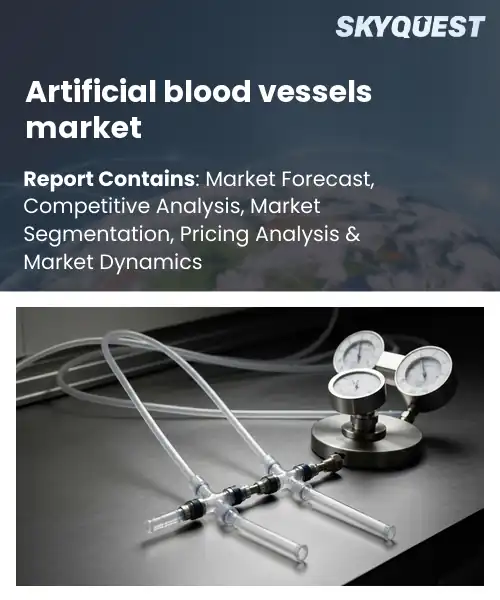
Artificial blood vessels market
Report ID: SQMIG35A3995
Report ID: SQMIG35A3995
[email protected]
USA +1 351-333-4748
Report ID:
SQMIG35A3995 |
Region:
Global |
Published Date: June, 2026
Pages:
157
|Tables:
180
|Figures:
79


Global Artificial Blood Vessels Market size was valued at USD 2.75 Billion in 2024 and is poised to grow from USD 2.91 Billion in 2025 to USD 4.57 Billion by 2033, growing at a CAGR of 5.8% during the forecast period (2026-2033).
High prevalence of cardiovascular diseases, increasing number of vascular surgeries, rising demand for tissue-engineered grafts, advancements in regenerative medicine, and expanding adoption of personalized treatment approaches are driving sales of artificial blood vessels.
Innovations in tissue engineering, biodegradable materials and patient-specific vascular grafts are leading to better long-term clinical results and opening new treatment possibilities. Substantial investments in regenerative medicine, 3D bioprinting, and stem cell-based vascular applications are also driving the market. The increased use of individualized therapies and the increased focus on the development of next-generation artificial grafts are expected to stimulate market competition. Moreover, positive reimbursement regulations and improved healthcare facilities provide promising prospects for the industry. Growing incidence of atherosclerosis, diabetes-related vascular disorders, and chronic cardiovascular diseases, coupled with increasing demand for advanced vascular reconstruction procedures, is expected to primarily drive artificial blood vessels market growth.
In contrast, high costs of advanced artificial blood vessels, stringent regulatory approval processes, limited long-term clinical evidence for emerging technologies, and risk of graft-related complications are anticipated to slow down artificial blood vessels market penetration through 2033.
How is AI Accelerating Customization of Artificial Blood Vessels?
AI is evolving the artificial blood vessels market by optimizing the design, development, and customization of vascular grafts. Through machine learning, the analysis of extensive patient anatomy data accelerates the design of grafts that cater specifically to blood flow dynamics and clinical requirements. In addition, AI assesses material performance data to determine optimal polymer blends, expediting the production of bio-compatible, robust artificial blood vessels. Virtual models estimate the long-term performance of grafts, minimizing lab testing duration, and shortening development timelines. These innovations are requisite to meet escalating demand for bespoke vascular interventions while enhancing product efficacy
Market snapshot - (2026-2033)
Global Market Size
USD 2.75 Billion
Largest Segment
Synthetic Vascular Grafts
Fastest Growth
Tissue-Engineered Blood Vessels
Growth Rate
5.8% CAGR
To get more insights on this market click here to Request a Free Sample Report
Global artificial blood vessels market is segmented by product type, material type, application, end user, procedure type, diameter type, and region. Based on product type, the market is segmented into synthetic vascular grafts, biological vascular grafts, tissue-engineered blood vessels, endovascular grafts, small-diameter vascular grafts, and large-diameter vascular grafts. Based on material type, the market is segmented into Expanded Polytetrafluoroethylene (ePTFE), Polyester (Dacron), polyurethane, biological materials, and hybrid biomaterials. Based on application, the market is segmented into aortic repair, peripheral vascular disease, hemodialysis access, coronary artery bypass, vascular trauma repair, and congenital vascular defects. Based on end user, the market is segmented into hospitals, cardiac surgery centers, vascular surgery centers and ambulatory surgical centers. Based on procedure type, the market is segmented into open surgical repair, endovascular repair, and hybrid procedures. Based on diameter type, the market is segmented into small-diameter grafts, medium-diameter grafts, and large-diameter grafts. Based on region, the market is segmented into North America, Europe, Asia Pacific, Latin America, and Middle East & Africa.
The synthetic vascular grafts segment is expected to lead the global artificial blood vessels market revenue generation potential through 2033. They offer a convenient off the shelf option best suited for routine arterial reconstructions requiring high throughput. Such familiarity is a vital prerequisite to widespread acceptance given their decades of long proven performance and strict regulatory oversight. Additionally, their low cost, ready availability and simple storage requirements facilitate their widespread adoption across various territories and interventions. In tandem with enhanced durability and commercially competitive pricing this benefits their thus far rule of the roost.
However, tissue engineered blood vessels segment is witnessing the strongest growth momentum as per this artificial blood vessels industry analysis, motivated by improvements in cellular scaffolding and bioprinting allowing patient specific constructs that emulate native physiology. Increasing adoption driven by growing demand for regenerative therapies and favorable regulatory climate positions this sector as potential drivers of future market growth and new treatment modalities.
The expanded polytetrafluoroethylene segment is anticipated to account for the highest global artificial blood vessels market share going forward. Its distinctive microporous design gives it outstanding compliance and necking resistance as well as providing a more predictable hemodynamic response from a broad range of vessel diameters. The surgeon appreciates the physical strength, demonstrated antibiotic properties and predictable performance of this material in both open and endovascular applications. It is compatible with a variety of stitch patterns ensuring an uneventful operation time and remains the most popular fabric of choice around the globe for many manufacturers and surgeons.
Meanwhile, hybrid biomaterials emerges as the fastest growing subsegment as it integrates the synthetic durability and biological harmony of the materials to combat the well-known trials of thrombosis and compliance mismatch. Continuous research on nanocoating and biological modifiers stimulate the clinical demand while partnerships of material scientists with existing device manufacturers push new products through the pipeline, offering new therapeutic options and extending product portfolio.
To get detailed segments analysis, Request a Free Sample Report
Advanced clinical capabilities, extensive research and development investment, and a regulatory framework that encourages rapid product approval help support the dominance of this region. In addition, there are significant reimbursement mechanisms, as well as a high level of insurance coverage, which enable patients to have access to the new artificial blood vessel products more quickly. The U.S. also has a large pool of engineering talent combined with considerable venture capital funds available, both of which encourage continuous innovation and public-private partnering to expedite translational research. When all these resources are combined, they create an environment that allows for rapid development of innovative technology from initial concept through clinical application, solidifying the position of North America as the worldwide leader. Presence of leading medical device companies in the United States are also driving high artificial blood vessels demand.
Artificial blood vessels market in the United States benefits from an extensive network of specialized cardiovascular centers that actively participate in early‑stage clinical evaluations. Partnerships between industry giants and renowned academic institutions accelerate technology transfer, while federal grant programs support exploratory research in biomaterials and tissue engineering. A mature reimbursement environment further incentivizes hospitals to adopt innovative grafts, and a culture of entrepreneurship drives rapid scaling of emerging companies pursuing next‑generation solutions.
Artificial blood vessels market in Canada is shaped by a publicly funded healthcare system that emphasizes evidence‑based adoption of new technologies. Distinctive collaboration between some provincial health authorities and research hospitals allows several coordinated clinical trials, as well as government-backed innovation funds directed to local manufacture of bioengineered grafts. Centers of world-class research clusters in north and east cities boosts several cross-discipline projects, coupled with regulation convergence with North American standards allows market penetration.
Coordinated regulatory harmonization, substantial public research funding, and a growing emphasis on personalized vascular therapies are shaping adoption of artificial blood vessels in the region. The regulatory framework provided by the EU has created an efficient system for approving the commercialization of new devices, which makes it much faster to bring new products to market. Much of this has been accomplished through collaborative research programs involving universities, biotechnology companies, and medical institutions working together across multiple countries. Emerging capabilities related to regenerative medicine and biomaterials, combined with robust intellectual property protections of these innovations, has created incentive for innovators to establish development centers in multiple locations throughout Europe. Health systems within Europe continue to focus on developing and using minimally invasive surgical techniques. As a result, many hospitals within Europe have begun using advanced graft technology to support wound healing or reconstructive surgery procedures.
Artificial blood vessels market in Germany enjoys leadership status supported by a dense concentration of medical device manufacturers and world‑renowned engineering institutes. Strong federal research initiatives fund translational projects that bridge material science with clinical application. Reimbursement policies that reward cost‑effective outcomes accelerate hospital uptake, while close cooperation between industry and university hospitals fosters rapid clinical validation. The presence of specialized vascular surgery centers further drives demand for high‑performance grafts, reinforcing Germany’s dominant position.
Artificial blood vessels market in the United Kingdom is characterized by the fastest growth among European nations, propelled by an aggressive venture capital ecosystem and a proactive regulatory authority. National health service programs support uptake of new vascular options that are proven to be cost effective. Networking clusters, bringing together biotech startups with top cardiac hospitals, offer a way to fast-track production and commercialization. Likewise, government-driven research funding incentives attract multinationals to set up their own R&D facilities, offering a lively backdrop to maintain the fast pace of market growth.
Artificial blood vessels market in France is emerging steadily, driven by strong governmental support for biomedical innovation and a collaborative culture among research hospitals. National research agencies give grants for tissue engineering and biodegradable scaffolds for early stage product development. The integration of new grafts within public hospitals emerges from health authority programs that focus on clinical evidence. The links between university laboratories and niche firms promote technology transfer while making France a key emerging country of the European Dynamics.
Asia Pacific is strengthening its position in the artificial blood vessels market through a combination of expanding healthcare infrastructure, rising prevalence of cardiovascular conditions, and vigorous governmental support for advanced medical technologies. Nations across the region invest heavily in hospital modernization, creating demand for sophisticated vascular grafts. Strategic public‑private partnerships encourage domestic firms to develop bio‑fabricated solutions, while collaborations with international research institutions accelerate knowledge transfer. Emerging manufacturing capabilities allow cost‑effective production of high‑quality devices, and regulatory reforms aimed at faster approvals further stimulate market entry. This synergistic environment enables the region to move from early adoption to a more prominent role in global supply chains for artificial blood vessels.
Artificial blood vessels market in Japan benefits from a mature healthcare system that emphasizes high‑quality clinical outcomes and a strong tradition of biomedical research. Government initiatives support development of regenerative vascular therapies, while leading universities partner with device companies to refine bioengineered grafts. Reimbursement structures that reward innovative procedures encourage hospitals to adopt advanced solutions. The presence of dedicated cardiovascular research centers accelerates clinical validation, positioning Japan as a key hub for both domestic innovation and regional dissemination of cutting‑edge technologies.
Artificial blood vessels market in South Korea is propelled by aggressive investment in biotechnology and a proactive regulatory environment that streamlines product evaluation. Academic hospitals work with relevant manufacturers on using the next generation of graft materials, while national funding initiatives push to focus on tissue scaffolds and intelligent biomaterials. As an anticipated increase in awareness of the importance of cardiovascular health, demand for noninvasive applications intensifies. Export-oriented policies support Korean companies in their efforts to penetrate regional markets. This translates into an expanding global stature for the country.
To know more about the market opportunities by region and country, click here to
Buy The Complete Report
Rising Demand for Minimally Invasive Procedures
Advancements in Biodegradable Polymer Technology
Regulatory Approval Complexity
High Manufacturing Cost Structures
Request Free Customization of this report to help us to meet your business objectives.
The artificial blood vessel market is shaped by intense competition as firms accelerate M&A activity, forge strategic partnerships with device manufacturers, and push tech innovation such as bio‑resorbable scaffolds and AI‑guided design; recent examples include a $35 million Series A for a vascular imaging platform and a multi‑partner collaboration to integrate 3‑D printing into graft production, underscoring the race to secure differentiated clinical solutions.
SkyQuest’s ABIRAW (Advanced Business Intelligence, Research & Analysis Wing) is our Business Information Services team that Collects, Collates, Correlates, and Analyses the Data collected by means of Primary Exploratory Research backed by robust Secondary Desk research.
As per SkyQuest analysis, increasing number of vascular surgeries, and rising demand for tissue-engineered grafts are anticipated to drive the demand for artificial blood vessels going forward. However, high costs of advanced artificial blood vessels and stringent regulatory approval processes are slated to slow down the adoption of artificial blood vessels in the future. North America is slated to spearhead the demand for artificial blood vessels owing to advanced cardiovascular care infrastructure, strong investments in regenerative medicine, and the presence of leading medical device manufacturers. AI-assisted graft design and advancements in tissue engineering and personalized vascular solutions are anticipated to be key trends driving the artificial blood vessels sector in the long run.
| Report Metric | Details |
|---|---|
| Market size value in 2024 | USD 2.75 Billion |
| Market size value in 2033 | USD 4.57 Billion |
| Growth Rate | 5.8% |
| Base year | 2024 |
| Forecast period | (2026-2033) |
| Forecast Unit (Value) | USD Billion |
| Segments covered |
|
| Regions covered | North America (US, Canada), Europe (Germany, France, United Kingdom, Italy, Spain, Rest of Europe), Asia Pacific (China, India, Japan, Rest of Asia-Pacific), Latin America (Brazil, Rest of Latin America), Middle East & Africa (South Africa, GCC Countries, Rest of MEA) |
| Companies covered |
|
| Customization scope | Free report customization with purchase. Customization includes:-
|
To get a free trial access to our platform which is a one stop solution for all your data requirements for quicker decision making. This platform allows you to compare markets, competitors who are prominent in the market, and mega trends that are influencing the dynamics in the market. Also, get access to detailed SkyQuest exclusive matrix.
Table Of Content
Executive Summary
Market overview
Parent Market Analysis
Market overview
Market size
KEY MARKET INSIGHTS
COVID IMPACT
MARKET DYNAMICS & OUTLOOK
Market Size by Region
KEY COMPANY PROFILES
Methodology
For the Artificial blood vessels market, our research methodology involved a mixture of primary and secondary data sources. Key steps involved in the research process are listed below:
1. Information Procurement: This stage involved the procurement of Market data or related information via primary and secondary sources. The various secondary sources used included various company websites, annual reports, trade databases, and paid databases such as Hoover's, Bloomberg Business, Factiva, and Avention. Our team did 45 primary interactions Globally which included several stakeholders such as manufacturers, customers, key opinion leaders, etc. Overall, information procurement was one of the most extensive stages in our research process.
2. Information Analysis: This step involved triangulation of data through bottom-up and top-down approaches to estimate and validate the total size and future estimate of the Artificial blood vessels market.
3. Report Formulation: The final step entailed the placement of data points in appropriate Market spaces in an attempt to deduce viable conclusions.
4. Validation & Publishing: Validation is the most important step in the process. Validation & re-validation via an intricately designed process helped us finalize data points to be used for final calculations. The final Market estimates and forecasts were then aligned and sent to our panel of industry experts for validation of data. Once the validation was done the report was sent to our Quality Assurance team to ensure adherence to style guides, consistency & design.
Analyst Support
Customization Options
With the given market data, our dedicated team of analysts can offer you the following customization options are available for the Artificial blood vessels market:
Product Analysis: Product matrix, which offers a detailed comparison of the product portfolio of companies.
Regional Analysis: Further analysis of the Artificial blood vessels market for additional countries.
Competitive Analysis: Detailed analysis and profiling of additional Market players & comparative analysis of competitive products.
Go to Market Strategy: Find the high-growth channels to invest your marketing efforts and increase your customer base.
Innovation Mapping: Identify racial solutions and innovation, connected to deep ecosystems of innovators, start-ups, academics, and strategic partners.
Category Intelligence: Customized intelligence that is relevant to their supply Markets will enable them to make smarter sourcing decisions and improve their category management.
Public Company Transcript Analysis: To improve the investment performance by generating new alpha and making better-informed decisions.
Social Media Listening: To analyze the conversations and trends happening not just around your brand, but around your industry as a whole, and use those insights to make better Marketing decisions.
REQUEST FOR SAMPLE
 REQUEST FREE CUSTOMIZATION
Global Artificial Blood Vessels Market size was valued at USD 2.75 Billion in 2024 and is poised to grow from USD 2.91 Billion in 2025 to USD 4.57 Billion by 2033, growing at a CAGR of 5.8% during the forecast period (2026-2033).
The artificial blood vessel market is shaped by intense competition as firms accelerate M&A activity, forge strategic partnerships with device manufacturers, and push tech innovation such as bio‑resorbable scaffolds and AI‑guided design; recent examples include a $35 million Series A for a vascular imaging platform and a multi‑partner collaboration to integrate 3‑D printing into graft production, underscoring the race to secure differentiated clinical solutions. 'W. L. Gore & Associates', 'Getinge', 'Terumo Corporation', 'LeMaitre Vascular', 'Becton Dickinson (BD)', 'Artivion', 'B. Braun', 'Meril Life Sciences', 'JOTEC', 'Braile Biomedica', 'Vascutek', 'Xeltis', 'Humacyte', 'Shanghai MicroPort Endovascular', 'Lifetech Scientific', 'Cook Medical', 'Endologix', 'Lombard Medical', 'Vascular Graft Solutions', 'Japan Lifeline'
Healthcare providers are increasingly preferring minimally invasive cardiovascular interventions, which require flexible, biocompatible conduits that can be delivered through small access points. Artificial blood vessels, designed to match these procedural requirements, enable surgeons to reduce operative trauma, shorten recovery times, and improve patient outcomes. This clinical preference fuels investment in advanced materials and manufacturing techniques, encouraging broader adoption of synthetic grafts across a growing number of procedures and thus accelerating market expansion. Additionally, reduced hospital stay associated with these procedures enhances cost efficiency for providers, reinforcing shift toward invasive solutions.
Personalized Scaffold Design: Advances in patient‑specific imaging and 3‑D printing enable manufacturers to create vascular scaffolds that match individual anatomical geometry, vessel diameter, and curvature. This customization improves graft integration, reduces postoperative complications, and shortens recovery times. Surgeons increasingly demand such tailored solutions, prompting firms to invest in digital design platforms and bio‑ink libraries. The shift toward bespoke products is reshaping supply chains, fostering collaborations between medical device companies and biotech startups, and creating new revenue streams anchored in precision medicine for patients.
Why does North America Dominate the Global Artificial blood vessels market? |@12


Want to customize this report? This report can be personalized according to your needs. Our analysts and industry experts will work directly with you to understand your requirements and provide you with customized data in a short amount of time. We offer $1000 worth of FREE customization at the time of purchase.
Feedback From Our Clients


 USA (+1) 351-333-4748

