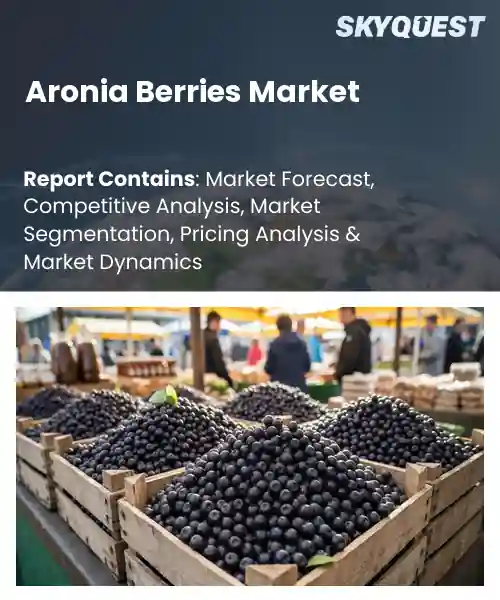
Aronia Berries Market
Report ID: SQMIG30H2394
Report ID: SQMIG30H2394
[email protected]
USA +1 351-333-4748
Report ID:
SQMIG30H2394 |
Region:
Global |
Published Date: April, 2026
Pages:
157
|Tables:
115
|Figures:
77


Global Aronia Berries Market size was valued at USD 860.0 Million in 2024 and is poised to grow from USD 921.06 Million in 2025 to USD 1594.42 Million by 2033, growing at a CAGR of 7.1% during the forecast period (2026-2033).
As a primary driver, rising consumer health consciousness around antioxidants and chronic disease prevention has propelled demand for aronia berries, a dark fruit rich in anthocyanins and polyphenols. The aronia market comprises fresh fruit production, value-added processing such as juices, concentrates, powders and nutraceutical extracts, and ingredient supply chains that serve food, supplement and cosmetic industries. This market matters because its nutritional profile commands premium positioning and enables diversified revenue streams for growers. Historically, cultivation expanded from Eastern Europe into North America and Scandinavia over past decades, while product innovation for example cold-pressed juices and freeze-dried powders has broadened commercial applications.A critical factor shaping the global aronia berries market is the maturation of processing and supply chain infrastructure, because enhanced cold storage, drying and extraction capacity reduces post-harvest loss and converts seasonal fruit into shelf-stable ingredients for year-round manufacture. As a result manufacturers can justify investment in product development, leading to expanded use cases such as powdered antioxidants in smoothie chains, standardized extracts in dietary supplements, natural colorants in yogurts and antioxidant serums in cosmetics. This commercialization creates demand signals that incentivize contract farming and varietal research, which in turn improves yields, quality and unlocks export opportunities and premium pricing.
How is AI transforming the Aronia berries market?
AI is reshaping the Aronia berries market by connecting field sensors image analytics and market intelligence to practical decisions that affect quality and supply. Key aspects include early stress and disease detection computer vision sorting for berry quality and predictive analytics for harvest timing and buyer matching. The current market reflects rising interest from nutraceutical and beverage formulators who prize Aronia for its antioxidant profile and from growers seeking reliable premium yields. In practice growers and processors are adopting data driven tools to improve consistency reduce waste and align limited harvests with product development timelines.Eevia Health May 2025, launched a high strength organic Aronia extract that signaled growing ingredient demand. AI supports this innovation by improving traceable sourcing automating quality inspection and optimizing distribution so suppliers can scale production efficiently shorten lead times and unlock new markets for Aronia ingredients.
Market snapshot - (2026-2033)
Global Market Size
USD 860.0 Million
Largest Segment
Aronia Melanocarpa (Black Chokeberry)
Fastest Growth
Aronia Prunifolia (Purple Chokeberry)
Growth Rate
7.1% CAGR
To get more insights on this market click here to Request a Free Sample Report
Global aronia berries market is segmented by product type, source, distribution channel, application and region. Based on product type, the market is segmented into Aronia Melanocarpa (Black Chokeberry), Aronia Prunifolia (Purple Chokeberry) and Aronia Arbutifolia (Red Chokeberry). Based on source, the market is segmented into Conventional and Organic. Based on distribution channel, the market is segmented into Offline and Online. Based on application, the market is segmented into Food & Beverages, Pharmaceutical and Others. Based on region, the market is segmented into North America, Europe, Asia Pacific, Latin America and Middle East & Africa.
Aronia Melanocarpa segment dominates because its dense antioxidant profile, robust flavor concentration, and established processing suitability make it the preferred variety for food, beverage, and nutraceutical formulations. Manufacturers favor its consistent yield and sensory profile, which simplifies product development and positions it as a reliable raw material. These attributes drive buyer preference and supply chain standardization, encouraging investment in cultivation and processing infrastructure that reinforce its market leadership.
However, Aronia Prunifolia is emerging as the most rapidly expanding variety due to its distinctive flavor profile and novel appeal for artisanal product formulations. Breeding advances and targeted marketing toward specialty beverage and functional snack developers are expanding demand, creating opportunities for value added processing and new product innovation that accelerate market growth.
Conventional segment dominates because its established cultivation practices, lower production costs, and broader availability ensure steady supply for processors and large scale manufacturers. Buyers rely on conventional sourcing to meet volume needs for mainstream food and beverage formulations, enabling stable pricing and simplified quality control. These operational advantages reduce supply chain friction and incentivize processors and retailers to standardize sourcing around conventional aronia.
However, Organic is emerging as the most rapidly expanding source driven by increasing clean label demand, premium positioning, and growing preference among health conscious formulators. Certification backed claims enable premium pricing and open opportunities in nutraceutical and specialty food categories, motivating growers to convert to organic practices and encouraging brands to develop differentiated, higher margin aronia products.
To get detailed segments analysis, Request a Free Sample Report
Europe commands a leading role in the global aronia berries market due to a convergence of agronomic suitability, established processing capacity, and sophisticated consumer demand for functional foods. Strong research networks and well developed horticultural infrastructure enable efficient cultivation and varietal improvement, while integrated supply chains connect growers with processors and specialty retailers. Regulatory clarity for health claims, coupled with an active organic segment and investment in value added products, supports diverse end uses across nutraceutical, food and cosmetic applications. Proximity to major ingredient manufacturers and cross border trade within the region enhance scale and consistency, reinforcing Europe as the primary hub for innovation and commercialization in the aronia berries landscape. Collaborative partnerships between growers, academic institutions and private firms further accelerate product development and market penetration across diverse channels.
Aronia Berries Market Germany benefits from advanced horticultural expertise, strong processing infrastructure and a well established organic sector supporting premium ingredient production. Cooperative research programs and specialty processors enable value added formulations for food and nutraceutical customers. Retail adoption is driven by health oriented consumers and a robust private label landscape, while export links and efficient logistics foster scale. Local innovation in cultivation techniques supports consistent quality and supplier reliability.
Aronia Berries Market United Kingdom sees growing consumer interest in functional foods and clean label items, driving demand via specialty retailers and foodservice. Ingredient manufacturers and contract processors support development of extracts and formulations for nutraceutical and cosmetic use. Industry groups and research partnerships advance cultivation practices and traceability. Marketing emphasizing provenance and wellness appeals to targeted consumers, while established distribution networks facilitate wider product availability and sampling and adoption.
Aronia Berries Market France benefits from strong artisanal food culture and a vibrant natural ingredients sector that supports premium positioning for aronia derived products. Specialty cooperatives and boutique processors collaborate with researchers to refine cultivation and postharvest handling, ensuring sensory and functional quality. Consumer interest in natural wellness and traditional preparation aids market penetration through gourmet retail and foodservice. Strategic export relationships and culinary innovation elevate demand among ingredient buyers.
North America is experiencing rapid expansion in the aronia berries market driven by converging consumer interest in plant based nutrition, robust product innovation across food and supplement categories, and strong private investment in cultivation and processing. Diverse climates allow for scalable experimental farming, while contract growing models and agritech adoption support productivity improvements and traceability. Established ingredient manufacturers and supplement companies are integrating aronia extracts into a broad set of formulations, increasing visibility and retail uptake. Regulatory pathways and transparent labeling practices help build consumer trust, and active marketing by brands emphasizing antioxidant and functional benefits accelerates mainstream acceptance. Cross sector partnerships between growers, processors and research institutions further strengthen the supply chain and shorten time to market for new applications.
Aronia Berries Market United States benefits from high consumer interest in functional ingredients and active private sector product development. Varied growing areas and advanced processors enable experimentation with extracts and purees for food and supplement use. Large retail and direct to consumer channels accelerate product discovery, while research institutions and industry groups promote quality standards. Focused brand marketing on wellness and natural benefits enhances mainstream awareness and further fosters adoption.
Aronia Berries Market Canada is characterized by growing interest in locally sourced superfruit ingredients and a strong culture of sustainable agriculture. Cooperative networks and smaller scale processors support artisanal extracts and value added products for specialty food and supplement channels. Regional research initiatives promote climate adaptive cultivation practices and postharvest quality. Consumer preference for clean label and organic options boosts retailer support, while collaborative supply chain models improve overall traceability.
Asia Pacific is strengthening its role in the aronia berries market through targeted product development, rising health consciousness, and strategic engagement with international breeders and ingredient suppliers. Markets in the region are incorporating aronia into premium beverages, supplements and skincare, leveraging local preferences for natural and functional ingredients. Investments in cold chain logistics and modernization of processing facilities increase ability to handle delicate fruit, while e commerce and specialty retail channels broaden consumer reach. Collaborative research between regional institutions and foreign partners accelerates varietal adaptation and cultivation practices suited to local climates. Regulatory engagement and focused marketing on traditional wellness concepts help integrate aronia into established dietary and cosmetic patterns, gradually expanding both domestic production capacity and regional demand sustainably.
Aronia Berries Market Japan reflects consumer demand for functional and premium natural ingredients, attracting interest from beverage and skincare manufacturers. Cultivation trials and partnerships with foreign breeders promote adaptation of varieties to local conditions, while processors emphasize careful handling and concentrated extracts. Retail preference for provenance and traceability supports niche premium positioning. Food innovators and wellness brands work to create culturally relevant products that integrate aronia into everyday consumption patterns.
Aronia Berries Market South Korea is driven by consumer demand for functional foods and beauty oriented ingredients, attracting interest from cosmetics and supplement makers. Local growers and research institutes collaborate on variety selection and cultivation practices suited to regional climates. Processors produce concentrated extracts and powder formats for retail and ingredient supply. E commerce and beauty retailers increase product visibility, while marketing linking aronia to traditional wellness supports premium positioning.
To know more about the market opportunities by region and country, click here to
Buy The Complete Report
Rising Consumer Awareness Of Benefits
Expansion In Functional Food Applications
Limited Grower Knowledge Of Agronomy
High Postharvest Handling Complexity
Request Free Customization of this report to help us to meet your business objectives.
Competitive dynamics in the global aronia berries market center on ingredient led differentiation and distribution partnerships; incumbents and startups pursue corporate incubators and product innovation to gain advantage. Examples include Kraft Heinz’s Springboard engagement with Poppilu, Atomo’s beanless coffee formulation using black aronia for functional positioning, and Shrubbly’s rebrand and retail expansion to Erewhon, moves that prioritize partnerships, tech driven product development and targeted channel growth.
Top Player’s Company Profile
Recent Developments
SkyQuest’s ABIRAW (Advanced Business Intelligence, Research & Analysis Wing) is our Business Information Services team that Collects, Collates, Correlates, and Analyses the Data collected by means of Primary Exploratory Research backed by robust Secondary Desk research. As per SkyQuest analysis, the global aronia berries market is being driven by rising consumer health consciousness around antioxidants and chronic disease prevention and further supported by expansion in functional food applications that broaden product use cases. Europe remains the dominating region due to strong horticultural networks and processing capacity while Aronia Melanocarpa is the dominating segment thanks to its high antioxidant density and processing suitability. Growth is restrained by limited grower knowledge of agronomy, which hampers yield consistency and supply reliability, but continued investment in processing, traceability and value added formulations is enabling stronger commercialization and premium positioning across food, nutraceutical and cosmetic channels.
| Report Metric | Details |
|---|---|
| Market size value in 2024 | USD 860.0 Million |
| Market size value in 2033 | USD 1594.42 Million |
| Growth Rate | 7.1% |
| Base year | 2024 |
| Forecast period | (2026-2033) |
| Forecast Unit (Value) | USD Million |
| Segments covered |
|
| Regions covered | North America (US, Canada), Europe (Germany, France, United Kingdom, Italy, Spain, Rest of Europe), Asia Pacific (China, India, Japan, Rest of Asia-Pacific), Latin America (Brazil, Rest of Latin America), Middle East & Africa (South Africa, GCC Countries, Rest of MEA) |
| Companies covered |
|
| Customization scope | Free report customization with purchase. Customization includes:-
|
To get a free trial access to our platform which is a one stop solution for all your data requirements for quicker decision making. This platform allows you to compare markets, competitors who are prominent in the market, and mega trends that are influencing the dynamics in the market. Also, get access to detailed SkyQuest exclusive matrix.
Table Of Content
Executive Summary
Market overview
Parent Market Analysis
Market overview
Market size
KEY MARKET INSIGHTS
COVID IMPACT
MARKET DYNAMICS & OUTLOOK
Market Size by Region
KEY COMPANY PROFILES
Methodology
For the Aronia Berries Market, our research methodology involved a mixture of primary and secondary data sources. Key steps involved in the research process are listed below:
1. Information Procurement: This stage involved the procurement of Market data or related information via primary and secondary sources. The various secondary sources used included various company websites, annual reports, trade databases, and paid databases such as Hoover's, Bloomberg Business, Factiva, and Avention. Our team did 45 primary interactions Globally which included several stakeholders such as manufacturers, customers, key opinion leaders, etc. Overall, information procurement was one of the most extensive stages in our research process.
2. Information Analysis: This step involved triangulation of data through bottom-up and top-down approaches to estimate and validate the total size and future estimate of the Aronia Berries Market.
3. Report Formulation: The final step entailed the placement of data points in appropriate Market spaces in an attempt to deduce viable conclusions.
4. Validation & Publishing: Validation is the most important step in the process. Validation & re-validation via an intricately designed process helped us finalize data points to be used for final calculations. The final Market estimates and forecasts were then aligned and sent to our panel of industry experts for validation of data. Once the validation was done the report was sent to our Quality Assurance team to ensure adherence to style guides, consistency & design.
Analyst Support
Customization Options
With the given market data, our dedicated team of analysts can offer you the following customization options are available for the Aronia Berries Market:
Product Analysis: Product matrix, which offers a detailed comparison of the product portfolio of companies.
Regional Analysis: Further analysis of the Aronia Berries Market for additional countries.
Competitive Analysis: Detailed analysis and profiling of additional Market players & comparative analysis of competitive products.
Go to Market Strategy: Find the high-growth channels to invest your marketing efforts and increase your customer base.
Innovation Mapping: Identify racial solutions and innovation, connected to deep ecosystems of innovators, start-ups, academics, and strategic partners.
Category Intelligence: Customized intelligence that is relevant to their supply Markets will enable them to make smarter sourcing decisions and improve their category management.
Public Company Transcript Analysis: To improve the investment performance by generating new alpha and making better-informed decisions.
Social Media Listening: To analyze the conversations and trends happening not just around your brand, but around your industry as a whole, and use those insights to make better Marketing decisions.
REQUEST FOR SAMPLE
 REQUEST FREE CUSTOMIZATION


Want to customize this report? This report can be personalized according to your needs. Our analysts and industry experts will work directly with you to understand your requirements and provide you with customized data in a short amount of time. We offer $1000 worth of FREE customization at the time of purchase.
Feedback From Our Clients


 USA (+1) 351-333-4748

