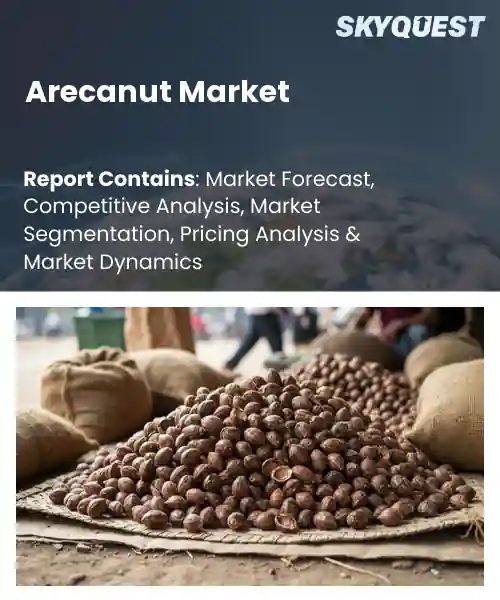
Arecanut Market
Report ID: SQMIG30J2041
Report ID: SQMIG30J2041
[email protected]
USA +1 351-333-4748
Report ID:
SQMIG30J2041 |
Region:
Global |
Published Date: March, 2026
Pages:
157
|Tables:
114
|Figures:
77


Global Arecanut Market size was valued at USD 11.3 Billion in 2024 and is poised to grow from USD 11.44 Billion in 2025 to USD 12.58 Billion by 2033, growing at a CAGR of 1.2% during the forecast period (2026-2033).
The global arecanut industry has been showing steady growth over the past few years, propelled by a combination of factors such as cultural significance, increasing commercial use and changing preferences of consumers. The market has remained conservatively tied to traditional consumption patterns, with the highest volume of usage being found throughout South and Southeast Asia. In these regions, the cultural use of arecanut forms a part of many social customs (e.g., ceremonious gatherings), and religious rituals, with its use in everyday chewing. Thus, the cultural attachment to arecanut ensures that it remains a major source of consistent demand, particularly in countries that dominate productivity and consumption.
Aside from traditional uses, product innovation and commercialization are creating a paradigm shift in the way arecanut is used. The increasing demand for processed products like pans masala, flavored supari and packaged types of arecanut (e.g., ready to use) is attracting an urban and young consumer base due, in part, to improved packaging, branding and distribution methods. In addition, with an increase in urbanization and lifestyle changes, there is growing demand for convenient, readily available products which will continue to drive the arecanut market growth.
The other major finding related to the consumption of arecanut products is that the nut is becoming more widely used in products other than chewing products. The arecanut is increasingly being incorporated into products used in the pharmaceutical, cosmetic, and food processing industries due to the presence of bioactive compounds and potential medicinal properties. As per global arecanut market analysis, Asia-Pacific dominates the arecanut market share due to strong production and consumption in countries such as India, Indonesia, and Bangladesh, supported by deep-rooted cultural usage and established supply chains.
How can IoT Improve Yield Forecasting in the Arecanut Market?
By using the Internet of Things (IoT) to connect field sensors, satellites and farm records, organizations can generate continuous crop intelligence which provides crucial information for yield forecasting in the arecanut market. The arecanut market is fragmented and consists of smallholder production decisions, disease pressures and local weather conditions.Thus, hindering supply predictability. Through real-time monitoring of soil moisture, leaf wetness, microclimate, and pest signals, the IoT facilitates model creation to learn how crops respond locally and allows for timely yield estimates.
Market snapshot - 2026-2033
Global Market Size
USD 11.3 Billion
Largest Segment
Raw Arecanut
Fastest Growth
Processed Arecanut
Growth Rate
1.2% CAGR
To get more insights on this market click here to Request a Free Sample Report
Global arecanut market is segmented into product type, end use, distribution channel, form factor and region. Based on product type, the market is segmented into raw arecanutand processed arecanut. Based on end use, the market is segmented into food industry, pharmaceuticals and cosmetics. Based on distribution channel, the market is segmented into online and offline. Based on form factor, the market is segmented into whole nuts and crushed nuts. Based on region, the market is segmented into North America, Europe, Asia Pacific, Latin America and Middle East & Africa.
Processed arecanut dominates the market because of the ease of integration by industrial buyers due to standardization and value-added processing. Consistent grading, better shelf stability, and specific sizes reduce the risk of formulating products using processed supply. Therefore, processed supply is preferred by food manufacturers. Production investment in processing technology, quality control, and traceability provides additional branding support to long supply chains for processed products, thereby increasing sales volume and contribution margin. All of these factors combined result in higher demand for arecanut processed products than raw product sales in the arecanut market.
As per global arecanut market analysis, the raw arecanut segment is experiencing the most rapid growth due to the increasing demand for natural and minimally processed food and ingredient products from specialty food producers. The ability for companies to directly source from farmers and the increasing demand for clean labels is driving a significant increase in demand for raw, unprocessed arecanut products. Thereby allowing additional aggregation and tracking services to be provided to smallholders and increasing access to the unprocessed arecanut market.
As per global arecanut market outlook, the online segment dominates due to digital platforms simplifying procurement and enhancing connections between buyers and sellers through the arecanut supply chain. E-commerce and dedicated online marketplaces provide buyers with direct access to the amrcnut supply chain via direct sourcing, transparent quality information and traceability, and fewer intermediate layers. Through these factors combined with logistics and payment systems, higher customer preference for commercial buyers and specialized traders is made possible by supporting fast order fulfilling and inventory visibility to drive concentrations of trade activity within digital channels.
As per global arecanut market forecast, the offline segment is experiencing the highest volume of growth as institutional buyers and traditional traders place the most emphasis on physical inspection and established credit relationships. Providing tactile quality assurance along with immediate availability are two of the reasons why traditional traders and institutional buyers use wholesale markets and intermediaries to acquire amrcnut. Investing in organized retail while developing aggregation sites will continually further drive efficiencies while enabling offline networks to sustain significant volumes of trade.
To get detailed segments analysis, Request a Free Sample Report
The arecanut industry is presently dominated by the Asia Pacific region due to an established base of local cultivation expertise, appropriate climate conditions, and the extensive downstream supply chain, which creates a secure supply chain. Smallholder and larger commercial farming systems provide a reliable supply of produce to domestic and international markets and fit into the supply chain by processing and packaging the product for delivery to buyers in the various countries where arecanut is consumed. The internal demand for arecanut is reinforced by cultural and culinary traditions of the region, which spur product innovation and value-added developments.
The arecanut market in Japan is primarily a premium, niche segment with an emphasis on quality and food safety standards, which influence sourcing and innovation. Retail and specialty sectors place a priority on processed and value-added products to meet the tastes of Japanese consumers. The reliance on imports and the presence of stringent regulatory frameworks create very close relationships with supplies and a great deal of investment in traceability. The interest of Japanese consumers in novel flavours and health positioned products helps support the development of niche products and provides distribution partners with the means to provide consistent quality, packaging and co-operation with their exporters.
The arecanut market in South Korea is characterized by a strong urban demand and acceptance of innovative formats for convenient consumption. Modern and online retail channels provide consumers with opportunities to try imported and artisan products and many processors are using flavours and ready-to-eat products to attract South Korean consumers. To create a consistent supply of products, processor and supplier selection and product packaging are based upon government quality assurance and regulation.
The accelerated growth of the arecanut market in Europe is a consequence of the combination of multiple factors driving both supply and demand upward. These include the growth of multicultural populations within Europe as well as an increased interest in ethnic cuisines, leading to the traditional use of arecanuts being maintained. Interest in using new ingredients and premium quality snack formats by mainstream consumers has led to a growing interest in arecanuts as a new product as well. Importers and specialty distributors are working hard to meet the demands that European buyers place on them with respect to rigorous quality expectations and requirements, including compliance with regulations, investment in traceability, and developing responsible sourcing narratives. Retailers and foodservice operators are exploring opportunities for developing innovative applications of arecanuts, thus stimulating product diversification. The growth of digital channels and the emergence of specialized trade-related events are also enabling exporters to access the market for the first time, while improved logistics access and partnerships with arecanut producers have reduced the time required to bring products to market. Together, these forces are transforming arecanuts from a niche specialty ethnic product to a broader specialty product category, with retail and foodservice presence growing in parallel.
As per global arecanut market regional outlook, Germany is expanding rapidly, supported by several culturally diverse consumers and a well-established distribution network that connects specialty and mainstream distribution channels. Importers and distributors are aligning their suppliers about safety and labeling regulations for products offered in the German market and are also tailoring the packaging for these products to fit the local market's needs. Ethnic community consumption is increasing, and demand for ethnic foods from artisanal producers and gourmet developers is also broadening the retail presence of arecanuts. Thereby stimulating investment in supply chains to increase product availability and product diversity.
The UK arecanut market comprises several key components: the presence of robust import routes, a diverse, multicultural customer base who buy both traditional and contemporary products. Retail and wholesale channels provide carefully selected product lines through both physical and internet locations, and government regulations ensure products are traceable and of superior quality to meet customers’ needs.
As per global arecanut market regional forecast, France market is developing through artisanal channels and the exploration of gourmet experiences that interest both consumers and retailers. Importers/distributors are ensuring compliance with applicable food safety laws while chefs and product developers are experimenting with creative uses of arecanutsin sweet and savoury dishes. The provision of information related to food provenance; quality claims; and product packaging is used to position arecanuts in the premium product category. Collaboration with export partners to provide a unique story about their products and an exclusive, small batch approach to marketing will create a connection with sophisticated buyers.
The North America arecanut market is growing as ways to improve its supply chain’s reliability, expand distribution/availability of the products, and more focus on new product development that meets the needs of changing consumer tastes. Importers/distributors are also investing in systems of traceability, quality assurance, and compliance to meet stringent requirements from buyers, thus creating a smoother path for reputable exporters entering the market.
The U.S. consists of a segmented customer population that includes those who are part of certain immigrant communities and consumers who want to try new/use novelties in their cooking. Most importers/distributors are working toward providing wide-ranging availability by retail, online, and food service while also complying with safety and labeling regulations/standards from customers. In addition, product developers are trying to provide convenient (easy to use/preparable) and premium-formatted products for consumers.Thus, partnering with exporters for supply reliability and traceability while also assisting in developing targeted marketing efforts that heighten the visibility of the category within both retail and consumer levels, resulting in growth.
As per global arecanut industry analysis, Canada market is influenced by multicultural consumers in urban areas, and they get their arecanut through specialty grocery stores, online shopping, and mainstream grocery stores. Importers and processors are working toward meeting quality/safety standards that are strict as well as developing value-added products that have local taste profiles. There are strong partnerships between distributors and importers to ensure that proper packaging holds throughout the distribution process; Canada’s distributors and suppliers outside of Canada work together to maintain supply; use traceability to enhance their ability to continue working with buyers who require those products source sustainably.
To know more about the market opportunities by region and country, click here to
Buy The Complete Report
Rising Demand for Natural Products
Many consumers have increased demand for arecanut primarily for its use as a natural stimulant and cultural staple in many regions due to their preference for traditional and natural ingredients. As a result of increased demand, both suppliers and farmers are encouraged to continue or expand their production, which leads to greater value chain investments from all stakeholders, including processors who create additional types of arecanut products that maintain their traditional characteristics. The sustained domestic demand found by all market participants provides them with confidence in pricing and investment decisions and allows for continued growth in their recorded investments in cultivation, processing capacity, and outreach into existing markets.
Increasing Use in Processed Products
The wide variety of arecanut products being developed for processed foods, confections, and specialty foods will enhance its marketability by allowing consumers and retailers to access more convenient forms of higher-value products. In addition, the use of better handling and packaging techniques by processors will reduce postharvest losses and expand the locations where processors can reach potential customers, helping suppliers match their cultivation practices to meet the needs of the industry. As a result of increased vertical integration, processors are investing in processing infrastructure and quality management systems that allow producers to gain access to larger distribution channels and higher-margin segments, thereby strengthening demand signals throughout the supply chain and continuing to provide growth incentives for all stakeholders.
Rising Production Costs
Rising expenditures related to cropping, such as inputs, workers, and post growing treatment limit crop growers' ability to remain profitable and make capital investments to increase productivity. With increasing operating expenses, cultivators expand their cultivated area or postpone capital expenditures, resulting in restricted supply responsiveness to demand and a disincentive for new entrants. In addition, margin pressure limits grower funds for activities that add value and ensure compliance with regulations, which may limit or reduce the opportunity for growers to add value and access markets for arecanut products. Together, these cost pressures may hamper the expansion of arecanutproduction and decrease the level of investment in the entire supply chain.
Health Warnings and Regulations
Public concern over health issues related to the use of arecanut and related regulatory responses have limited market expansion through changes in consumer perceptions and limiting promotional efforts. Changes to mandatory health warnings, advertising restrictions, and tighter sale regulations have increased legal compliance for producers and processors, resulting in increases in operational complexity and costs. In some instances, public health campaigns are diminishing overall market demand for arecanut products, while businesses are constrained by limited ability to position their products and limited market outreach opportunities. These combined effects of changes in the arecanutmarket are causing diminished attractiveness to potential investors and limiting opportunities for product innovation and expanded distribution, thereby hindering potential growth in the industry.
Request Free Customization of this report to help us to meet your business objectives.
The global arecanut industry competitive environment is greatly influenced by the local and regional processors and producers. Sustainable producers of tableware and agritechorganizations have also begun to enter the market, adding value to those products by implementing sustainable practices and ensuring a stable supply of arecanut. The increased demand for biodegradable products has driven a number of partnerships and capacity-building efforts, such as areca plate manufacturing through women-owned companies, agritech companies utilizing drone technology to monitor plantation growth, and making strategic acquisitions and/or partnerships within the value-added processing supply chain.
Value Added Product Diversification: Raw nut sales are increasingly combined with branded, value-added products, such as prepared snacks that are ready-to-eat, concentrated extracts for use in foods and cosmetics, and specialty ingredients for high-end markets. These changes in product formats require the development of new products, improved packaging and shelf-life, as well as improved methods for communicating the origin and quality of products. Through these changes, producers cangenerate additional revenue, develop relationships with retailers, expand their export potential, and create a more robust processing infrastructure while investing in skill development among small-scale farmers to capture higher profits and build loyalty among consumers.
Sustainable Cultivation and Traceability: The importance of sustainable cultivation and traceable supply chains are becoming more important to marketers and buyers. This trend has led to an increase in the use of certified production and agroecological growing approaches, as well as new tools to trace the supply chain. Decision-making about sourcing is increasingly based on considerations about soil health, plant diversity, and responsible water usage, which has led to new models for conducting business that are environmentally and economically sustainable. Increased traceability stories and consumer transparency with suppliers create greater trust in brands, allow brands to be priced at a premium, and facilitate partnerships between retailers and suppliers. Investments in training farmers, cooperative development, and digital record keeping contribute to farmers being able to meet compliance requirements and gain access to better markets, while increasing the ability of farmers to recover from environmental and economic changes.
SkyQuest’s ABIRAW (Advanced Business Intelligence, Research & Analysis Wing) is our Business Information Services team that Collects, Collates, Correlates, and Analyses the Data collected by means of Primary Exploratory Research backed by robust Secondary Desk research.
As per SkyQuest analysis, the global arecanut market is supported by rising consumer preference for natural and traditional ingredients as a key driver and further propelled by growing incorporation of arecanut into processed foods and value-added products as a second driver. Processed arecanut remains in the dominating segment due to standardization and shelf stable formats while Asia Pacific is the dominating region because of entrenched cultivation, strong domestic demand and export infrastructure. A meaningful restraint is rising production costs, which pressure margins and limit investment in productivity and quality upgrades. Overall, the market’s outlook favors processors and traceability investments that link smallholder supply to premium and export channels. As per global arecanut market trends, the market is witnessing growth driven by rising demand for processed products like pan masala and flavored supari, increasing adoption of sustainable and organic cultivation practices, and expanding applications across food, pharmaceutical, and traditional medicine sectors.
| Report Metric | Details |
|---|---|
| Market size value in 2024 | USD 11.3 Billion |
| Market size value in 2033 | USD 12.58 Billion |
| Growth Rate | 1.2% |
| Base year | 2024 |
| Forecast period | 2026-2033 |
| Forecast Unit (Value) | USD Billion |
| Segments covered |
|
| Regions covered | North America (US, Canada), Europe (Germany, France, United Kingdom, Italy, Spain, Rest of Europe), Asia Pacific (China, India, Japan, Rest of Asia-Pacific), Latin America (Brazil, Rest of Latin America), Middle East & Africa (South Africa, GCC Countries, Rest of MEA) |
| Companies covered |
|
| Customization scope | Free report customization with purchase. Customization includes:-
|
To get a free trial access to our platform which is a one stop solution for all your data requirements for quicker decision making. This platform allows you to compare markets, competitors who are prominent in the market, and mega trends that are influencing the dynamics in the market. Also, get access to detailed SkyQuest exclusive matrix.
Table Of Content
Executive Summary
Market overview
Parent Market Analysis
Market overview
Market size
KEY MARKET INSIGHTS
COVID IMPACT
MARKET DYNAMICS & OUTLOOK
Market Size by Region
KEY COMPANY PROFILES
Methodology
For the Arecanut Market, our research methodology involved a mixture of primary and secondary data sources. Key steps involved in the research process are listed below:
1. Information Procurement: This stage involved the procurement of Market data or related information via primary and secondary sources. The various secondary sources used included various company websites, annual reports, trade databases, and paid databases such as Hoover's, Bloomberg Business, Factiva, and Avention. Our team did 45 primary interactions Globally which included several stakeholders such as manufacturers, customers, key opinion leaders, etc. Overall, information procurement was one of the most extensive stages in our research process.
2. Information Analysis: This step involved triangulation of data through bottom-up and top-down approaches to estimate and validate the total size and future estimate of the Arecanut Market.
3. Report Formulation: The final step entailed the placement of data points in appropriate Market spaces in an attempt to deduce viable conclusions.
4. Validation & Publishing: Validation is the most important step in the process. Validation & re-validation via an intricately designed process helped us finalize data points to be used for final calculations. The final Market estimates and forecasts were then aligned and sent to our panel of industry experts for validation of data. Once the validation was done the report was sent to our Quality Assurance team to ensure adherence to style guides, consistency & design.
Analyst Support
Customization Options
With the given market data, our dedicated team of analysts can offer you the following customization options are available for the Arecanut Market:
Product Analysis: Product matrix, which offers a detailed comparison of the product portfolio of companies.
Regional Analysis: Further analysis of the Arecanut Market for additional countries.
Competitive Analysis: Detailed analysis and profiling of additional Market players & comparative analysis of competitive products.
Go to Market Strategy: Find the high-growth channels to invest your marketing efforts and increase your customer base.
Innovation Mapping: Identify racial solutions and innovation, connected to deep ecosystems of innovators, start-ups, academics, and strategic partners.
Category Intelligence: Customized intelligence that is relevant to their supply Markets will enable them to make smarter sourcing decisions and improve their category management.
Public Company Transcript Analysis: To improve the investment performance by generating new alpha and making better-informed decisions.
Social Media Listening: To analyze the conversations and trends happening not just around your brand, but around your industry as a whole, and use those insights to make better Marketing decisions.
REQUEST FOR SAMPLE
 REQUEST FREE CUSTOMIZATION
Global Arecanut Market size was valued at USD 11.3 Billion in 2024 and is poised to grow from USD 11.44 Billion in 2025 to USD 12.58 Billion by 2033, growing at a CAGR of 1.2% during the forecast period (2026-2033).
Competitive landscape in the global arecanut market is shaped by regional processors, sustainable tableware makers and agri tech entrants competing on value addition and supply stability. Demand for biodegradable products drives tie ups and capacity moves; documented strategies include partnerships supporting women led plate manufacturing, drone based plantation monitoring by agritech firms, and selective M&A and partnering in adjacent processing chains. 'Karnataka Arecanut Marketing Federation', 'Arecanut Export Corporation', 'Gokul Agro Resources', 'Ranjani Agro Products', 'K.K. Arecanut Company', 'Malabar Arecanut Co-operative', 'Savanur Areca Growers Association', 'Manjunatha Areca Industries', 'Sree Venkateshwara Traders', 'Vijaya Areca Suppliers', 'Green Wala Agro Products', 'Omega Agro Exports', 'Horticulture Enterprises Ltd.', 'Devkaran & Sons', 'Shri Kshetra Areca', 'Rotiwala Foods', 'Vasantha Agro Products', 'Sri Nandi Areca Nut Industries', 'Surya Agri Products', 'Sree Laxmi Agro Exporters'
Consumers' preference for natural and traditional ingredients has elevated demand for arecanut across several regional markets, as it is perceived as a natural stimulant and cultural staple. This preference encourages farmers and suppliers to maintain or expand production, supports value chain investments, and motivates processors to develop varied product formats that retain traditional qualities. As a result, market participants find sustained domestic demand that underpins pricing confidence and investment decisions, fostering expansion in cultivation, processing capacity, and market outreach among established stakeholders.
Value Added Product Diversification: Producers and processors are expanding beyond raw nut sales into branded, value added formats such as ready to consume snacks, concentrated extracts for food and cosmetic use, and specialty ingredients targeted at premium markets. This shift emphasizes product innovation, packaging, shelf life improvement and storytelling around origin and quality. It enables new revenue streams, closer retailer collaborations and broader export appeal while encouraging investment in processing infrastructure and skills development among smallholder networks to capture higher margins and consumer loyalty.
Asia Pacific Dominate the Global Arecanut Market.


Want to customize this report? This report can be personalized according to your needs. Our analysts and industry experts will work directly with you to understand your requirements and provide you with customized data in a short amount of time. We offer $1000 worth of FREE customization at the time of purchase.
Feedback From Our Clients


 USA (+1) 351-333-4748

