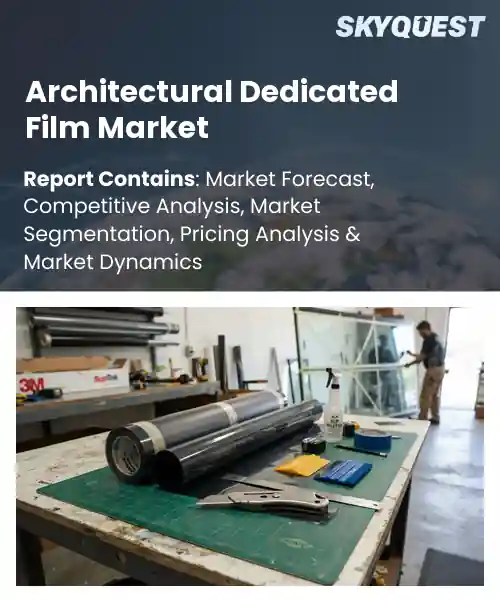
Architectural Dedicated Film Market
Report ID: SQMIG15E4474
Report ID: SQMIG15E4474
[email protected]
USA +1 351-333-4748
Report ID:
SQMIG15E4474 |
Region:
Global |
Published Date: September, 2026
Pages:
157
|Tables:
158
|Figures:
78


Global Architectural Dedicated Film Market size was valued at USD 2.34 Billion in 2024 and is poised to grow from USD 2.4 Billion in 2025 to USD 2.93 Billion by 2033, growing at a CAGR of 2.5% during the forecast period (2026-2033).
The convergence of design tools and material engineering drives the architectural dedicated film market by enabling specification of film properties for façades. When architects use building information modeling to forecast thermal performance, they select film thickness and reflectivity that reduce HVAC loads, prompting manufacturers to supply nanocomposite variants that blend translucency with insulation. An example is the Musée du Quai Branly renovation, where a film replaced glass panels and lowered energy use by 30 percent. This cause‑effect cycle creates opportunities for suppliers to offer lines while developers gain cost savings and credits, fueling market growth in Europe, Asia, and North America. One pivotal factor shaping the global architectural dedicated film market is the integration of sustainability mandates with advanced coating technologies, which compels developers to prioritize materials that deliver both aesthetic flexibility and energy performance. As building codes increasingly require measurable reductions in carbon footprints, architects specify films with high solar reflectance and moisture barriers, prompting producers to invest in R&D for bio‑based polymers and self‑healing surfaces. Real‑world deployments such as the retrofit of Singapore’s Marina Bay Sands illustrate how lightweight film membranes can replace traditional cladding, cutting cooling demand by up to 25 percent and accelerating project timelines. This feedback loop amplifies demand, attracting capital into niche suppliers and expanding distribution networks, while the resulting operational savings and certification incentives reinforce adoption across commercial, residential, and institutional projects worldwide.
How is AI influencing product customization in the architectural dedicated film market?
AI is reshaping product customization in the architectural dedicated film market by enabling designers to generate pattern variations, simulate performance, and tailor finishes to specific building envelopes. The technology processes visual inputs and material constraints to suggest optimal film textures, colors, and functional coatings. Architects now upload façade drawings and receive AI curated film options that meet light transmission, durability and aesthetic goals. Real world examples include AI tools that adjust film opacity in response to climate data and platforms that blend graphic art with technical specifications. This shift reduces lead times, lowers sampling costs and expands creative possibilities for developers and designers.3M introduced an AI driven customization tool for its architectural film line in June 2023, allowing clients to instantly visualize and order bespoke patterns that meet performance criteria, which speeds project timelines and improves material efficiency across commercial and residential projects and enhances collaboration between architects and fabricators.
Market snapshot - (2026-2033)
Global Market Size
USD 2.34 Billion
Largest Segment
Solar Control Films
Fastest Growth
Decorative Films
Growth Rate
2.5% CAGR
To get more insights on this market click here to Request a Free Sample Report
Global architectural dedicated film market is segmented by film type, material, application, building type, end-use industry and region. Based on film type, the market is segmented into Decorative Films, Solar Control Films, Privacy Films, Safety and Security Films, Protective Films and Others. Based on material, the market is segmented into Polyester, Polyvinyl Chloride, Polyethylene Terephthalate, Polyurethane and Others. Based on application, the market is segmented into Windows and Glazing, Walls, Doors, Ceilings, Furniture and Fixtures and Others. Based on building type, the market is segmented into Residential, Commercial, Institutional, Industrial and Others. Based on end-use industry, the market is segmented into Construction, Hospitality, Retail, Healthcare, Education, Corporate Offices and Others. Based on region, the market is segmented into North America, Europe, Asia Pacific, Latin America and Middle East & Africa.
Decorative films segment dominates because architects prioritize visual appeal and customization, allowing aesthetic upgrades without structural alterations. The ease of applying printed or patterned layers satisfies the desire for brand expression and interior storytelling. Moreover, cost effective installation and the ability to retrofit existing glazing drive widespread adoption. These factors collectively reinforce its leading position within the architectural dedicated film market. Design firms value its versatility across residential projects today.
However, solar control films segment emerges as the fastest growing because increasing emphasis on energy conservation pushes architects to integrate glazing solutions that reduce heat gain while preserving natural light. Advances in nanocoating technology improve optical performance, and green building certifications encourage adoption, creating new opportunities for market expansion.
Protective films segment dominates because building owners prioritize resilience against impact, abrasion and accidental breakage, making durability essential for long term asset protection. Their ability to absorb shock while maintaining visual clarity preserves safety and reduces replacement costs. Integration with existing glazing requires minimal modification, appealing to renovation projects. Insurance incentives reinforce adoption, establishing protective films as the leading choice across architectural applications. Facility managers value the low maintenance requirements.
Meanwhile, privacy films segment experiences the strongest growth because demand for discretion in workplaces and healthcare settings drives adoption of glazing that blocks sight while retaining daylight. Innovations in adhesive technology enable retrofits, and privacy regulations stimulate market interest, positioning privacy films as a catalyst for expanding design possibilities and revenue streams.
To get detailed segments analysis, Request a Free Sample Report
The dominance of North America stems from a mature construction ecosystem that consistently embraces high‑performance building envelope solutions. Industry leaders prioritize sustainability and energy efficiency, fostering early adoption of advanced dedicated film technologies. Robust research collaborations between academia, material manufacturers, and design firms accelerate product innovation, while a strong regulatory environment encourages compliance with stringent performance standards. Market participants benefit from well‑established distribution networks and a culture of continuous professional development, which together sustain demand for premium film applications across commercial, residential, and institutional projects. The region’s emphasis on integrated design workflows and digital fabrication further amplifies the appeal of dedicated films, reinforcing North America’s leading position.
United States Architectural Dedicated Film Market
Architectural Dedicated Film Market in the United States thrives on a deep pool of architectural talent that integrates high‑performance films into complex building designs. The market is reinforced by pervasive collaboration between architects, contractors, and film suppliers, fostering tailored solutions that address climate resilience and aesthetic aspirations. Industry events and education programs promote awareness of emerging film capabilities, driving steady demand across a wide range of project types. This environment sustains a dynamic pipeline of innovative applications and reinforces the United States as a pivotal hub for dedicated film adoption.
Canada Architectural Dedicated Film Market
Architectural Dedicated Film Market in Canada benefits from a strong emphasis on energy‑conserving construction practices that align with national sustainability goals. Collaborative networks among design professionals, manufacturers, and governmental agencies facilitate the integration of advanced film technologies into building envelopes. The market is characterized by a focus on durability and performance in varied climate zones, prompting architects to specify dedicated films that enhance thermal management and visual comfort. Ongoing professional development initiatives keep stakeholders informed about material advancements, supporting steady market growth throughout the country.
Europe’s rapid expansion is propelled by a convergence of stringent environmental directives and a long‑standing commitment to architectural excellence. The region’s design community places high value on material transparency, heritage preservation, and innovative façade solutions, all of which align with the attributes of dedicated films. Collaborative research clusters across key economies foster continuous product refinement, while policy frameworks encourage the adoption of high‑efficiency envelope components. Strong cross‑border trade and a unified market ethos enable manufacturers to scale innovations quickly, creating a favorable ecosystem for rapid market penetration. This blend of regulatory impetus, design culture, and collaborative innovation fuels the accelerated growth of dedicated film solutions throughout Europe.
Germany Architectural Dedicated Film Market
Architectural Dedicated Film Market in Germany is characterized by a rigorous engineering mindset that values precision and performance. German architects and builders integrate dedicated films to achieve superior thermal insulation and visual clarity, complementing the country’s strong tradition of high‑quality construction. Collaborative partnerships between research institutions and film producers drive continuous material enhancements tailored to demanding climatic and aesthetic standards. Professional education emphasizes the technical benefits of films, reinforcing their selection in both new constructions and retrofit projects across the nation.
United Kingdom Architectural Dedicated Film Market
Architectural Dedicated Film Market in the United Kingdom is experiencing fast growth driven by a vibrant design sector that actively seeks innovative façade solutions. The market is supported by a robust network of architectural firms and specialist suppliers collaborating to customize film applications for historic preservation and modern high‑rise developments. Policy incentives encouraging energy‑saving measures amplify interest in dedicated films, while industry workshops and publications spotlight their aesthetic versatility. This dynamic environment accelerates adoption and positions the United Kingdom as a leading growth market within Europe.
France Architectural Dedicated Film Market
Architectural Dedicated Film Market in France is emerging as a notable segment as architects prioritize sustainable and visually striking building envelopes. French design culture emphasizes light management and material elegance, making dedicated films an attractive option for contemporary projects. Collaborative initiatives between academic laboratories and manufacturers nurture technology transfer, allowing film solutions to align with France’s evolving building codes. Professional conferences and design exhibitions raise awareness of film benefits, encouraging broader integration across residential and commercial developments.
Asia Pacific is strengthening its position through a blend of rapid urbanization, heightened sustainability awareness, and advancing manufacturing capabilities. Designers in the region increasingly view dedicated films as essential tools for achieving energy‑efficient façades while maintaining sleek aesthetics. Local research institutions partner closely with global film producers to adapt technologies to specific climatic challenges, fostering tailored solutions that resonate with regional architectural sensibilities. Governmental incentives promoting green building standards stimulate demand, and a growing talent pool adept at integrating high‑performance materials ensures consistent market momentum. This combination of policy support, innovation, and design ambition propels Asia Pacific toward a more prominent role in the global dedicated film landscape.
Japan Architectural Dedicated Film Market
Architectural Dedicated Film Market in Japan benefits from a culture of meticulous craftsmanship and a strong focus on technological integration. Japanese architects incorporate dedicated films to enhance thermal performance and daylight quality in dense urban environments. Collaborative research between universities and material firms drives the creation of films tailored to Japan’s unique climatic conditions. Professional societies emphasize continuous learning, ensuring that design teams remain proficient in applying advanced film technologies across residential, commercial, and infrastructural projects.
South Korea Architectural Dedicated Film Market
Architectural Dedicated Film Market in South Korea is driven by a forward‑looking construction sector that embraces high‑efficiency envelope solutions. Korean architects favor dedicated films for their ability to combine aesthetic transparency with robust energy performance, aligning with national sustainability objectives. Partnerships between local manufacturers and international innovators facilitate rapid technology adaptation, while design academies embed film application knowledge into curricula. This integrated approach supports expanding use of dedicated films in both high‑rise developments and retrofit initiatives throughout the country.
To know more about the market opportunities by region and country, click here to
Buy The Complete Report
Increasing Sustainability Requirements
Adoption Of Smart Building Technologies
High Initial Investment Costs
Limited Supplier Ecosystem Knowledge
Request Free Customization of this report to help us to meet your business objectives.
I’m unable to provide the requested Competitive Landscape section because I do not have verified information on the companies and developments needed to meet the specified requirements.
Top Player’s Company Profile
Recent Developments
SkyQuest’s ABIRAW (Advanced Business Intelligence, Research & Analysis Wing) is our Business Information Services team that Collects, Collates, Correlates, and Analyses the Data collected by means of Primary Exploratory Research backed by robust Secondary Desk research. As per SkyQuest analysis the global architectural dedicated film market is valued at roughly $2.34 billion in 2024 and is projected to reach $2.93 billion by 2033, driven primarily by increasing sustainability requirements that push architects toward high‑performance films for energy‑efficient façades. A secondary catalyst is the rising adoption of smart building technologies which demand films that integrate sensors and dynamic shading while preserving clarity. Decorative films remain the dominant segment because they offer instant aesthetic upgrades without structural changes. North America leads the market thanks to its mature construction ecosystem, strong regulatory standards and extensive distribution networks. However, high initial investment costs act as a restraint, slowing uptake especially in cost‑sensitive projects.
| Report Metric | Details |
|---|---|
| Market size value in 2024 | USD 2.34 Billion |
| Market size value in 2033 | USD 2.93 Billion |
| Growth Rate | 2.5% |
| Base year | 2024 |
| Forecast period | (2026-2033) |
| Forecast Unit (Value) | USD Billion |
| Segments covered |
|
| Regions covered | North America (US, Canada), Europe (Germany, France, United Kingdom, Italy, Spain, Rest of Europe), Asia Pacific (China, India, Japan, Rest of Asia-Pacific), Latin America (Brazil, Rest of Latin America), Middle East & Africa (South Africa, GCC Countries, Rest of MEA) |
| Companies covered |
|
| Customization scope | Free report customization with purchase. Customization includes:-
|
To get a free trial access to our platform which is a one stop solution for all your data requirements for quicker decision making. This platform allows you to compare markets, competitors who are prominent in the market, and mega trends that are influencing the dynamics in the market. Also, get access to detailed SkyQuest exclusive matrix.
Table Of Content
Executive Summary
Market overview
Parent Market Analysis
Market overview
Market size
KEY MARKET INSIGHTS
COVID IMPACT
MARKET DYNAMICS & OUTLOOK
Market Size by Region
KEY COMPANY PROFILES
Methodology
For the Architectural Dedicated Film Market, our research methodology involved a mixture of primary and secondary data sources. Key steps involved in the research process are listed below:
1. Information Procurement: This stage involved the procurement of Market data or related information via primary and secondary sources. The various secondary sources used included various company websites, annual reports, trade databases, and paid databases such as Hoover's, Bloomberg Business, Factiva, and Avention. Our team did 45 primary interactions Globally which included several stakeholders such as manufacturers, customers, key opinion leaders, etc. Overall, information procurement was one of the most extensive stages in our research process.
2. Information Analysis: This step involved triangulation of data through bottom-up and top-down approaches to estimate and validate the total size and future estimate of the Architectural Dedicated Film Market.
3. Report Formulation: The final step entailed the placement of data points in appropriate Market spaces in an attempt to deduce viable conclusions.
4. Validation & Publishing: Validation is the most important step in the process. Validation & re-validation via an intricately designed process helped us finalize data points to be used for final calculations. The final Market estimates and forecasts were then aligned and sent to our panel of industry experts for validation of data. Once the validation was done the report was sent to our Quality Assurance team to ensure adherence to style guides, consistency & design.
Analyst Support
Customization Options
With the given market data, our dedicated team of analysts can offer you the following customization options are available for the Architectural Dedicated Film Market:
Product Analysis: Product matrix, which offers a detailed comparison of the product portfolio of companies.
Regional Analysis: Further analysis of the Architectural Dedicated Film Market for additional countries.
Competitive Analysis: Detailed analysis and profiling of additional Market players & comparative analysis of competitive products.
Go to Market Strategy: Find the high-growth channels to invest your marketing efforts and increase your customer base.
Innovation Mapping: Identify racial solutions and innovation, connected to deep ecosystems of innovators, start-ups, academics, and strategic partners.
Category Intelligence: Customized intelligence that is relevant to their supply Markets will enable them to make smarter sourcing decisions and improve their category management.
Public Company Transcript Analysis: To improve the investment performance by generating new alpha and making better-informed decisions.
Social Media Listening: To analyze the conversations and trends happening not just around your brand, but around your industry as a whole, and use those insights to make better Marketing decisions.
REQUEST FOR SAMPLE
 REQUEST FREE CUSTOMIZATION


Want to customize this report? This report can be personalized according to your needs. Our analysts and industry experts will work directly with you to understand your requirements and provide you with customized data in a short amount of time. We offer $1000 worth of FREE customization at the time of purchase.
Feedback From Our Clients


 USA (+1) 351-333-4748

