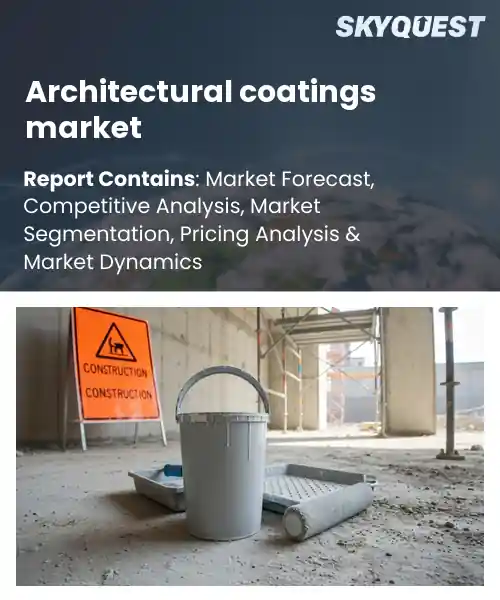
Architectural coatings market
Report ID: SQMIG15E3828
Report ID: SQMIG15E3828
[email protected]
USA +1 351-333-4748
Report ID:
SQMIG15E3828 |
Region:
Global |
Published Date: June, 2026
Pages:
157
|Tables:
182
|Figures:
79


Global Architectural Coatings Market size was valued at USD 89.3 Billion in 2024 and is poised to grow from USD 93.59 Billion in 2025 to USD 136.18 Billion by 2033, growing at a CAGR of 4.8% during the forecast period (2026-2033).
Rising urbanization, increasing residential and commercial construction activities, rising demand for sustainable low-VOC coatings, advancements in coating technologies, and growing investments in building renovation projects are driving sales of architectural coatings.
Increasing construction and infrastructure development activities around the world, coupled with increasing demand for durable, aesthetically appealing, and environmentally friendly coatings are supporting sustained architectural coatings market growth. Growing use of water-based, low-VOC and bio-based coating formulations is allowing manufacturers to meet the strict emission requirements of environmental regulations while also improving indoor air quality. Active innovations in antimicrobial coatings, nan-coatings and weather resistant formulations are constantly improving product performance for both residential and commercial purposes. The rise in focus on green building standards and energy-efficient construction is also driving the expansion of the market. Moreover, soaring renovation and refurbishment activity in developing and industrialized countries is predicted to open new growth avenues for the market across the globe.
However, volatile raw material prices, stringent environmental regulations on chemical formulations, high production costs for advanced coatings, and intense competition from low-cost manufacturers are anticipated to slow down architectural coatings market penetration across the study period.
How is AI-driven Automation Influencing the Demand for Architectural Coatings?
AI is revolutionizing the architectural coatings industry through optimized formulation, production, application, and finishing. Machine learning algorithms can recommend a formulation based on properties of raw materials and coating systems will use automated, spray technology to control spray pressure and flow to deliver a uniform coating. AI systems that offer color matching and formulation by analyzing pictures allow cost-effective and precise formulation of paint pigment, greatly reducing the formulation development time and waste. AI can further predict market demand to optimize manufacturing inventory levels and reduce supply chain delays and product shortages.
Market snapshot - (2026-2033)
Global Market Size
USD 89.3 Billion
Largest Segment
Acrylic Coatings
Fastest Growth
Specialty Resin Coatings
Growth Rate
4.8% CAGR
To get more insights on this market click here to Request a Free Sample Report
Global architectural coatings market is segmented by resin type, product type, technology, application, end user, distribution channel, and region. Based on resin type, the market is segmented into acrylic coatings, alkyd coatings, epoxy coatings, polyurethane coatings, polyester coatings, vinyl coatings, and specialty resin coatings. Based on product type, the market is segmented into interior architectural coatings, exterior architectural coatings, primers & sealers, decorative coatings, and protective architectural coatings. Based on technology, the market is segmented into waterborne coatings, solventborne coatings, powder coatings, and high-solid coatings. Based on application, the market is segmented into residential buildings, commercial buildings, institutional buildings, industrial buildings, and infrastructure projects. Based on end user, the market is segmented into homeowners, professional contractors, commercial construction firms, and government & public institutions. Based on distribution channel, the market is segmented into company-owned stores, paint dealers, home improvement retailers, and e-commerce. Based on region, the market is segmented into North America, Europe, Asia Pacific, Latin America, and Middle East & Africa.
The waterborne coatings segment is forecasted to lead the global architectural coatings market revenue generation through 2033. It coincides with strict environmental mandates and market satisfaction for green economy compatible with low VOC, thereby designated as the best fit for both indoor and outdoor uses. Its adaptation to different formulation can give desirable retention of color as well as thermal stability, and less harmful emission, strengthens its acceptance by professional builders and residential users. Its green trend of architecture application promotes the development of residential, commercial, and institutional building.
However, powder coatings segment emerges as the fastest growing one as per this architectural coatings market forecast, as its solvent free methodology fulfills market trends seeking energy saving and hardened coatings, and its modifications to powder technology allow for a wider color range and enhanced compatibility, opening new potential applications for commercial moist and internal surfaces, thus hastening market growth and the generation of revenues.
The exterior architectural coatings segment is expected to account for the highest global architectural coatings market share in the future. It offers significant weather resistance, UV stability and thermal insulation capable of protecting building envelope assets through extended lifecycles. Pioneering special blends of polymers designed to ensure higher adhesion and added flexibility helps the structures to withstand extreme climatic episodes without breakdown. The need to protect investments at various customer locations in the residential, commercial and institutional sector continues to drive formulation modifications, making the product a key player in the architectural coatings segment and conform to changing sustainable developments.
On the other hand, decorative coatings segment emerges as rapidly expanding as consumer desire for aesthetics to experiment with textures and metallic effects using innovative pigments. Solid formulation techniques facilitate its application and durability; which tempts homeowners and designers to adopt it leading to market gaps and market growth.
To get detailed segments analysis, Request a Free Sample Report
Rapid urban expansion, intensive infrastructure development, and a strong tradition of manufacturing excellence are forecasted to help this region maintain its dominant stance. Both consumers and developers are seeking high quality environmentally friendly finishes which have led local suppliers to make significant investments in product research and formulation development. Local supply chains are well established and tight integration with neighboring markets such as building products and decorative surfaces offers economies of scale that deliver quality products at reduced prices. Governmental focus on energy efficient architecture is also guiding the use of low VOC and energy efficient coating solutions across Asia Pacific. Efforts to reinforce the vision of China becoming the world's leader in coating volume and technology are also cementing the region’s dominance.
Architectural coatings market in Japan is shaped by a mature construction sector that values precision and durability, leading manufacturers to focus on high‑performance, low‑emission products. Consumer preferences for subtle aesthetic finishes combine with stringent regulatory expectations, encouraging continuous innovation. Industry collaboration between coating producers and architectural firms supports the development of bespoke solutions that meet both functional and design requirements, reinforcing Japan’s position as a benchmark for quality in the region.
Architectural coatings market in South Korea reflects a dynamic building environment driven by rapid residential and commercial growth. Innovative coating systems for buildings are preferred by manufacturers which can help in achieving climate resilience and sustainability in keeping with national policies for eco-friendly building techniques. The adaptability of the industry is aided by the presence of good research facilities and a culture of innovation leading to the development of coating systems that are efficient and have minimal odor.
Heightened focus on sustainability, regulatory harmonization, and renovation activity across mature building stocks are supporting consistent sales of architectural coatings across the region. A rise in the number of environmental laws and regulations globally has prompted paint manufacturers to find new low-VOC, bio-based, and energy efficient coatings to meet customer demand. Architects and contractors look for premium, high performance, and aesthetically pleasing coatings to fit their customers' needs. Established distribution networks and skilled workforces are helping to facilitate product acceptance. Additionally, the growing trend toward restoring historic buildings is creating a need for specialized coating products that meet the requirements of those buildings. All these factors are creating opportunities for new innovative and high performing coating products into the market.
Architectural coatings market in Germany is characterized by a strong industrial base that emphasizes precision engineering and high‑quality standards. Manufacturers respond to rigorous environmental and performance regulations by delivering technically sophisticated, durable coatings that meet both commercial and residential needs. Close cooperation between industry associations and research institutes fuels continuous product refinement, ensuring that German solutions remain at the forefront of innovation and reliability in the European context.
Architectural coatings market in the United Kingdom experiences rapid growth due to a vibrant housing renovation sector and increasing consumer appetite for sustainable, design‑forward finishes. Regulatory motivations toward energy-efficient building practices simultaneously promote the utilization of low emission, high-performance coatings. Innovative color trends push the desire for an extensive palette and surface variation. Market advantages arise from a flexible, efficient supply chain and a resilient designer-manufacturer alliance that hastens the introduction of state-of-the-art coatings over the exciting new faces in the market.
Architectural coatings market in France is emerging as a focal point for innovative, aesthetically oriented solutions that respond to both modern construction and heritage preservation. French manufacturers emphasize eco‑friendly formulations to align with national sustainability goals, while also catering to designers seeking sophisticated visual effects. Growing awareness of the health and environmental benefits of low‑VOC products fuels market acceptance, positioning France as a growing hub for forward‑looking coating technologies within the broader European landscape.
North America reinforces its market position through a blend of technological leadership, sustainability focus, and extensive construction activity across both new builds and retrofits. Industry players invest heavily in research to create high‑performance, low‑impact coatings that meet rigorous environmental standards and address diverse climate challenges. The region’s expansive distribution infrastructure, coupled with strong collaboration between manufacturers, architects, and contractors, facilitates rapid adoption of innovative products. Consumer demand for health‑conscious interiors and resilient exterior finishes further drives the evolution of sophisticated coating solutions, cementing North America’s role as a leader in advanced architectural finishes.
Architectural coatings market in the United States is driven by large‑scale construction projects and a culture of continuous product innovation. Companies emphasize the development of high‑efficiency, low‑odor coatings that meet stringent environmental regulations while providing versatile aesthetic options. Collaboration between industry leaders and design professionals accelerates the introduction of cutting‑edge technologies, supporting a dynamic market that prioritizes both performance and sustainability across residential and commercial sectors.
Architectural coatings market in Canada places strong emphasis on climate‑responsive solutions, reflecting the country’s diverse environmental conditions. Producers of durable, energy efficient, enduring coating systems designed for use in the most extreme temperature ranges emphasize sustainable product development, building codes and regulations compliance, working with builders and architects to assure that Canadian products meet current everyday demands for performance, health and environmental sustainability.
To know more about the market opportunities by region and country, click here to
Buy The Complete Report
Increasing Urbanization Demand
Adoption Of Green Building Standards
High Cost Of Advanced Formulations
Regulatory Compliance Complexity
Request Free Customization of this report to help us to meet your business objectives.
The architectural coatings market is shaped by intense rivalry among global giants such as AkzoNobel, DowDuPont, PPG Industries, Sherwin‑Williams and BASF Coatings AG, each leveraging M&A, strategic partnerships and technology innovation to capture premium segments; recent acquisitions and joint‑development projects focus on low‑VOC formulations, digital color‑matching tools and sustainable binder technologies, driving differentiation and market share shifts.
SkyQuest’s ABIRAW (Advanced Business Intelligence, Research & Analysis Wing) is our Business Information Services team that Collects, Collates, Correlates, and Analyses the Data collected by means of Primary Exploratory Research backed by robust Secondary Desk research.
As per SkyQuest analysis, increasing residential and commercial construction activities, and rising demand for sustainable low-VOC coatings are anticipated to drive the demand for architectural coatings going forward. However, volatile raw material prices and stringent environmental regulations on chemical formulations are slated to slow down the adoption of architectural coatings in the future. Asia Pacific is slated to spearhead the demand for architectural coatings owing to strong construction renovation activities, widespread adoption of green building standards, and high demand for sustainable coating solutions. AI-powered formulation technologies and development of water-based, low-VOC, and high-performance coatings are anticipated to be key trends driving the architectural coatings industry over the coming years.
| Report Metric | Details |
|---|---|
| Market size value in 2024 | USD 89.3 Billion |
| Market size value in 2033 | USD 136.18 Billion |
| Growth Rate | 4.8% |
| Base year | 2024 |
| Forecast period | (2026-2033) |
| Forecast Unit (Value) | USD Billion |
| Segments covered |
|
| Regions covered | North America (US, Canada), Europe (Germany, France, United Kingdom, Italy, Spain, Rest of Europe), Asia Pacific (China, India, Japan, Rest of Asia-Pacific), Latin America (Brazil, Rest of Latin America), Middle East & Africa (South Africa, GCC Countries, Rest of MEA) |
| Companies covered |
|
| Customization scope | Free report customization with purchase. Customization includes:-
|
To get a free trial access to our platform which is a one stop solution for all your data requirements for quicker decision making. This platform allows you to compare markets, competitors who are prominent in the market, and mega trends that are influencing the dynamics in the market. Also, get access to detailed SkyQuest exclusive matrix.
Table Of Content
Executive Summary
Market overview
Parent Market Analysis
Market overview
Market size
KEY MARKET INSIGHTS
COVID IMPACT
MARKET DYNAMICS & OUTLOOK
Market Size by Region
KEY COMPANY PROFILES
Methodology
For the Architectural coatings market, our research methodology involved a mixture of primary and secondary data sources. Key steps involved in the research process are listed below:
1. Information Procurement: This stage involved the procurement of Market data or related information via primary and secondary sources. The various secondary sources used included various company websites, annual reports, trade databases, and paid databases such as Hoover's, Bloomberg Business, Factiva, and Avention. Our team did 45 primary interactions Globally which included several stakeholders such as manufacturers, customers, key opinion leaders, etc. Overall, information procurement was one of the most extensive stages in our research process.
2. Information Analysis: This step involved triangulation of data through bottom-up and top-down approaches to estimate and validate the total size and future estimate of the Architectural coatings market.
3. Report Formulation: The final step entailed the placement of data points in appropriate Market spaces in an attempt to deduce viable conclusions.
4. Validation & Publishing: Validation is the most important step in the process. Validation & re-validation via an intricately designed process helped us finalize data points to be used for final calculations. The final Market estimates and forecasts were then aligned and sent to our panel of industry experts for validation of data. Once the validation was done the report was sent to our Quality Assurance team to ensure adherence to style guides, consistency & design.
Analyst Support
Customization Options
With the given market data, our dedicated team of analysts can offer you the following customization options are available for the Architectural coatings market:
Product Analysis: Product matrix, which offers a detailed comparison of the product portfolio of companies.
Regional Analysis: Further analysis of the Architectural coatings market for additional countries.
Competitive Analysis: Detailed analysis and profiling of additional Market players & comparative analysis of competitive products.
Go to Market Strategy: Find the high-growth channels to invest your marketing efforts and increase your customer base.
Innovation Mapping: Identify racial solutions and innovation, connected to deep ecosystems of innovators, start-ups, academics, and strategic partners.
Category Intelligence: Customized intelligence that is relevant to their supply Markets will enable them to make smarter sourcing decisions and improve their category management.
Public Company Transcript Analysis: To improve the investment performance by generating new alpha and making better-informed decisions.
Social Media Listening: To analyze the conversations and trends happening not just around your brand, but around your industry as a whole, and use those insights to make better Marketing decisions.
REQUEST FOR SAMPLE
 REQUEST FREE CUSTOMIZATION
Global Architectural Coatings Market size was valued at USD 89.3 Billion in 2024 and is poised to grow from USD 93.59 Billion in 2025 to USD 136.18 Billion by 2033, growing at a CAGR of 4.8% during the forecast period (2026-2033).
The architectural coatings market is shaped by intense rivalry among global giants such as AkzoNobel, DowDuPont, PPG Industries, Sherwin‑Williams and BASF Coatings AG, each leveraging M&A, strategic partnerships and technology innovation to capture premium segments; recent acquisitions and joint‑development projects focus on low‑VOC formulations, digital color‑matching tools and sustainable binder technologies, driving differentiation and market share shifts. 'Sherwin-Williams', 'PPG Industries', 'Akzo Nobel', 'Nippon Paint Holdings', 'RPM International', 'Asian Paints', 'Berger Paints India', 'Jotun', 'Kansai Paint', 'Axalta Coating Systems', 'Masco Corporation (Behr)', 'Hempel', 'Benjamin Moore', 'DAW SE', 'SK Kaken', 'Teknos Group', 'Tikkurila', 'Diamond Vogel', 'Cloverdale Paint', 'Kelly-Moore Paints'
The rapid expansion of cities creates continuous need for new construction and renovation projects, prompting architects and developers to seek high‑performance coatings that combine durability, aesthetic versatility, and environmental compliance. This demand drives manufacturers to innovate product portfolios, expand distribution networks, and invest in brand positioning, thereby accelerating market growth as more projects adopt advanced coating solutions to meet stringent regulatory and client expectations. Additionally, the growing emphasis on sustainable design encourages the use of low‑VOC and energy‑efficient finishes, further reinforcing the market’s upward trajectory.
Sustainable Finishes Gain Traction: Architects and developers increasingly prioritize low‑VOC, water‑based and bio‑based coatings to meet green building certifications and occupant health expectations. Manufacturers respond by expanding portfolios with renewable resin technologies, incorporating natural pigments and enhancing durability through nanostructured additives. This shift accelerates collaboration with sustainability consultants and drives supply‑chain transparency, as stakeholders demand lifecycle assessments and carbon‑footprint disclosures. The resulting market momentum encourages investment in R&D focused on eco‑efficiency, positioning sustainable finishes as a differentiator in competitive project bids. globally today.
Why does Asia Pacific Dominate the Global Architectural coatings market? |@12


Want to customize this report? This report can be personalized according to your needs. Our analysts and industry experts will work directly with you to understand your requirements and provide you with customized data in a short amount of time. We offer $1000 worth of FREE customization at the time of purchase.
Feedback From Our Clients


 USA (+1) 351-333-4748

