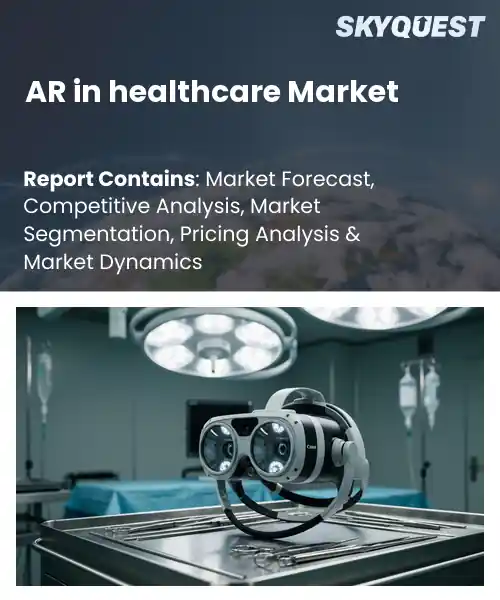
AR in Healthcare Market
Report ID: SQMIG35G2457
Report ID: SQMIG35G2457
[email protected]
USA +1 351-333-4748
Report ID:
SQMIG35G2457 |
Region:
Global |
Published Date: June, 2026
Pages:
157
|Tables:
92
|Figures:
76


Global AR in Healthcare Market size was valued at USD 2.01 Billion in 2024 and is poised to grow from USD 2.54 Billion in 2025 to USD 16.44 Billion by 2033, growing at a CAGR of 26.3% during the forecast period (2026-2033).
The key driving factor boosting the development of augmented reality in healthcare is primarily the necessity for improved accuracy, efficiency, reduced costs, and risks involved. The use of augmented reality in healthcare involves technology that adds digital data to the field of view of healthcare professionals to achieve such tasks as surgical navigation, imaging veins, teaching anatomy, and performing guidance. What makes this topic important is the fact that better visualization leads to fewer complications, faster procedures, and better training of staff. Traditionally, the development of augmented reality has gone through various stages, starting from heads-up displays for aviation up until mobile AR systems are used today, for example AccuVein vein finding systems.
In the context of increasing clinical efficacy, another significant reason behind the growth of the international market for augmented reality is economic alignment and technological infrastructure that remove limitations while enhancing utility. The combination of cheap sensors and mobile AR frameworks along with low latency through 5G have led to the development of remote proctoring and collaborative surgical platforms; for instance, Proximie’s telecollaborative use of AR has made it possible for expert surgeons to direct surgeries at resource-constrained hospitals. As evidence of better results comes from pilot studies, hospitals spend while insurers reimburse, resulting in investments and EHR integration.
How is AR Integrated with AI Enhancing Surgical Training in the Healthcare Market?
The combination of augmented reality with AI technology revolutionizes surgical training through the addition of customized 3D patient anatomy in front of the trainee's eye combined with the delivery of real time guidance and automatic performance feedback. Important features include immersive simulation for hands on practice, AI-enabled assessments that customize the training path and remote mentoring that reduces the time taken to learn. At present, the marketplace features enterprise level mixed reality tools and validated simulations employed by teaching institutions and medical equipment manufacturers to enhance consistency and prepare the learner. They range from mixed reality guidance solutions that visualize surgical plans on the operating theater screen to immersive platforms that record skills and provide actionable data for the teacher.Stryker Jan 2024, successfully executed its first surgeries involving a shoulder replacement using its Blueprint mixed reality surgical guidance tool.
Market snapshot - (2026-2033)
Global Market Size
USD 2.01 Billion
Largest Segment
Hardware
Fastest Growth
Software
Growth Rate
26.3% CAGR
To get more insights on this market click here to Request a Free Sample Report
Global AR in healthcare market is segmented by component, application, end-user and region. Based on component, the market is segmented into Hardware, Software and Others. Based on application, the market is segmented into Surgery and Medical Training, Patient Management, Fitness Management, Pharmacy Management and Others. Based on end-user, the market is segmented into Hospitals and Clinics, Academic Institutes and Others. Based on region, the market is segmented into North America, Europe, Asia Pacific, Latin America and Middle East & Africa.
Dominance of the software segment lies in the capability of software platforms to quickly develop the content, integrate it into electronic health record systems, and deploy it effectively within workflow procedures, generating value for end users. Well-established developer ecosystems and interoperability frameworks decrease the implementation hurdles that drive adoption and investment from vendors. Remote iterations of features strengthen the diagnostic overlay capabilities and enhance training modules as well, further emphasizing the preference towards software-led solutions for AR clinical applications.
On the other hand, the growth of hardware is the fastest one due to the developments in optics that make the devices smaller, better-performing display technologies and medical sensors that facilitate clinical usability of devices. Focus of the vendors on ergonomics and certification pathways leads to physician acceptance of devices and their procedural implementation.
Surgical procedures and medical education dominate due to the application of augmented reality technology in simulation-based learning, intraoperative viewing, and hands-on practice that enhance clinical outcomes and procedure confidence. Collaboration between the device manufacturer and the surgical educators results in customized content creation and verified learning curriculum, which minimizes the required training duration and variability of each procedure. The immediate advantages of utilizing augmented reality technology in important procedures promote procurement in institutions and ensure its adoption through incorporation into residency training and professional continuing education programs.
Nevertheless, patient management remains one of the fastest-growing applications because of the utilization of AR to provide remote patient monitoring and adherence reminders alongside immersive teleconsultations that increase patient engagement. Interoperability with care delivery software and consumer wearables opens new opportunities for chronic disease management, which attracts the attention of payers.
To get detailed segments analysis, Request a Free Sample Report
The US and Canada account for a large share of the worldwide market for AR applications in the healthcare industry because of their combination of advanced clinical infrastructure, technical know-how, and commercialization efforts. Universities, hospitals, and innovative startups work alongside well-established manufacturers of devices and software to develop viable products from AR prototypes. With support from the favorable regulation and reimbursement landscape, the industry has succeeded in rolling out pilot programs in surgery, education, and remote assistance. At the same time, significant venture capital investments and a competent workforce are driving the development of AR products. Clinicians' need for digitalization and training makes the health facilities in the region conducive to the growth of AR solutions.
The healthcare AR market in the US enjoys advantages in the form of concentration of academic medical centers, technology firms, and medical device companies that fast-track the validation and commercialization processes. Stakeholders in health systems focus on integration within surgery procedures, education for clinicians, and interpretation of images, as startup firms work alongside existing technology vendors in enterprise deployments. Regulation and payers’ interaction aid in proving the value, and investments aid in refining and scaling products.
Market for Healthcare AR In Canada is governed by the cooperation of academic hospitals, provincial health agencies, and tech companies concentrating on clinical workflow optimization and clinical training. The pilot projects include assistance in surgery, teleconsultation, and training. Interoperability issues and clinicians' acceptance play an important role. Government procurement and regional incubators can facilitatethe implementation, whereas cooperation between researchers and industry may help validate prototypes of the technology.
The rapid adoption of AR technology in healthcare applications within Europe is underpinned by harmonized policies related to digital health, strong manufacturing capabilities within medical technology sector, and active use of the technology within clinical environments. Within each nation, there is support for the use of immersive technology within surgical navigation, educational tools, and telemedicine settings, and consortia both within the nation and across international borders are facilitating research and standardization. Within Germany, there is an excellent infrastructure for manufacturing and clinical trials, while in the United Kingdom, the national procurement systems of the health care sector facilitate scaling from pilots to widespread usage. In France, the focus on incubating innovations has been successful in fostering AR technologies.
The German market for AR in healthcare benefits from an advanced infrastructure for manufacturing medical technologies, strong engineering capabilities, and clinical evaluation competences in university hospitals. Providers focus on accurate procedures, surgical navigation, and radiology visualization, which is beneficial for conducting trials and testing pilot projects. Partnership between hardware providers, software companies, and clinical researchers facilitates innovations. At the same time, innovation regions and hospital acquisitions contribute to the implementation of AR solutions.
AR in healthcare market in the United Kingdom Benefits from involvement in a national health system able to facilitate trials and expansion in hospitals. A focus on digitization, education of clinicians, and procurement makes room for solutions in surgical assistance, remote consultations, and learning to expand beyond trial use. Partnerships between startups, traditional vendors, and academic institutions help provide evidence and ease of implementation.
The French market for AR in healthcare involves high levels of backing from public organizations for research, hospital innovation laboratories, and incubation programs for young companies to conduct clinical trials. The focus is mainly on surgeries, medical education, and image visualization where new processes are tested at academic institutions. Collaborations among clinicians, software providers, and manufacturers help develop better user experiences and integration capability.
Players in this regional market are focusing on capabilities, national initiatives, and deployment in leading clinical settings. Both Japan and South Korea utilize their electronics, imaging, and optical strengths to create high fidelity AR systems, while clinical hospitals implement use cases such as surgery, rehabilitation, and simulation training. Local ecosystems that consist of manufacturers and innovative startups and established industry companies enable quicker refinement and localization of technologies to address local clinical requirements. National research funding programs and collaborations with international vendors promote clinical validation initiatives. Interoperability, usability, and manufacturability considerations ensure that the region is poised to convert prototypes to clinically viable solutions.
AR for Healthcare Market in Japan is supported by a high degree of expertise in the fields of optics, sensors, and manufacturing which enables the development of display devices and visualization technologies. Partnerships among companies in the field of electronics and medical devices along with hospitals are leading the way in surgery guidance, diagnostic applications, and therapy. Such efforts at a national level of research as well as hospital trials have focused on ergonomics and regulatory requirements.
The South Korean market is driven by a thriving consumer electronics industry, capable software engineers, and early adopters of hospitals who facilitate fast prototyping and clinical trials. Hospitals develop technology in three primary areas – surgical aids, training simulation, and remote consultations. Hospitals work closely with both start-ups and manufacturers to fine-tune the technology.
To know more about the market opportunities by region and country, click here to
Buy The Complete Report
Integration with Electronic Health Records
The integration capabilities of electronic health records allow the AR solution to gain access to information about the patients involved, leading to less resistance against adopting the new technology among practitioners. The smooth connectivity facilitates better decision-making, context overlay, and interface customization by vendors that increases provider confidence. This makes the adoption process easier, while at the same time addressing operational needs and encourages the involvement of institutions.
Enhanced Surgical Visualization Capabilities
Increased capability of visualizing during surgery gives surgeons an overlay in real time with information about what is happening, making procedures clearer and therefore making surgeons more confident in performing them; cognitive load can be decreased when doing complex procedures with AR technology. Since AR gives users clear visual cues and increased spatial awareness, this technology becomes helpful in teaching and learning new procedures, thus motivating medical professionals to use this technology during operations.
Regulatory Approval Complexity
The unpredictability that comes with the complexities and diversities involved in securing regulatory approvals is discouraging to developers, resulting in delays in entry into the market along with additionalcosts involved in demonstrating safety and efficacy of AR technologies used in health care. Varying guidelines from one region to another, as well as the need to provide clinical evidence, pose challenges that might deter smaller firms from participating in such ventures.
Patient Data Privacy Concerns
The issues of confidentiality with regard to the patients' personal information, as well as the safety of any visual or sensed data, constitute major barriers to the implementation of augmented reality systems in medical practice since healthcare providers need to ensure adequate protection of any data related to their operations. The potential threats, together with a lack of clear liability in case of any compromise, lead to increased risks and require a lot of planning in terms of policies, cybersecurity, and legal concerns.
Request Free Customization of this report to help us to meet your business objectives.
The competitive landscape revolves around firms that manage to attain regulatory clearances, clinical validation, and key industry partnerships to gain traction within hospitals. Some of these initiatives include strategic investments and fund raising, which help in scaling up and integrating their products. These include some key investment and FDA clearances helping firms differentiate themselves from others, while other competing firms invest in product development and pilot programs at hospitals.
Workforce Training and Upskilling: AR technologies are being used in healthcare institutions for the rapid training of professionals, rehearsal of procedures, and transfer of skills between dispersed teams. The use of immersive overlays will help minimize dependence on simulations and remote mentoring, thus ensuring competency-based development and fast onboarding. Vendors are concentrating on curriculum development and authoring tools that suit clinical processes and credentialing. This approach will encourage continuous professional development, minimize variation in care processes, and contribute to workforce retention.
Interoperability and Ecosystem Partnerships: AR technologies that can be seamlessly integrated into electronic records, imaging, and other medical device systems have become the primary focus of manufacturers, software companies, and hospitals. The availability of open platforms and standards allows the development of shared content repositories, standardized interfaces, and collaborative support that makes implementation easier. Collaboration within these ecosystems speeds up the validation process in clinical environments and ensures large-scale deployment. The focus on neutral vendors and joint frameworks helps drive innovation and prevent overlap, creating commercially viable opportunities for AR-assisted healthcare services.
SkyQuest’s ABIRAW (Advanced Business Intelligence, Research & Analysis Wing) is our Business Information Services team that Collects, Collates, Correlates, and Analyses the Data collected by means ofPrimary Exploratory Research backed by robust Secondary Desk research.
As per SkyQuest analysis, there is tremendous potential for growth within the global market for AR in healthcare, with clinical necessity for increasing accuracy and efficiency in procedures and training serving as the main driver and the reduction in price for hardware alongside advancements in technology like 5G, which allow for scalable remote monitoring and collaboration, being the second driver. The restraints include the lengthy nature of regulatory approval processes, which limit commercialization. North America is the leading region as a result of its highly developed clinical environments as well as early adoption of technology, whereas the software category is the leader because of platform capabilities.
| Report Metric | Details |
|---|---|
| Market size value in 2024 | USD 2.01 Billion |
| Market size value in 2033 | USD 16.44 Billion |
| Growth Rate | 26.3% |
| Base year | 2024 |
| Forecast period | (2026-2033) |
| Forecast Unit (Value) | USD Billion |
| Segments covered |
|
| Regions covered | North America (US, Canada), Europe (Germany, France, United Kingdom, Italy, Spain, Rest of Europe), Asia Pacific (China, India, Japan, Rest of Asia-Pacific), Latin America (Brazil, Rest of Latin America), Middle East & Africa (South Africa, GCC Countries, Rest of MEA) |
| Companies covered |
|
| Customization scope | Free report customization with purchase. Customization includes:-
|
To get a free trial access to our platform which is a one stop solution for all your data requirements for quicker decision making. This platform allows you to compare markets, competitors who are prominent in the market, and mega trends that are influencing the dynamics in the market. Also, get access to detailed SkyQuest exclusive matrix.
Table Of Content
Executive Summary
Market overview
Parent Market Analysis
Market overview
Market size
KEY MARKET INSIGHTS
COVID IMPACT
MARKET DYNAMICS & OUTLOOK
Market Size by Region
KEY COMPANY PROFILES
Methodology
For the AR in Healthcare Market, our research methodology involved a mixture of primary and secondary data sources. Key steps involved in the research process are listed below:
1. Information Procurement: This stage involved the procurement of Market data or related information via primary and secondary sources. The various secondary sources used included various company websites, annual reports, trade databases, and paid databases such as Hoover's, Bloomberg Business, Factiva, and Avention. Our team did 45 primary interactions Globally which included several stakeholders such as manufacturers, customers, key opinion leaders, etc. Overall, information procurement was one of the most extensive stages in our research process.
2. Information Analysis: This step involved triangulation of data through bottom-up and top-down approaches to estimate and validate the total size and future estimate of the AR in Healthcare Market.
3. Report Formulation: The final step entailed the placement of data points in appropriate Market spaces in an attempt to deduce viable conclusions.
4. Validation & Publishing: Validation is the most important step in the process. Validation & re-validation via an intricately designed process helped us finalize data points to be used for final calculations. The final Market estimates and forecasts were then aligned and sent to our panel of industry experts for validation of data. Once the validation was done the report was sent to our Quality Assurance team to ensure adherence to style guides, consistency & design.
Analyst Support
Customization Options
With the given market data, our dedicated team of analysts can offer you the following customization options are available for the AR in Healthcare Market:
Product Analysis: Product matrix, which offers a detailed comparison of the product portfolio of companies.
Regional Analysis: Further analysis of the AR in Healthcare Market for additional countries.
Competitive Analysis: Detailed analysis and profiling of additional Market players & comparative analysis of competitive products.
Go to Market Strategy: Find the high-growth channels to invest your marketing efforts and increase your customer base.
Innovation Mapping: Identify racial solutions and innovation, connected to deep ecosystems of innovators, start-ups, academics, and strategic partners.
Category Intelligence: Customized intelligence that is relevant to their supply Markets will enable them to make smarter sourcing decisions and improve their category management.
Public Company Transcript Analysis: To improve the investment performance by generating new alpha and making better-informed decisions.
Social Media Listening: To analyze the conversations and trends happening not just around your brand, but around your industry as a whole, and use those insights to make better Marketing decisions.
REQUEST FOR SAMPLE
 REQUEST FREE CUSTOMIZATION
Global Ar In Healthcare Market size was valued at USD 2.01 Billion in 2024 and is poised to grow from USD 2.54 Billion in 2025 to USD 16.44 Billion by 2033, growing at a CAGR of 26.3% during the forecast period (2026-2033).
Competition is concentrated among companies securing regulatory clearances, clinical evidence, and strategic industry partnerships to win hospital adoption; recent moves include strategic investments and large funding rounds that accelerate deployment and product integration. Examples include major institutional investments and FDA clearances driving differentiation, while competitors pursue product innovation and hospital pilots to translate AR image fusion and intraoperative guidance into validated clinical workflows. 'Alphabet', 'Microsoft Corporation', 'Meta Platforms', 'Sony Group Corporation', 'Siemens Healthineers', 'Philips', 'GE HealthCare', 'Intuitive Surgical', 'Johnson & Johnson', 'Stryker Corporation', 'Zimmer Biomet', 'Medtronic', 'AccuVein', 'Augmedics', 'Magic Leap', 'CAE Inc', 'EchoPixel', 'Mindmaze', 'Osso VR', 'Vicarious Surgical'
Integration with electronic health records enables augmented reality solutions to access relevant patient data and clinical workflows, which reduces workflow friction and makes AR tools more practical for clinicians to adopt. This seamless connectivity supports clinical decision making, allows contextual overlays during procedures, and helps vendors tailor interfaces to existing systems, thereby increasing provider confidence. By simplifying implementation and aligning with operational needs, EHR integration encourages institutional investment and broader deployment across care settings, and facilitating coordinated multidisciplinary workflows.
Workforce Training And Upskilling: Healthcare organizations are adopting AR to accelerate clinician training, procedural rehearsals, and skills transfer across distributed teams. Immersive overlays reduce reliance on physical simulations and enable remote mentoring, fostering standardized competency development and faster onboarding. Vendors focus on authoring tools and curriculum integration that align with clinical workflows and credentialing requirements. This trend promotes continuous professional development, reduces variability in care delivery, and supports workforce retention by offering engaging, on-demand learning experiences that adapt to evolving clinical practices and scalability.
Why does North America Dominate the Global AR in healthcare Market? |@12


Want to customize this report? This report can be personalized according to your needs. Our analysts and industry experts will work directly with you to understand your requirements and provide you with customized data in a short amount of time. We offer $1000 worth of FREE customization at the time of purchase.
Feedback From Our Clients


 USA (+1) 351-333-4748

