Apron feeder market
Report ID: SQMIG20I3148
Report ID: SQMIG20I3148
[email protected]
USA +1 351-333-4748
Report ID:
SQMIG20I3148 |
Region:
Global |
Published Date: June, 2026
Pages:
157
|Tables:
180
|Figures:
79


Global Apron Feeder Market size was valued at USD 3.2 Billion in 2024 and is poised to grow from USD 3.38 Billion in 2025 to USD 5.23 Billion by 2033, growing at a CAGR of 5.6% during the forecast period (2026-2033).
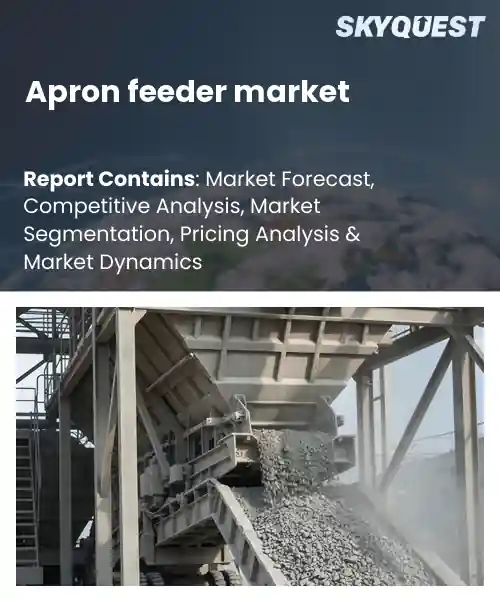
The apron feeder market encompasses equipment that transports bulk materials such as coal, ore, grain, and aggregates. Its significance stems from the need for continuous, low‑maintenance flow in mining, power generation, and food processing plants, where downtime directly erodes profit margins. Historically, the market emerged in the 1970s as simple belt‑driven units, but advances in modular design and dust‑suppression technology during the 1990s expanded applications into environments. Today, manufacturers cite the surge in renewable‑energy projects and mining expansions as the primary driver of demand, illustrated by the 2022 significant installation of a 2‑km apron feeder line at an Australian iron‑ore mine.
Automation and digital integration constitute the key trend driving the global apron feeder sector, because they enable remote monitoring, predictive maintenance, and adaptive speed control lower operating costs. When sensors feed real data to cloud platforms, plant operators can anticipate belt wear before failure, preventing costly shutdowns extending equipment life. This capability has prompted projects such as the 2023 retrofit of a coal‑handling facility in South Africa, where IoT feeders reduced downtime by 18 %. Consequently, manufacturers intensify R&D on drives and modular control units, opening opportunities for revenue streams and positioning apron feeders as integral components of Industry 4.0‑compliant ecosystems.
How are AI and IoT Technologies Reshaping the Apron Feeder Market?
AI and IoT are turning apron feeders into intelligent handling systems. Sensors now capture vibration, temperature and load data in real time while cloud platforms store the information for analysis. AI algorithms turn those streams into predictive maintenance alerts, allowing operators to address wear before a failure occurs. Remote monitoring lets managers adjust speed and belt tension from a central dashboard, improving material flow and reducing energy use. Leading manufacturers such as Metso, Sandvik and Terex are embedding IoT modules and AI driven control loops into new models, creating equipment that learns from each cycle and adapts to changing production demands.
In November 2022, McLanahan unveiled its largest apron feeder equipped with AI driven load monitoring and IoT connectivity, enabling real time performance tracking and automated adjustments. This innovation demonstrates how intelligent technology can boost throughput while lowering downtime, reinforcing market momentum toward smarter material handling solutions.
Market snapshot - (2026-2033)
Global Market Size
USD 3.2 Billion
Largest Segment
Heavy-Duty Apron Feeders
Fastest Growth
Electromechanical Apron Feeders
Growth Rate
5.6% CAGR
To get more insights on this market click here to Request a Free Sample Report
Global apron feeder market is segmented by product type, application, drive type, end-use industry, capacity, installation type and region. Based on product type, the market is segmented into heavy-duty apron feeders, medium-duty apron feeders, light-duty apron feeders, hydraulic apron feeders and electromechanical apron feeders. Based on application, the market is segmented into mining, quarrying, aggregates processing, cement manufacturing, bulk material handling and metallurgical processing. Based on drive type, the market is segmented into electric drive, hydraulic drive and variable frequency drive (VFD). Based on end-use industry, the market is segmented into mining, cement, metals & minerals, construction materials and industrial processing. Based on capacity, the market is segmented into below 500 TPH, 500–2,000 TPH and Above 2,000 TPH. Based on installation type, the market is segmented into fixed, mobile and semi-mobile. Based on region, the market is segmented into North America, Europe, Asia Pacific, Latin America and Middle East & Africa.
Based on the global airborne surveillance market growth, heavy duty apron feeders segment dominates because they provide the robust structural integrity required for high load throughput in demanding industries. Their reinforced frames and high wear components enable continuous operation under extreme conditions, reducing downtime and maintenance costs. This reliability appeals to operators seeking long term asset performance, and the ability to handle diverse material types reinforces their preference across the market landscape and supports scaling of production lines.
However, variable frequency drive technology is witnessing the strongest growth momentum because its energy efficiency and precise speed control enable operators to optimize power consumption while adapting to variable material flow. This flexibility drives adoption in newer facilities and retrofits, creating fresh opportunities for market expansion and innovation.
Hydraulic drive segment dominates because it delivers the high torque and precise force control essential for moving heavy bulk loads. The direct fluid power ensures smooth acceleration and deceleration, reducing mechanical stress and extending equipment lifespan. Operators value this reliability in rugged environments, where consistent performance and low maintenance are critical for uninterrupted production cycles. Additionally, the ability to integrate with existing hydraulic circuits simplifies retrofits and supports flexible plant layouts.
Meanwhile, mobile installation type is emerging as the key high growth area because its transportability enables rapid redeployment across multiple sites. This agility meets the demand for flexible material handling solutions, especially in projects with shifting extraction zones. The reduced infrastructure footprint accelerates project timelines and opens new market niches for equipment providers.
To get detailed segments analysis, Request a Free Sample Report
As per the global airborne surveillance market share, North America benefits from a mature foodservice landscape where consumer expectations for speed, safety, and consistency drive relentless demand for reliable apron feeding solutions. A deep pool of engineering talent and established equipment manufacturers enable rapid innovation and customization, while sophisticated logistics networks ensure efficient distribution across vast territories. Strong regulatory frameworks emphasize hygiene and operational excellence, positioning providers to meet stringent standards. Collaborative partnerships between suppliers, distributors, and end users foster continuous improvement, and a culture of technology adoption encourages integration of advanced controls and monitoring. These combined strengths create a resilient ecosystem that sustains leadership and cultivates ongoing market dominance.
Apron feeder market in the United States thrives on extensive food processing capacity and a high‑velocity retail environment that prizes efficiency and product integrity. Manufacturers capitalize on advanced automation capabilities and invest heavily in research to tailor solutions for diverse culinary applications. Distribution channels are finely tuned, enabling swift delivery to both large‑scale operations and specialty establishments. The emphasis on compliance with rigorous safety protocols reinforces confidence among operators, while a proactive approach to sustainability drives the incorporation of eco‑friendly materials and energy‑saving designs.
Apron feeder market in Canada reflects a balanced blend of innovation and adherence to stringent quality standards that resonate with a discerning consumer base. Providers leverage a strong engineering foundation to develop adaptable equipment suited for multicultural foodservice concepts and seasonal variability. Collaborative networks between regional distributors and equipment manufacturers facilitate rapid response to evolving market needs. Emphasis on environmental stewardship inspires the use of recyclable components and low‑impact manufacturing processes, reinforcing Canada’s reputation for responsible and reliable apron feeding solutions.
Based on global airborne surveillance regional forecast, Europe expands rapidly due to a convergence of sustainability imperatives, sophisticated culinary trends, and a commitment to operational excellence. Producers prioritize energy efficiency and waste reduction, prompting the adoption of innovative feeding mechanisms that align with green initiatives. High consumer expectations for food safety and presentation drive investment in precision equipment, while rigorous quality regulations ensure consistent performance. Cross‑border collaboration among leading engineering hubs, especially in Germany, the United Kingdom, and France, accelerates technology transfer and standardization. The region’s dense network of foodservice establishments and strong emphasis on training empower operators to maximize equipment capabilities, further fuelling market momentum and reinforcing Europe’s position as a hub of advanced apron feeding solutions.
Apron feeder market in Germany stands out through a heritage of precision engineering and a systematic approach to process optimization. Suppliers integrate detailed sensor technologies and modular designs that cater to the exacting standards of both industrial and artisanal food producers. Close cooperation with research institutes fuels continuous refinement, while a robust supply chain ensures timely availability of high‑quality components. The focus on durability and efficiency resonates with German manufacturers seeking long‑term reliability and reduced operational costs.
Apron feeder market in the United Kingdom experiences swift growth as retailers and hospitality venues embrace modernized service models that demand speed and consistency. Providers emphasize flexible configurations that accommodate diverse menu offerings and dynamic kitchen layouts. Strong emphasis on food safety compliance drives the integration of hygienic materials and easy‑clean mechanisms. Collaborative initiatives between industry bodies and technology firms accelerate the rollout of smart monitoring solutions, positioning the United Kingdom as a fast‑adapting landscape for apron feeding innovations.
Apron feeder market in France is emerging alongside a vibrant culinary culture that values artisanal quality and presentation. Equipment designers focus on elegant yet functional solutions that complement boutique bakeries and upscale dining establishments. Attention to sustainability encourages the use of recyclable polymers and energy‑saving motors, aligning with French consumer preferences for environmentally conscious practices. Partnerships with culinary schools and regional food incubators foster early adoption of advanced feeding technologies, helping to propel France’s market trajectory.
As per global airborne surveillance regional outlook, Asia Pacific strengthens its industry presence by marrying rapid economic development with an increasing appetite for sophisticated foodservice experiences. Nations in the region invest heavily in modern manufacturing capabilities, enabling the production of high‑performance feeding systems that meet rising quality expectations. A focus on automation and digital integration allows operators to enhance throughput while maintaining strict hygiene standards. Cultural emphasis on innovation drives collaborations between local equipment firms and global technology providers, resulting in tailored solutions for diverse culinary traditions. Growing export orientation further amplifies the region’s influence, as manufacturers leverage competitive cost structures and adaptable designs to serve markets beyond their borders. Collectively, these dynamics elevate Asia Pacific as a pivotal contributor to the evolving landscape of apron feeding technology.
Apron feeder market in Japan blends meticulous craftsmanship with cutting‑edge automation to satisfy a discerning consumer base that prizes precision and consistency. Suppliers develop compact, high‑efficiency units that integrate seamlessly into space‑constrained kitchens common in urban settings. Emphasis on rigorous sanitation protocols leads to the adoption of materials resistant to corrosion and easy to sterilize. Collaborative research initiatives with technology institutes promote the incorporation of smart sensors and predictive maintenance features, reinforcing Japan’s reputation for reliable and innovative feeding equipment.
Apron feeder market in South Korea is propelled by a dynamic food culture that embraces both traditional dishes and fast‑casual concepts, requiring versatile feeding solutions. Manufacturers prioritize rapid prototyping and agile production methods to deliver equipment that can be quickly customized for varied menu demands. Strong governmental support for manufacturing excellence encourages the integration of advanced robotics and IoT connectivity, enhancing operational oversight. The focus on sleek design aesthetics aligns with South Korean consumer preferences, ensuring that apron feeders not only perform efficiently but also complement modern kitchen environments.
To know more about the market opportunities by region and country, click here to
Buy The Complete Report
Sustainable Practices Driving Demand
Cost Efficiency Through Standardization
Supply Chain Disruptions Impact Availability
Regulatory Compliance Costs Increasing
Request Free Customization of this report to help us to meet your business objectives.
Competitive Landscape
The global airborne surveillance market outlook is highly competitive, led by companies such as Boeing, Northrop Grumman, Saab AB, L3Harris Technologies, Airbus Defence and Space, Leonardo S.p.A., and RTX Corporation. Market leaders focus on AI-enabled surveillance, multi-domain ISR integration, and advanced radar technologies to strengthen their portfolios. Saab emphasizes GlobalEye platform expansion, Boeing advances E-7 Wedgetail deployments, while L3Harris and Northrop Grumman invest in open-architecture mission systems and digital modernization to enhance operational flexibility and global defense competitiveness.
Top Player’s Company Profile
Recent Developments
SkyQuest’s ABIRAW (Advanced Business Intelligence, Research & Analysis Wing) is our Business Information Services team that Collects, Collates, Correlates, and Analyses the Data collected by means of Primary Exploratory Research backed by robust Secondary Desk research.
As per SkyQuest analysis, the global airborne surveillance industry is driven primarily by automation and digital integration that enable predictive maintenance and energy savings, while a second important driver is cost efficiency through standardized components which lower capital spend and simplify upkeep. The heavy‑duty apron feeder segment leads the market because its robust design meets high‑throughput demands in mining and construction. North America remains the dominant region thanks to its mature industrial base and strong engineering ecosystem. However, persistent supply‑chain disruptions for steel and electronic parts act as a restraint, slowing order fulfilment and prompting buyers to defer upgrades.
| Report Metric | Details |
|---|---|
| Market size value in 2024 | USD 3.2 Billion |
| Market size value in 2033 | USD 5.23 Billion |
| Growth Rate | 5.6% |
| Base year | 2024 |
| Forecast period | (2026-2033) |
| Forecast Unit (Value) | USD Billion |
| Segments covered |
|
| Regions covered | North America (US, Canada), Europe (Germany, France, United Kingdom, Italy, Spain, Rest of Europe), Asia Pacific (China, India, Japan, Rest of Asia-Pacific), Latin America (Brazil, Rest of Latin America), Middle East & Africa (South Africa, GCC Countries, Rest of MEA) |
| Companies covered |
|
| Customization scope | Free report customization with purchase. Customization includes:-
|
To get a free trial access to our platform which is a one stop solution for all your data requirements for quicker decision making. This platform allows you to compare markets, competitors who are prominent in the market, and mega trends that are influencing the dynamics in the market. Also, get access to detailed SkyQuest exclusive matrix.
Table Of Content
Executive Summary
Market overview
Parent Market Analysis
Market overview
Market size
KEY MARKET INSIGHTS
COVID IMPACT
MARKET DYNAMICS & OUTLOOK
Market Size by Region
KEY COMPANY PROFILES
Methodology
For the Apron feeder market, our research methodology involved a mixture of primary and secondary data sources. Key steps involved in the research process are listed below:
1. Information Procurement: This stage involved the procurement of Market data or related information via primary and secondary sources. The various secondary sources used included various company websites, annual reports, trade databases, and paid databases such as Hoover's, Bloomberg Business, Factiva, and Avention. Our team did 45 primary interactions Globally which included several stakeholders such as manufacturers, customers, key opinion leaders, etc. Overall, information procurement was one of the most extensive stages in our research process.
2. Information Analysis: This step involved triangulation of data through bottom-up and top-down approaches to estimate and validate the total size and future estimate of the Apron feeder market.
3. Report Formulation: The final step entailed the placement of data points in appropriate Market spaces in an attempt to deduce viable conclusions.
4. Validation & Publishing: Validation is the most important step in the process. Validation & re-validation via an intricately designed process helped us finalize data points to be used for final calculations. The final Market estimates and forecasts were then aligned and sent to our panel of industry experts for validation of data. Once the validation was done the report was sent to our Quality Assurance team to ensure adherence to style guides, consistency & design.
Analyst Support
Customization Options
With the given market data, our dedicated team of analysts can offer you the following customization options are available for the Apron feeder market:
Product Analysis: Product matrix, which offers a detailed comparison of the product portfolio of companies.
Regional Analysis: Further analysis of the Apron feeder market for additional countries.
Competitive Analysis: Detailed analysis and profiling of additional Market players & comparative analysis of competitive products.
Go to Market Strategy: Find the high-growth channels to invest your marketing efforts and increase your customer base.
Innovation Mapping: Identify racial solutions and innovation, connected to deep ecosystems of innovators, start-ups, academics, and strategic partners.
Category Intelligence: Customized intelligence that is relevant to their supply Markets will enable them to make smarter sourcing decisions and improve their category management.
Public Company Transcript Analysis: To improve the investment performance by generating new alpha and making better-informed decisions.
Social Media Listening: To analyze the conversations and trends happening not just around your brand, but around your industry as a whole, and use those insights to make better Marketing decisions.
REQUEST FOR SAMPLE
 REQUEST FREE CUSTOMIZATION
Global Apron Feeder Market size was valued at USD 3.2 Billion in 2024 and is poised to grow from USD 3.38 Billion in 2025 to USD 5.23 Billion by 2033, growing at a CAGR of 5.6% during the forecast period (2026-2033).
Top Player’s Company Profile 'Metso', 'FLSmidth', 'McLanahan Corporation', 'TAKRAF Group', 'Thyssenkrupp Mining Technologies', 'Sandvik', 'MMD Group', 'TerraSource Global', 'Osborn Engineered Products', 'MEKA Crushing & Screening', 'L&T Construction & Mining Machinery', 'AUMUND Group', 'Deister Machine Company', 'Elecon Engineering', 'Williams Patent Crusher', 'NHI (Northern Heavy Industries)', 'CITIC Heavy Industries', 'IMECO', 'Binder+Co', 'HAZEMAG'
Growing consumer and airline emphasis on eco‑friendly operations encourages manufacturers to develop lightweight, recyclable apron feeders, which reduce fuel consumption and waste. Operators view such equipment as a tangible way to meet corporate sustainability goals, leading to increased procurement cycles. The alignment of product design with environmental standards also enhances brand perception and stakeholder confidence, creating a virtuous cycle where demand for greener feeders accelerates market expansion across regional and international airports. Additionally, airlines increasingly integrate procurement criteria into supplier contracts, reinforcing the shift toward ground support equipment.
Sustainability‑Driven Material Innovation: Manufacturers are increasingly adopting eco‑friendly fibers, recycled polymers, and biodegradable coatings for aprons, driven by consumer demand for greener products and corporate ESG commitments. This shift encourages collaborations with textile innovators, leading to lighter, more breathable aprons that retain protective performance while reducing environmental impact. Brands that showcase transparent sustainability narratives gain competitive advantage, fostering loyalty among hospitality and food‑service operators seeking to align procurement with their own sustainability goals and long‑term cost efficiencies while enhancing brand reputation globally today.
Why does North America Dominate the Global Apron feeder market? |@12


Want to customize this report? This report can be personalized according to your needs. Our analysts and industry experts will work directly with you to understand your requirements and provide you with customized data in a short amount of time. We offer $1000 worth of FREE customization at the time of purchase.
Feedback From Our Clients


 USA (+1) 351-333-4748

