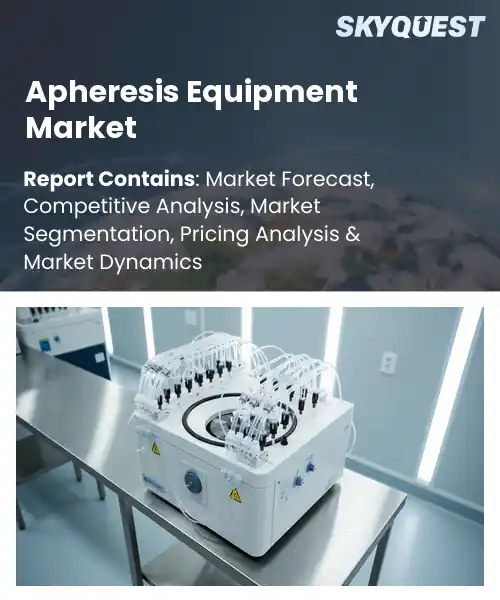
Apheresis Equipment Market
Report ID: SQMIG35A4084
Report ID: SQMIG35A4084
[email protected]
USA +1 351-333-4748
Report ID:
SQMIG35A4084 |
Region:
Global |
Published Date: July, 2026
Pages:
157
|Tables:
171
|Figures:
79


Global Apheresis Equipment Market size was valued at USD 4.87 Billion in 2024 and is poised to grow from USD 5.28 Billion in 2025 to USD 10.07 Billion by 2033, growing at a CAGR of 8.4% during the forecast period (2026-2033).
The global apheresis equipment market includes devices that, in a roundabout way, separate blood components for therapeutic or diagnostic purposes, such as plasma‑exchange systems and leukapheresis machines. People say its importance is tied to the growing burden of autoimmune disorders, chronic kidney disease, and the increasing appetite for plasma‑derived therapeutics, so the demand tends to pull in efficient solutions. The main push comes from the faster roll‑out of biologics and plasma‑derived product pipelines, and that makes hospitals and specialty clinics want to modernize their infrastructure sooner rather than later.
Then there is outpatient apheresis services, which drives the apheresis equipment market growth, since insurers are now reimbursing same‑day treatments and patients prefer less invasive locations. With shorter hospital stays, the overall costs drop, and health systems feel more comfortable buying portable devices that work at the bedside. For example, regional blood centers have added compact plasma‑exchange units for hyper‑IgM syndrome, and they report faster turnaround, plus better satisfaction. At the same time personalized immunotherapies, including CAR‑T cell production, raise the need for leukapheresis platforms able to collect enough lymphocytes with minimal variability . Manufacturers that bring modular, IoT‑enabled systems tend to get a leg up , while emerging markets often benefit from smaller capital spending and improved therapy access.
AI is reshaping apheresis equipment market outlook by putting predictive analytics inside it, adding real‑time monitoring, and using adaptive control algorithms. Machine‑learning models keep checking blood flow dynamics and catching irregularities before they turn into actual safety concerns, which is the whole point. Some systems also include visual‑inspection tools that flag clot formation or tubing leaks, so operators can respond immediately, without waiting. Then there is process‑optimization software that fine-tunes anticoagulant dosing and centrifuge speed using patient‑specific information, so there are fewer manual tweaks and the procedure often ends sooner . The outcome is a smoother workflow , less operator tiredness, and more consistent treatments, and all of that builds trust among clinicians and patients, which then supports broader adoption of apheresis therapies across hospitals and specialized centers.
Market snapshot - (2026-2033)
Global Market Size
USD 4.87 Billion
Largest Segment
Plasmapheresis Equipment
Fastest Growth
Platelet Apheresis Equipment
Growth Rate
8.4% CAGR
To get more insights on this market click here to Request a Free Sample Report
The global apheresis equipment market is segmented by product type, procedure type, technology, end user, application, mobility and region. Based on product type, the market is segmented into Plasmapheresis Equipment, Platelet Apheresis Equipment, Leukapheresis Equipment and Others. Based on procedure type, the market is segmented into Therapeutic Apheresis and Donor Apheresis. Based on technology, the market is segmented into Centrifugation-Based Systems and Membrane Filtration Systems. Based on end user, the market is segmented into Hospitals, Blood Collection Centers, Specialty Clinics and Others. Based on application, the market is segmented into Hematology, Neurology, Nephrology and Others. Based on mobility, the market is segmented into Stationary Systems and Portable Systems. Based on region, the market is segmented into North America, Europe, Asia Pacific, Latin America and Middle East & Africa.
As per the apheresis equipment market analysis, the Plasmapheresis equipment takes the lead because it ends up covering the widest range of clinical needs, autoimmune disorders, hyperlipidemia and all that, so it becomes the workhorse of apheresis treatment. There’s this established track record too, plus lots of doctors already know how to use it, and supply chains are settled, so the demand feeds itself over time. When hospitals and blood centers already have these machines, they stick with them, which grows market share, and then incremental upgrades follow, locking in the leadership position. On top of that, the systems tend to be reliable enough that downtime is lower, and that makes clinicians more confident.
However, the Platelet apheresis equipment category appears to be the fastest-moving, mainly because improvements in platelet collection can boost transfusion safety and help with inventory control. Those gains pull blood centers toward newer setups with higher yield and reduced contamination risk, and that pulls more investment into newer platforms. And with more emphasis on personalized transfusion strategies, demand ramps up faster, opening new growth pockets for manufacturers.
According to the apheresis equipment market forecast, the Therapeutic apheresis segment dominates, since it maps to key care pathways for things like multiple sclerosis, graft‑versus‑host disease, and severe hyperlipidemia, where medication options are not that great or they’re limited. Clinicians lean on its ability to remove harmful factors quickly, so hospitals keep buying it consistently. Plus, ongoing clinical proof along with reimbursement backing reinforces the “center of gravity” role, meaning it stays a core category. Also, the fact that it’s broadly applicable across specialties helps spread adoption, and manufacturers then feel pressure to keep innovating inside that bucket.
Whereas the Donor apheresis equipment is predicted to have the largest apheresis equipment market share because demand for blood components keeps climbing, so collection centers start shifting toward automation. Better user interfaces and added safety features also reduce staffing strain, making these devices more attractive purchases. Donor recruitment programs and stricter quality rules then add another push, and that positions donor apheresis like a driver for market expansion, rather than just a supporting act.
To get detailed segments analysis, Request a Free Sample Report
As per the apheresis equipment market regional forecast, North America benefits from a very mature healthcare system, with this whole emphasis on early take up of advanced therapeutic technologies , and it makes it easier for hospitals to move fast on apheresis solutions. There is a solid funding mechanisms plus reimbursement pathways that push integration quicker . The top manufacturers keep research and development hubs in the region, which helps with continuous innovation ,and also keeps things close with academic institutions, so the feedback feels more immediate. On top of that, the regulatory framework is strong enough that guidance is clearer ,which can cut down time to market for new devices. Then there are the big clinical trial networks and a skilled biomedical workforce too, so the region can translate cutting edge science into routine patient care and it locks in leadership in the global apheresis equipment landscape .
United States Apheresis Equipment Market
The United States Apheresis Equipment sector is doing well due to heavy investment in biomedical research and a network of top academic hospitals, that push clinical adoption. Reimbursement policies back a wide set of therapeutic uses , so providers can put apheresis into standard protocols without as much friction. Also it helps that device innovators are close by , which speeds up those feedback loops, making sure improvements match real clinical needs. In practice, industry plus research centers keep teaming up, sustaining a pipeline of new technologies that keeps the market competitive and dominant.
Canada Apheresis Equipment Market
The Apheresis Equipment industry in Canada gets a boost from a universal healthcare setup that leans toward fair access to advanced therapies. Government health agencies actively fund clinical evaluations, and that encourages hospitals to roll out apheresis platforms across different care environments. Strong provincial collaborations help create a more unified setting for knowledge sharing and training, so practitioner expertise grows. And then there are emerging partnerships with international manufacturers , bringing more cutting edge solutions for Canadian patients. That said it also reinforces Canada’s overall image as a forward looking market for apheresis technologies.
Europe’s apheresis equipment market penetration is pushed by coordinated regulatory standards that make market entry smoother across member states, so manufacturers can scale without too much delay. There’s also growing prevalence of chronic and immune-mediated conditions, which creates steady clinical demand for apheresis interventions. On the funding side, big public plus private research investments support collaborative studies that confirm therapeutic benefits, while reimbursement schemes increasingly treat apheresis as a cost-effective choice. The region also has a manufacturing backbone, especially in Germany, and then plus progressive health policies in the United Kingdom, with early but growing adoption in France. Altogether it builds a dynamic ecosystem that moves market growth along across the continent.
Germany Apheresis Equipment Market
In Germany, the Apheresis Equipment Market leans on a strong engineering tradition and a dense map of tertiary care hospitals, where high precision medical devices get prioritized. National health insurers cover a broad range of apheresis procedures comprehensively, and that encourages wider clinical use. Manufacturers also stay close to research institutions, so continuous product refinement happens in a fairly steady way. That combination helps position Germany as a quality and reliability benchmark across Europe.
United Kingdom Apheresis Equipment Market
The Apheresis Equipment Market in the United Kingdom benefits from a centralized health service that focuses on equitable access to new therapies. National health authorities have introduced supportive funding routes, which speeds up adoption of apheresis within specialist centers. There are also strong clinical research programs, many times done alongside major academic hospitals, and the evidence they generate tends to drive faster uptake. This keeps the UK on track as a rapidly growing market for apheresis solutions.
France Apheresis Equipment Market
The Apheresis Equipment Market in France is becoming a noticeable part of the broader European picture. French health policy is increasingly recognizing the therapeutic value of apheresis, and that’s leading to gradual expansion of reimbursement backing. Academic collaborations, along with specialized treatment centers, are helping early clinical rollouts, creating a groundwork for faster market development and more visibility among local stakeholders.
Asia Pacific is pushing its apheresis footprint forward via smart investments in healthcare infrastructure and a real focus on the growing load of long lasting chronic ailments. Across the region, governments are putting a priority on newer treatment modalities, which then leads to policy setups that make it easier to bring in sophisticated apheresis systems. Meanwhile, local manufacturers are making pacts with worldwide tech leaders, so domestic production improves and technology transfer actually happens. And as private hospital groups grow, plus clinical research activity ramps up, apheresis gets more and more plugged into everyday care, which makes the region look like a more and more meaningful player in the international market.
Japan Apheresis Equipment Market
The Apheresis Equipment Market in Japan is being supported by a medically advanced community that emphasizes accuracy and usefulness. An aging population, with bigger needs for focused therapeutic approaches, nudges hospitals to treat apheresis as a routine option. Tight teamwork between device creators and top clinical hubs helps speed up the uptake of next generation tech , so Japan stays seen as a market that’s ahead of the curve.
South Korea Apheresis Equipment Market
The Apheresis Equipment Market in South Korea is riding on strong government backing for medical device invention, plus a health sector that keeps growing fast, particularly on the private side. National health insurers are slowly but steadily widening reimbursement for apheresis procedures, so hospitals feel more pressure ( in a good way ) to add these systems to their offerings. At the same time, collaborations between domestic producers and multinational corporations help adoption happen quickly, making South Korea a lively and fast changing market for apheresis equipment.
To know more about the market opportunities by region and country, click here to
Buy The Complete Report
Rising Demand for Chronic Therapies
Advances in Automated Apheresis Systems
High Capital Investment Requirements
Stringent Regulatory Approval Processes
Request Free Customization of this report to help us to meet your business objectives.
The competitive terrain is getting tangled up by fierce rivalry between the well known manufacturers, they keep pushing into new areas by growing product lineups via strategic acquisitions plus partnerships, while newer players are moving faster with AI driven workflow automation and more unified data platforms. And those recent big funding rounds, like high value ones, signal a change in focus toward better filtration tech and broader consolidation across the global supply chain.
Top Player’s Company Profile
Recent Developments in the Apheresis Equipment Market
SkyQuest’s ABIRAW (Advanced Business Intelligence, Research & Analysis Wing) is our Business Information Services team that Collects, Collates, Correlates, and Analyses the Data collected by means of Primary Exploratory Research backed by robust Secondary Desk research.
As per SkyQuest analysis, the market is being propelled mainly by a growing need for long term therapies, which in turn pushes hospitals to buy advanced apheresis devices. On top of that, the quick uptake of automated systems that bring together sensors, and AI, keeps the momentum going. The biggest segment is plasmapheresis equipment, because it has such broad clinical use, and North America is still leading the way, largely due to well established reimbursement frameworks and substantial R&D investment. Even so, the high upfront capital investment requirement becomes a restraint, slowing adoption for smaller facilities , and making many buyers look at leasing instead. Put together, these factors keep pointing to a market expected to expand steadily.
| Report Metric | Details |
|---|---|
| Market size value in 2024 | USD 4.87 Billion |
| Market size value in 2033 | USD 10.07 Billion |
| Growth Rate | 8.4% |
| Base year | 2024 |
| Forecast period | (2026-2033) |
| Forecast Unit (Value) | USD Billion |
| Segments covered |
|
| Regions covered | North America (US, Canada), Europe (Germany, France, United Kingdom, Italy, Spain, Rest of Europe), Asia Pacific (China, India, Japan, Rest of Asia-Pacific), Latin America (Brazil, Rest of Latin America), Middle East & Africa (South Africa, GCC Countries, Rest of MEA) |
| Companies covered |
|
| Customization scope | Free report customization with purchase. Customization includes:-
|
To get a free trial access to our platform which is a one stop solution for all your data requirements for quicker decision making. This platform allows you to compare markets, competitors who are prominent in the market, and mega trends that are influencing the dynamics in the market. Also, get access to detailed SkyQuest exclusive matrix.
Table Of Content
Executive Summary
Market overview
Parent Market Analysis
Market overview
Market size
KEY MARKET INSIGHTS
COVID IMPACT
MARKET DYNAMICS & OUTLOOK
Market Size by Region
KEY COMPANY PROFILES
Methodology
For the Apheresis Equipment Market, our research methodology involved a mixture of primary and secondary data sources. Key steps involved in the research process are listed below:
1. Information Procurement: This stage involved the procurement of Market data or related information via primary and secondary sources. The various secondary sources used included various company websites, annual reports, trade databases, and paid databases such as Hoover's, Bloomberg Business, Factiva, and Avention. Our team did 45 primary interactions Globally which included several stakeholders such as manufacturers, customers, key opinion leaders, etc. Overall, information procurement was one of the most extensive stages in our research process.
2. Information Analysis: This step involved triangulation of data through bottom-up and top-down approaches to estimate and validate the total size and future estimate of the Apheresis Equipment Market.
3. Report Formulation: The final step entailed the placement of data points in appropriate Market spaces in an attempt to deduce viable conclusions.
4. Validation & Publishing: Validation is the most important step in the process. Validation & re-validation via an intricately designed process helped us finalize data points to be used for final calculations. The final Market estimates and forecasts were then aligned and sent to our panel of industry experts for validation of data. Once the validation was done the report was sent to our Quality Assurance team to ensure adherence to style guides, consistency & design.
Analyst Support
Customization Options
With the given market data, our dedicated team of analysts can offer you the following customization options are available for the Apheresis Equipment Market:
Product Analysis: Product matrix, which offers a detailed comparison of the product portfolio of companies.
Regional Analysis: Further analysis of the Apheresis Equipment Market for additional countries.
Competitive Analysis: Detailed analysis and profiling of additional Market players & comparative analysis of competitive products.
Go to Market Strategy: Find the high-growth channels to invest your marketing efforts and increase your customer base.
Innovation Mapping: Identify racial solutions and innovation, connected to deep ecosystems of innovators, start-ups, academics, and strategic partners.
Category Intelligence: Customized intelligence that is relevant to their supply Markets will enable them to make smarter sourcing decisions and improve their category management.
Public Company Transcript Analysis: To improve the investment performance by generating new alpha and making better-informed decisions.
Social Media Listening: To analyze the conversations and trends happening not just around your brand, but around your industry as a whole, and use those insights to make better Marketing decisions.
REQUEST FOR SAMPLE
 REQUEST FREE CUSTOMIZATION
Global Apheresis Equipment Market size was valued at USD 4.87 Billion in 2024 and is poised to grow from USD 5.28 Billion in 2025 to USD 10.07 Billion by 2033, growing at a CAGR of 8.4% during the forecast period (2026-2033).
The competitive landscape is shaped by intense rivalry among established manufacturers expanding product portfolios through strategic acquisitions and partnerships, while newer entrants accelerate growth with AI‑driven process automation and integrated data platforms; recent high‑value funding rounds underscore a shift toward advanced filtration technologies and global supply‑chain consolidation. 'Terumo Blood and Cell Technologies', 'Fresenius Kabi AG', 'Haemonetics Corporation', 'B. Braun SE', 'Nikkiso Co., Ltd.', 'Asahi Kasei Medical Co., Ltd.', 'Kaneka Corporation', 'Miltenyi Biotec B.V. & Co. KG', 'Macopharma SA', 'Cerus Corporation', 'Medica S.p.A.', 'Hemocare Corporation', 'Infomed SA', 'Sichuan Nigale Biomedical Co., Ltd.', 'HemaCare Corporation', 'Braile Biomédica', 'Fresenius Medical Care AG', 'Baxter International Inc.', 'CytoSorbents Corporation', 'Kawasumi Laboratories, Inc.'
Clinicians are increasingly relying on apheresis to manage complex hematologic and immunologic conditions, which drives hospital procurement cycles and encourages manufacturers to expand product portfolios. The therapeutic relevance of apheresis in removing pathogenic substances and collecting valuable cellular components creates sustained clinical interest, prompting investment in research and development. Consequently, healthcare providers prioritize acquisition of advanced devices to improve patient outcomes and operational efficiency, reinforcing market expansion across both established and emerging regions. These dynamics also foster collaborations between equipment suppliers and academic institutions, accelerating innovation pipelines.
Personalized Therapeutic Integration: Emerging clinical protocols increasingly combine apheresis with targeted biologic therapies, enabling real‑time removal of pathogenic cells while concurrently delivering personalized agents. This convergence reduces treatment cycles, improves patient outcomes, and aligns with value‑based care models. Providers are adopting integrated platforms that synchronize collection, processing, and infusion, fostering seamless workflows. As physicians seek tailored interventions for complex diseases, manufacturers are prioritizing modular equipment capable of rapid reconfiguration, positioning the market for sustained growth driven by clinical innovation across global healthcare ecosystems.
Why does North America Dominate the Global Apheresis Equipment Market? |@12


Want to customize this report? This report can be personalized according to your needs. Our analysts and industry experts will work directly with you to understand your requirements and provide you with customized data in a short amount of time. We offer $1000 worth of FREE customization at the time of purchase.
Feedback From Our Clients


 USA (+1) 351-333-4748

