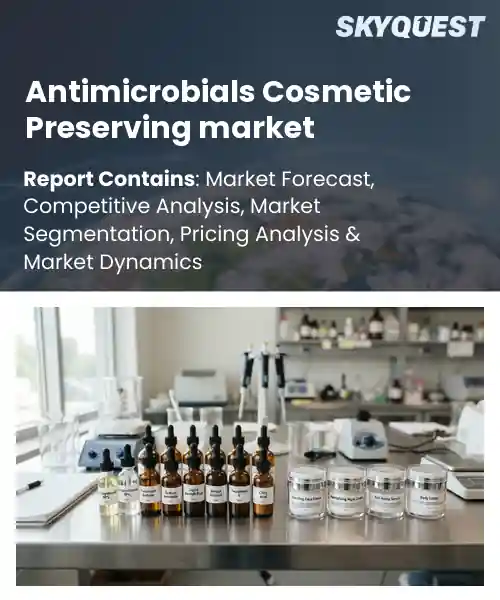
Antimicrobials Cosmetic Preserving market
Report ID: SQMIG30L2604
Report ID: SQMIG30L2604
[email protected]
USA +1 351-333-4748
Report ID:
SQMIG30L2604 |
Region:
Global |
Published Date: September, 2026
Pages:
157
|Tables:
143
|Figures:
78


Global Antimicrobials Cosmetic Preserving Market size was valued at USD 2.72 Billion in 2024 and is poised to grow from USD 2.9 Billion in 2025 to USD 4.92 Billion by 2033, growing at a CAGR of 6.8% during the forecast period (2026-2033).
The antimicrobials cosmetic preserving market includes ingredients that inhibit microbial growth in products, ensuring safety, shelf life, and compliance. Its importance stems from rising consumer awareness of contamination and stricter hygiene standards imposed by agencies such as the FDA and EU Cosmetics Regulation. The primary driver is the growth of natural and organic lines, which demand preservative systems compatible with formulas while maintaining efficacy. Historically, parabens dominated the sector, but scandals over endocrine disruption prompted a shift toward alternatives like phenoxyethanol, benzyl alcohol, and bio‑based peptides. Consequently, manufacturers have accelerated research to create preservatives that meet claims without compromising stability. Regulatory pressure now acts as a pivotal factor in the antimicrobials cosmetic preserving market because agencies demand documented efficacy and safety for each preservative. This requirement pushes suppliers toward advanced testing such as rapid microbiological challenge assays, which shorten product launch timelines for brands seeking market advantage. A European skincare firm recently switched to a peptide‑based preservative that achieved broad‑spectrum activity at low dosage, allowing a 20 % cut in overall preservative load and supporting a “reduced chemical exposure” claim. The shift creates space for niche natural‑origin providers and motivates large corporations to acquire biotech startups, expanding the global competitive arena.
How is AI-driven automation reshaping the antimicrobial cosmetic preservative market?
AI-driven automation is streamlining the antimicrobial cosmetic preservative market by accelerating formulation testing, optimizing ingredient blends, and reducing reliance on manual laboratory work. Machine‑learning models predict preservative efficacy against a broad spectrum of microbes, allowing formulators to narrow down candidates before costly bench trials. Integrated robotic platforms execute high‑throughput screening, generating consistent data while freeing scientists to focus on creative problem‑solving. Real‑time analytics guide adjustments in concentration and synergy, improving product stability and safety. This digital workflow shortens time‑to‑market, cuts waste, and supports regulatory compliance, making it easier for brands to launch preservative‑free or low‑preservative cosmetics that meet consumer demand for cleaner products.A recent development specifically linking AI automation to preservative innovation could not be verified with a company name and month/year at this time.
Market snapshot - (2026-2033)
Global Market Size
USD 2.72 Billion
Largest Segment
Alcohols & Phenols
Fastest Growth
Multifunctional Preservatives
Growth Rate
6.8% CAGR
To get more insights on this market click here to Request a Free Sample Report
Global antimicrobials cosmetic preserving market is segmented by preservative type, form, cosmetic product, function, end user and region. Based on preservative type, the market is segmented into Organic Acids, Alcohols & Phenols, Quaternary Ammonium Compounds and Multifunctional Preservatives. Based on form, the market is segmented into Liquid and Powder. Based on cosmetic product, the market is segmented into Skin Care, Hair Care and Color Cosmetics. Based on function, the market is segmented into Antibacterial Preservation and Antifungal Preservation. Based on end user, the market is segmented into Cosmetic Manufacturers, Contract Manufacturers and Personal Care Product Manufacturers. Based on region, the market is segmented into North America, Europe, Asia Pacific, Latin America and Middle East & Africa.
Organic acids segment dominates because they provide broad‑spectrum antimicrobial activity while maintaining compatibility with delicate skin‑care actives. Their mild acidity preserves product integrity without inducing irritation, making formulators prefer them for sensitive formulations. Additionally, their natural origin aligns with consumer demand for clean‑label ingredients, reinforcing brand positioning. Their ease of incorporation into water‑based systems further simplifies manufacturing, driving widespread adoption across the antimicrobials cosmetic preserving market today globally for manufacturers.
However, alcohols & phenols segment is witnessing the strongest growth momentum as formulators seek preservatives that can stabilize water‑rich products. Their evaporative nature offers quick microbial kill and reduces residual odor, appealing to premium hair‑care and color‑cosmetics lines. Emerging nanotechnology blends enhance efficacy, propelling broader adoption and unlocking formulation possibilities.
Liquid segment dominates because it seamlessly integrates into existing aqueous manufacturing streams, allowing dosing without additional processing steps. Its solubility ensures uniform distribution of antimicrobial agents, enhancing efficacy across diverse skin‑care, hair‑care, and color‑cosmetics matrices. The ease of viscosity adjustment supports a range of product textures, while consumer preference for fluid formulations reinforces its prevalence. Moreover, regulatory acceptance of liquid preservatives simplifies compliance, cementing their leading position in the market.
Meanwhile, powder segment emerges as the key high‑growth area as manufacturers pursue stable formulations. Its low moisture content minimizes microbial proliferation during storage, extending shelf life for skin‑care and color‑cosmetics lines. Advances in microencapsulation enable precise release, attracting brands and driving expansion of product portfolios across the antimicrobials cosmetic preserving market.
To get detailed segments analysis, Request a Free Sample Report
North America leads the Antimicrobials Cosmetic Preserving market through a confluence of advanced research infrastructure, clear regulatory guidance, and strong consumer demand for high‑quality personal care products. The region hosts a dense network of ingredient manufacturers that benefit from substantial investment in biotechnology and microbiology, enabling rapid development of safe and effective preservatives. Regulatory agencies provide transparent pathways that encourage adoption of innovative antimicrobial agents while ensuring product safety. Consumers in the United States and Canada place a premium on efficacy and safety, prompting brands to source premium preservation technologies. Robust distribution channels and a culture of collaboration between academia, industry, and regulatory bodies further reinforce market leadership, allowing North America to set performance benchmarks that influence global standards.
United States Antimicrobials Cosmetic Preserving market
Antimicrobials Cosmetic Preserving market in United States benefits from a ecosystem that accelerates ingredient innovation and validation. Companies leverage microbiological testing laboratories to assure product safety, while regulatory agencies provide guidance that encourages adoption of antimicrobial agents. Consumer confidence in certified brand claims drives procurement by cosmetic manufacturers, and a supply chain ensures transition from pilot to commercial volumes. Collaborative partnerships between ingredient specialists and beauty groups reinforce market resilience.
Canada Antimicrobials Cosmetic Preserving market
Antimicrobials Cosmetic Preserving market in Canada is supported by a research environment that integrates university expertise with industry labs. Regulatory bodies maintain evaluation procedures, giving formulators confidence to incorporate new antimicrobial agents. Consumer awareness of product safety fuels demand from natural and premium cosmetic lines, prompting ingredient suppliers to prioritize preservation solutions. Strong logistics networks enable swift distribution across the domestic market and into neighboring territories, reinforcing a growth trajectory.
The European landscape drives rapid expansion of the Antimicrobials Cosmetic Preserving market through a combination of rigorous safety standards, deep‑rooted consumer emphasis on product integrity and a dense network of innovative ingredient producers. Harmonized regulations across member states create a predictable environment that encourages formulators to adopt advanced antimicrobial solutions while ensuring compliance. Leading beauty brands prioritize sustainability and transparency, prompting demand for preservatives that balance efficacy with mildness. Research institutions in key economies collaborate closely with manufacturers, accelerating the development of novel bio‑based agents. Additionally, well‑established distribution channels and a culture of cross‑border trade allow efficient scaling of new technologies across the continent, reinforcing Europe’s position as a catalyst for market growth.
Germany Antimicrobials Cosmetic Preserving market
Antimicrobials Cosmetic Preserving market in Germany is anchored by a robust chemical engineering sector that excels in precision formulation. Stringent national guidelines reinforce the use of scientifically validated preservatives, fostering trust among high‑end cosmetics manufacturers. Collaborative clusters of universities and biotech firms accelerate the translation of research into market‑ready antimicrobial ingredients. Efficient logistics and export‑focused production ensure that German innovations reach both domestic consumers and broader European global markets rapidly.
United Kingdom Antimicrobials Cosmetic Preserving market
Antimicrobials Cosmetic Preserving market in United Kingdom experiences the fastest growth due to a beauty startup ecosystem and strong consumer demand for clean‑label products. Regulatory framework encourages the adoption of antimicrobial technologies while maintaining safety oversight. Academic institutions partnered with cosmetics companies accelerate the commercialization of bio‑derived preservatives. An agile supply chain supported by e‑commerce platforms allows rapid market penetration, making the United Kingdom a pivotal hub for preservation solutions.
France Antimicrobials Cosmetic Preserving market
Antimicrobials Cosmetic Preserving market in France is emerging as a focal point for green chemistry initiatives in cosmetics. Incentives promote development of biodegradable antimicrobial ingredients that meet consumer demand for products. French beauty houses integrate these advances to differentiate premium lines, while chemical firms expand capabilities to produce preservatives at scale. Collaborative networks between labs and industry accelerate knowledge transfer, positioning France as a rising contributor to the European market.
Asia Pacific is strengthening its position in the Antimicrobials Cosmetic Preserving market by leveraging technological adoption, expanding consumer awareness of product safety and a burgeoning manufacturing base. Nations in the region invest heavily in research focused on natural antimicrobial extracts, aligning with a cultural shift toward clean‑beauty concepts. Strong government support for biotech innovation accelerates the translation of laboratory discoveries into commercially viable preservatives. Integration of supply‑chain platforms enables scaling from local formulation houses to multinational cosmetics producers. The growing middle‑class consumer base drives demand for personal care items, prompting manufacturers to seek advanced antimicrobial solutions that extend shelf‑life without compromising sensorial attributes. Regional trade agreements facilitate the flow of ingredients across borders, allowing firms to capitalize on advantages in raw material sourcing. Partnerships with research centers in Europe and North America further enrich the innovation pipeline, positioning Asia Pacific as a hub and an export supplier of cosmetic preservatives.
Japan Antimicrobials Cosmetic Preserving market
Antimicrobials Cosmetic Preserving market in Japan reflects a tradition of manufacturing and a regulatory environment that prioritizes consumer safety. Domestic ingredient specialists collaborate closely with leading beauty brands to develop antimicrobial solutions that meet efficacy standards while preserving product sensorial qualities. Government‑backed research programs focus on marine‑derived biocides, aligning with market interest in natural preservatives. Supply chains ensure rapid delivery of these advanced ingredients to local formulators and export markets.
South Korea Antimicrobials Cosmetic Preserving market
Antimicrobials Cosmetic Preserving market in South Korea is driven by fast‑adopting beauty manufacturers and a proactive government stance on cosmetic safety. Local research institutes excel in isolating plant‑based antimicrobial compounds that appeal to consumers seeking gentle yet effective preservation. Close collaboration between ingredient producers and K‑beauty brands shortens time‑to‑market for innovative preservatives. Robust logistics infrastructure supports seamless distribution of these solutions across domestic channels and to key global export destinations.
To know more about the market opportunities by region and country, click here to
Buy The Complete Report
Increasing Consumer Demand for Natural Preservation
Regulatory Support for Antimicrobial Ingredients
Stringent Safety Regulations Limit Formulation
High Cost of Advanced Antimicrobial Technologies
Request Free Customization of this report to help us to meet your business objectives.
Top Player’s Company Profile
Recent Developments
SkyQuest’s ABIRAW (Advanced Business Intelligence, Research & Analysis Wing) is our Business Information Services team that Collects, Collates, Correlates, and Analyses the Data collected by means of Primary Exploratory Research backed by robust Secondary Desk research. As per SkyQuest analysis, the global antimicrobial cosmetic preserving market is being propelled primarily by rising consumer demand for natural preservation solutions, which pushes formulators toward bio‑based ingredients such as organic acids that currently dominate the segment thanks to their broad‑spectrum activity and mild skin profile. A second driver is the clearer regulatory support that streamlines approval pathways for new preservatives, shortening product development cycles. However, the market faces a restraint in the form of stringent safety regulations that increase testing burdens and slow innovation. North America leads the market, leveraging its strong research ecosystem and clear guidelines, reinforcing its position as the dominant region.
| Report Metric | Details |
|---|---|
| Market size value in 2024 | USD 2.72 Billion |
| Market size value in 2033 | USD 4.92 Billion |
| Growth Rate | 6.8% |
| Base year | 2024 |
| Forecast period | (2026-2033) |
| Forecast Unit (Value) | USD Billion |
| Segments covered |
|
| Regions covered | North America (US, Canada), Europe (Germany, France, United Kingdom, Italy, Spain, Rest of Europe), Asia Pacific (China, India, Japan, Rest of Asia-Pacific), Latin America (Brazil, Rest of Latin America), Middle East & Africa (South Africa, GCC Countries, Rest of MEA) |
| Companies covered |
|
| Customization scope | Free report customization with purchase. Customization includes:-
|
To get a free trial access to our platform which is a one stop solution for all your data requirements for quicker decision making. This platform allows you to compare markets, competitors who are prominent in the market, and mega trends that are influencing the dynamics in the market. Also, get access to detailed SkyQuest exclusive matrix.
Table Of Content
Executive Summary
Market overview
Parent Market Analysis
Market overview
Market size
KEY MARKET INSIGHTS
COVID IMPACT
MARKET DYNAMICS & OUTLOOK
Market Size by Region
KEY COMPANY PROFILES
Methodology
For the Antimicrobials Cosmetic Preserving market, our research methodology involved a mixture of primary and secondary data sources. Key steps involved in the research process are listed below:
1. Information Procurement: This stage involved the procurement of Market data or related information via primary and secondary sources. The various secondary sources used included various company websites, annual reports, trade databases, and paid databases such as Hoover's, Bloomberg Business, Factiva, and Avention. Our team did 45 primary interactions Globally which included several stakeholders such as manufacturers, customers, key opinion leaders, etc. Overall, information procurement was one of the most extensive stages in our research process.
2. Information Analysis: This step involved triangulation of data through bottom-up and top-down approaches to estimate and validate the total size and future estimate of the Antimicrobials Cosmetic Preserving market.
3. Report Formulation: The final step entailed the placement of data points in appropriate Market spaces in an attempt to deduce viable conclusions.
4. Validation & Publishing: Validation is the most important step in the process. Validation & re-validation via an intricately designed process helped us finalize data points to be used for final calculations. The final Market estimates and forecasts were then aligned and sent to our panel of industry experts for validation of data. Once the validation was done the report was sent to our Quality Assurance team to ensure adherence to style guides, consistency & design.
Analyst Support
Customization Options
With the given market data, our dedicated team of analysts can offer you the following customization options are available for the Antimicrobials Cosmetic Preserving market:
Product Analysis: Product matrix, which offers a detailed comparison of the product portfolio of companies.
Regional Analysis: Further analysis of the Antimicrobials Cosmetic Preserving market for additional countries.
Competitive Analysis: Detailed analysis and profiling of additional Market players & comparative analysis of competitive products.
Go to Market Strategy: Find the high-growth channels to invest your marketing efforts and increase your customer base.
Innovation Mapping: Identify racial solutions and innovation, connected to deep ecosystems of innovators, start-ups, academics, and strategic partners.
Category Intelligence: Customized intelligence that is relevant to their supply Markets will enable them to make smarter sourcing decisions and improve their category management.
Public Company Transcript Analysis: To improve the investment performance by generating new alpha and making better-informed decisions.
Social Media Listening: To analyze the conversations and trends happening not just around your brand, but around your industry as a whole, and use those insights to make better Marketing decisions.
REQUEST FOR SAMPLE
 REQUEST FREE CUSTOMIZATION


Want to customize this report? This report can be personalized according to your needs. Our analysts and industry experts will work directly with you to understand your requirements and provide you with customized data in a short amount of time. We offer $1000 worth of FREE customization at the time of purchase.
Feedback From Our Clients


 USA (+1) 351-333-4748

