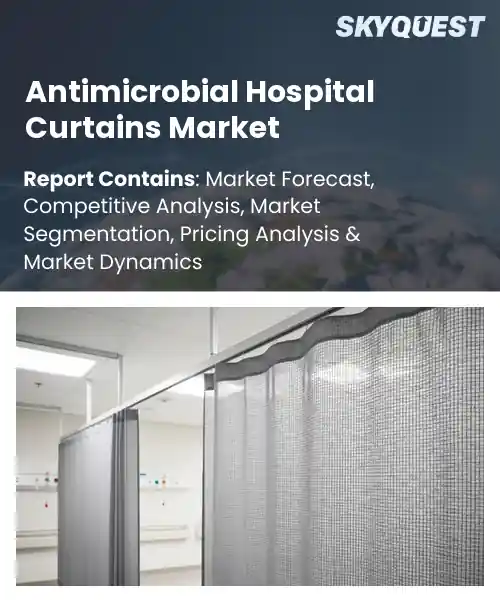
Antimicrobial Hospital Curtains Market
Report ID: SQMIG35B2404
Report ID: SQMIG35B2404
[email protected]
USA +1 351-333-4748
Report ID:
SQMIG35B2404 |
Region:
Global |
Published Date: July, 2026
Pages:
157
|Tables:
149
|Figures:
78


Global Antimicrobial Hospital Curtains Market size was valued at USD 1.91 Billion in 2024 and is poised to grow from USD 2.02 Billion in 2025 to USD 3.12 Billion by 2033, growing at a CAGR of 5.6% during the forecast period (2026-2033).
The antimicrobial hospital curtains market comprises manufacturers and suppliers of textile barriers treated with agents to inhibit bacterial, viral and fungal colonization on hospital walls. Its importance stems from the role of curtains as reservoirs for pathogens such as MRSA and C. difficile, which contribute to nosocomial infections and increase patient morbidity. Growth accelerated after the 2015 CDC guidance urging hospitals to adopt antimicrobial fabrics, prompting early adopters like Cleveland Clinic to replace polyester with silver‑ion infused curtains. Over the past decade, regulatory endorsements and heightened infection‑control awareness have transformed curtains from passive décor into infection‑prevention tools, fueling demand worldwide. Regulatory pressure on hospital infection‑control practices now acts as the catalyst propelling the antimicrobial curtains market because tighter standards force facilities to replace conventional fabrics with barrier solutions. When health authorities mandate environmental decontamination, hospitals procure curtains embedded with silver‑nanoparticle or copper technologies, which have cut bacterial load by up to 90 % in trials at sites such as Mayo Clinic. This requirement drives demand for certified products, prompting manufacturers to adopt scalable coating processes and to add reusable, eco‑friendly options that reduce costs. The resulting surge opens opportunities in emerging regions where expanding private‑hospital networks seek affordable, high‑performance antimicrobial textiles.
How is IoT integration improving the antimicrobial hospital curtains market efficiency?
IoT integration is reshaping antimicrobial hospital curtains by embedding sensors that continuously track humidity, temperature and microbial activity. These data streams feed into hospital management platforms, enabling predictive replacement schedules rather than fixed timelines. Real‑time alerts reduce unnecessary changes while ensuring curtains are swapped before contamination reaches critical levels. The technology also links to inventory systems, automatically ordering new curtains when usage spikes, which streamlines logistics and cuts waste. By providing actionable insights, IoT‑enabled curtains support infection‑control protocols and free staff to focus on patient care. The result is a more responsive, cost‑effective supply chain that aligns with heightened hygiene standards across healthcare facilities.In June 2023, 3M, introduced an IoT‑enabled antimicrobial curtain line that notifies staff of rising bacterial loads, allowing timely cleaning and extending product life, thereby boosting market efficiency.
Market snapshot - (2026-2033)
Global Market Size
USD 1.91 Billion
Largest Segment
Polyester
Fastest Growth
Niche Blends
Growth Rate
5.6% CAGR
To get more insights on this market click here to Request a Free Sample Report
Global antimicrobial hospital curtains market is segmented by material type, usability type, distribution channel, facility application zone, end user and region. Based on material type, the market is segmented into Polyester, Polypropylene, Niche Blends and Others. Based on usability type, the market is segmented into Reusable Curtains and Disposable Curtains. Based on distribution channel, the market is segmented into Offline Stores and Online Stores. Based on facility application zone, the market is segmented into Intensive Care Units, Emergency Departments, Patient Wards, Recovery Areas and Pediatric Wards. Based on end user, the market is segmented into Hospitals, Private Clinics, Emergency Settings, Short Stay Settings, Nursing Homes, Ambulatory Surgical Centers and Others. Based on region, the market is segmented into North America, Europe, Asia Pacific, Latin America and Middle East & Africa.
Polyester segment dominates because it offers a balance of affordability and durability that aligns with the cost sensitivities of most healthcare providers. Its fiber structure readily accepts antimicrobial treatments, ensuring long term efficacy without compromising fabric strength. This combination of economic and functional benefits drives widespread adoption across hospital environments, reinforcing its position as the preferred material choice. It also accepts a wide range of colors, supporting hospital branding goals.
Meanwhile, Polypropylene segment emerges as the fastest growing because its lightweight nature reduces handling effort and its inherent chemical resistance extends curtain lifespan under rigorous cleaning protocols. Innovation in antimicrobial coating technologies amplifies its appeal, encouraging facilities to adopt this material as they seek higher hygiene standards and operational efficiency.
Reusable Curtains segment dominates because healthcare institutions prioritize long term cost efficiencies and environmental stewardship. These curtains can be laundered repeatedly without losing antimicrobial performance, allowing facilities to spread acquisition costs over many uses. Their durability minimizes waste generation, aligning with green procurement policies and reducing the burden on waste management systems. Consequently, hospitals favor reusable options to achieve fiscal responsibility while upholding strict infection control standards and patient safety.
Conversely, Disposable Curtains segment experiences the strongest growth because institutions seek antimicrobial protection without laundering constraints. Advances in biodegradable film technologies address environmental concerns, making single use options more acceptable. Rising demand for rapid turnover in high traffic zones accelerates adoption, creating opportunities for manufacturers delivering compliant, friendly disposable solutions.
To get detailed segments analysis, Request a Free Sample Report
North America leads the Antimicrobial Hospital Curtains market through a confluence of advanced healthcare infrastructure, strong regulatory frameworks, and heightened emphasis on infection control. Hospital networks across the United States and Canada prioritize patient safety, driving adoption of high‑performance textile solutions that incorporate antimicrobial technologies. Robust research collaborations between medical device manufacturers and academic institutions foster continuous innovation, resulting in products that meet stringent quality standards. Moreover, well‑established procurement channels and the presence of major global suppliers streamline market entry and distribution. The region’s commitment to sustainability and advanced material science further reinforces its competitive edge, ensuring that healthcare providers can access curtains that combine durability with proven pathogen‑reducing properties. In addition, the emphasis on accreditation standards encourages hospitals to adopt evidence‑based solutions, while continuous professional training reinforces proper handling and maintenance of antimicrobial curtains. Such systemic support consolidates North America’s leadership and creates a resilient market environment.
Antimicrobial Hospital Curtains Market in the United States benefits from a mature healthcare system that emphasizes cutting‑edge infection‑prevention strategies. Large hospital networks adopt rigorous procurement standards, favoring products with validated antimicrobial efficacy. Strong collaboration between textile innovators and clinical specialists accelerates product customization to meet diverse facility needs. Additionally, continuous professional development programs reinforce best practices for curtain handling, ensuring sustained performance and patient safety across acute care settings environments.
Antimicrobial Hospital Curtains Market in Canada is shaped by a strong public health framework that prioritizes antimicrobial stewardship throughout clinical environments. Provincial health authorities enforce stringent product evaluation criteria, encouraging adoption of curtains with proven pathogen‑inhibiting properties. Collaborative research initiatives between Canadian universities and textile manufacturers drive the development of eco‑friendly antimicrobial fibers. This integration of safety, sustainability, and regulatory rigor supports broad deployment across hospitals and long‑term care facilities.
Europe’s Antimicrobial Hospital Curtains market is propelled by a combination of rigorous health‑care standards, strong environmental regulations, and a culture of innovation across the continent. German manufacturers lead with technically advanced textile engineering, while the United Kingdom’s dynamic funding models accelerate adoption in both public and private hospitals. France’s emerging focus on sustainable health solutions fuels interest in antimicrobial fabrics that align with circular‑economy goals. Collaborative research clusters linking academic labs, medical institutions, and textile firms generate continuous product enhancements. Policy frameworks that emphasize infection control, coupled with reimbursement mechanisms that recognize long‑term cost savings, encourage healthcare providers to replace traditional curtains with antimicrobial alternatives, reinforcing Europe’s competitive position in the global arena. The emphasis on patient safety also drives hospitals to integrate antimicrobial curtains into broader hygiene protocols, creating a synergistic effect that amplifies infection‑prevention outcomes across diverse care settings.
Antimicrobial Hospital Curtains Market in Germany is underpinned by a strong engineering tradition and stringent quality certifications that assure high performance. Leading textile firms collaborate closely with hospital infection committees to tailor antimicrobial fabrics for intensive care environments. Government incentives for advanced medical textiles encourage investment in research and sustainable production methods. This combination of technical excellence and regulatory support accelerates market acceptance across public and private healthcare institutions nationwide.
Antimicrobial Hospital Curtains Market in the United Kingdom is propelled by procurement policies that value clinical efficacy and sustainability. NHS trusts select curtains with verified antimicrobial performance to curb infections and meet green objectives. Collaborative projects between UK textile innovators and research universities generate fabrics that combine renewable fibers with durable antimicrobial agents. This synergy enables hospitals nationwide to adopt curtain solutions that reinforce patient safety while supporting environmental commitments.
Antimicrobial Hospital Curtains Market in France is growing as hospitals integrate infection‑control measures with procurement practices. French health authorities encourage the use of curtains that demonstrate antimicrobial effectiveness while meeting standards. Collaborations between local textile companies and research institutes focus on developing fibers infused with antimicrobial compounds. This approach allows French healthcare facilities to enhance patient protection and reduce chemical waste, positioning antimicrobial curtains as a component of hospital design.
Asia Pacific is rapidly strengthening its position in the Antimicrobial Hospital Curtains market through a blend of technological adoption, expanding healthcare infrastructure, and rising awareness of infection prevention. Japan’s strong emphasis on high‑quality medical textiles and its tradition of integrating advanced materials fosters the development of curtains with superior antimicrobial longevity. South Korea’s agile manufacturing sector leverages cutting‑edge nanotechnology to embed durable antimicrobial agents within fabric structures. Both nations benefit from government initiatives that support innovation in hospital hygiene products and from private‑sector investments targeting modern hospital design. The growing middle class and increasing hospital construction further drive demand for premium curtain solutions that combine safety, aesthetics, and environmental stewardship, reinforcing the region’s emerging leadership on the global stage. Collaborative regional forums also facilitate knowledge exchange, accelerating the rollout of best‑practice curtain technologies across diverse healthcare settings.
Antimicrobial Hospital Curtains Market in Japan is driven by a commitment to engineering and infection control standards. Japanese manufacturers integrate cutting‑edge antimicrobial agents into textiles that withstand sterilization cycles, ensuring efficacy. Collaboration between medical device companies and research universities fosters refinement of fabric technologies. This focus on durability and performance enables Japanese hospitals to adopt curtain solutions that reinforce patient safety while aligning with the nation’s standards for medical quality.
Antimicrobial Hospital Curtains Market in South Korea benefits from a manufacturing ecosystem and governmental support for healthcare innovation. Korean firms apply nanotechnology to embed antimicrobial particles within textile fibers, achieving pathogen inhibition. Collaboration with leading hospitals provides feedback that accelerates product refinement. The emphasis on aesthetic appeal and functional safety allows Korean curtain solutions to meet the expectations of medical facilities, reinforcing the country’s reputation for high medical textile solutions.
To know more about the market opportunities by region and country, click here to
Buy The Complete Report
Rising Hospital Infection Awareness
Adoption of Antimicrobial Textile Standards
Higher Production Cost Implications
Regulatory Approval Complexity
Request Free Customization of this report to help us to meet your business objectives.
The competitive landscape is shaped by manufacturers leveraging advanced antimicrobial technologies, strategic acquisitions of niche textile firms, and partnerships with hospital procurement groups to secure long‑term supply contracts, while regulatory approvals and sustainability standards drive differentiation. Recent moves include a leading curtain producer acquiring a polymer coating specialist to enhance pathogen‑kill performance and another forming a joint venture with a global health‑care distributor to expand market reach across North America and Europe.
Top Player’s Company Profile
Recent Developments
SkyQuest’s ABIRAW (Advanced Business Intelligence, Research & Analysis Wing) is our Business Information Services team that Collects, Collates, Correlates, and Analyses the Data collected by means of Primary Exploratory Research backed by robust Secondary Desk research. As per SkyQuest analysis, the antimicrobial hospital curtains market is being propelled primarily by rising hospital infection awareness, which pushes facilities to select textiles that actively limit pathogen spread, while the adoption of antimicrobial textile standards serves as a second catalyst by providing clear performance benchmarks that accelerate procurement cycles. The market’s growth is tempered by higher production cost implications, as specialized coating processes raise unit prices and can deter budget‑constrained institutions. North America remains the dominant region thanks to its advanced healthcare infrastructure, strong regulatory frameworks and established supply chains. Within the product landscape, polyester‑based curtains dominate because the fiber readily accepts antimicrobial treatments while offering affordability and durability that align with most hospitals’ cost and performance requirements.
| Report Metric | Details |
|---|---|
| Market size value in 2024 | USD 1.91 Billion |
| Market size value in 2033 | USD 3.12 Billion |
| Growth Rate | 5.6% |
| Base year | 2024 |
| Forecast period | (2026-2033) |
| Forecast Unit (Value) | USD Billion |
| Segments covered |
|
| Regions covered | North America (US, Canada), Europe (Germany, France, United Kingdom, Italy, Spain, Rest of Europe), Asia Pacific (China, India, Japan, Rest of Asia-Pacific), Latin America (Brazil, Rest of Latin America), Middle East & Africa (South Africa, GCC Countries, Rest of MEA) |
| Companies covered |
|
| Customization scope | Free report customization with purchase. Customization includes:-
|
To get a free trial access to our platform which is a one stop solution for all your data requirements for quicker decision making. This platform allows you to compare markets, competitors who are prominent in the market, and mega trends that are influencing the dynamics in the market. Also, get access to detailed SkyQuest exclusive matrix.
Table Of Content
Executive Summary
Market overview
Parent Market Analysis
Market overview
Market size
KEY MARKET INSIGHTS
COVID IMPACT
MARKET DYNAMICS & OUTLOOK
Market Size by Region
KEY COMPANY PROFILES
Methodology
For the Antimicrobial Hospital Curtains Market, our research methodology involved a mixture of primary and secondary data sources. Key steps involved in the research process are listed below:
1. Information Procurement: This stage involved the procurement of Market data or related information via primary and secondary sources. The various secondary sources used included various company websites, annual reports, trade databases, and paid databases such as Hoover's, Bloomberg Business, Factiva, and Avention. Our team did 45 primary interactions Globally which included several stakeholders such as manufacturers, customers, key opinion leaders, etc. Overall, information procurement was one of the most extensive stages in our research process.
2. Information Analysis: This step involved triangulation of data through bottom-up and top-down approaches to estimate and validate the total size and future estimate of the Antimicrobial Hospital Curtains Market.
3. Report Formulation: The final step entailed the placement of data points in appropriate Market spaces in an attempt to deduce viable conclusions.
4. Validation & Publishing: Validation is the most important step in the process. Validation & re-validation via an intricately designed process helped us finalize data points to be used for final calculations. The final Market estimates and forecasts were then aligned and sent to our panel of industry experts for validation of data. Once the validation was done the report was sent to our Quality Assurance team to ensure adherence to style guides, consistency & design.
Analyst Support
Customization Options
With the given market data, our dedicated team of analysts can offer you the following customization options are available for the Antimicrobial Hospital Curtains Market:
Product Analysis: Product matrix, which offers a detailed comparison of the product portfolio of companies.
Regional Analysis: Further analysis of the Antimicrobial Hospital Curtains Market for additional countries.
Competitive Analysis: Detailed analysis and profiling of additional Market players & comparative analysis of competitive products.
Go to Market Strategy: Find the high-growth channels to invest your marketing efforts and increase your customer base.
Innovation Mapping: Identify racial solutions and innovation, connected to deep ecosystems of innovators, start-ups, academics, and strategic partners.
Category Intelligence: Customized intelligence that is relevant to their supply Markets will enable them to make smarter sourcing decisions and improve their category management.
Public Company Transcript Analysis: To improve the investment performance by generating new alpha and making better-informed decisions.
Social Media Listening: To analyze the conversations and trends happening not just around your brand, but around your industry as a whole, and use those insights to make better Marketing decisions.
REQUEST FOR SAMPLE
 REQUEST FREE CUSTOMIZATION


Want to customize this report? This report can be personalized according to your needs. Our analysts and industry experts will work directly with you to understand your requirements and provide you with customized data in a short amount of time. We offer $1000 worth of FREE customization at the time of purchase.
Feedback From Our Clients


 USA (+1) 351-333-4748

