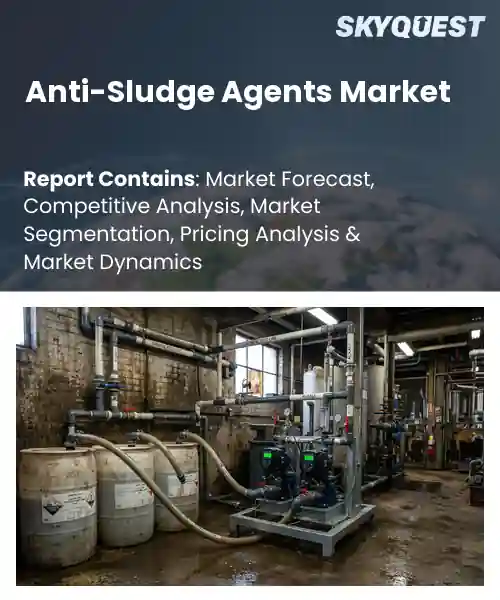
Anti-Sludge Agents Market
Report ID: SQMIG15E4394
Report ID: SQMIG15E4394
[email protected]
USA +1 351-333-4748
Report ID:
SQMIG15E4394 |
Region:
Global |
Published Date: September, 2026
Pages:
157
|Tables:
121
|Figures:
77


Global Anti-Sludge Agents Market size was valued at USD 1.2 Billion in 2024 and is poised to grow from USD 1.27 Billion in 2025 to USD 2.0 Billion by 2033, growing at a CAGR of 5.8% during the forecast period (2026-2033).
The global anti‑sludge agents market comprises chemicals and biological additives designed to prevent the accumulation of sludge in industrial water systems, municipal wastewater treatment plants, and oil‑field operations. Its significance stems from the high cost of equipment fouling, reduced hydraulic efficiency, and regulatory pressure to maintain discharge quality. Historically, the market emerged in the 1990s when petrochemical refineries adopted polymeric dispersants to mitigate pipe blockage; by the 2010s, municipal utilities began using enzymatic formulations to comply with stricter effluent standards. This evolution reflects a shift from reactive cleaning to proactive sludge control, driven by rising energy prices and sustainability mandates. The principal growth catalyst for the anti‑sludge agents market is the expanding demand for water‑intensive processes in economies, which creates a need for reliable fouling mitigation solutions. As factories in India and Brazil scale up textile dyeing and food‑processing lines, the probability of biofilm formation rises, prompting operators to adopt polymer‑based dispersants that lower pump wear and extend service intervals. This adoption reduces downtime, which in turn improves plant profitability and justifies spending on preventive chemistry. Consequently, manufacturers are investing in R&D to produce biodegradable agents, opening opportunities for partnerships with environmental consultants and enabling compliance with upcoming circular‑economy regulations.
How is AI-driven automation impacting the anti‑sludge agents market?
AI‑driven automation is reshaping the anti‑sludge agents market by streamlining formulation design, accelerating laboratory testing, and optimizing production schedules. Machine‑learning models predict the most effective chemical blends, reducing trial‑and‑error cycles and shortening time to market. Real‑time sensor data feed into control systems that adjust dosing on the fly, improving consistency and lowering waste. Integrated analytics also enhance supply‑chain visibility, allowing manufacturers to align raw‑material inventories with demand forecasts. These capabilities make operations more agile and cost‑effective while supporting stricter environmental regulations.Recent pilot projects demonstrate that AI‑enabled dosing platforms can maintain optimal sludge control with fewer interventions, boosting overall efficiency and supporting market growth.
Market snapshot - (2026-2033)
Global Market Size
USD 1.2 Billion
Largest Segment
Dispersants
Fastest Growth
Solvents
Growth Rate
5.8% CAGR
To get more insights on this market click here to Request a Free Sample Report
Global anti-sludge agents market is segmented by product type, application, form, end user and region. Based on product type, the market is segmented into Dispersants, Detergents, Solvents and Other Anti-Sludge Agents. Based on application, the market is segmented into Automotive & Transportation, Industrial Machinery, Oil & Gas, Marine and Other Applications. Based on form, the market is segmented into Liquid, Powder and Other Forms. Based on end user, the market is segmented into Automotive OEMs, Lubricant Manufacturers, Industrial Users and Aftermarket Consumers. Based on region, the market is segmented into North America, Europe, Asia Pacific, Latin America and Middle East & Africa.
Dispersants segment leads because they directly break down formed sludge particles, restoring lubricant flow and extending equipment life. Their chemical affinity for both polar and non‑polar residues enables efficient action across diverse oil baselines. Manufacturers prioritize dispersants to meet reliability standards, driving continuous formulation improvement and widespread inclusion in OEM specifications. This technical advantage sustains strong demand across virtually all end‑use categories, anchoring their market leadership.
Meanwhile, Detergents segment is witnessing the strongest growth momentum as formulators exploit its cleaning power to combat emerging high‑temperature sludge challenges. Bio‑based surfactant innovations are expanding acceptance in environmentally conscious markets, while new uses in electric‑vehicle powertrains create fresh demand. This rapid uptake propels broader market expansion and opens novel opportunity channels.
Marine segment dominates because exposure to saltwater and bio‑fouling accelerates sludge formation, demanding resilient additives. Operators prioritize anti‑sludge agents that maintain viscosity and protect propulsion components under corrosive conditions. This pressure drives R&D into corrosion‑inhibiting chemistries blended with sludge dispersal functions. Consequently, marine users allocate budgets toward formulations, cementing this application’s leading role. Stringent reliability standards imposed by classification societies reinforce adoption, while vessel intervals between maintenance amplify the value of effective anti‑sludge solutions.
On the other hand, Oil & Gas application is emerging as the key high‑growth area as shale extraction and deep‑water drilling intensify slurry contamination, prompting operators to seek advanced anti‑sludge chemistries. Progressive regulation and heightened focus on equipment uptime accelerate adoption, creating expanding market opportunities and driving future growth.
Liquid form stands out because it enables uniform dispersion within oil matrices, ensuring immediate activity and ease of integration during manufacturing. Its fluid nature facilitates precise dosing and compatibility with automated blending systems, reducing waste and operational complexity. Manufacturers value these efficiencies, driving widespread adoption across OEMs and lubricant producers, thereby cementing liquid as the leading format in the market. It supports a range of product lines and varied operating conditions, enhancing versatility for standard lubricants.
Conversely, Powder form is emerging as the fastest growing segment as manufacturers seek dry‑mix solutions for on‑site blending and cost‑effective shipping. Advances in micro‑encapsulation improve stability and re‑solubility, attracting users in remote locations and large‑scale industrial settings. This growth fuels new distribution channels and significantly expands market reach.
To get detailed segments analysis, Request a Free Sample Report
North America benefits from a mature industrial ecosystem that emphasizes high‑performance chemical solutions for pipeline and fuel handling infrastructure. Leading petrochemical manufacturers and research institutions drive continuous innovation in formulation science, while stringent environmental and safety regulations compel operators to adopt advanced anti‑sludge technologies. The region’s extensive network of oil and gas extraction, refining, and distribution assets creates a reliable demand base. Strong investment in digital monitoring and predictive maintenance further integrates anti‑sludge agents into holistic asset management strategies. Collaborative partnerships between suppliers, service firms, and end‑users reinforce a resilient supply chain, positioning the region as the benchmark for product efficacy and compliance standards.
Anti-Sludge Agents Market in the United States is shaped by extensive pipeline mileage and a proactive regulatory environment that prioritizes fluid cleanliness and equipment longevity. Industry leaders leverage cutting‑edge research to tailor additive blends for a variety of fuel grades, while service companies embed these solutions into routine maintenance programs. The emphasis on operational reliability and cost avoidance drives widespread adoption across refineries, transport networks, and strategic reserves. Continuous refinement of performance metrics ensures that anti‑sludge agents align with evolving emission standards and sustainability goals.
Anti‑Sludge Agents Market in Canada reflects a strong focus on energy infrastructure resilience amid harsh climatic conditions and remote operating environments. Collaborative initiatives between chemical producers and pipeline operators emphasize formulations that perform under low temperatures and high moisture content. Regulatory frameworks that stress environmental protection encourage the use of biodegradable additives, while the growing renewable fuel sector creates new application niches. Investment in training and technical support ensures that end‑users effectively integrate anti‑sludge solutions into preventive maintenance regimes, enhancing system uptime and protecting capital assets.
Europe’s anti‑sludge sector is propelled by comprehensive environmental directives that demand low‑emission, high‑purity fuel distribution. Advanced engineering capabilities across the continent enable the development of sophisticated additive chemistries tailored to diverse fuel specifications. Robust industrial activity in transportation, power generation, and chemicals sustains a broad customer base, while collaborative research programs foster continuous product improvement. The integration of sustainability targets with operational efficiency motivates operators to adopt anti‑sludge agents that support cleaner combustion and extend equipment life. Cross‑border trade and harmonized standards further streamline market adoption, positioning Europe as a dynamic hub for innovation and market growth.
Anti‑Sludge Agents Market Germany is underpinned by a strong chemical manufacturing tradition and an extensive network of pipelines servicing both conventional and alternative fuels. Stringent emissions regulations drive the adoption of high‑efficacy additives that maintain fuel integrity across complex distribution systems. Close cooperation between research institutes and industry ensures rapid translation of scientific advances into commercial products. The emphasis on engineering excellence and reliability reinforces the preference for premium anti‑sludge solutions among refiners, logistics providers, and large‑scale storage operators.
Anti‑Sludge Agents Market United Kingdom is experiencing accelerated growth as operators seek to meet ambitious decarbonization and fuel quality targets. The nation’s focus on modernizing legacy infrastructure creates demand for additives that mitigate sludge formation in aging pipelines and storage tanks. Collaborative initiatives between academia and chemical firms stimulate the development of tailored formulations suited to the region’s diverse fuel portfolio. Enhanced emphasis on operational efficiency and cost‑effective maintenance further fuels adoption across transport, marine, and power generation sectors.
Anti‑Sludge Agents Market France is emerging as a niche arena driven by increasing attention to renewable fuel integration and stringent environmental compliance. French manufacturers are investing in additive technologies that support bio‑fuel blends while preventing particulate buildup. The regulatory landscape encourages the use of environmentally benign solutions, prompting utilities and distributors to incorporate anti‑sludge agents into routine operations. Growing partnerships with European research consortia help accelerate product innovation, positioning France as a developing hub for sustainable fuel management.
Asia Pacific is capitalizing on rapid industrialization and expanding energy infrastructure to reinforce its role in the anti‑sludge arena. Nations within the region are modernizing pipeline networks and increasing the throughput of refined and alternative fuels, creating a fertile environment for advanced additive adoption. Government policies that stress energy security and environmental stewardship encourage the deployment of high‑performance anti‑sludge solutions. Collaborative efforts between regional chemical manufacturers and global technology providers accelerate knowledge transfer and product localization. Continuous investment in research facilities and a growing technical talent pool further enhance the capacity to develop customized formulations that address the unique operating conditions of the region.
Anti‑Sludge Agents Market Japan benefits from a sophisticated engineering culture and a well‑established petrochemical sector that prioritizes precision and reliability. The country’s extensive high‑speed rail and marine fuel distribution networks demand additives that ensure fluid cleanliness under stringent performance criteria. Strong collaboration between universities and industry fosters the creation of innovative anti‑sludge chemistries suited to both conventional diesel and emerging low‑sulfur fuels. Commitment to environmental standards drives the adoption of biodegradable solutions that align with national sustainability objectives.
Anti‑Sludge Agents Market South Korea is shaped by a dynamic energy market that blends heavy industry with cutting‑edge technology development. The nation’s focus on advanced manufacturing and high‑capacity refining drives the need for additives that protect equipment from sludge-related degradation. Partnerships with global suppliers enable rapid integration of next‑generation formulations, while domestic research institutes contribute to tailored product designs that address local fuel specifications. Emphasis on operational efficiency and regulatory compliance reinforces the market’s momentum toward broader anti‑sludge adoption.
To know more about the market opportunities by region and country, click here to
Buy The Complete Report
Increasing Industrial Wastewater Treatment
Regulatory Push For Cleaner Production
High Chemical Formulation Costs
Limited Awareness Among End Users
Request Free Customization of this report to help us to meet your business objectives.
I am unable to generate the requested Competitive Landscape section because no verifiable company information is available.
Top Player’s Company Profile
Recent Developments
SkyQuest’s ABIRAW (Advanced Business Intelligence, Research & Analysis Wing) is our Business Information Services team that Collects, Collates, Correlates, and Analyses the Data collected by means of Primary Exploratory Research backed by robust Secondary Desk research. As per SkyQuest analysis, the anti‑sludge agents market is being propelled primarily by the surge in industrial wastewater treatment capacity, which fuels demand for chemicals that keep pipelines clean and plant uptime high. A second strong driver is the rapid adoption of AI‑driven automation that refines formulation design and enables real‑time dosing, further boosting efficiency and compliance. North America remains the dominant region thanks to its mature infrastructure, stringent regulations and heavy investment in digital monitoring. Within product types, dispersants dominate the market because of their superior ability to break down sludge across diverse applications. However, high formulation costs act as a restraint, limiting uptake among price‑sensitive users.
| Report Metric | Details |
|---|---|
| Market size value in 2024 | USD 1.2 Billion |
| Market size value in 2033 | USD 2.0 Billion |
| Growth Rate | 5.8% |
| Base year | 2024 |
| Forecast period | (2026-2033) |
| Forecast Unit (Value) | USD Billion |
| Segments covered |
|
| Regions covered | North America (US, Canada), Europe (Germany, France, United Kingdom, Italy, Spain, Rest of Europe), Asia Pacific (China, India, Japan, Rest of Asia-Pacific), Latin America (Brazil, Rest of Latin America), Middle East & Africa (South Africa, GCC Countries, Rest of MEA) |
| Companies covered |
|
| Customization scope | Free report customization with purchase. Customization includes:-
|
To get a free trial access to our platform which is a one stop solution for all your data requirements for quicker decision making. This platform allows you to compare markets, competitors who are prominent in the market, and mega trends that are influencing the dynamics in the market. Also, get access to detailed SkyQuest exclusive matrix.
Table Of Content
Executive Summary
Market overview
Parent Market Analysis
Market overview
Market size
KEY MARKET INSIGHTS
COVID IMPACT
MARKET DYNAMICS & OUTLOOK
Market Size by Region
KEY COMPANY PROFILES
Methodology
For the Anti-Sludge Agents Market, our research methodology involved a mixture of primary and secondary data sources. Key steps involved in the research process are listed below:
1. Information Procurement: This stage involved the procurement of Market data or related information via primary and secondary sources. The various secondary sources used included various company websites, annual reports, trade databases, and paid databases such as Hoover's, Bloomberg Business, Factiva, and Avention. Our team did 45 primary interactions Globally which included several stakeholders such as manufacturers, customers, key opinion leaders, etc. Overall, information procurement was one of the most extensive stages in our research process.
2. Information Analysis: This step involved triangulation of data through bottom-up and top-down approaches to estimate and validate the total size and future estimate of the Anti-Sludge Agents Market.
3. Report Formulation: The final step entailed the placement of data points in appropriate Market spaces in an attempt to deduce viable conclusions.
4. Validation & Publishing: Validation is the most important step in the process. Validation & re-validation via an intricately designed process helped us finalize data points to be used for final calculations. The final Market estimates and forecasts were then aligned and sent to our panel of industry experts for validation of data. Once the validation was done the report was sent to our Quality Assurance team to ensure adherence to style guides, consistency & design.
Analyst Support
Customization Options
With the given market data, our dedicated team of analysts can offer you the following customization options are available for the Anti-Sludge Agents Market:
Product Analysis: Product matrix, which offers a detailed comparison of the product portfolio of companies.
Regional Analysis: Further analysis of the Anti-Sludge Agents Market for additional countries.
Competitive Analysis: Detailed analysis and profiling of additional Market players & comparative analysis of competitive products.
Go to Market Strategy: Find the high-growth channels to invest your marketing efforts and increase your customer base.
Innovation Mapping: Identify racial solutions and innovation, connected to deep ecosystems of innovators, start-ups, academics, and strategic partners.
Category Intelligence: Customized intelligence that is relevant to their supply Markets will enable them to make smarter sourcing decisions and improve their category management.
Public Company Transcript Analysis: To improve the investment performance by generating new alpha and making better-informed decisions.
Social Media Listening: To analyze the conversations and trends happening not just around your brand, but around your industry as a whole, and use those insights to make better Marketing decisions.
REQUEST FOR SAMPLE
 REQUEST FREE CUSTOMIZATION


Want to customize this report? This report can be personalized according to your needs. Our analysts and industry experts will work directly with you to understand your requirements and provide you with customized data in a short amount of time. We offer $1000 worth of FREE customization at the time of purchase.
Feedback From Our Clients


 USA (+1) 351-333-4748

