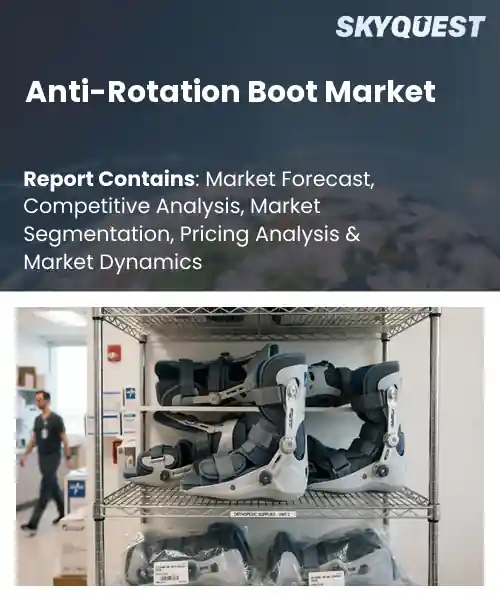
Anti-Rotation Boot Market
Report ID: SQMIG35B2509
Report ID: SQMIG35B2509
[email protected]
USA +1 351-333-4748
Report ID:
SQMIG35B2509 |
Region:
Global |
Published Date: August, 2026
Pages:
157
|Tables:
119
|Figures:
77


Global Anti-Rotation Boot Market size was valued at USD 483.0 Million in 2024 and is poised to grow from USD 514.88 Million in 2025 to USD 858.55 Million by 2033, growing at a CAGR of 6.6% during the forecast period (2026-2033).
The global anti‑rotation boot market revolves around orthopedic footwear designed to limit ankle inversion and supination after ligament injuries. Its relevance stems from the rising incidence of sports‑related sprains and the growing elderly population prone to falls, both of which demand immobilisation solutions. Historically the market emerged in the late 1990s when manufacturers replaced casts with polymer boots, offering patients rehabilitation and lower complication rates. As physiotherapy protocols began emphasizing mobilization, demand accelerated, prompting firms to invest in ergonomic designs and breathable materials. Consequently, the sector has evolved from niche medical supply to a component of orthopaedic and athletic recovery. Beyond injury treatment, embedding smart sensors into anti‑rotation boots now propels market growth. Manufacturers embed motion‑tracking chips that transmit data on ankle angle, load and wear time to clinicians via apps, enabling tailored rehab protocols and detecting non‑compliance. Professional soccer clubs have adopted the technology, adjusting training loads from the feedback and cutting re‑injury rates noticeably. Significant clinical benefits raise demand from hospitals and sports teams, and the generated data support subscription analytics services, adding revenue for suppliers. Consequently, companies that pair durable materials with digital connectivity are poised to secure a larger share of the future expanding orthopaedic‑wearable sector.
How is AI enhancing fit and safety in the anti-rotation boot market?
AI is reshaping anti‑rotation boots by embedding sensors that map ankle contours in real time and feeding that data to machine‑learning models. The models predict optimal strap tension and brace geometry for each patient, reducing pressure points and improving gait stability. Manufacturers integrate these insights into adjustable shells that self‑tighten when movement deviates from safe limits. Clinicians receive alerts on mobile dashboards, enabling quick interventions before injuries worsen. This data‑driven approach is raising confidence among patients and expanding adoption in outpatient clinics, where personalized protection is increasingly demanded.Ossur released an AI‑enhanced fit system in June 2026, streamlining boot customization and delivering immediate safety feedback, which is accelerating market uptake and operational efficiency.
Market snapshot - (2026-2033)
Global Market Size
USD 483.0 Million
Largest Segment
Standard Anti-Rotation Boots
Fastest Growth
Custom Anti-Rotation Boots
Growth Rate
6.6% CAGR
To get more insights on this market click here to Request a Free Sample Report
Global anti-rotation boot market is segmented by product type, material, application, end user and region. Based on product type, the market is segmented into Standard Anti-Rotation Boots, Heavy-Duty Anti-Rotation Boots and Custom Anti-Rotation Boots. Based on material, the market is segmented into Rubber, Thermoplastic Elastomer, Silicone and Polyurethane. Based on application, the market is segmented into Automotive, Industrial Equipment, Aerospace and Construction Machinery. Based on end user, the market is segmented into OEMs, Aftermarket and Maintenance & Repair Service Providers. Based on region, the market is segmented into North America, Europe, Asia Pacific, Latin America and Middle East & Africa.
Standard Anti-Rotation Boots segment dominates because it meets the core functional requirements of most vehicle manufacturers with a proven balance of cost efficiency and reliable performance. Its design simplicity allows quick integration into existing assembly lines, reducing engineering effort. The widespread acceptance of this baseline offering is reinforced by longstanding supplier relationships and the ability to satisfy diverse torque specifications without extensive customization, fostering steady demand across the market.
However, Heavy Duty Anti-Rotation Boots are witnessing the strongest growth momentum as heavy equipment manufacturers seek solutions that can endure extreme loads and harsh operating environments. Innovations in reinforcement technologies and the push for longer service intervals drive adoption, opening new opportunities for suppliers to capture value in sectors demanding superior resilience.
Silicone material segment dominates because its inherent temperature resistance and chemical inertness align perfectly with the stringent performance criteria of aerospace components. The material’s ability to maintain elasticity under extreme thermal cycles reduces the risk of seal failure, which is critical for mission critical applications. This reliability, combined with low outgassing properties, makes silicone the preferred choice for manufacturers prioritizing safety and longevity in high altitude environments.
Meanwhile, Thermoplastic Elastomer is emerging as the key high growth area as manufacturers pursue lighter weight solutions without compromising durability. Advances in polymer blending enable improved abrasion resistance, while the material’s recyclability appeals to sustainability initiatives. These factors accelerate its adoption across multiple applications, positioning it to expand market reach and drive future innovation.
To get detailed segments analysis, Request a Free Sample Report
North America benefits from a mature safety culture that permeates heavy‑industry sectors such as construction, mining, and energy production. Rigorous occupational safety standards drive broad adoption of protective footwear, while a deep supply chain anchored by established manufacturers accelerates product innovation and rapid market rollout. The region’s strong research and development ecosystem fosters continuous improvement in material performance and ergonomic design, reinforcing brand loyalty among end users. Extensive distribution networks and a high level of technical expertise among distributors further enhance market reach, ensuring that cutting‑edge solutions are readily accessible across diverse industrial hubs. Collaborative initiatives between industry associations and regulatory bodies also promote best‑practice adoption, cementing North America’s position as the leading market for anti‑rotation boots.
Anti-Rotation Boot Market growth in the United States is propelled by large‑scale infrastructure projects and a heightened focus on worker protection in the petroleum and construction sectors. Manufacturers prioritize advanced composite technologies that deliver superior slip resistance and durability, aligning with the rigorous compliance expectations of major employers. A well‑integrated distribution framework enables swift product availability, while strong technical support services reinforce confidence among safety managers and end users alike.
Anti-Rotation Boot Market dynamics in Canada reflect a robust emphasis on occupational health within natural resources extraction and civil engineering activities. Collaborative partnerships between local manufacturers and research institutions drive innovations that address cold‑weather performance and comfort. Supply chain efficiency is supported by proximity to major North American production hubs, allowing timely delivery to remote work sites. Government‑backed safety programs further encourage adoption of high‑quality protective footwear across the industrial landscape.
Europe’s expansion is anchored by stringent regulatory frameworks that compel manufacturers and employers to prioritize worker safety across sectors such as manufacturing, logistics, and construction. A strong tradition of engineering excellence fuels the development of highly specialized boot designs that balance comfort with extreme durability. Market participants benefit from a dense network of specialized distributors that facilitate rapid dissemination of new technologies. Collaborative research initiatives among universities, industry groups, and standards bodies accelerate innovation cycles, while a growing awareness of ergonomic benefits drives broader acceptance among labor forces. The combination of regulatory pressure, technical expertise, and proactive market collaboration positions Europe as a vibrant growth arena for anti‑rotation boots.
Anti-Rotation Boot Market presence in Germany is characterized by a concentration of precision engineering firms that deliver high‑performance solutions for heavy‑industry applications. Close ties between manufacturers and vocational training institutions ensure that product specifications align with evolving workplace safety requirements. The country’s robust export orientation also supports the diffusion of German‑engineered boots throughout the broader European market, reinforcing its reputation for quality and reliability.
Anti-Rotation Boot Market activity in the United Kingdom is accelerating due to heightened safety awareness within construction and rail infrastructure projects. Domestic manufacturers focus on lightweight materials that enhance worker mobility without compromising protection. Industry associations actively promote best‑practice guidelines, encouraging rapid adoption of advanced boot technologies among contractors and subcontractors across the region.
Anti-Rotation Boot Market development in France is emerging as companies respond to increasing demand from the renewable energy and public works sectors. Emphasis on sustainable material sourcing and ergonomic design helps differentiate offerings in a competitive landscape. Collaborative efforts between manufacturers and safety consultants foster the introduction of tailored solutions that address the specific hazards of French industrial environments.
Asia Pacific’s strengthening role stems from rapid industrialization and expanding infrastructure initiatives that heighten the need for advanced worker protection. Growing awareness of occupational safety standards drives manufacturers to adopt cutting‑edge technologies that improve slip resistance and comfort, especially in humid and high‑temperature conditions. The region benefits from a cost‑efficient production base that supports large‑scale manufacturing while maintaining quality benchmarks. Close collaboration between original equipment manufacturers and local distributors accelerates product localization, ensuring that solutions meet diverse regulatory and cultural expectations. Investment in research partnerships further fuels innovation, positioning Asia Pacific as an increasingly influential contributor to the global anti‑rotation boot landscape.
Anti-Rotation Boot Market in Japan is shaped by a strong safety culture within the automotive and precision machinery sectors. Manufacturers emphasize high‑grade material blends that provide exceptional durability under demanding operational conditions. Continuous improvement practices embedded in the industry encourage the integration of ergonomic features that enhance user comfort during prolonged wear.
Anti-Rotation Boot Market activity in South Korea reflects a focus on high‑tech production processes that deliver lightweight yet robust protective footwear. Close collaboration between technology firms and boot manufacturers enables rapid incorporation of advanced composite materials, meeting the rigorous safety expectations of the nation’s expanding shipbuilding and petrochemical industries.
To know more about the market opportunities by region and country, click here to
Buy The Complete Report
Increasing Safety Regulations
Adoption of Ergonomic Designs
High Manufacturing Cost
Limited Consumer Awareness
Request Free Customization of this report to help us to meet your business objectives.
The anti‑rotation boot market is shaped by intense rivalry among specialized footwear manufacturers, each leveraging strategic M&A to integrate sensor‑based stability technologies, forming distribution partnerships with orthopedic clinics, and accelerating product innovation through collaborations with biomechanics research labs. Recent joint ventures have focused on embedding smart‑fit systems that adjust tension in real‑time, intensifying competition for market share.
Top Player’s Company Profile
Recent Developments
SkyQuest’s ABIRAW (Advanced Business Intelligence, Research & Analysis Wing) is our Business Information Services team that Collects, Collates, Correlates, and Analyses the Data collected by means of Primary Exploratory Research backed by robust Secondary Desk research. As per SkyQuest analysis the global anti‑rotation boot market is set to expand at a 6.6% CAGR through 2033, driven primarily by tightening safety regulations that push manufacturers and end‑users toward compliant protective footwear, while the adoption of AI‑enhanced fit systems adds a second growth catalyst by improving comfort and injury prevention. High manufacturing cost remains the main restraint, limiting price‑sensitive buyers and slowing adoption in emerging segments. North America dominates the market owing to its mature safety culture and strong supply chain, and within the product mix the standard anti‑rotation boot segment holds the largest share thanks to its cost‑effectiveness and ease of integration across automotive OEM lines.
| Report Metric | Details |
|---|---|
| Market size value in 2024 | USD 483.0 Million |
| Market size value in 2033 | USD 858.55 Million |
| Growth Rate | 6.6% |
| Base year | 2024 |
| Forecast period | (2026-2033) |
| Forecast Unit (Value) | USD Million |
| Segments covered |
|
| Regions covered | North America (US, Canada), Europe (Germany, France, United Kingdom, Italy, Spain, Rest of Europe), Asia Pacific (China, India, Japan, Rest of Asia-Pacific), Latin America (Brazil, Rest of Latin America), Middle East & Africa (South Africa, GCC Countries, Rest of MEA) |
| Companies covered |
|
| Customization scope | Free report customization with purchase. Customization includes:-
|
To get a free trial access to our platform which is a one stop solution for all your data requirements for quicker decision making. This platform allows you to compare markets, competitors who are prominent in the market, and mega trends that are influencing the dynamics in the market. Also, get access to detailed SkyQuest exclusive matrix.
Table Of Content
Executive Summary
Market overview
Parent Market Analysis
Market overview
Market size
KEY MARKET INSIGHTS
COVID IMPACT
MARKET DYNAMICS & OUTLOOK
Market Size by Region
KEY COMPANY PROFILES
Methodology
For the Anti-Rotation Boot Market, our research methodology involved a mixture of primary and secondary data sources. Key steps involved in the research process are listed below:
1. Information Procurement: This stage involved the procurement of Market data or related information via primary and secondary sources. The various secondary sources used included various company websites, annual reports, trade databases, and paid databases such as Hoover's, Bloomberg Business, Factiva, and Avention. Our team did 45 primary interactions Globally which included several stakeholders such as manufacturers, customers, key opinion leaders, etc. Overall, information procurement was one of the most extensive stages in our research process.
2. Information Analysis: This step involved triangulation of data through bottom-up and top-down approaches to estimate and validate the total size and future estimate of the Anti-Rotation Boot Market.
3. Report Formulation: The final step entailed the placement of data points in appropriate Market spaces in an attempt to deduce viable conclusions.
4. Validation & Publishing: Validation is the most important step in the process. Validation & re-validation via an intricately designed process helped us finalize data points to be used for final calculations. The final Market estimates and forecasts were then aligned and sent to our panel of industry experts for validation of data. Once the validation was done the report was sent to our Quality Assurance team to ensure adherence to style guides, consistency & design.
Analyst Support
Customization Options
With the given market data, our dedicated team of analysts can offer you the following customization options are available for the Anti-Rotation Boot Market:
Product Analysis: Product matrix, which offers a detailed comparison of the product portfolio of companies.
Regional Analysis: Further analysis of the Anti-Rotation Boot Market for additional countries.
Competitive Analysis: Detailed analysis and profiling of additional Market players & comparative analysis of competitive products.
Go to Market Strategy: Find the high-growth channels to invest your marketing efforts and increase your customer base.
Innovation Mapping: Identify racial solutions and innovation, connected to deep ecosystems of innovators, start-ups, academics, and strategic partners.
Category Intelligence: Customized intelligence that is relevant to their supply Markets will enable them to make smarter sourcing decisions and improve their category management.
Public Company Transcript Analysis: To improve the investment performance by generating new alpha and making better-informed decisions.
Social Media Listening: To analyze the conversations and trends happening not just around your brand, but around your industry as a whole, and use those insights to make better Marketing decisions.
REQUEST FOR SAMPLE
 REQUEST FREE CUSTOMIZATION


Want to customize this report? This report can be personalized according to your needs. Our analysts and industry experts will work directly with you to understand your requirements and provide you with customized data in a short amount of time. We offer $1000 worth of FREE customization at the time of purchase.
Feedback From Our Clients


 USA (+1) 351-333-4748

