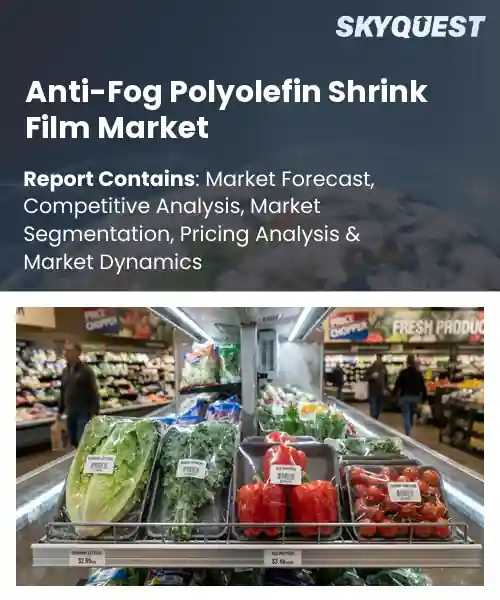
Anti-Fog Polyolefin Shrink Film Market
Report ID: SQMIG15E4238
Report ID: SQMIG15E4238
[email protected]
USA +1 351-333-4748
Report ID:
SQMIG15E4238 |
Region:
Global |
Published Date: August, 2026
Pages:
157
|Tables:
143
|Figures:
78


Global Anti-Fog Polyolefin Shrink Film Market size was valued at USD 2.18 Billion in 2024 and is poised to grow from USD 2.33 Billion in 2025 to USD 3.95 Billion by 2033, growing at a CAGR of 6.8% during the forecast period (2026-2033).
Growth driver for the anti‑fog polyolefin shrink film market is the surge in meals that demand packaging throughout refrigeration. When fog obscures product appearance, retailers face higher return rates, prompting manufacturers to adopt anti‑fog additives to preserve visual quality. This shift has lifted film shipments by eight percent, creating a cause‑effect link between consumer preference and production volume. Cold‑chain markets amplify the opportunity; a Southeast Asian beverage firm introduced anti‑fog film for bottled water, cutting complaints by fifteen percent and gaining placement on premium shelves. Such outcomes illustrate how demand for hygiene and visibility fuels sustained global ongoing market expansion. The anti‑fog polyolefin shrink film market supplies transparent, moisture‑resistant packaging that remains clear under temperature fluctuations, a need for food, medical and consumer goods sectors. Its importance stems from the ability to preserve product visibility while preventing condensation that can compromise safety or aesthetics. Originating in the early 2000s as a niche solution for refrigerated produce, the market expanded rapidly as manufacturers adopted shrink tunnels and integrated anti‑fog additives into polyethylene. For example, a leading snack producer switched to anti‑fog film in 2015, reducing spoilage claims by 12 percent and extending shelf life, illustrating the technology’s significant evolution to mainstream.
How is AI improving production efficiency in the anti-fog polyolefin shrink film market?
AI is reshaping anti‑fog polyolefin shrink film production by embedding sensors and machine‑learning models directly into extrusion lines. Real‑time data on temperature, tension and film thickness feed algorithms that instantly adjust settings, keeping the anti‑fog additive evenly dispersed. Predictive maintenance alerts operators to equipment wear before a failure occurs, reducing unplanned downtime. Quality‑control cameras coupled with AI detect surface defects faster than human inspection, allowing immediate correction and minimizing scrap. Integrated demand forecasts help schedule runs that match market peaks, ensuring raw‑material use aligns with output and cutting excess inventory. Together these tools tighten process control, lower waste and accelerate throughput, making the sector more responsive and cost‑effective.JTPackage, February 2026, launched an AI‑driven coating station that continuously monitors fog‑resistance performance and automatically tweaks formulation parameters, cutting cycle time and supporting faster market adoption.
Market snapshot - (2026-2033)
Global Market Size
USD 2.18 Billion
Largest Segment
Polyethylene
Fastest Growth
Polypropylene
Growth Rate
6.8% CAGR
To get more insights on this market click here to Request a Free Sample Report
Global anti-fog polyolefin shrink film market is segmented by polyolefin type, film structure, shrinkage type, application, end-use industry and region. Based on polyolefin type, the market is segmented into Polyethylene and Polypropylene. Based on film structure, the market is segmented into Monolayer and Multilayer. Based on shrinkage type, the market is segmented into Cross-Linked and Non-Cross-Linked. Based on application, the market is segmented into Food Packaging, Pharmaceutical Packaging, Consumer Goods Packaging and Industrial Packaging. Based on end-use industry, the market is segmented into Food & Beverage, Pharmaceuticals, Consumer Goods and Industrial Manufacturing. Based on region, the market is segmented into North America, Europe, Asia Pacific, Latin America and Middle East & Africa.
Polyethylene segment dominates because its inherent flexibility allows the film to conform tightly around irregular product shapes while maintaining a clear, anti‑fog surface. The material’s natural moisture permeability and ease of processing enable manufacturers to integrate anti‑fog additives without compromising shrink performance. This combination of processing efficiency, cost‑effectiveness, and visual clarity makes it the preferred choice for most anti‑fog polyolefin shrink film applications across diverse packaging sectors worldwide and beyond.
Meanwhile, Polypropylene segment emerges as the most rapidly expanding because its higher tensile strength supports thinner film constructions that still meet anti‑fog standards. Recent innovations in polymer blending and extrusion technology have unlocked new performance levels, attracting manufacturers seeking lightweight solutions and enabling broader adoption across emerging product categories globally.
Food Packaging segment dominates because clear product visibility is essential for consumer trust, and anti‑fog shrink film directly addresses this need by preserving optical clarity throughout distribution. The high turnover of perishable goods accelerates demand for films that prevent moisture‑induced clouding, while retailers require attractive presentations on shelves. Consequently, manufacturers prioritize food‑focused formulations, driving investment in specialized additives and process controls that enhance fog resistance without sacrificing shrink efficiency overall.
On the other hand, Pharmaceutical Packaging segment emerges as the most rapidly expanding because sterility regulations demand fog‑free visibility for dosage verification and patient safety. Advances in anti‑fog additive technology tailored for barrier films have opened opportunities, prompting pharma firms to adopt shrink film solutions that maintain clarity while ensuring compliance.
To get detailed segments analysis, Request a Free Sample Report
Asia Pacific commands the global Anti-Fog Polyolefin Shrink Film market through a combination of deep manufacturing expertise, strong demand from food‑packaging sectors, and proactive regulatory environments. The region benefits from a dense network of polymer producers that deliver high‑quality materials at competitive cost. Consumer expectations for fresh, visually appealing produce drive extensive adoption of anti‑fog solutions, while leading research institutions foster continuous innovation in film performance. Additionally, the proximity to major agricultural exporters creates a seamless supply chain, and government initiatives that emphasize food safety and sustainability reinforce market momentum across the region. Regional trade agreements facilitate cross‑border distribution, while a culture of rapid product development enables manufacturers to tailor film specifications to diverse market segments. Investments in advanced extrusion technologies further enhance film clarity and durability, reinforcing consumer confidence and encouraging broader adoption across retail and industrial channels.
Anti-Fog Polyolefin Shrink Film Market in Japan is characterized by a strong emphasis on premium packaging quality and rigorous food‑safety standards. Japanese manufacturers integrate sophisticated polymer chemistries to achieve superior clarity and anti‑fog performance, while local suppliers prioritize sustainable sourcing. Collaborative efforts between industry associations and research institutes drive continuous improvements, supporting a wide range of applications from fresh‑produce wraps to ready‑meal packaging.
Anti-Fog Polyolefin Shrink Film Market in South Korea benefits from an agile manufacturing base and a high appetite for innovative packaging solutions. South Korean producers leverage cutting‑edge film extrusion techniques to deliver anti‑fog properties that align with consumer demands for visual appeal. Government‑backed sustainability programs encourage the use of recyclable polymers, and strong partnerships with global food retailers accelerate adoption across fresh‑food and convenience‑product segments.
The rapid expansion of the Anti-Fog Polyolefin Shrink Film market in North America is fueled by a confluence of consumer preferences for fresh, visually appealing products and a robust retail infrastructure that prioritizes packaging excellence. Leading grocery chains adopt anti‑fog films to enhance shelf presentation, while manufacturers respond with tailored formulations that balance clarity, durability, and environmental considerations. Strong research ecosystems across the United States and Canada accelerate development of advanced polymer blends, and regulatory guidance promotes consistent food‑safety compliance. Additionally, the emphasis on sustainable packaging drives investment in recyclable film technologies, reinforcing market growth and positioning North America as a dynamic hub for anti‑fog shrink film innovation.
Anti-Fog Polyolefin Shrink Film Market in the United States is driven by extensive retail networks that demand high‑performance packaging to showcase fresh produce. American producers focus on integrating nano‑level additives that improve fog resistance while maintaining film strength. Collaborative initiatives between packaging firms and food processors foster customized solutions for a variety of product lines, from fresh fruits to ready‑to‑eat meals. The emphasis on sustainability further encourages the development of recyclable film options that meet evolving consumer expectations.
Anti-Fog Polyolefin Shrink Film Market in Canada reflects a strong commitment to food‑safety standards and environmentally responsible packaging. Canadian manufacturers align product development with stringent regulatory frameworks, emphasizing clear visual presentation and anti‑fog functionality. Partnerships with local agricultural cooperatives ensure that film technologies address the unique needs of fresh‑produce supply chains across diverse climatic regions. Ongoing investment in research promotes the adoption of bio‑based polymers, reinforcing Canada’s position as a forward‑looking market for anti‑fog shrink film solutions.
The European anti‑fog polyolefin shrink film market is strengthening its position through rigorous sustainability mandates, advanced research collaborations, and a deep‑rooted tradition of high‑quality food packaging. Regulatory bodies across the continent set stringent guidelines that drive manufacturers to innovate for clarity, fog resistance, and recyclability. Cross‑border initiatives among leading petrochemical firms and academic institutions accelerate the development of next‑generation film chemistries, while sophisticated logistics networks ensure efficient distribution to retail and food‑service sectors. Consumer expectations for premium, eco‑friendly packaging further compel brands to adopt anti‑fog solutions, cementing Europe’s role as a leader in sophisticated shrink film applications.
Anti-Fog Polyolefin Shrink Film Market in Germany is anchored by a robust chemical industry that prioritizes precision engineering and environmental stewardship. German producers combine high‑performance polymers with advanced extrusion processes to achieve superior anti‑fog characteristics. Close cooperation with food‑industry associations ensures compliance with strict safety standards, while sustainability programs encourage the use of recyclable and bio‑based materials. This integrated approach supports a wide spectrum of applications, from fresh‑produce packaging to high‑value culinary products.
Anti-Fog Polyolefin Shrink Film Market in the United Kingdom leverages a dynamic packaging sector that emphasizes innovation and consumer appeal. British manufacturers focus on developing films with exceptional clarity and fog‑free performance, catering to retailers seeking premium visual presentation. Collaboration with research institutes fosters the introduction of novel additives that enhance film durability and sustainability. Regulatory alignment with European standards ensures consistent safety, positioning the United Kingdom as a pivotal market for advanced anti‑fog shrink film solutions.
Anti-Fog Polyolefin Shrink Film Market in France benefits from a strong culinary culture that demands elegant and functional packaging. French producers integrate refined polymer blends to deliver clear, fog‑resistant films that complement the visual quality of fresh foods. Industry partnerships with gastronomic brands drive customized solutions tailored to high‑end market segments. Commitment to circular economy principles promotes the adoption of recyclable film technologies, reinforcing France’s contribution to the broader European leadership in anti‑fog shrink film innovation.
To know more about the market opportunities by region and country, click here to
Buy The Complete Report
Increasing Demand for Food Packaging
Regulatory Push for Food Safety
Higher Production Cost Compared
Limited Awareness Among Users
Request Free Customization of this report to help us to meet your business objectives.
The anti‑fog polyolefin shrink film market is shaped by intense competition among established packaging firms that are accelerating sustainable product lines through strategic acquisitions, joint ventures and advanced coating technologies; recent M&A activity and partnerships aim to secure proprietary anti‑fog formulations and expand recyclable film offerings, driving differentiation in a rapidly consolidating sector.
Top Player’s Company Profile
Recent Developments
SkyQuest’s ABIRAW (Advanced Business Intelligence, Research & Analysis Wing) is our Business Information Services team that Collects, Collates, Correlates, and Analyses the Data collected by means of Primary Exploratory Research backed by robust Secondary Desk research. As per SkyQuest analysis, the anti‑fog polyolefin shrink film market is being propelled primarily by the rising demand for food packaging that preserves visual clarity in refrigerated environments, while a regulatory push for food safety adds further momentum by encouraging manufacturers to adopt moisture‑resistant solutions. The market is led by Asia Pacific, where a dense polymer supply chain and strong consumer expectations drive adoption, and polyethylene remains the dominant segment thanks to its flexibility and ease of processing. However, higher production costs linked to specialized additives act as a restraint, tempering broader uptake until economies of scale are achieved globally in the industry.
| Report Metric | Details |
|---|---|
| Market size value in 2024 | USD 2.18 Billion |
| Market size value in 2033 | USD 3.95 Billion |
| Growth Rate | 6.8% |
| Base year | 2024 |
| Forecast period | (2026-2033) |
| Forecast Unit (Value) | USD Billion |
| Segments covered |
|
| Regions covered | North America (US, Canada), Europe (Germany, France, United Kingdom, Italy, Spain, Rest of Europe), Asia Pacific (China, India, Japan, Rest of Asia-Pacific), Latin America (Brazil, Rest of Latin America), Middle East & Africa (South Africa, GCC Countries, Rest of MEA) |
| Companies covered |
|
| Customization scope | Free report customization with purchase. Customization includes:-
|
To get a free trial access to our platform which is a one stop solution for all your data requirements for quicker decision making. This platform allows you to compare markets, competitors who are prominent in the market, and mega trends that are influencing the dynamics in the market. Also, get access to detailed SkyQuest exclusive matrix.
Table Of Content
Executive Summary
Market overview
Parent Market Analysis
Market overview
Market size
KEY MARKET INSIGHTS
COVID IMPACT
MARKET DYNAMICS & OUTLOOK
Market Size by Region
KEY COMPANY PROFILES
Methodology
For the Anti-Fog Polyolefin Shrink Film Market, our research methodology involved a mixture of primary and secondary data sources. Key steps involved in the research process are listed below:
1. Information Procurement: This stage involved the procurement of Market data or related information via primary and secondary sources. The various secondary sources used included various company websites, annual reports, trade databases, and paid databases such as Hoover's, Bloomberg Business, Factiva, and Avention. Our team did 45 primary interactions Globally which included several stakeholders such as manufacturers, customers, key opinion leaders, etc. Overall, information procurement was one of the most extensive stages in our research process.
2. Information Analysis: This step involved triangulation of data through bottom-up and top-down approaches to estimate and validate the total size and future estimate of the Anti-Fog Polyolefin Shrink Film Market.
3. Report Formulation: The final step entailed the placement of data points in appropriate Market spaces in an attempt to deduce viable conclusions.
4. Validation & Publishing: Validation is the most important step in the process. Validation & re-validation via an intricately designed process helped us finalize data points to be used for final calculations. The final Market estimates and forecasts were then aligned and sent to our panel of industry experts for validation of data. Once the validation was done the report was sent to our Quality Assurance team to ensure adherence to style guides, consistency & design.
Analyst Support
Customization Options
With the given market data, our dedicated team of analysts can offer you the following customization options are available for the Anti-Fog Polyolefin Shrink Film Market:
Product Analysis: Product matrix, which offers a detailed comparison of the product portfolio of companies.
Regional Analysis: Further analysis of the Anti-Fog Polyolefin Shrink Film Market for additional countries.
Competitive Analysis: Detailed analysis and profiling of additional Market players & comparative analysis of competitive products.
Go to Market Strategy: Find the high-growth channels to invest your marketing efforts and increase your customer base.
Innovation Mapping: Identify racial solutions and innovation, connected to deep ecosystems of innovators, start-ups, academics, and strategic partners.
Category Intelligence: Customized intelligence that is relevant to their supply Markets will enable them to make smarter sourcing decisions and improve their category management.
Public Company Transcript Analysis: To improve the investment performance by generating new alpha and making better-informed decisions.
Social Media Listening: To analyze the conversations and trends happening not just around your brand, but around your industry as a whole, and use those insights to make better Marketing decisions.
REQUEST FOR SAMPLE
 REQUEST FREE CUSTOMIZATION


Want to customize this report? This report can be personalized according to your needs. Our analysts and industry experts will work directly with you to understand your requirements and provide you with customized data in a short amount of time. We offer $1000 worth of FREE customization at the time of purchase.
Feedback From Our Clients


 USA (+1) 351-333-4748

