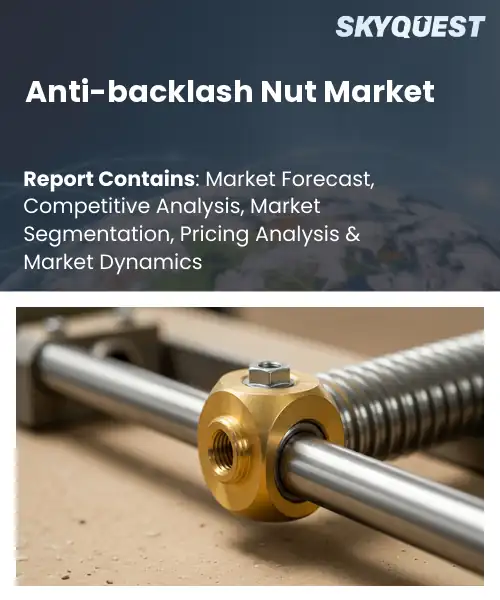
Anti-backlash Nut Market
Report ID: SQMIG20I2765
Report ID: SQMIG20I2765
[email protected]
USA +1 351-333-4748
Report ID:
SQMIG20I2765 |
Region:
Global |
Published Date: March, 2026
Pages:
157
|Tables:
116
|Figures:
77


Global Anti-Backlash Nut Market size was valued at USD 330.0 Million in 2024 and is poised to grow from USD 352.77 Million in 2025 to USD 601.61 Million by 2033, growing at a CAGR of 6.9% during the forecast period (2026-2033).The goal of an anti-backlash nut is to eliminate backlash or slop from a lead screw assembly that could otherwise impact the performance of the assembly. The anti-backlash nut market is driven by applications that demand extreme accuracy or precision, such as robotics, semiconductor manufacturing, or aerospace. Currently, the major driving force for this market is the continually increasing use of automation and high precision motion systems, which has resulted in engineers requesting preloaded or split nut solutions to accommodate the effects of cyclic loading and maintain repeatability. Original designs differed from the first generation of anti-backlash nuts, using simple bronze or acetal inserts, into complex, preloaded steel assemblies using polymer damping; this occurred due to increasing performance requirements in terms of tighter tolerances and higher speeds.
Suppliers providing anti-backlash nuts have evolved their technology through advancements in material science and increased efficiency through automation, allowing them to manufacture anti-backlash nuts with less backlash and longer life.Through the advancements that have been made over the years, the market factor for anti-backlash nuts is an increasing demand for efficient, high-performance automation systems. As both cycle count and positional requirements increase, manufacturers are looking for solutions to reduce both scheduled and unscheduled maintenance intervals on their equipment. As that level of demand continues to increase, there will be continued innovation in the areas of material science, preloading and integrated sensing technologies, which will result in opportunities for suppliers to provide retrofit kits for CNC machines and custom configured assemblies for surgical robots where micron-level accuracy is critical. An example of this is in semiconductor pick and place lines, where repeated micro-positioning will require low backlash preloading to achieve maximum performance by decreasing the amount of rejection due to scrap and increasing overall throughput, leading manufacturers to be willing to pay a premium to achieve this level of success.
How is AI Enhancing Precision in the Anti-backlash Nut Market?
The anti-backlash nut industry is experiencing increased precision through a combination of improved design and increased process control by adopting artificial intelligence technology. Some of the main AI technologies available for anti-backlash nuts include design optimization using AI to create better thread forms, machine learning to enable process control during the machining process, and automated visual metrology for in-line inspection. Manufacturers today use historical mechanical preload technologies (torsion and helical spring nuts) with AI quality technologies (such as artificial neural networks to improve quality) to reduce variability and drift in assembly processes. Demand from the aerospace robotics and semiconductor sectors continues to drive investment in AI quality technologies. Examples of implemented AI technologies are Nanotec's anti-backlash nuts and industry examples of AI inspection and intelligent ball screw systems that help create consistent quality from manufacturing to shipment.
Market snapshot - (2026-2033)
Global Market Size
USD 330.0 Million
Largest Segment
Spring-loaded Split Nut
Fastest Growth
Preloaded Torsion Nut
Growth Rate
6.9% CAGR
To get more insights on this market click here to Request a Free Sample Report
Global anti-backlash nut market is segmented into design configuration, material composition, lead screw compatibility, application load and region. Based on design configuration, the market is segmented into spring-loaded split nut, adjustable compression nut and preloaded torsion nut. Based on material composition, the market is segmented into high-performance polymers, bronze & brass alloys and composite materials. Based on lead screw compatibility, the market is segmented into acme lead screws, ball screws and trapezoidal screws. Based on application load, the market is segmented into low load and high precision/heavy load. Based on region, the market is segmented into North America, Europe, Asia Pacific, Latin America and Middle East & Africa.
As per anti-backlash nut market analysis, the spring-loaded split nut segment is by far the most dominant due to its inherent preload design that keeps opposing threads in a constant state of contact. This results in a direct reduction in axial clearance between the two threads, which reduces lost motion and positional error caused by axial clearance. Another benefit of the spring-loaded split nut is that it automatically compensates for wear and thermal changes; therefore, it reduces the amount of maintenance required to maintainconsistent performance.
As per anti-backlash nut market forecast, the spring-loaded split nut also has a high level of compatibility with standard lead screw profiles, making it easy to retrofit when required by an OEM (Original Equipment Manufacturer), making it a popular choice for precision automation applications. The demand for reliability under cyclic loads continues to drive procurement decisions based on these factors. While the spring-loaded split nut dominates commercial production and heavy-duty designs, the adjustable compression nut is quickly emerging as one of the fastest growing markets. The adjustable compression nut allows for a field-adjustable preload that simplifies commissioning and in-service tuning without replacing any components. Also, as the demand for configurable machinery and custom automation continues to grow, suppliers can utilize innovative design techniques to create tool-free and fully integrated adjustment mechanisms.
Bronze & brass based materials continue to dominate with large anti-backlash nut market share due to their properties that provide consistent wear surfaces due to their metallurgical characteristics and favorable frictional behavior, which will provide preload resistance under cyclical loads. The ability of these alloys to be machined to fine tolerances and operatepredictably with traditional types of lubrication will decrease service interventions while maintaining positional accuracy during long service lives. As such, they are the default material for heavy-duty and legacy systems where both continuity of supply and maintainability are of critical importance.
However, the performance polymeric materials segment of this market will experience the highest anti-backlash nut market growth due to the demand for lower friction, corrosion resistance, and reduce weight/noise in compact automation and medical devices. Advances in tribology of polymers and additive manufacturing will enable parts to be designed with integrated anti-backlash geometries, as well as providing customized parts, accelerating the replacement of metals in targeted applications and thereby creating new design-led products for manufacturers.
To get detailed segments analysis, Request a Free Sample Report
According to the latest forecasts for the global anti-backlash nut market, the Asia-Pacific region holds a prominent market position due to its integrated manufacturing ecosystem and strong supplier networks that enable fast product innovation. The considerable number of precision-machined components in this region indicates that manufacturers are heavily focused on the design and engineering aspects of their products, as evidenced by how readily they continue to purchase and adopt the advanced locking technologies. The development of close partnerships between component manufacturers and end users in this region facilitates an even quicker uptake of new product designs.
The Japanese anti-backlash nut market is driven by the country’s culture of precision engineering and close working relationships between component manufacturers and original equipment suppliers. The market is characterized by high customer expectations for durability and limited backlash, which drives demand for high-quality locking solutions that are better suited for compact, high-speed applications. Japan has many experienced suppliers who can provide custom prototypes and variations and has implemented strict quality and service processes to maintain long-lasting relationships with end users in industries such as robotics, semiconductor manufacturing, and precision motion and beyond.
The South Korean anti-backlash nut market is defined by a rapidly increasing number of technological advances incorporated into high-performance manufacturing and automated production equipment. Ongoing collaboration between technology partners and systems integrators contributes to continuous design refinement of anti-backlash nuts. Consequently, South Korea’s focus on compact design and reliable backlash control will facilitate the adoption of anti-backlash nuts in electronics assembly, precision tool and die, and industrial automation.
As per anti-backlash nut market regional outlook, the expansion occurring throughout Europe can be attributed to both the technological advancements occurring within manufacturing operations, as well as the increased demand from automation and renewable energy supply markets. The focus on precision motion control across many different industries is one factor driving this growth. Additionally, the combination of established engineering practice combined with a vast amount of specialized component manufacturing allows advanced design concepts to be easily adapted for large-scale production across many different sectors. The growing emphasis placed by regulators on product reliability and interoperability is creating demand for anti-backlash products that provide superior reliability and interoperability. Collaboration across multiple countries involving research institutions and industrial partners greatly increases the speed at which customized versions of anti-backlash products can be developed for niche applications.
As per anti-backlash nut market regional forecast, Germany market is primarily made up of a very close-knit group of machine tool builders and companies specializing in automation systems. Companies within this market place a very high level of importance on precision performance, making it essential that component manufacturers and end user engineering teams be able to work together efficiently to specify appropriate locking devices. Reliability and long-term serviceability are essential factors contributing to the demand for anti-backlash products. The availability of a highly experienced and trained supply chain network, along with the presence of many established distribution centers located throughout Germany, allow end users to have access to complete anti-backlash assemblies as well as aftermarket replacement parts across all major industrial segments quickly and efficiently.
As per anti-backlash nut industry analysis, United Kingdom is driven by an active combination of cutting-edge engineering companies, application-based research, and a strong ecosystem that supports the rapid adoption of new products. Agile and specialized distributors and manufacturers respond quickly to rapidly changing demands within automation, robotics and advanced manufacturing sectors. Modular system designs and a strong aftermarket service ability are key contributors to uptake, while the establishment of collaborative networks between academia and industry enables continuous refinement of solutions designed for performance.
The anti-backlash nut market in France is reflective of new demand resulting from modernization initiatives being implemented across many industries, as well as a growing focus by industrial companies on precision instrument manufacturing. Local engineering firms focus on custom design balances of performance and compact design solutions that are well-suited to meet the needs of the specialist machinery markets. Efforts are being made to increase collaboration with suppliers in Europe and to encourage systems of integrators to conduct additional trials of products. The growth of local knowledge and targeted quality assurance capabilities will assist suppliers in positioning themselves for potential expansion of product applications broadly.
North America is improving its competitiveness and ability to meet customer demands for ongoing lifecycle support. OEMs, automation integrators and component providers work together to quickly specify application-specific anti-backlash products. Investments in advanced additive manufacturing processes and precision machining capabilities enable rapid prototyping and customization of products used in the heavy equipment and robotics industries.
The United States anti-backlash nut market has a solid OEM landscape along with a thriving innovation ecosystem focused on customized products for motion control applications. Efforts to improve materials and precision machining have supported high-performance locking systems.
The Canada anti-backlash nut market is facilitated by manufacturing clusters that facilitate the integration of component manufacturing with system assembly to support specialized equipment needs. A focus on lightweight design and corrosion resistance meets the requirements of transportation industries. Many smaller and medium-sized suppliers are well positioned to provide customized flexibility and responsive technical support that allows for rapid prototypes and reliable post-sale service. Partnerships with research institutions and cross-border partnerships enhance the ability to deliver complex motion control assemblies for specialized industrial applications.
To know more about the market opportunities by region and country, click here to
Buy The Complete Report
Rising Automotive Manufacturing Demand
Demand for hyper-precise mechanical fastening solutions is growing as manufacturers produce more vehicles and vehicle parts. The component of choice for maintaining positional accuracy and reducing assembly play are anti-backlash fasteners. With manufacturers focused on improving reliability and reducing maintenance, anti-backlash fasteners are being specified for steering, transmission and actuator applications. As OEMs continue to pursue tighter tolerances and smoother motion for their products, suppliers and designers of anti-backlash fasteners are using this type of fastener to help meet quality requirements and to increase product durability; ultimately leading to wider acceptance and steady growth within the overall marketplace.
Electric Vehicle Adoption Influence
The transition to electric vehicles (EVs) represents the change to an electrified drivetrain and presents unique mechanical challenges for supporting this technology. Therefore, there is an increase in demand for anti-backlash fasteners as a means of controlling axial play and enabling precise motion within compact, high torque assemblies. Based on noise reduction, drivetrain efficiency and improved responsiveness, OEMs see value in utilizing anti-backlash fasteners where motors are connected to motor shafts, steering systems, and actuator linkages, etc. In addition, anti-backlash fasteners provide an opportunity for engineers to meet tight packaging and performance criteria; thus, increasing demand from manufacturers focused on creating great EVs and enhancing the customer experience.
Cost Sensitivity Among Manufacturers
Cost-conscious buyers and manufacturers may shy away from anti-backlash nuts because of their higher production costs compared to traditional hardware, and this is limiting specification of anti-backlash nuts in very price-sensitive applications. The majority of manufacturers and end-users have budget constraints and will try to find the lowest price option, or the simplest design for a job, and therefore will use lower-cost or simpler options, resulting in their not using anti-backlash nuts even though the benefits of using them would be substantial. Many procurement and aftermarket suppliers will use standard "non-anti-backlash" fasteners to manage their costs, and these price pressures decrease the more widespread adoption of anti-backlash nuts. Therefore, the opposite of anti-backlash will be less expensive will slow further development and market adoption of these products across the spectrum of industries where anti-backlash will create an upscale of new technology over time.
Lack of Standardization
The lack of widely accepted industry standards and common specifications for anti-backlash nuts makes interoperability difficult and complicates procurement, which in turn is an obstacle to the purchase of anti-backlash nuts by a broad base of manufacturers and suppliers. If any component requires a special customized design for a particular assembly, that creates additional time and engineering effort that makes designers or purchasing teams hesitant to use these types of parts; therefore, by having many different companies design a part, it increases the difficulty of integrating a part without considerable effort. In addition, the fragmented nature of the design approaches for anti-backlash nuts and the limited harmonization in testing and/or qualification criteria reduces the reliability of finding compatible components from different suppliers. Thus restricting anti-backlash nuts from gaining broader acceptance across all industry segments despite the technological advantages offered by the use of such parts.
Request Free Customization of this report to help us to meet your business objectives.
Various factors that have resulted in the competitive environment of the global anti backlash nut industry include OEMs (Original Equipment Manufacturers) forming alliances, the consolidation of precision nut manufacturing through companies like AMETEK that have acquired Haydon Kerk. Additionally, suppliers like Nanotec and Helix Linear have introduced products based on either spring or torsion designs to differentiate their anti-backlash offerings, thus impacting their competitors' levels of competition.
Lightweight Materials Adoption: As manufacturers search for lighter components, they are using more composite materials and are changing the designs of anti-backlash nuts to accommodate the various thermal expansion properties, stiffnesses, and fastening surfaces of these new materials. This focus has led to closer cooperation between fastener manufacturers and original equipment manufacturers (OEMs) to develop geometries and surface treatments that work together and maintain preload and anti-rotation during service. In addition, the need for durable finished products, corrosion resistance, and ease of assembly guide how suppliers of fasteners are selected.
Smart Integration of Fasteners into Supply Chain Management: The integration of sensors and connectivity into fasteners will change how they are specified and tracked throughout the supply chain as well as change how they are maintained. Condition monitoring and assembly verification, which use embedded sensors in anti-backlash nuts, will improve quality control throughout the assembly process and provide for smooth transitions between automated assembly processes to service. Suppliers with products that are interoperable and firmware-enabled with clear output data and a complete traceable lifecycle will be preferred. The anti-backlash nut market trends favor partnerships among fastener manufacturers, software developers, and OEMs to create scalable and configurable solutions that will simplify installing fasteners and managing them as assets throughout their life cycle.
SkyQuest’s ABIRAW (Advanced Business Intelligence, Research & Analysis Wing) is our Business Information Services team that Collects, Collates, Correlates, and Analyses the Data collected by means of Primary Exploratory Research backed by robust Secondary Desk research.
As per SkyQuest analysis, growth in the global anti-backlash nut industry is primarily driven by accelerating adoption of automation and high-precision motion systems, while a second driver is rising electric vehicle and automotive manufacturing demand that requires compact, low-play components. A significant restraint remains cost sensitivity among manufacturers, where higher precision component costs limit uptake in price-sensitive segments. Asia Pacific dominates the market due to integrated manufacturing ecosystems, supplier networks and proximity to precision machinery demand. The spring-loaded split nut design leads the product mix because its self-adjusting preload reduces axial clearance, simplifies retrofits and sustains repeatable performance under cyclic loads, making it the preferred choice for OEMs.
| Report Metric | Details |
|---|---|
| Market size value in 2024 | USD 330.0 Million |
| Market size value in 2033 | USD 601.61 Million |
| Growth Rate | 6.9% |
| Base year | 2024 |
| Forecast period | (2026-2033) |
| Forecast Unit (Value) | USD Million |
| Segments covered |
|
| Regions covered | North America (US, Canada), Europe (Germany, France, United Kingdom, Italy, Spain, Rest of Europe), Asia Pacific (China, India, Japan, Rest of Asia-Pacific), Latin America (Brazil, Rest of Latin America), Middle East & Africa (South Africa, GCC Countries, Rest of MEA) |
| Companies covered |
|
| Customization scope | Free report customization with purchase. Customization includes:-
|
To get a free trial access to our platform which is a one stop solution for all your data requirements for quicker decision making. This platform allows you to compare markets, competitors who are prominent in the market, and mega trends that are influencing the dynamics in the market. Also, get access to detailed SkyQuest exclusive matrix.
Table Of Content
Executive Summary
Market overview
Parent Market Analysis
Market overview
Market size
KEY MARKET INSIGHTS
COVID IMPACT
MARKET DYNAMICS & OUTLOOK
Market Size by Region
KEY COMPANY PROFILES
Methodology
For the Anti-backlash Nut Market, our research methodology involved a mixture of primary and secondary data sources. Key steps involved in the research process are listed below:
1. Information Procurement: This stage involved the procurement of Market data or related information via primary and secondary sources. The various secondary sources used included various company websites, annual reports, trade databases, and paid databases such as Hoover's, Bloomberg Business, Factiva, and Avention. Our team did 45 primary interactions Globally which included several stakeholders such as manufacturers, customers, key opinion leaders, etc. Overall, information procurement was one of the most extensive stages in our research process.
2. Information Analysis: This step involved triangulation of data through bottom-up and top-down approaches to estimate and validate the total size and future estimate of the Anti-backlash Nut Market.
3. Report Formulation: The final step entailed the placement of data points in appropriate Market spaces in an attempt to deduce viable conclusions.
4. Validation & Publishing: Validation is the most important step in the process. Validation & re-validation via an intricately designed process helped us finalize data points to be used for final calculations. The final Market estimates and forecasts were then aligned and sent to our panel of industry experts for validation of data. Once the validation was done the report was sent to our Quality Assurance team to ensure adherence to style guides, consistency & design.
Analyst Support
Customization Options
With the given market data, our dedicated team of analysts can offer you the following customization options are available for the Anti-backlash Nut Market:
Product Analysis: Product matrix, which offers a detailed comparison of the product portfolio of companies.
Regional Analysis: Further analysis of the Anti-backlash Nut Market for additional countries.
Competitive Analysis: Detailed analysis and profiling of additional Market players & comparative analysis of competitive products.
Go to Market Strategy: Find the high-growth channels to invest your marketing efforts and increase your customer base.
Innovation Mapping: Identify racial solutions and innovation, connected to deep ecosystems of innovators, start-ups, academics, and strategic partners.
Category Intelligence: Customized intelligence that is relevant to their supply Markets will enable them to make smarter sourcing decisions and improve their category management.
Public Company Transcript Analysis: To improve the investment performance by generating new alpha and making better-informed decisions.
Social Media Listening: To analyze the conversations and trends happening not just around your brand, but around your industry as a whole, and use those insights to make better Marketing decisions.
REQUEST FOR SAMPLE
 REQUEST FREE CUSTOMIZATION
Global Anti-Backlash Nut Market size was valued at USD 330.0 Million in 2024 and is poised to grow from USD 352.77 Million in 2025 to USD 601.61 Million by 2033, growing at a CAGR of 6.9% during the forecast period (2026-2033).
Competitive landscape in the global anti backlash nut market is shaped by consolidation, OEM alliances and component innovation that directly influence competitive positioning; AMETEK’s acquisition of Haydon Kerk shows consolidation of precision nut capacity, Thomson introduced sensor integrated anti backlash nuts to add condition monitoring, and suppliers such as Nanotec and Helix Linear have rolled out torsion and spring based anti backlash designs as product differentiation. 'Thomson Industries', 'SKF Group', 'Nook Industries', 'NTN Corporation', 'Motion Industries', 'Kaman Corporation', 'Faulhaber Motors', 'AST Bearings', 'Accu-Tech', 'Wittenstein SE', 'Ruland Manufacturing', 'HPI (High Precision)', 'MRO Supply', 'PBC Linear', 'AeroSpace Components', 'Saji Engineering', 'Penta Precision', 'KTN Engineering', 'Greenfield Industries', 'BNL Tech'
The expanding production of vehicles and components has increased demand for precision mechanical fastening solutions, and anti-backlash nuts are sought for their ability to maintain positional accuracy and reduce play in assemblies. Manufacturers prioritize components that improve reliability and reduce maintenance, prompting specification of anti-backlash nuts in steering, transmission, and actuator applications. As OEMs pursue tighter tolerances and smoother motion, suppliers and designers integrate these nuts to meet quality requirements and extend component life, thereby supporting broader market adoption and steady growth.
Lightweight Materials Adoption: Manufacturers increasingly favor lightweight materials and composite structures, prompting anti-backlash nut designs to adapt for different thermal expansion, stiffness and fastening interfaces. This trend drives closer collaboration between fastener makers and OEMs to co-develop material-compatible geometries and surface treatments that preserve preload and anti-rotation performance under varied service conditions. Emphasis on long-term durability, corrosion resistance and assembly ease influences supplier selection and product roadmaps, creating opportunities for differentiated solutions tailored to sector-specific packaging and servicing requirements and maintenance inspection protocols.
Why does Asia Pacific Dominate the Global Anti-backlash Nut Market? |@12


Want to customize this report? This report can be personalized according to your needs. Our analysts and industry experts will work directly with you to understand your requirements and provide you with customized data in a short amount of time. We offer $1000 worth of FREE customization at the time of purchase.
Feedback From Our Clients


 USA (+1) 351-333-4748

