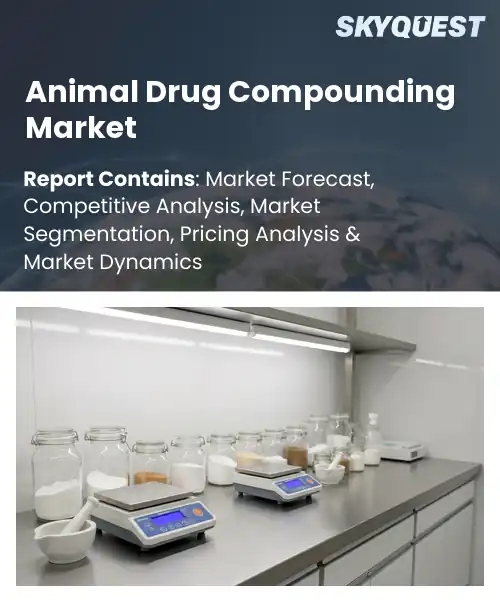
Animal Drug Compounding Market
Report ID: SQMIG35I2637
Report ID: SQMIG35I2637
[email protected]
USA +1 351-333-4748
Report ID:
SQMIG35I2637 |
Region:
Global |
Published Date: May, 2026
Pages:
157
|Tables:
151
|Figures:
78


Global Animal Drug Compounding Market size was valued at USD 1.85 Billion in 2024 and is poised to grow from USD 2.01 Billion in 2025 to USD 3.92 Billion by 2033, growing at a CAGR of 8.7% during the forecast period (2026-2033).
High demand for customized veterinary therapies, increasing pet ownership, rising adoption of specialized treatments for companion and exotic animals, advancements in veterinary pharmacy services, and growing focus on animal welfare are driving demand for animal drug compounding.
Increased requirement for personalized oral liquids, flavors for medicines, topical gel preparations, sterile injectable drugs, and dose modifications are also predicted to drive up the demand for animal drug compounding. Veterinary pharmacies and providers are increasingly spending in modern compounding labs, telepharmacy facilities, quality management systems, and custom-made medication preparation to enhance the quality of care provided and deal with shortage of commercially available products. Increased regulatory requirements for veterinary compounding practices and growing demand for specialized products in livestock and exotic animals are also leading to new opportunities for commercialization. Growing need for personalized veterinary medications around the world coupled with increasing demand for dosage flexibility, palatable formulations, and alternative drug delivery methods are expected to primarily drive animal drug compounding market growth.
On the contrary, stringent regulatory compliance requirements, concerns regarding formulation consistency and product safety, high operational costs associated with sterile compounding facilities, and limited availability of standardized veterinary compounding guidelines across regions are anticipated to hamper animal drug compounding market penetration through 2033.
How is AI Enhancing Quality Control In Animal Drug Compounding Companies?
For veterinary drug compounding, AI is helping in improving quality control by automating the inspection process and making standardization of the pharmacy processes easier. Many compounding pharmacies have adopted AI technology to make their work more efficient and consistent. They are able to do this by optimizing the formulation process and reviewing electronic batch records. With such initiatives, pharmaceuticals will be able to make their work easier while at the same time ensuring that customized drugs for animals remain safe.
Market snapshot - (2026-2033)
Global Market Size
USD 1.85 Billion
Largest Segment
Anti-Infective Agents
Fastest Growth
Hormones & Substitutes
Growth Rate
8.7% CAGR
To get more insights on this market click here to Request a Free Sample Report
Global animal drug compounding market is segmented by product, animal type, dosage form, route of administration, distribution channel, and region. Based on product, the market is segmented into anti-infective agents, anti-inflammatory agents, hormones & substitutes, CNS agents, GI drugs, and others. Based on animal type, the market is segmented into companion animals and livestock animals. Based on dosage form, the market is segmented into capsules, powders, solutions, suspensions, and ointments & creams. Based on route of administration, the market is segmented into oral, injectable, topical, ocular, and rectal. Based on distribution channel, the market is segmented into veterinary hospitals, veterinary clinics, compounding pharmacies, and online veterinary pharmacies. Based on region, the market is segmented into North America, Europe, Asia Pacific, Latin America, and Middle East & Africa.
The anti-infective agents segment is forecasted to account for the largest global animal drug compounding market share in the future. Veterinarians regularly find themselves in need of personalized antimicrobial therapies for different species and infections, with compounding offering the advantage of individualized dosing, palatable bases, and even administration routes to compensate for deficiencies in commercially available formulations. The popularity of compounding within this field is fueled by the necessity to control antimicrobial resistance, administer off-label treatments, and modify therapies according to individual animal characteristics.
However, anti-inflammatory agents are emerging as the most rapidly expanding segment as per this animal drug compounding industry analysis. Recognition of chronic pains and inflammation, requirement for customization and controlled release of drugs, and development of non-steroid preparations that can interact with biologicals present some opportunities in this regard. The above discussion shows that there exist certain opportunities related to this trend.
The companion animals segment is anticipated to spearhead the global animal drug compounding market revenue generation across the study period. Pet owners are requesting customized medication for their animals, and veterinarians are looking for customized drugs to meet their needs in order to accommodate differences in breeds, weight, and palatability. Compounding provides solutions for the development of drugs needed for pediatric and geriatric animals, specialized diets, and chronic treatments. It facilitates accurate drug dosing while ensuring better monitoring of patient compliance.
Nonetheless, livestock animals segment is experiencing rapid growth as there are efforts to develop specific therapeutic treatments on farms for increased herd health and productivity, improved withdrawal times, along with developments in bulk dosage products and improved methods for administering these drugs. This will increase the demand for compounded medications suitable for the agricultural industry.
To get detailed segments analysis, Request a Free Sample Report
Advanced veterinary infrastructure, well established compounding pharmacies, and close ties between academic research and industry are helping this region cement its dominance. Veterinarians possess strong clinical experience that drives their request for individualized formulations based on specific patient needs. In addition, there exists a distribution network that integrates the distribution of both companion animals and livestock, which contributes to a reliable supply of pharmaceuticals for veterinarians to use in their practices. The regulatory environment ensures that all compounding is done in a consistent manner based upon established standards, which improves quality control and boosts business scope. High investment by companies in specialized equipment and training, as well as in the continued development of new products to meet the needs of specialty animal patients. Thus, North America will continue to lead in compounded pharmaceuticals through strong leadership and continued innovation and improvement in the development of formulations and in their availability.
Animal drug compounding adoption in the United States exhibits deep clinical integration and a dense network of specialized compounding pharmacies that cater to veterinary needs. Efficient supply chain management and quality control systems serve to ensure the success of new compounded products. The need for customized treatment in both companion and production animals fuels the development of a strong service network. Professionalism in terms of knowledge of both veterinarians and pharmacists in addition to having well-developed laboratory techniques and good cooperation with research organizations.
Emphasis on quality assured compounding services and close collaboration between veterinary clinics and compounding laboratories shapes demand for animal drug compounding solutions in Canada. Animal drug compounding adoption is influenced by adherence to compliance, partnerships with clinical research organizations, and accessibility to specialized drugs in urban and rural veterinary clinics. Veterinary care in the country focuses on developing treatment options for companion and herd health management through expertise in formulation development and well-trained professionals.
High demand for personalized veterinary therapies, harmonization of regulatory frameworks, and growing emphasis on animal welfare and disease management help create new opportunities in Europe. The region has excellent national capabilities in manufacturing pharmaceutical products, along with a solid base of veterinarians that make the area favorable for innovation in custom formulating of products. Technology transfer in the region from cross-border collaboration of academic researchers with the private sector is bound to gain speed, alongside the different market needs in the sectors of companion animals and livestock. Also, further efforts in terms of education, quality control, and distribution will increase the capability of the EU to meet the demands of the region.
Animal drug compounding demand in Germany benefits from a robust pharmaceutical industry foundation and rigorous quality standards that elevate compounding practices. Compliance, effectiveness, and customized therapy are valued in the country. Technical experts and advanced production methods guarantee complex mixtures applicable for different applications in the veterinary industry. Effective linkages between researchers and industrial laboratories encourage innovations, while an effective delivery network guarantees that the products are available to both pet clinics and farms.
The accelerated development of veterinary compounding in the UK has been made possible through entrepreneurship, clinical advances in compounding practice, and increased use of customized veterinary treatment. Emphasis on practicality in clinical experience, quality control, and rapid dissemination results in a dynamic environment, which makes it easier for new compounding techniques to emerge. The demand for bespoke formulas is becoming more common amongst veterinarians, as well as partnerships between the private sector and academia, which improves the science of formula development.
Emphasis on artisanal expertise and strengthening regulatory alignment that supports growth in specialized veterinary formulations governs animal drug compounding industry in France. Focus on the tailoring of therapy and animal welfare brings about a more mature market. Compounding pharmacies as well as laboratory networks that are locally-based are increasing their abilities to cater to animals’ needs. Education and quality assurance have been improved through investments, leading to improved services.
Strategic investments in veterinary infrastructure, modernization of compounding facilities, and expanded clinical expertise are helping boost demand for animal drug compounding across the region. A growing demand for additional veterinary services as a result of the rise of companion pets and increasing demand for livestock indicates that more custom formulation will be used in the future. Regional collaboration among countries, transfer of technology, and building capacity in pharmaceutical sciences will continue to lead to the establishment of regulated compounding practices. The establishment of improved regulations, as well as the expansion of contract manufacturing capacity within the region, will contribute to this supply of specialty products domestically and to selected export markets, improving the competitive advantage of the region.
Adoption of animal drug compounding in Japan is backed by high technical standards and disciplined regulatory oversight to advance veterinary compounding capabilities. Collaborative relationships between the industry and academia allow for innovation in formulation and practice of use. An appreciation of the importance of research, proper formulation, and professional training encourages the formulation of specific therapies for pets and food animals. Sound laboratory facilities and quality control processes guarantee the consistent performance of products.
Animal drug compounding market South Korea is progressing through rapid enhancement of compounding technologies and growing clinical demand for customized veterinary medications. The collaborative efforts of veterinary doctors and compounding professionals have made it possible for prompt production of custom-made medicines, and robust local manufacturing makes it possible to increase formulation options. With investments in state-of-the-art laboratories, well-trained staff, and better regulations, service delivery is improving.
To know more about the market opportunities by region and country, click here to
Buy The Complete Report
Rising Demand For Personalized Therapies
Favorable Regulatory Flexibility
Limited Standardization In Quality
Complex Liability and Legal Risks
Request Free Customization of this report to help us to meet your business objectives.
Competitive landscape in the global animal drug compounding market is driven by consolidation, private equity acquisitions, targeted partnerships, and rapid adoption of pharmacy automation that change clinic access and distribution models. Partners Group’s acquisition of Wedgewood illustrates M&A-led scale. Covetrus has invested in automated specialty pharmacy facilities. Revelation Pharma launched an animal-focused division to reach veterinary channels and clinic office stock.
SkyQuest’s ABIRAW (Advanced Business Intelligence, Research & Analysis Wing) is our Business Information Services team that Collects, Collates, Correlates, and Analyses the Data collected by means of Primary Exploratory Research backed by robust Secondary Desk research.
As per SkyQuest analysis, increasing demand for customized veterinary therapies and increasing adoption of personalized medications for companion and exotic animals are anticipated to drive the demand for animal drug compounding going forward. However, stringent regulatory compliance requirements and concerns regarding formulation consistency and product safety are slated to slow down the adoption of animal drug compounding in the future. North America is slated to spearhead the demand for animal drug compounding owing to high pet ownership rates and advanced veterinary healthcare infrastructure. Development of AI-enabled quality control systems and increasing integration of telepharmacy and automated compounding technologies are anticipated to be key trends driving the animal drug compounding sector in the long run.
| Report Metric | Details |
|---|---|
| Market size value in 2024 | USD 1.85 Billion |
| Market size value in 2033 | USD 3.92 Billion |
| Growth Rate | 8.7% |
| Base year | 2024 |
| Forecast period | (2026-2033) |
| Forecast Unit (Value) | USD Billion |
| Segments covered |
|
| Regions covered | North America (US, Canada), Europe (Germany, France, United Kingdom, Italy, Spain, Rest of Europe), Asia Pacific (China, India, Japan, Rest of Asia-Pacific), Latin America (Brazil, Rest of Latin America), Middle East & Africa (South Africa, GCC Countries, Rest of MEA) |
| Companies covered |
|
| Customization scope | Free report customization with purchase. Customization includes:-
|
To get a free trial access to our platform which is a one stop solution for all your data requirements for quicker decision making. This platform allows you to compare markets, competitors who are prominent in the market, and mega trends that are influencing the dynamics in the market. Also, get access to detailed SkyQuest exclusive matrix.
Table Of Content
Executive Summary
Market overview
Parent Market Analysis
Market overview
Market size
KEY MARKET INSIGHTS
COVID IMPACT
MARKET DYNAMICS & OUTLOOK
Market Size by Region
KEY COMPANY PROFILES
Methodology
For the Animal Drug Compounding Market, our research methodology involved a mixture of primary and secondary data sources. Key steps involved in the research process are listed below:
1. Information Procurement: This stage involved the procurement of Market data or related information via primary and secondary sources. The various secondary sources used included various company websites, annual reports, trade databases, and paid databases such as Hoover's, Bloomberg Business, Factiva, and Avention. Our team did 45 primary interactions Globally which included several stakeholders such as manufacturers, customers, key opinion leaders, etc. Overall, information procurement was one of the most extensive stages in our research process.
2. Information Analysis: This step involved triangulation of data through bottom-up and top-down approaches to estimate and validate the total size and future estimate of the Animal Drug Compounding Market.
3. Report Formulation: The final step entailed the placement of data points in appropriate Market spaces in an attempt to deduce viable conclusions.
4. Validation & Publishing: Validation is the most important step in the process. Validation & re-validation via an intricately designed process helped us finalize data points to be used for final calculations. The final Market estimates and forecasts were then aligned and sent to our panel of industry experts for validation of data. Once the validation was done the report was sent to our Quality Assurance team to ensure adherence to style guides, consistency & design.
Analyst Support
Customization Options
With the given market data, our dedicated team of analysts can offer you the following customization options are available for the Animal Drug Compounding Market:
Product Analysis: Product matrix, which offers a detailed comparison of the product portfolio of companies.
Regional Analysis: Further analysis of the Animal Drug Compounding Market for additional countries.
Competitive Analysis: Detailed analysis and profiling of additional Market players & comparative analysis of competitive products.
Go to Market Strategy: Find the high-growth channels to invest your marketing efforts and increase your customer base.
Innovation Mapping: Identify racial solutions and innovation, connected to deep ecosystems of innovators, start-ups, academics, and strategic partners.
Category Intelligence: Customized intelligence that is relevant to their supply Markets will enable them to make smarter sourcing decisions and improve their category management.
Public Company Transcript Analysis: To improve the investment performance by generating new alpha and making better-informed decisions.
Social Media Listening: To analyze the conversations and trends happening not just around your brand, but around your industry as a whole, and use those insights to make better Marketing decisions.
REQUEST FOR SAMPLE
 REQUEST FREE CUSTOMIZATION
Global Animal Drug Compounding Market size was valued at USD 1.85 Billion in 2024 and is poised to grow from USD 2.01 Billion in 2025 to USD 3.92 Billion by 2033, growing at a CAGR of 8.7% during the forecast period (2026-2033).
Competitive landscape in the global animal drug compounding market is driven by consolidation, private equity acquisitions, targeted partnerships, and rapid adoption of pharmacy automation that change clinic access and distribution models. Partners Group’s acquisition of Wedgewood illustrates M&A-led scale. Covetrus has invested in automated specialty pharmacy facilities. Revelation Pharma launched an animal focused division to reach veterinary channels and clinic office stock. 'Wedgewood Pharmacy', 'Vimian Group AB', 'MEDISCA Inc.', 'Triangle Compounding Pharmacy', 'Pace Pharmacy', 'Aurora Compounding', 'Miller's Pharmacy', 'Vertisis Custom Pharmacy', 'Chiron Compounding Pharmacy', 'Akina Animal Health', 'Chewy, Inc.', 'Covetrus, Inc.', 'PetMeds', 'Mixlab, Inc.', 'People's Choice Pharmacy', 'Smith Caldwell Drug Store', 'Dougherty's Pharmacy', 'Pratt's Compounding Pharmacy', 'Hoye's Pharmacy', 'Victoria Compounding Pharmacy'
Rising demand for personalized therapies encourages veterinarians and compounding pharmacists to develop customized formulations that meet specific animal needs, thereby expanding the market for compounded animal drugs. This demand supports investment in specialized compounding services and drives service differentiation, as tailored dosage forms and combinations address unique patient conditions and owner preferences. As a result, stakeholders prioritize capability expansion, collaboration, and training to offer individualized solutions, which in turn stimulates broader adoption of compounding practices and enhances perceived clinical value within veterinary care pathways.
Precision Therapeutics Adoption: Veterinarians and compounding pharmacies increasingly prioritize tailored drug formulations to address species-specific physiology, dosing flexibility and route-of-administration preferences. This shift emphasizes individualized therapy plans, improving clinical outcomes and client satisfaction while enabling alternatives when commercial products are unavailable. Demand for compounding supports chronic disease management and behavioral therapies, prompting investment in specialized compounding expertise and collaborative workflows between prescribers and pharmacists. As customization becomes central, quality assurance, formulation knowledge and service differentiation will be critical competitive levers for market participants.
Why does North America Dominate the Global Animal Drug Compounding Market? |@12


Want to customize this report? This report can be personalized according to your needs. Our analysts and industry experts will work directly with you to understand your requirements and provide you with customized data in a short amount of time. We offer $1000 worth of FREE customization at the time of purchase.
Feedback From Our Clients


 USA (+1) 351-333-4748

