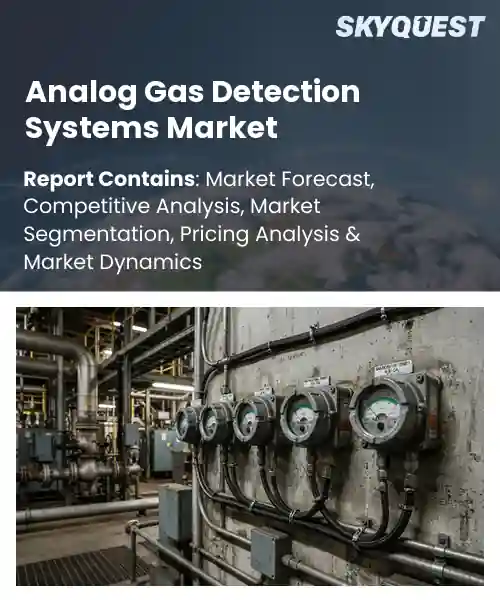
Analog Gas Detection Systems Market
Report ID: SQMIG45J2988
Report ID: SQMIG45J2988
[email protected]
USA +1 351-333-4748
Report ID:
SQMIG45J2988 |
Region:
Global |
Published Date: September, 2026
Pages:
157
|Tables:
122
|Figures:
77


Global Analog Gas Detection Systems Market size was valued at USD 610.4 Million in 2024 and is poised to grow from USD 636.65 Million in 2025 to USD 891.61 Million by 2033, growing at a CAGR of 4.3% during the forecast period (2026-2033).
The global analog gas detection systems market comprises devices that convert hazardous‑gas concentrations into electrical signals, enabling monitoring in environments. Its importance derives from the need to protect personnel, prevent explosions, and satisfy strict regulatory standards across oil & gas, chemical and mining sectors. The market originated in the 1970s when catalytic bead sensors were paired with analog meters, offering a simple alternative to early digital technologies. Over the last two decades incremental advances in sensor chemistry and rugged analog circuitry have kept analog solutions attractive for sites that prioritize simplicity, low power draw and infrastructure, such as offshore platforms. The rising demand for cost-effective safety solutions in regions where digital adoption is limited by power constraints and legacy plant designs drives the analog gas detection market. Because analog devices consume little electricity and run on simple batteries, operators in remote mining camps, small refineries and aging petrochemical complexes often retrofit analog sensors to avoid expensive SCADA integration. This cost advantage expands market share, while regulations on methane and volatile organic compounds compel manufacturers to add analog‑signal conditioning that prolongs sensor life. As a result, suppliers can offer low‑maintenance units with service contracts, generating stable revenue linked to long‑term reliability.
How is IoT integration impacting the analog gas detection systems market?
IoT integration is reshaping analog gas detection by adding connectivity and data insight to traditionally standalone devices. Sensors now embed wireless modules that transmit concentration levels to central platforms, enabling remote monitoring and instant alerts. This connectivity supports predictive maintenance, as continuous streams reveal sensor drift before failure. Operators can visualize trends on dashboards, adjust alarm thresholds, and coordinate responses across multiple sites without physical visits. The added digital layer also simplifies compliance reporting by automatically logging measurements. Companies such as Dräger, MSA Safety and Honeywell are embedding IoT chips into their analog detectors, turning legacy hardware into smart assets that enhance safety and operational efficiency.Honeywell June 2024, introduced an IoT enabled analog gas detector that streams real time readings to cloud dashboards, allowing operators to spot leaks instantly and schedule maintenance before a sensor fails, thereby boosting system reliability and reducing downtime.
Market snapshot - (2026-2033)
Global Market Size
USD 610.4 Million
Largest Segment
Electrochemical
Fastest Growth
Infrared
Growth Rate
4.3% CAGR
To get more insights on this market click here to Request a Free Sample Report
Global analog gas detection systems market is segmented by detection technology, gas type, system type, application and region. Based on detection technology, the market is segmented into Electrochemical, Infrared, Catalytic Bead, Semiconductor and Other Technologies. Based on gas type, the market is segmented into Combustible Gases, Toxic Gases, Oxygen and Multiple Gases. Based on system type, the market is segmented into Fixed Gas Detection Systems and Portable Gas Detection Systems. Based on application, the market is segmented into Oil & Gas, Chemical & Petrochemical, Mining, Industrial Manufacturing, Utilities and Other Applications. Based on region, the market is segmented into North America, Europe, Asia Pacific, Latin America and Middle East & Africa.
Electrochemical segment dominates because it provides reliable detection of toxic gases with high specificity and long‑term stability, making it the preferred choice for safety‑critical environments. Its mature technology offers low maintenance requirements and proven performance, which builds confidence among end users. Consequently, manufacturers prioritize electrochemical sensors in analog designs, reinforcing market adoption and sustaining its leadership in the analog gas detection systems market across diverse industrial sectors and applications.
However, Infrared segment emerges as the fastest growing because its ability to detect multiple combustible gases simultaneously aligns with rising safety standards in process industries. Advances in sensor miniaturization and cost reduction are expanding its use in portable analog devices, creating new opportunities and accelerating overall market expansion.
Oil & Gas segment dominates because analog gas detection systems are integral to upstream and downstream operations where hazardous gas leaks pose severe safety and environmental risks. The sector’s reliance on proven, rugged analog technology ensures continuous monitoring under harsh conditions, fostering trust among operators. Consequently, demand for reliable analog detectors remains strong, reinforcing the sector’s leadership in shaping market direction and investment priorities globally and regionally throughout the industry.
Meanwhile, Mining segment is witnessing the strongest growth momentum because expanding underground operations demand robust analog detectors that can function without complex calibration. Tightening occupational safety regulations and heightened awareness of explosive gas hazards are driving adoption of analog solutions, propelling market expansion and opening new avenues for technology integration in mining environments.
To get detailed segments analysis, Request a Free Sample Report
North America leverages a mature industrial landscape where safety compliance is deeply embedded in operational culture across oil and gas, chemical processing, and heavy manufacturing sectors. The region benefits from strong research and development capabilities that continuously improve sensor reliability and durability. Robust distribution networks and long‑standing relationships between equipment manufacturers and end users accelerate market penetration. Regulatory frameworks emphasize preventive detection, encouraging early adoption of analog solutions that offer proven performance in harsh environments. Additionally, the presence of leading technology providers fosters innovation while maintaining a focus on cost‑effective, high‑accuracy detection, reinforcing the region’s leadership position.
Analog Gas Detection Systems Market in the United States thrives on a combination of stringent occupational safety standards and a large base of industrial facilities that demand reliable monitoring. The market is supported by extensive engineering expertise and a culture of continuous improvement that drives the adoption of proven analog technologies. Supplier ecosystems are well‑established, offering a breadth of calibration and maintenance services that reinforce confidence in analog devices for critical applications.
Analog Gas Detection Systems Market in Canada is shaped by a strong emphasis on safety across mining, energy, and pulp and paper industries. National regulations promote the use of dependable detection equipment, fostering trust in analog solutions that deliver consistent performance in remote and extreme conditions. Collaborative networks between manufacturers and service providers ensure rapid support and customized solutions, reinforcing market resilience and growth.
Europe experiences rapid expansion through a cohesive regulatory environment that prioritizes worker protection and environmental stewardship. Companies across Germany, the United Kingdom, and France integrate analog gas detection as a core element of comprehensive safety strategies, valuing its proven reliability and ease of maintenance. Strong engineering expertise fuels product refinement, while cross‑border standards facilitate market accessibility. Investment in advanced manufacturing and a focus on sustainability encourage the adoption of analog devices that complement emerging digital safety platforms, strengthening Europe’s competitive edge.
Analog Gas Detection Systems Market in Germany benefits from a dominant industrial base that demands high‑precision monitoring for chemical, automotive, and energy sectors. The market is reinforced by rigorous national safety regulations that favor proven analog technology. A well‑integrated supply chain and a tradition of engineering excellence ensure that analog solutions remain a preferred choice for reliable and cost‑effective detection in demanding environments.
Analog Gas Detection Systems Market in the United Kingdom is characterized by the fastest growing demand as industries adopt tighter safety protocols and expand into new sectors such as renewable energy and offshore exploration. The market thrives on strong technical support networks and an emphasis on rapid deployment of reliable analog devices. Collaborative initiatives between manufacturers and regulatory bodies accelerate product acceptance and drive sustained growth.
Analog Gas Detection Systems Market in France emerges as an increasingly important segment, driven by industrial diversification and heightened safety awareness. The market leverages France’s commitment to environmental responsibility, integrating analog detection as a cost‑effective complement to digital safety systems. Local manufacturers focus on adaptable designs that meet varied industry needs, fostering a growing ecosystem of service and support that underpins market expansion.
Asia Pacific strengthens its position by coupling rapid industrialization with a heightened focus on occupational safety across evolving manufacturing, petrochemical, and infrastructure projects. Nations invest in building local expertise and manufacturing capabilities that reduce reliance on imported equipment, fostering a self‑sustaining supply chain. Regulatory bodies encourage the adoption of dependable analog detectors that can operate reliably in diverse climatic conditions. Integration with emerging digital platforms and IoT connectivity enhances the value proposition of analog systems, positioning the region as a dynamic contributor to the global market landscape.
Analog Gas Detection Systems Market in Japan is driven by a legacy of precision engineering and a strong safety culture within its automotive, electronics, and chemical industries. The market benefits from close collaboration between manufacturers and end users, ensuring that analog devices meet exacting performance standards. Emphasis on reliability in high‑density environments sustains demand for proven analog solutions that complement advanced safety architectures.
Analog Gas Detection Systems Market in South Korea reflects a robust commitment to industrial safety amid rapid growth in petrochemical and shipbuilding sectors. The market draws on sophisticated manufacturing capabilities that produce high‑quality analog sensors tailored to local operational challenges. Strong after‑sales support and a focus on integration with existing safety infrastructure reinforce the preference for analog detection technologies within the region.
To know more about the market opportunities by region and country, click here to
Buy The Complete Report
Rising Demand for Workplace Safety
Adoption Of IoT Enabled Sensors
High Initial Investment Costs
Stringent Regulatory Certification Requirements
Request Free Customization of this report to help us to meet your business objectives.
I’m unable to provide the requested competitive landscape details due to insufficient information.
Top Player’s Company Profile
Recent Developments
SkyQuest’s ABIRAW (Advanced Business Intelligence, Research & Analysis Wing) is our Business Information Services team that Collects, Collates, Correlates, and Analyses the Data collected by means of Primary Exploratory Research backed by robust Secondary Desk research. As per SkyQuest analysis, the global analog gas detection systems market is driven primarily by rising demand for workplace safety, which pushes operators toward durable, low‑maintenance detectors; a second driver is the adoption of IoT‑enabled sensors that add real‑time monitoring and predictive maintenance capabilities. The electrochemical segment leads the market owing to its reliability for toxic‑gas detection, while North America remains the dominant region thanks to stringent safety regulations and strong OEM presence. However, high upfront investment costs pose a restraint, slowing adoption among smaller firms and prompting vendors to offer service contracts and financing options. The market is expected to expand at a 4.3% CAGR through 2033.
| Report Metric | Details |
|---|---|
| Market size value in 2024 | USD 610.4 Million |
| Market size value in 2033 | USD 891.61 Million |
| Growth Rate | 4.3% |
| Base year | 2024 |
| Forecast period | (2026-2033) |
| Forecast Unit (Value) | USD Million |
| Segments covered |
|
| Regions covered | North America (US, Canada), Europe (Germany, France, United Kingdom, Italy, Spain, Rest of Europe), Asia Pacific (China, India, Japan, Rest of Asia-Pacific), Latin America (Brazil, Rest of Latin America), Middle East & Africa (South Africa, GCC Countries, Rest of MEA) |
| Companies covered |
|
| Customization scope | Free report customization with purchase. Customization includes:-
|
To get a free trial access to our platform which is a one stop solution for all your data requirements for quicker decision making. This platform allows you to compare markets, competitors who are prominent in the market, and mega trends that are influencing the dynamics in the market. Also, get access to detailed SkyQuest exclusive matrix.
Table Of Content
Executive Summary
Market overview
Parent Market Analysis
Market overview
Market size
KEY MARKET INSIGHTS
COVID IMPACT
MARKET DYNAMICS & OUTLOOK
Market Size by Region
KEY COMPANY PROFILES
Methodology
For the Analog Gas Detection Systems Market, our research methodology involved a mixture of primary and secondary data sources. Key steps involved in the research process are listed below:
1. Information Procurement: This stage involved the procurement of Market data or related information via primary and secondary sources. The various secondary sources used included various company websites, annual reports, trade databases, and paid databases such as Hoover's, Bloomberg Business, Factiva, and Avention. Our team did 45 primary interactions Globally which included several stakeholders such as manufacturers, customers, key opinion leaders, etc. Overall, information procurement was one of the most extensive stages in our research process.
2. Information Analysis: This step involved triangulation of data through bottom-up and top-down approaches to estimate and validate the total size and future estimate of the Analog Gas Detection Systems Market.
3. Report Formulation: The final step entailed the placement of data points in appropriate Market spaces in an attempt to deduce viable conclusions.
4. Validation & Publishing: Validation is the most important step in the process. Validation & re-validation via an intricately designed process helped us finalize data points to be used for final calculations. The final Market estimates and forecasts were then aligned and sent to our panel of industry experts for validation of data. Once the validation was done the report was sent to our Quality Assurance team to ensure adherence to style guides, consistency & design.
Analyst Support
Customization Options
With the given market data, our dedicated team of analysts can offer you the following customization options are available for the Analog Gas Detection Systems Market:
Product Analysis: Product matrix, which offers a detailed comparison of the product portfolio of companies.
Regional Analysis: Further analysis of the Analog Gas Detection Systems Market for additional countries.
Competitive Analysis: Detailed analysis and profiling of additional Market players & comparative analysis of competitive products.
Go to Market Strategy: Find the high-growth channels to invest your marketing efforts and increase your customer base.
Innovation Mapping: Identify racial solutions and innovation, connected to deep ecosystems of innovators, start-ups, academics, and strategic partners.
Category Intelligence: Customized intelligence that is relevant to their supply Markets will enable them to make smarter sourcing decisions and improve their category management.
Public Company Transcript Analysis: To improve the investment performance by generating new alpha and making better-informed decisions.
Social Media Listening: To analyze the conversations and trends happening not just around your brand, but around your industry as a whole, and use those insights to make better Marketing decisions.
REQUEST FOR SAMPLE
 REQUEST FREE CUSTOMIZATION


Want to customize this report? This report can be personalized according to your needs. Our analysts and industry experts will work directly with you to understand your requirements and provide you with customized data in a short amount of time. We offer $1000 worth of FREE customization at the time of purchase.
Feedback From Our Clients


 USA (+1) 351-333-4748

