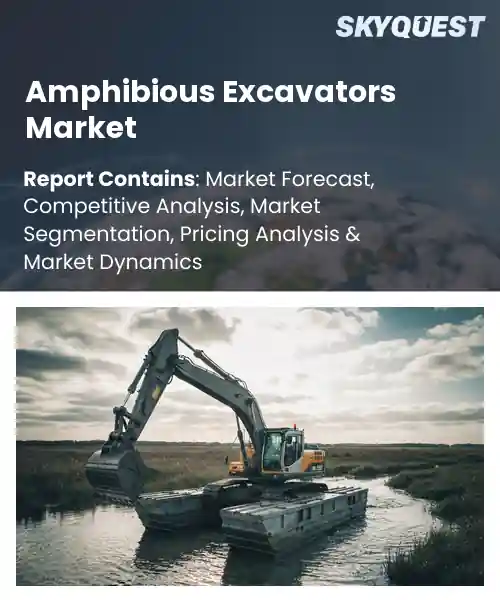
Amphibious Excavators Market
Report ID: SQMIG20C2239
Report ID: SQMIG20C2239
[email protected]
USA +1 351-333-4748
Report ID:
SQMIG20C2239 |
Region:
Global |
Published Date: June, 2026
Pages:
157
|Tables:
148
|Figures:
78


Global Amphibious Excavators Market size was valued at USD 7.7 Billion in 2024 and is poised to grow from USD 8.51 Billion in 2025 to USD 18.91 Billion by 2033, growing at a CAGR of 10.5% during the forecast period (2026-2033).
The primary driver of the amphibious excavators market is the escalating demand for effective aquatic earthmoving solutions to manage wetlands, shorelines, and flood-prone infrastructure. Amphibious excavators are tracked, swamp-capable machines that operate on soft terrain and shallow water, enabling dredging, canal maintenance, and ecological restoration where conventional excavators cannot reach. This market matters because rising urbanization, climate change-induced flooding, and stricter environmental regulations create persistent needs for specialized equipment to protect communities and natural habitats. Over past decade manufacturers improved flotation technology, modular attachments, and remote-control systems, exemplified by projects restoring marshland in the Mississippi Delta and Indonesian mangrove rehabilitation.Building on technological advancements and rising demand, a key factor propelling global amphibious excavator growth is enhanced customization for diverse aquatic environments, which improves operational efficiency and opens new market opportunities. Manufacturers offering interchangeable pontoons, longer-reach booms, and low-ground-pressure tracks enable contractors to perform river dredging, peatland restoration, and coastal defense construction faster and with lower environmental impact, thereby attracting infrastructure and environmental remediation budgets. As governments fund climate resilience and private developers require reliable waterfront access, sales accelerate and aftermarket services expand, creating secondary revenue streams such as training, spare-part supply, and digital monitoring that further reinforce market expansion.
How is automation improving productivity in the amphibious excavators market?
Automation is improving productivity in the amphibious excavators market by bringing together machine guidance, remote operation, autonomous repetition of routine tasks and fleet telematics. Key aspects include sensor guided digging, remote operator stations and retrofit autonomy kits that allow machines to follow planned excavation paths with less continuous human input. The current state shows OEMs and integrators embedding software and sensors to cope with soft ground and shifting waterlines while boosting safety and uptime. This shift matters because marshland restoration and dredging require consistent, low impact work and automation helps deliver repeatable, reliable results supported by recent industry demonstrations.HD Hyundai April 2026, deployed an unmanned autonomous excavator at a real job site, demonstrating how autonomy extends operating windows in hazardous wetlands, reduces operator exposure and enables more predictable dredging cycles. That kind of automation accelerates adoption in the amphibious excavator market by improving efficiency and making remote sensitive site work more practical.
Market snapshot - (2026-2033)
Global Market Size
USD 7.7 Billion
Largest Segment
Medium Excavators
Fastest Growth
Small Excavators
Growth Rate
10.5% CAGR
To get more insights on this market click here to Request a Free Sample Report
Global amphibious excavators market is segmented by type, machine type, propulsion system, application, end user and region. Based on type, the market is segmented into Small Excavators, Medium Excavators and Large Excavators. Based on machine type, the market is segmented into Tracked Amphibious Excavators, Wheeled Amphibious Excavators and Pontoon-Based Excavators. Based on propulsion system, the market is segmented into Hydraulic, Electric and Diesel / Hybrid. Based on application, the market is segmented into Dredging, Construction, Flood Control, Environmental Remediation and Mining. Based on end user, the market is segmented into Government Agencies, Construction Companies, Mining Companies, Oil & Gas Industry and Environmental Agencies. Based on region, the market is segmented into North America, Europe, Asia Pacific, Latin America and Middle East & Africa.
Tracked Amphibious Excavators segment dominates because their wide undercarriage and continuous track provide superior stability and flotation on soft soils and wetlands, enabling reliable positioning for dredging and flood control operations. Their adaptability to heavy attachments and deep reach configurations reduces cycle times and improves task versatility, driving preference among construction and government operators. Proven service networks and established OEM offerings further lower operational risk, reinforcing procurement decisions toward tracked platforms.
However, Pontoon-Based Excavators are emerging as the fastest growing area due to modular buoyant hulls that support larger payloads and heavier cutter heads, unlocking heavy dredging and restoration projects. Innovations in pontoon materials and rapid mobilization designs expand applications, attracting operators seeking scalable capacity and creating new opportunity streams in waterway and remediation work.
Diesel / Hybrid segment leads because established diesel powerplants deliver consistent high torque and endurance for prolonged dredging and heavy lift tasks while hybrid integration improves fuel efficiency and operational flexibility. Familiar service infrastructure and existing refueling supply chains reduce downtime and support intensive fleet cycles, encouraging adoption by construction, mining and government operators. Combined reliability and retrofitability into existing platforms drive procurement toward diesel hybrid designs in demanding amphibious applications.
However, Electric propulsion is emerging as the most rapidly expanding area as battery and motor advances enable quiet zero emissions operation suited to sensitive dredging and remediation work. Regulatory and customer pressure for cleaner sites and lower operating costs is driving pilots, fleet electrification and OEM focus, creating new procurement pathways and commercial opportunities.
To get detailed segments analysis, Request a Free Sample Report
Asia Pacific dominates due to a combination of concentrated manufacturing expertise, extensive coastal infrastructure needs, and mature equipment manufacturing ecosystems that accelerate product development and localization. Strong integration between equipment makers, specialized component suppliers, and contractors enables rapid adaptation of amphibious platforms to diverse wetland and estuarine conditions. Public sector emphasis on coastal protection and environmental remediation sustains steady demand, while well developed rental and aftersales networks lower adoption barriers. Regional research institutes and partnerships with international suppliers promote continuous innovation in corrosion protection, propulsion systems, and compact designs suited to constrained sites, reinforcing leadership in both high end and cost sensitive segments. Investment by local tiered suppliers in manufacturing scale and targeted service hubs enhances aftermarket responsiveness, while clustering of expertise in certain countries fosters export orientation and competitive pricing that attracts diverse operators across public and private sectors.
Amphibious Excavators Market in Japan benefits from a concentrated engineering ecosystem, close ties between manufacturers and infrastructure projects, and a strong culture of precision manufacturing. Demand is driven by coastal maintenance, river dredging initiatives, and environmental remediation programs. Local service networks and specialized rental providers support adoption, while emphasis on compact, high‑reliability platforms aligns with urban and constrained site requirements, sustaining steady procurement from public and private operators across sectors.
Amphibious Excavators Market in South Korea is supported by advanced shipbuilding and heavy equipment clusters that enable localized production. Focus on coastal resilience, port works, and reclamation encourages use of versatile floating machines. Cooperation between suppliers, contractors, and research institutions drives innovation in amphibious drivetrains and corrosion protection. Aftermarket service networks and operator training facilitate integration of complex equipment into municipal and industrial maintenance fleets across wetland and estuarine environments.
Rapid expansion in Europe is driven by heightened emphasis on environmental protection, flood resilience, and restoration of inland and coastal ecosystems, prompting renewed procurement activity among municipalities and contractors. Stringent regulatory frameworks encourage adoption of low impact equipment, while public investment priorities channel work toward dredging, habitat rehabilitation, and waterfront renewal. Market momentum is amplified by cross border contracting practices and a growing rental economy that reduces up front capital requirements. Collaboration between established engineering firms and innovative equipment suppliers accelerates adaptation of platforms to temperate and tidal environments. Consolidation in supply chains and expansion of service networks improve accessibility, enabling diverse end users to integrate amphibious platforms into routine maintenance and specialized remediation projects. Regional centers of engineering excellence and tailored financing solutions are helping smaller contractors trial amphibious solutions without large capital commitments, further broadening the user base.
Amphibious Excavators Market in Germany reflects a concentration of engineering expertise, a mature supply chain, and emphasis on heavy civil maintenance of rivers and inland waterways. Demand is underpinned by strong collaboration between equipment manufacturers, municipal authorities, and specialized contractors focused on flood risk reduction and habitat restoration. High expectations for durability and serviceability drive procurement of premium platforms. Established rental and aftermarket channels support lifecycle management and operator training.
Amphibious Excavators Market in United Kingdom is experiencing adoption driven by focus on coastal protection, estuarine restoration, and intertidal construction. Contractors favor adaptable platforms that reduce mobilization complexity for projects in tidal zones. Rental markets and specialist service providers enable deployment for varied contracts. Innovation partnerships between equipment makers and end users emphasize modularity, low ground pressure tracks, and emission controls to meet demanding site access and environmental sensitivity requirements.
Amphibious Excavators Market in France is emerging as authorities and contractors prioritize coastal defense, marsh rehabilitation, and navigable waterway upkeep. Growing interest in low environmental impact methods supports procurement of amphibious platforms for sensitive habitat work. Local service providers and engineering consultancies are adapting standard platforms to regional needs, emphasizing corrosion resistance and maneuverability. Collaboration with research centers fosters tailored solutions that address estuarine sediment management and coastal infrastructure projects.
North America is strengthening its position through a combination of localized manufacturing, adaptation to diverse climatic and site conditions, and expanding support infrastructure that makes amphibious platforms more accessible to public and private operators. Increasing emphasis on wetland restoration, shoreline stabilization, and resilient infrastructure is creating steady demand among federal, state, and municipal agencies as well as environmental contractors. The rental sector and service networks are expanding to lower barriers to trial and adoption. Close collaboration between equipment builders, aftermarket specialists, and academic research groups promotes adaptation for cold climates, emission standards, and operator ergonomics. Growing customization capability and a focus on total cost of ownership considerations are making amphibious solutions viable across a broader range of North American projects.
Amphibious Excavators Market in United States is supported by a mature rental network, contractor base, and significant activity in coastal resilience and inland waterway maintenance. Demand arises from municipal programs, environmental remediation projects, and large infrastructure contractors seeking versatile access solutions. Emphasis on compliance with emission and safety standards drives demand for modernized platforms. Strong aftermarket services and customization shops enable adaptation of machines to regional climatic and operational requirements.
Amphibious Excavators Market in Canada reflects demand from shoreline protection and wetland conservation projects that require robust cold weather performance. Operators seek platforms modified for low temperatures, enhanced corrosion protection, and transport across challenging terrain. Indigenous and municipal stakeholders engage contractors to address erosion and habitat restoration needs. Emphasis on lifecycle support has encouraged growth of regional service hubs and rental options that enable efficient use of specialized amphibious equipment.
To know more about the market opportunities by region and country, click here to
Buy The Complete Report
Increasing Inland Wetland Development
Technological Enhancements In Machines
High Initial Acquisition Costs
After Sales Support and Logistics
Request Free Customization of this report to help us to meet your business objectives.
Competitive landscape is intensifying as OEMs pursue product and technology differentiation, pushing amphibious specialists to match electrification, autonomy, and modular pontoon solutions. XCMG’s recent electric excavator deliveries and SANY’s intelligent excavator rollouts illustrate tech-driven rivalry. Regional amphibious manufacturers and service providers are leveraging targeted partnerships and project wins to defend niche wetland and coastal infrastructure contracts.
Top Player’s Company Profile
Recent Developments
SkyQuest’s ABIRAW (Advanced Business Intelligence, Research & Analysis Wing) is our Business Information Services team that Collects, Collates, Correlates, and Analyses the Data collected by means of Primary Exploratory Research backed by robust Secondary Desk research. As per SkyQuest analysis, the global amphibious excavators market is driven primarily by rising demand for aquatic earthmoving solutions to protect wetlands, shorelines and flood-prone infrastructure, while high upfront acquisition costs remain a key restraint. Asia Pacific leads the market, supported by concentrated manufacturing and coastal infrastructure programs, and tracked amphibious excavators dominate due to superior flotation and stability on soft soils. Further growth is propelled by technological enhancements and customization including modular pontoons, automation and hybrid propulsion that improve efficiency and reduce environmental impact, encouraging adoption despite capital constraints. Expanding aftermarket services such as training, spare-parts supply and digital monitoring create secondary revenue streams and help mitigate ownership costs for operators, reinforcing procurement from governments, construction and environmental agencies.
| Report Metric | Details |
|---|---|
| Market size value in 2024 | USD 7.7 Billion |
| Market size value in 2033 | USD 18.91 Billion |
| Growth Rate | 10.5% |
| Base year | 2024 |
| Forecast period | (2026-2033) |
| Forecast Unit (Value) | USD Billion |
| Segments covered |
|
| Regions covered | North America (US, Canada), Europe (Germany, France, United Kingdom, Italy, Spain, Rest of Europe), Asia Pacific (China, India, Japan, Rest of Asia-Pacific), Latin America (Brazil, Rest of Latin America), Middle East & Africa (South Africa, GCC Countries, Rest of MEA) |
| Companies covered |
|
| Customization scope | Free report customization with purchase. Customization includes:-
|
To get a free trial access to our platform which is a one stop solution for all your data requirements for quicker decision making. This platform allows you to compare markets, competitors who are prominent in the market, and mega trends that are influencing the dynamics in the market. Also, get access to detailed SkyQuest exclusive matrix.
Table Of Content
Executive Summary
Market overview
Parent Market Analysis
Market overview
Market size
KEY MARKET INSIGHTS
COVID IMPACT
MARKET DYNAMICS & OUTLOOK
Market Size by Region
KEY COMPANY PROFILES
Methodology
For the Amphibious Excavators Market, our research methodology involved a mixture of primary and secondary data sources. Key steps involved in the research process are listed below:
1. Information Procurement: This stage involved the procurement of Market data or related information via primary and secondary sources. The various secondary sources used included various company websites, annual reports, trade databases, and paid databases such as Hoover's, Bloomberg Business, Factiva, and Avention. Our team did 45 primary interactions Globally which included several stakeholders such as manufacturers, customers, key opinion leaders, etc. Overall, information procurement was one of the most extensive stages in our research process.
2. Information Analysis: This step involved triangulation of data through bottom-up and top-down approaches to estimate and validate the total size and future estimate of the Amphibious Excavators Market.
3. Report Formulation: The final step entailed the placement of data points in appropriate Market spaces in an attempt to deduce viable conclusions.
4. Validation & Publishing: Validation is the most important step in the process. Validation & re-validation via an intricately designed process helped us finalize data points to be used for final calculations. The final Market estimates and forecasts were then aligned and sent to our panel of industry experts for validation of data. Once the validation was done the report was sent to our Quality Assurance team to ensure adherence to style guides, consistency & design.
Analyst Support
Customization Options
With the given market data, our dedicated team of analysts can offer you the following customization options are available for the Amphibious Excavators Market:
Product Analysis: Product matrix, which offers a detailed comparison of the product portfolio of companies.
Regional Analysis: Further analysis of the Amphibious Excavators Market for additional countries.
Competitive Analysis: Detailed analysis and profiling of additional Market players & comparative analysis of competitive products.
Go to Market Strategy: Find the high-growth channels to invest your marketing efforts and increase your customer base.
Innovation Mapping: Identify racial solutions and innovation, connected to deep ecosystems of innovators, start-ups, academics, and strategic partners.
Category Intelligence: Customized intelligence that is relevant to their supply Markets will enable them to make smarter sourcing decisions and improve their category management.
Public Company Transcript Analysis: To improve the investment performance by generating new alpha and making better-informed decisions.
Social Media Listening: To analyze the conversations and trends happening not just around your brand, but around your industry as a whole, and use those insights to make better Marketing decisions.
REQUEST FOR SAMPLE
 REQUEST FREE CUSTOMIZATION


Want to customize this report? This report can be personalized according to your needs. Our analysts and industry experts will work directly with you to understand your requirements and provide you with customized data in a short amount of time. We offer $1000 worth of FREE customization at the time of purchase.
Feedback From Our Clients


 USA (+1) 351-333-4748

