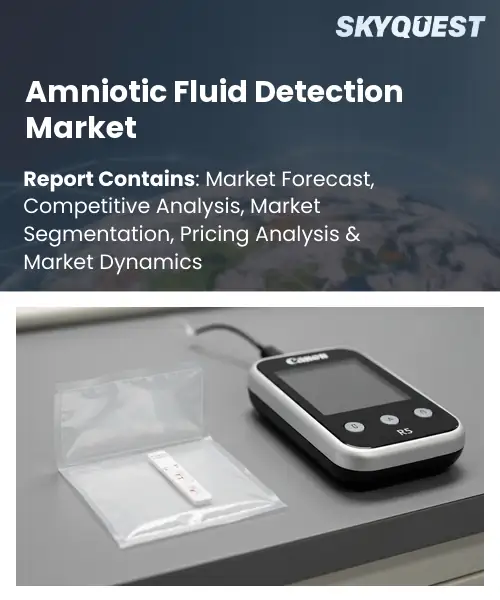
Amniotic Fluid Detection Market
Report ID: SQMIG35B2455
Report ID: SQMIG35B2455
[email protected]
USA +1 351-333-4748
Report ID:
SQMIG35B2455 |
Region:
Global |
Published Date: August, 2026
Pages:
157
|Tables:
116
|Figures:
77


Global Amniotic Fluid Detection Market size was valued at USD 214.8 Million in 2024 and is poised to grow from USD 230.27 Million in 2025 to USD 401.59 Million by 2033, growing at a CAGR of 7.2% during the forecast period (2026-2033).
The global amniotic fluid detection industry encompasses technologies that quantify or image fetal fluid volume to assess pregnancy health. Its importance stems from the direct link between abnormal fluid levels and complications such as pre‑eclampsia, oligohydramnios, and pulmonary hypoplasia, which drive clinical demand. Historically, detection relied on qualitative ultrasound grading, but advancements in three‑dimensional imaging, bio‑impedance sensors, and AI‑enhanced sonography have transformed the field into a data‑rich diagnostic arena.
A second key factor propelling market expansion is the escalating prevalence of high‑risk pregnancies in emerging economies, which fuels the need for precise monitoring solutions. As birth rates stabilize in developed nations, healthcare systems redirect resources toward maternal‑fetal safety, prompting reimbursement policies that endorse quantitative fluid assessments. Consequently, manufacturers such as GE Healthcare and Samsung Medison have accelerated R&D pipelines, integrating machine‑learning algorithms that predict adverse outcomes from subtle fluid‑volume trends. Deployments illustrate the chain: a Brazil pilot used an AI‑enhanced Doppler probe to spot oligohydramnios 48 hours earlier, cutting neonatal ICU admissions by 12 percent and confirming cost‑effectiveness for public hospitals.
How is AI improving accuracy in the amniotic fluid detection market?
AI enhances amniotic fluid detection by integrating deep‑learning algorithms with ultrasound imaging, allowing systems to differentiate fluid pockets from surrounding tissues more reliably. These models are trained on large, annotated datasets, improving pattern recognition and reducing operator dependence. Real‑time analysis highlights subtle acoustic signatures that traditional methods may miss, leading to earlier identification of oligohydramnios or polyhydramnios. Clinicians benefit from clearer visual overlays and confidence scores, which streamline decision‑making and support consistent monitoring across diverse patient populations. As hospitals adopt smarter imaging platforms, the overall diagnostic workflow becomes faster, less invasive, and more reproducible, fostering greater trust in prenatal care.
A recent development in the field was announced by a leading medical‑technology firm in March 2024, demonstrating how AI‑driven image analysis can pinpoint amniotic fluid volume with heightened precision, reinforcing market momentum and clinical confidence.
Market snapshot - (2026-2033)
Global Market Size
USD 214.8 Million
Largest Segment
Rapid Test Kits
Fastest Growth
Rapid Test Kits
Growth Rate
7.2% CAGR
To get more insights on this market click here to Request a Free Sample Report
Global amniotic fluid detection market is segmented by product type, technology, application, end user and region. Based on product type, the market is segmented into Rapid Test Kits, Diagnostic Swabs and Laboratory Reagents. Based on technology, the market is segmented into Immunoassay, pH-Based Detection and Protein Biomarker Detection. Based on application, the market is segmented into Premature Rupture of Membranes and Obstetric Diagnosis. Based on end user, the market is segmented into Hospitals, Maternity Clinics and Diagnostic Laboratories. Based on region, the market is segmented into North America, Europe, Asia Pacific, Latin America and Middle East & Africa.
Rapid test kits segment dominates with large amniotic fluid detection market share because they provide clinicians with immediate visual results, eliminating the need for complex laboratory infrastructure. Their ease of use at point‑of‑care aligns with the urgent diagnostic timelines inherent to obstetric emergencies, fostering widespread adoption across delivery settings. By combining simple sampling with built‑in detection chemistry, these kits streamline workflow, reduce turnaround time, and enhance decision‑making confidence for practitioners managing potential membrane rupture in routine clinical practice.
As per amniotic fluid detection market outlook, diagnostic swabs segment emerges as the most rapidly expanding area because manufacturers are integrating multiplexed detection formats that capture multiple biomarkers simultaneously. This innovation meets rising clinician demand for comprehensive assessments, fuels adoption in varied care settings, and creates new opportunities for product diversification, propelling overall market growth.
As per amniotic fluid detection market forecast, immunoassay segment dominates because it delivers highly specific antigen‑antibody interactions that translate minute concentrations of fetal proteins into readable signals. This scientific robustness aligns with clinicians’ need for reliable confirmation of membrane status, especially in ambiguous cases. The established assay formats support standardized protocols, reduce false‑negative risk, and integrate smoothly with existing laboratory workflows, reinforcing its preferential selection across diagnostic pathways throughout the clinical decision‑making process and improves patient outcomes.
As per amniotic fluid detection market analysis, protein biomarker detection segment is witnessing the strongest growth momentum because advances in proteomics reveal novel fetal markers that improve early rupture identification. This breakthrough attracts research investment, expands test menus, and encourages clinicians to adopt more diagnostics, accelerating market expansion and creating revenue streams.
To get detailed segments analysis, Request a Free Sample Report
North America commands market leadership through an ecosystem that blends cutting‑edge clinical research with a highly integrated healthcare delivery network. The region benefits from mature diagnostic laboratories that prioritize rapid adoption of innovative testing protocols, while leading medical device firms accelerate product pipelines tailored to prenatal care. Robust reimbursement frameworks and proactive regulatory pathways facilitate swift market entry, encouraging clinicians to incorporate advanced fluid analysis into routine obstetric practice. Collaborative partnerships between academic institutions and industry further reinforce the pipeline of novel biomarkers, ensuring that North America remains at the forefront of clinical adoption and technological refinement.
As per amniotic fluid detection market regional outlook, United States thrives on a culture of rapid innovation and strong payer support, enabling widespread clinical integration of sophisticated fluid analysis techniques. Leading research hospitals generate extensive clinical evidence that drives guideline endorsement, while a broad network of specialized laboratories ensures consistent access across diverse care settings. Collaborative initiatives between technology developers and obstetric practitioners expedite the translation of emerging biomarkers into practical diagnostic tools, reinforcing the United States position as a benchmark for clinical excellence.
As per amniotic fluid detection market regional forecast, Canada is shaped by a publicly funded health system that emphasizes evidence‑based adoption of new diagnostic methods, fostering uniform access to advanced testing across provinces. Strong ties between university research centers and commercial innovators nurture a pipeline of clinically relevant technologies, while coordinated health authority reviews streamline incorporation into standard prenatal protocols. This supportive environment encourages healthcare providers to leverage fluid analysis for early risk identification, reinforcing Canada’s reputation for high‑quality maternal care.
Europe’s expansion is propelled by a cohesive blend of rigorous clinical research, harmonized regulatory standards, and healthcare systems that prioritize preventive obstetric care. Strong academic clusters, particularly in Germany and the United Kingdom, generate robust clinical data that underpins guideline updates, while collaborative funding mechanisms accelerate technology translation. Reimbursement policies across member states increasingly accommodate novel diagnostic assays, encouraging hospitals to integrate fluid analysis into routine screenings. Additionally, cross‑border cooperation among research institutes and industry partners facilitates shared expertise, creating a fertile landscape for sustained market growth throughout the continent.
Germany benefits from world‑renowned clinical research institutions that continuously refine fluid‑based biomarkers for obstetric use. A well‑established network of specialized diagnostics labs ensures high‑quality testing availability, while strong insurance coverage supports broad clinical uptake. Partnerships between biotech firms and university hospitals expedite the development of next‑generation assays, reinforcing Germany’s leadership in delivering precise prenatal diagnostics to practitioners.
United Kingdom is accelerated by a proactive health policy environment that encourages early detection of pregnancy complications. National health services provide structured pathways for incorporating fluid analysis into prenatal visits, while leading research universities generate innovative diagnostic approaches. Collaborative ventures between public health entities and technology innovators foster rapid dissemination of emerging tests, positioning the United Kingdom as a dynamic hub for market expansion.
France is emerging through focused investment in maternal health initiatives and a growing emphasis on personalized prenatal care. Academic laboratories contribute pioneering research on fluid biomarkers, and regional health agencies are increasingly receptive to integrating advanced testing into standard obstetric protocols. This supportive framework nurtures early adoption among clinicians, laying a solid foundation for market development within the French healthcare landscape.
Asia Pacific is solidifying its role by aligning rapid advancements in prenatal technology with expanding healthcare infrastructure across the region. Governments are prioritizing maternal health within broader public health agendas, fostering incentives that spur local innovation and adoption of fluid‑based diagnostics. Emerging biotech clusters in Japan and South Korea are generating novel assay platforms, while increasing clinician awareness drives integration of these tools into routine obstetric practice. Collaborative networks linking research institutions, hospitals, and industry accelerates knowledge transfer, ensuring that the region moves swiftly from proof‑of‑concept to widespread clinical implementation.
Japan leverages a strong tradition of precision medicine and a well‑organized network of obstetric care centers that embrace advanced diagnostic technologies. Leading research universities collaborate closely with medical device manufacturers to refine fluid analysis methods, while national health guidelines increasingly endorse their use for early risk assessment. This synergy promotes consistent clinical adoption and reinforces Japan’s reputation for high‑quality prenatal diagnostics.
South Korea is driven by a vibrant biotech ecosystem that emphasizes rapid development of cutting‑edge diagnostic tools. Government health initiatives prioritize maternal outcomes, encouraging hospitals to integrate fluid‑based testing into standard prenatal protocols. Strong partnerships between academic research labs and technology firms facilitate swift translation of innovative biomarkers into practical clinical solutions, enhancing South Korea’s emerging leadership in the field.
To know more about the market opportunities by region and country, click here to
Buy The Complete Report
Growing Demand For Early Diagnosis
Adoption Of Non‑Invasive Techniques
Limited Reimbursement Policies
High Cost of Equipment
Request Free Customization of this report to help us to meet your business objectives.
The global amniotic fluid detection industry is moderately competitive, with key players focusing on diagnostic accuracy, rapid testing technologies, and expansion of maternal healthcare solutions. Companies are investing in advanced detection methods such as immunoassay-based tests, biomarker identification technologies, and point-of-care diagnostic platforms to improve the early detection of premature rupture of membranes (PROM).
SkyQuest’s ABIRAW (Advanced Business Intelligence, Research & Analysis Wing) is our Business Information Services team that Collects, Collates, Correlates, and Analyses the Data collected by means of Primary Exploratory Research backed by robust Secondary Desk research.
As per SkyQuest analysis the global amniotic fluid detection market growth is being propelled primarily by a growing demand for early diagnosis, which pushes hospitals and prenatal centers to seek rapid, reliable testing. A second important driver is the expanding adoption of non‑invasive techniques that lower patient risk and fit smoothly into routine screening workflows. The market, however, faces a restraint in limited reimbursement policies that curb budget‑constrained facilities from investing in advanced equipment. North America remains the dominant region, benefitting from strong research, integrated healthcare networks and supportive payer frameworks. Within the segment hierarchy rapid test kits lead the market by offering point‑of‑care results that accelerate clinical decision‑making. The global amniotic fluid detection market trend is witnessing steady growth due to increasing awareness of prenatal care, rising maternal health concerns, and the growing importance of early diagnosis of pregnancy-related complications.
| Report Metric | Details |
|---|---|
| Market size value in 2024 | USD 214.8 Million |
| Market size value in 2033 | USD 401.59 Million |
| Growth Rate | 7.2% |
| Base year | 2024 |
| Forecast period | (2026-2033) |
| Forecast Unit (Value) | USD Million |
| Segments covered |
|
| Regions covered | North America (US, Canada), Europe (Germany, France, United Kingdom, Italy, Spain, Rest of Europe), Asia Pacific (China, India, Japan, Rest of Asia-Pacific), Latin America (Brazil, Rest of Latin America), Middle East & Africa (South Africa, GCC Countries, Rest of MEA) |
| Companies covered |
|
| Customization scope | Free report customization with purchase. Customization includes:-
|
To get a free trial access to our platform which is a one stop solution for all your data requirements for quicker decision making. This platform allows you to compare markets, competitors who are prominent in the market, and mega trends that are influencing the dynamics in the market. Also, get access to detailed SkyQuest exclusive matrix.
Table Of Content
Executive Summary
Market overview
Parent Market Analysis
Market overview
Market size
KEY MARKET INSIGHTS
COVID IMPACT
MARKET DYNAMICS & OUTLOOK
Market Size by Region
KEY COMPANY PROFILES
Methodology
For the Amniotic Fluid Detection Market, our research methodology involved a mixture of primary and secondary data sources. Key steps involved in the research process are listed below:
1. Information Procurement: This stage involved the procurement of Market data or related information via primary and secondary sources. The various secondary sources used included various company websites, annual reports, trade databases, and paid databases such as Hoover's, Bloomberg Business, Factiva, and Avention. Our team did 45 primary interactions Globally which included several stakeholders such as manufacturers, customers, key opinion leaders, etc. Overall, information procurement was one of the most extensive stages in our research process.
2. Information Analysis: This step involved triangulation of data through bottom-up and top-down approaches to estimate and validate the total size and future estimate of the Amniotic Fluid Detection Market.
3. Report Formulation: The final step entailed the placement of data points in appropriate Market spaces in an attempt to deduce viable conclusions.
4. Validation & Publishing: Validation is the most important step in the process. Validation & re-validation via an intricately designed process helped us finalize data points to be used for final calculations. The final Market estimates and forecasts were then aligned and sent to our panel of industry experts for validation of data. Once the validation was done the report was sent to our Quality Assurance team to ensure adherence to style guides, consistency & design.
Analyst Support
Customization Options
With the given market data, our dedicated team of analysts can offer you the following customization options are available for the Amniotic Fluid Detection Market:
Product Analysis: Product matrix, which offers a detailed comparison of the product portfolio of companies.
Regional Analysis: Further analysis of the Amniotic Fluid Detection Market for additional countries.
Competitive Analysis: Detailed analysis and profiling of additional Market players & comparative analysis of competitive products.
Go to Market Strategy: Find the high-growth channels to invest your marketing efforts and increase your customer base.
Innovation Mapping: Identify racial solutions and innovation, connected to deep ecosystems of innovators, start-ups, academics, and strategic partners.
Category Intelligence: Customized intelligence that is relevant to their supply Markets will enable them to make smarter sourcing decisions and improve their category management.
Public Company Transcript Analysis: To improve the investment performance by generating new alpha and making better-informed decisions.
Social Media Listening: To analyze the conversations and trends happening not just around your brand, but around your industry as a whole, and use those insights to make better Marketing decisions.
REQUEST FOR SAMPLE
 REQUEST FREE CUSTOMIZATION
Global Amniotic Fluid Detection Market size was valued at USD 214.8 Million in 2024 and is poised to grow from USD 230.27 Million in 2025 to USD 401.59 Million by 2033, growing at a CAGR of 7.2% during the forecast period (2026-2033).
Top Player’s Company Profile 'QIAGEN N.V.', 'Abbott Laboratories', 'F. Hoffmann-La Roche Ltd.', 'Siemens Healthineers AG', 'Danaher Corporation', 'Thermo Fisher Scientific Inc.', 'Sera Prognostics, Inc.', 'Hologic, Inc.', 'NX Prenatal Inc.', 'IQ Products B.V.', 'Laborie Medical Technologies', 'Medix Biochemica', 'Clinical Innovations, LLC', 'MedGyn Products, Inc.', 'CooperSurgical, Inc.', 'Acon Laboratories, Inc.', 'Savyon Diagnostics Ltd.', 'Sekisui Diagnostics, LLC', 'Biosynex SA', 'DIALAB GmbH'
Clinicians increasingly recognize that early diagnosis of fetal abnormalities relies on precise assessment of amniotic fluid volume, prompting hospitals and prenatal centers to incorporate advanced detection systems into routine obstetric protocols. This heightened clinical emphasis drives demand for reliable, rapid testing solutions that can inform timely therapeutic decisions and improve maternal‑fetal outcomes. As practitioners prioritize early intervention strategies, manufacturers experience stronger market pull to develop and supply sophisticated detection platforms that meet evolving diagnostic expectations across global healthcare networks worldwide.
Ai-Driven Diagnostic Integration: The adoption of artificial intelligence in prenatal care is reshaping amniotic fluid analysis by enabling rapid, image‑based interpretation of ultrasonic and MRI data. Machine‑learning algorithms learn subtle patterns linked to fluid volume anomalies, allowing clinicians to diagnose conditions earlier and with greater confidence. This technology reduces reliance on manual measurements, shortens turnaround times, and supports remote telemedicine workflows, expanding access to specialist insight in underserved regions while driving continuous improvement through data‑rich feedback loops globally, enhancing patient outcomes and safety.
Why does North America Dominate the Global Amniotic Fluid Detection Market? |@12


Want to customize this report? This report can be personalized according to your needs. Our analysts and industry experts will work directly with you to understand your requirements and provide you with customized data in a short amount of time. We offer $1000 worth of FREE customization at the time of purchase.
Feedback From Our Clients


 USA (+1) 351-333-4748

