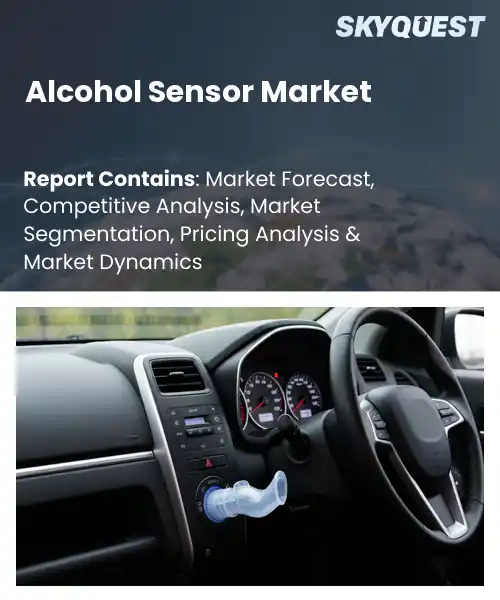
Alcohol Sensor Market
Report ID: SQMIG45J2613
Report ID: SQMIG45J2613
[email protected]
USA +1 351-333-4748
Report ID:
SQMIG45J2613 |
Region:
Global |
Published Date: July, 2026
Pages:
157
|Tables:
93
|Figures:
76


Global Alcohol Sensor Market size was valued at USD 2.1 Billion in 2024 and is poised to grow from USD 2.33 Billion in 2025 to USD 5.4 Billion by 2033, growing at a CAGR of 10.8% during the forecast period (2026-2033).
The alcohol sensor market comprises devices used for detecting ethanol vapors in breath, industrial emissions, and safety systems. It is relevant because of the increasing regulatory focus on drinking driving, workplace safety and food beverage quality control. The primary catalyst is the tightening of legal blood alcohol limits in Europe, North America and emerging economies forcing manufacturers to embed sensors in automobiles and law enforcement equipment. Historically early semiconductor chemi resistors gave rough estimates . Progress in metal oxide nanostructures and laser based spectroscopy have improved accuracy and lowered cost . The scope of adoption expanded from police checkpoints to personal breathalyzers and even home devices.
The growth is driven by the integration of alcohol sensors into Internet of Things platforms as connectivity allows real time transmission of data to cloud analytics to drive interventions. Fleet operators are installing wireless breath analyzers that trigger alerts when driver intoxication is detected, reducing accident risk and insurance premiums. Wearable sensors connected to health dashboards deliver exposure monitoring in workplaces, initiating corrective actions and reporting. Driven by the need for low power, miniaturized modules, semiconductor companies are developing silicon-based MEMS designs, which reduces production costs and opens the door for startups to enter the market. Rapidly enhancing today’s adoption across hospitality, safety and wellness sectors worldwide.
How is AI-driven IoT Integration Enhancing Accuracy In The Alcohol Sensor Market?
Real-time data streams combined with adaptive algorithms are improving performance of alcohol sensor with AI powered IoT integration. Sensors now stream continuous data to cloud platforms where machine learning models filter noise, calibrate drift and predict sensor health. Edge computing reduces latency, enabling devices to change sensitivity on the fly. This synergy enhances the reliability of detection in various environments such as in vehicles, workplaces and smart homes. As the market evolves, manufacturers are embedding these capabilities into small modules that are easier to deploy at scale and consume little power. The result is a more responsive ecosystem that promotes regulatory compliance and user safety.
Market snapshot - (2026-2033)
Global Market Size
USD 2.1 Billion
Largest Segment
Breathalyzers
Fastest Growth
Infrared Sensors
Growth Rate
10.8% CAGR
To get more insights on this market click here to Request a Free Sample Report
Global alcohol sensor market is segmented by product type, application, end user and region. Based on product type, the market is segmented into Breathalyzers, Fuel Cell Sensors, Semiconductor Oxide Sensors and Infrared Sensors. Based on application, the market is segmented into Vehicle Controlling, Healthcare Application, Law Enforcement and Workplace Testing. Based on end user, the market is segmented into Automotive, Healthcare Facilities, Government Agencies and Industrial Workplaces. Based on region, the market is segmented into North America, Europe, Asia Pacific, Latin America and Middle East & Africa.
The breathalyzers segment is the dominant segment, offering instant and user-friendly readings that are critical for on-site decisions. They are popular with individuals and small businesses because they are portable and inexpensive. The increasing precision of sensors, and their incorporation into smartphones, keep making them more appealing and driving their uptake across various market segments. and thereby influence the purchasing priorities, channel investments and the overall growth trajectory of the alcohol sensor market.
However, the strongest growth momentum is set to be witnessed by fuel cell sensors, owing to their higher precision and long lifespan, while meeting stringent performance standards in settings. Increasing integration of vehicle telematics and advanced data analytics is acting as a catalyst to increase applications and new revenue streams in the alcohol sensor market.
Law enforcement segment takes the lion’s share as it is highly reliant on quick-to-collect and legally admissible evidence to support public safety initiatives. The need for accurate and tamper-proof results drives the need of certified devices and promotes the establishment of deep relationships with regulatory bodies. The pressure to avoid liability, coupled with ongoing legislative reinforcement, compels agencies to concentrate on reliable alcohol detection. This focus drives substantial budgetary resources and propels the validation of technology across the alcohol sensor market within the sector. These factors influence standards, training protocols, and cooperation between jurisdictions.
Meanwhile, workplace testing is the key high-growth area as employer liability concerns grow and wellness initiatives push on-site alcohol monitoring. Integration with digital compliance platforms and real-time analytics accelerate adoption, enabling new service models and expanding market reach beyond traditional safety programs, driving overall market growth.
To get detailed segments analysis, Request a Free Sample Report
North America has a well-developed regulatory environment for transportation, occupational health and consumer products, with a focus on safety and compliance. Strong research institutions and advanced manufacturing capabilities continuously drive innovations in sensor technologies, providing highly reliable and compact devices. The region has large distribution networks and pre-established partnerships between technology providers and end-user sectors that speed up market adoption. The region’s leadership position is maintained by a strong demand base, further embedding alcohol detection solutions into everyday practice due to consumer awareness towards responsible drinking and corporate responsibility initiatives.
The United States alcohol sensor market thrives on deep integration with automotive safety systems, workplace monitoring programs and public health initiatives. Top universities, private research laboratories, and major manufacturers work together to create a pipeline of state-of-the-art sensor designs. Good testing standards and enforcement help get industry to adopt early and in a wide range of industries. A good supply chain helps get new products to market fast.
The rising focus of government on road safety and occupational health in Canada has fueled demand for detection devices, which has driven the growth of the alcohol sensor market. Close ties between research centres and commercial firms promote innovation tailored to cold-climate performance and low-power operation. Canada’s wide-ranging public-sector procurement policies and emphasis on sustainable technology also help to stimulate the market and make it an important player in regional development.
Europe’s expansion is propelled by stringent safety regulations and a proactive stance on public health that encourage adoption of alcohol detection across mobility, workplace, and hospitality sectors. Collaborative research frameworks across the continent accelerate technological refinement, emphasizing accuracy, miniaturization, and integration with digital platforms. Strong consumer advocacy and heightened awareness of responsible consumption support market penetration, while a dense network of automotive manufacturers and industrial firms creates a fertile environment for rapid diffusion of advanced sensor solutions throughout the region.
Alcohol Sensor Market in Germany benefits from a robust engineering tradition and close cooperation between automotive giants, research institutes, and sensor specialists. Emphasis on precision and reliability drives continuous improvement of detection capabilities, while nationwide safety campaigns promote broad implementation in transport and industrial environments. The country’s focus on sustainable manufacturing also encourages development of low‑energy, high‑performance sensors that align with broader environmental goals.
Alcohol Sensor Market in the United Kingdom is characterized by fast‑moving adoption driven by rigorous road safety legislation and a vibrant start‑up ecosystem focused on wearable and IoT‑enabled detection devices. Strong academic‑industry partnerships foster rapid prototyping and field testing, while public health initiatives raise consumer consciousness about responsible drinking. The integration of sensors into smart city projects and corporate wellness programs further accelerates market momentum.
Alcohol Sensor Market in France is emerging steadily as regulatory encouragement and increasing corporate responsibility initiatives stimulate demand for reliable detection solutions. Collaborative projects between national research laboratories and technology firms prioritize user‑friendly designs that suit hospitality and transportation sectors. Growing consumer advocacy for safe drinking environments and supportive government incentives create a conducive landscape for expansion of sensor applications across the French market.
Asia Pacific advances its position through a combination of rapid industrialization, expanding transportation networks, and heightened awareness of workplace safety that collectively drive demand for sophisticated alcohol detection technologies. Strong emphasis on research and development within the region fuels innovation, focusing on miniaturized, low‑cost sensors suitable for mass deployment in emerging economies. Strategic collaborations between local manufacturers and global technology leaders facilitate technology transfer and accelerate market penetration, while governmental safety campaigns and evolving regulatory frameworks further embed sensor solutions into everyday operations.
Alcohol Sensor Market in Japan leverages the nation’s expertise in precision electronics and a deep commitment to public safety, resulting in highly accurate and compact sensor offerings. Integration of detection systems into automotive safety platforms and extensive use in industrial compliance programs highlight market depth. Collaborative initiatives between leading electronics firms and research universities drive continuous refinement of sensor performance, while cultural emphasis on responsible drinking supports broader consumer acceptance.
Alcohol Sensor Market in South Korea is bolstered by aggressive investment in smart‑city infrastructure and a thriving automotive sector that prioritize advanced safety features. Close cooperation between government agencies, tech incubators, and established manufacturers nurtures rapid development of innovative, low‑power sensors. Growing public health campaigns and corporate wellness programs further expand usage across transportation, workplace, and hospitality environments, reinforcing South Korea’s emerging leadership in the regional market.
To know more about the market opportunities by region and country, click here to
Buy The Complete Report
Increasing Demand for Safety
Adoption of IoT Enabled Devices
High Cost of Sensor Technology
Regulatory Fragmentation Across Regions
Request Free Customization of this report to help us to meet your business objectives.
The competitive landscape is shaped by aggressive M&A activity, strategic partnerships linking sensor manufacturers with AI analytics firms, and rapid tech innovation such as integrated breath‑analysis chips; for example, a leading sensor maker recently partnered with an AI startup to embed real‑time data processing, while another major player acquired a niche nanomaterial company to boost sensor sensitivity, intensifying rivalry and accelerating product differentiation.
SkyQuest’s ABIRAW (Advanced Business Intelligence, Research & Analysis Wing) is our Business Information Services team that Collects, Collates, Correlates, and Analyses the Data collected by means of Primary Exploratory Research backed by robust Secondary Desk research.
As per SkyQuest analysis, the global alcohol sensor market is expanding rapidly, propelled primarily by stricter safety regulations that push manufacturers to embed reliable detection systems across automotive, workplace and consumer applications. A second strong catalyst is the surge in IoT‑enabled devices, which allow real‑time data sharing and analytics, enhancing sensor usefulness and adoption. The market is led by North America, where mature regulatory frameworks and advanced manufacturing support growth, and breathalyzers remain the dominant product segment due to their portability and low cost. However, high sensor costs limit broader uptake, especially among price‑sensitive users, tempering the overall pace of diffusion.
| Report Metric | Details |
|---|---|
| Market size value in 2024 | USD 2.1 Billion |
| Market size value in 2033 | USD 5.4 Billion |
| Growth Rate | 10.8% |
| Base year | 2024 |
| Forecast period | (2026-2033) |
| Forecast Unit (Value) | USD Billion |
| Segments covered |
|
| Regions covered | North America (US, Canada), Europe (Germany, France, United Kingdom, Italy, Spain, Rest of Europe), Asia Pacific (China, India, Japan, Rest of Asia-Pacific), Latin America (Brazil, Rest of Latin America), Middle East & Africa (South Africa, GCC Countries, Rest of MEA) |
| Companies covered |
|
| Customization scope | Free report customization with purchase. Customization includes:-
|
To get a free trial access to our platform which is a one stop solution for all your data requirements for quicker decision making. This platform allows you to compare markets, competitors who are prominent in the market, and mega trends that are influencing the dynamics in the market. Also, get access to detailed SkyQuest exclusive matrix.
Table Of Content
Executive Summary
Market overview
Parent Market Analysis
Market overview
Market size
KEY MARKET INSIGHTS
COVID IMPACT
MARKET DYNAMICS & OUTLOOK
Market Size by Region
KEY COMPANY PROFILES
Methodology
For the Alcohol Sensor Market, our research methodology involved a mixture of primary and secondary data sources. Key steps involved in the research process are listed below:
1. Information Procurement: This stage involved the procurement of Market data or related information via primary and secondary sources. The various secondary sources used included various company websites, annual reports, trade databases, and paid databases such as Hoover's, Bloomberg Business, Factiva, and Avention. Our team did 45 primary interactions Globally which included several stakeholders such as manufacturers, customers, key opinion leaders, etc. Overall, information procurement was one of the most extensive stages in our research process.
2. Information Analysis: This step involved triangulation of data through bottom-up and top-down approaches to estimate and validate the total size and future estimate of the Alcohol Sensor Market.
3. Report Formulation: The final step entailed the placement of data points in appropriate Market spaces in an attempt to deduce viable conclusions.
4. Validation & Publishing: Validation is the most important step in the process. Validation & re-validation via an intricately designed process helped us finalize data points to be used for final calculations. The final Market estimates and forecasts were then aligned and sent to our panel of industry experts for validation of data. Once the validation was done the report was sent to our Quality Assurance team to ensure adherence to style guides, consistency & design.
Analyst Support
Customization Options
With the given market data, our dedicated team of analysts can offer you the following customization options are available for the Alcohol Sensor Market:
Product Analysis: Product matrix, which offers a detailed comparison of the product portfolio of companies.
Regional Analysis: Further analysis of the Alcohol Sensor Market for additional countries.
Competitive Analysis: Detailed analysis and profiling of additional Market players & comparative analysis of competitive products.
Go to Market Strategy: Find the high-growth channels to invest your marketing efforts and increase your customer base.
Innovation Mapping: Identify racial solutions and innovation, connected to deep ecosystems of innovators, start-ups, academics, and strategic partners.
Category Intelligence: Customized intelligence that is relevant to their supply Markets will enable them to make smarter sourcing decisions and improve their category management.
Public Company Transcript Analysis: To improve the investment performance by generating new alpha and making better-informed decisions.
Social Media Listening: To analyze the conversations and trends happening not just around your brand, but around your industry as a whole, and use those insights to make better Marketing decisions.
REQUEST FOR SAMPLE
 REQUEST FREE CUSTOMIZATION
Global Alcohol Sensor Market size was valued at USD 2.1 Billion in 2024 and is poised to grow from USD 2.33 Billion in 2025 to USD 5.4 Billion by 2033, growing at a CAGR of 10.8% during the forecast period (2026-2033).
The competitive landscape is shaped by aggressive M&A activity, strategic partnerships linking sensor manufacturers with AI analytics firms, and rapid tech innovation such as integrated breath‑analysis chips; for example, a leading sensor maker recently partnered with an AI startup to embed real‑time data processing, while another major player acquired a niche nanomaterial company to boost sensor sensitivity, intensifying rivalry and accelerating product differentiation. 'Dragerwerk AG and Co', 'BACtrack LLC', 'Lifeloc Technologies Inc', 'Box Inc', 'Zoom Video Communications Inc', 'Asahi Kasei Corporation', 'Alcohol Countermeasure Systems Corp', 'AlcoPro Inc', 'Giner Labs Inc', 'Intoximeters Inc', 'Robert Bosch GmbH', 'Denso Corporation', 'Continental AG', 'Sensorcon Inc', 'Quest Products Inc', 'Andatech Pty Ltd', 'Alcohol Detection Systems LLC', 'C4 Development Limited', 'Guth Laboratories Inc', 'Securmetrics Inc'
Regulatory bodies across regions are imposing stricter safety standards for beverage production and distribution, prompting manufacturers to integrate advanced alcohol detection technologies. This heightened focus on consumer protection drives adoption of reliable sensors that can monitor ethanol concentrations in real time, ensuring compliance and preventing contamination. As producers seek to safeguard brand reputation and mitigate liability, the demand for accurate, portable, and easy‑to‑integrate alcohol sensors rises, directly expanding the market for these analytical devices across various segments including brewing, distilling, and hospitality.
Smart Vehicle Integration: Automakers are embedding compact alcohol sensors directly into vehicle cabin systems, enabling continuous monitoring of driver sobriety without manual testing. Integrated with infotainment platforms, these sensors provide real‑time alerts to prevent impaired driving, while data feeds support predictive maintenance and insurance risk modeling. The seamless fusion of sensor hardware with vehicle software aligns with broader trends toward connected mobility, offering manufacturers a differentiated safety feature that resonates with regulators and safety‑conscious consumers alike and strengthens brand loyalty across markets globally.
Why does North America Dominate the Global Alcohol Sensor Market? |@12


Want to customize this report? This report can be personalized according to your needs. Our analysts and industry experts will work directly with you to understand your requirements and provide you with customized data in a short amount of time. We offer $1000 worth of FREE customization at the time of purchase.
Feedback From Our Clients


 USA (+1) 351-333-4748

