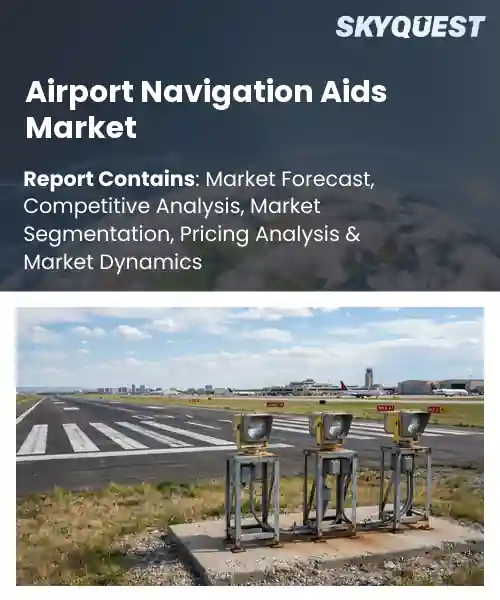
Airport Navigation Aids Market
Report ID: SQMIG20A2919
Report ID: SQMIG20A2919
[email protected]
USA +1 351-333-4748
Report ID:
SQMIG20A2919 |
Region:
Global |
Published Date: September, 2026
Pages:
157
|Tables:
121
|Figures:
77


Global Airport Navigation Aids Market size was valued at USD 3.27 Billion in 2024 and is poised to grow from USD 3.4 Billion in 2025 to USD 4.62 Billion by 2033, growing at a CAGR of 3.9% during the forecast period (2026-2033).
Engine driving the airport navigation aids market is the rise in air passenger volume, which forces airports to demand precision and reliability in runway guidance. The market includes Instrument Landing Systems, VHF Omnidirectional Range beacons, Distance Measuring Equipment, and satellite‑based solutions such as ADS‑B. Its relevance lies in the direct link between accurate navigation, runway utilization, and flight safety, making it a cornerstone of aviation infrastructure. Historically the sector moved from ground‑based radio cues of the 1950s to networked ecosystems; for example, U.S. NextGen program and Europe’s SESAR initiative have replaced legacy equipment with performance‑based systems, illustrating rapid technological turnover.Another pivotal factor shaping the global airport navigation aids market is the adoption of performance‑based navigation, which unlocks capacity gains by allowing aircraft to follow three‑dimensional trajectories. When regulators certify such procedures, airlines can reduce separation minima, leading to higher take‑off and landing rates without expanding runway space. This effect is evident at Singapore Changi Airport, where the implementation of RNP‑AR approaches has yielded a 15 percent increase in runway throughput while cutting fuel burn for operators. The resulting efficiency gains attract investment in GNSS receivers and ground‑based augmentation, creating a loop that spurs further deployment of guidance solutions worldwide.
How is AI enhancing the accuracy of airport navigation aid systems?
Artificial intelligence is reshaping airport navigation aids by merging data from radar, satellite and ground sensors into a unified picture that continuously self corrects. Machine learning models learn the subtle variations in signal propagation caused by weather, terrain and aircraft weight, allowing the system to fine tune guidance cues with each landing. Real time processing enables dynamic updates to instrument landing system beams and visual approach slope indicators, reducing the margin of error for pilots. Operators benefit from predictive maintenance alerts that keep equipment calibrated, while airlines experience smoother approaches and lower diversion rates. The market is seeing rapid adoption as airports seek higher safety standards and operational efficiency.Honeywell April 2024, introduced an AI driven runway guidance system that refines signal precision and reduces pilot workload while improving overall safety and supporting market growth through smarter infrastructure. The solution integrates real time sensor fusion with predictive algorithms to automatically adjust glide path angles and lighting intensity, delivering consistent performance across varying weather conditions and demonstrating the value of AI in modernizing airport navigation aids.
Market snapshot - (2026-2033)
Global Market Size
USD 3.27 Billion
Largest Segment
Lighting Systems
Fastest Growth
Visual Navigation Aids
Growth Rate
3.9% CAGR
To get more insights on this market click here to Request a Free Sample Report
Global airport navigation aids market is segmented by type, navigation aid, application, airport type and region. Based on type, the market is segmented into Visual Navigation Aids, Radio Navigation Aids, Lighting Systems and Marking & Signage Systems. Based on navigation aid, the market is segmented into Runway Lighting Systems, Taxiway Lighting Systems, Approach Lighting Systems, Visual Approach Slope Indicators, Airfield Signs & Markings and Radio Navigation Systems. Based on application, the market is segmented into Runways, Taxiways and Aprons & Other Airside Areas. Based on airport type, the market is segmented into Commercial Airports, Military Airports and General Aviation Airports. Based on region, the market is segmented into North America, Europe, Asia Pacific, Latin America and Middle East & Africa.
Runway lighting systems segment dominates because they are essential for aircraft operations during low visibility and night conditions. Their reliability directly influences runway occupancy, pilot confidence and regulatory compliance, prompting airports to prioritize investment in high performance lighting. Continuous upgrades to LED technology and integration with monitoring systems reinforce their central position in the market. Airlines also depend on these systems for precise touchdown guidance, while regulators mandate performance assessments to ensure safety standards are met.
However, taxiway lighting systems are witnessing the strongest growth momentum as airports expand surface movement capacity and adopt advanced guidance solutions. The shift toward automated ground handling and the need for precise lane delineation drive demand, encouraging manufacturers to develop energy efficient, smart lighting that integrates with airport operational platforms.
Visual approach slope indicators segment dominates because they provide immediate visual glide path information that enhances pilot situational awareness during critical landing phases. Their simplicity and reliability reduce dependence on complex electronic systems, making them attractive for airports seeking cost effective safety upgrades. Continuous improvements in illumination technology and standardized installation practices increase their appeal, ensuring they remain a core component of runway visual guidance strategies worldwide.
Meanwhile, airfield signs and markings are emerging as the key high growth area within visual navigation aids as airports modernize their ground infrastructure. The push for standardized graphics and durable materials to support increased traffic and regulatory scrutiny fuels adoption, creating new opportunities for suppliers to innovate with reflective technologies and integration.
To get detailed segments analysis, Request a Free Sample Report
North America benefits from a mature aviation infrastructure, extensive research institutions, and leading technology manufacturers that drive continuous innovation in navigation solutions. Strong collaboration between airlines, airport operators, and regulatory bodies ensures rapid adoption of advanced systems. The region’s emphasis on safety and operational efficiency fuels investment in cutting‑edge guidance technologies, while robust funding mechanisms support large‑scale upgrades at major hubs. Additionally, a high volume of international and domestic traffic creates sustained demand for reliable, high‑performance aids, reinforcing North America’s leadership position in the global landscape.
United States Airport Navigation Aids Market
Airport Navigation Aids Market in the United States is propelled by a dense network of airports that prioritize state‑of‑the‑art instrument landing systems and satellite‑based guidance. Collaborative initiatives between federal agencies and private manufacturers accelerate development cycles, while a culture of stringent safety standards drives frequent system enhancements. The widespread adoption of integrated digital platforms further streamlines operational workflows, reinforcing the market’s resilience and capacity for innovation.
Canada Airport Navigation Aids Market
Airport Navigation Aids Market in Canada is shaped by a commitment to modernizing regional and international gateways, emphasizing reliability in challenging weather conditions. Partnership between governmental aviation authorities and technology providers fosters the rollout of advanced surveillance and precision approach solutions. The focus on sustainable operations encourages incorporation of energy‑efficient equipment, while ongoing training programs ensure skilled personnel can maximize the benefits of emerging navigation technologies.
The Asia Pacific region experiences rapid expansion due to surging passenger demand, extensive airport construction, and strategic governmental commitments to upgrade air traffic management. Nations are investing heavily in modernizing legacy systems, shifting toward satellite‑based navigation to enhance capacity and safety. Integration of digital solutions and smart airport concepts attracts multinational technology firms, fostering local expertise and supply chains. Moreover, the emphasis on harmonizing standards across borders accelerates deployment of interoperable equipment, positioning the region as a dynamic hub for next‑generation navigation technologies.
Japan Airport Navigation Aids Market
Airport Navigation Aids Market in Japan focuses on integrating highly reliable precision approach systems to support densely trafficked corridors and mountainous terrain. Strong collaboration between aerospace manufacturers and regulatory agencies drives the adoption of advanced satellite navigation and real‑time monitoring tools. Emphasis on resilience against natural disruptions leads to robust system design, while continuous research initiatives promote incremental enhancements that keep the market at the forefront of technological sophistication.
South Korea Airport Navigation Aids Market
Airport Navigation Aids Market in South Korea is propelled by aggressive modernization of existing airports and development of new hubs to accommodate growing air travel. Government incentives encourage the deployment of cutting‑edge digital guidance solutions, while partnerships with global equipment suppliers facilitate technology transfer. The focus on seamless integration with next‑generation air traffic management platforms enhances operational efficiency, and a strong engineering talent pool supports rapid customization and maintenance of sophisticated navigation infrastructures.
Europe strengthens its position through coordinated regulatory frameworks, substantial public‑private investment, and a collaborative approach to research and development across borders. The region’s emphasis on sustainability drives the integration of eco‑friendly navigation technologies, while legacy infrastructure upgrades leverage advanced digital connectivity. Strong aerospace clusters foster innovation ecosystems that produce high‑precision equipment, and harmonized standards enable seamless cross‑border operations. These combined efforts ensure Europe remains a pivotal contributor to the evolution of global airport navigation solutions.
Germany Airport Navigation Aids Market
Airport Navigation Aids Market in Germany benefits from a dense network of international airports that prioritize precision approach and surveillance technologies. Close cooperation between engineering firms and aviation authorities accelerates the rollout of cutting‑edge satellite‑based systems. Emphasis on safety and efficiency fuels continuous refinement of digital integration, while strong research institutions support ongoing innovation in navigation solutions.
United Kingdom Airport Navigation Aids Market
Airport Navigation Aids Market in the United Kingdom is driven by strategic upgrades to both legacy and new airport facilities, emphasizing resilient, high‑accuracy guidance tools. Collaborative initiatives among industry leaders and regulatory bodies foster the rapid adoption of interoperable satellite navigation platforms. The focus on sustainable operations encourages the deployment of energy‑efficient equipment, while continuous professional development ensures expertise in emerging technologies.
France Airport Navigation Aids Market
Airport Navigation Aids Market in France is shaped by a concerted effort to modernize air traffic management through advanced navigation aids across major and regional airports. Partnerships between national agencies and technology innovators promote the integration of sophisticated precision approach systems. Commitment to environmental stewardship steers investment toward greener solutions, and strong engineering capabilities enable the customization of equipment to meet complex operational requirements.
To know more about the market opportunities by region and country, click here to
Buy The Complete Report
Increasing Air Traffic Demand
Adoption Of Satellite Based Systems
High Installation And Maintenance Costs
Regulatory Approval And Certification Delays
Request Free Customization of this report to help us to meet your business objectives.
The global airport navigation aids market is shaped by intense competition among established aerospace and defense firms that are accelerating technology roll‑outs, forging strategic alliances, and pursuing selective acquisitions to broaden product portfolios and geographic reach. Recent M&A activity, such as Honeywell’s acquisition of Avionics Systems Ltd., and partnerships like Thales teaming with Airbus to develop AI‑enhanced ILS solutions, are driving faster deployment of precision‑guidance technologies and reinforcing market positioning.
Top Player’s Company Profile
Recent Developments
SkyQuest’s ABIRAW (Advanced Business Intelligence, Research & Analysis Wing) is our Business Information Services team that Collects, Collates, Correlates, and Analyses the Data collected by means of Primary Exploratory Research backed by robust Secondary Desk research. As per SkyQuest analysis, the global airport navigation aids market is being propelled primarily by the surge in air traffic demand, which compels airports to upgrade to more precise guidance solutions, while the adoption of satellite‑based systems such as GNSS and ADS‑B serves as a second powerful catalyst accelerating modernisation. The runway lighting systems segment remains the dominant share because of its critical role in low‑visibility operations, and North America continues to lead the market thanks to its mature infrastructure and strong technology base. However, the high installation and maintenance costs of advanced equipment act as a notable restraint, tempering the pace of new deployments despite the overall growth momentum.
| Report Metric | Details |
|---|---|
| Market size value in 2024 | USD 3.27 Billion |
| Market size value in 2033 | USD 4.62 Billion |
| Growth Rate | 3.9% |
| Base year | 2024 |
| Forecast period | (2026-2033) |
| Forecast Unit (Value) | USD Billion |
| Segments covered |
|
| Regions covered | North America (US, Canada), Europe (Germany, France, United Kingdom, Italy, Spain, Rest of Europe), Asia Pacific (China, India, Japan, Rest of Asia-Pacific), Latin America (Brazil, Rest of Latin America), Middle East & Africa (South Africa, GCC Countries, Rest of MEA) |
| Companies covered |
|
| Customization scope | Free report customization with purchase. Customization includes:-
|
To get a free trial access to our platform which is a one stop solution for all your data requirements for quicker decision making. This platform allows you to compare markets, competitors who are prominent in the market, and mega trends that are influencing the dynamics in the market. Also, get access to detailed SkyQuest exclusive matrix.
Table Of Content
Executive Summary
Market overview
Parent Market Analysis
Market overview
Market size
KEY MARKET INSIGHTS
COVID IMPACT
MARKET DYNAMICS & OUTLOOK
Market Size by Region
KEY COMPANY PROFILES
Methodology
For the Airport Navigation Aids Market, our research methodology involved a mixture of primary and secondary data sources. Key steps involved in the research process are listed below:
1. Information Procurement: This stage involved the procurement of Market data or related information via primary and secondary sources. The various secondary sources used included various company websites, annual reports, trade databases, and paid databases such as Hoover's, Bloomberg Business, Factiva, and Avention. Our team did 45 primary interactions Globally which included several stakeholders such as manufacturers, customers, key opinion leaders, etc. Overall, information procurement was one of the most extensive stages in our research process.
2. Information Analysis: This step involved triangulation of data through bottom-up and top-down approaches to estimate and validate the total size and future estimate of the Airport Navigation Aids Market.
3. Report Formulation: The final step entailed the placement of data points in appropriate Market spaces in an attempt to deduce viable conclusions.
4. Validation & Publishing: Validation is the most important step in the process. Validation & re-validation via an intricately designed process helped us finalize data points to be used for final calculations. The final Market estimates and forecasts were then aligned and sent to our panel of industry experts for validation of data. Once the validation was done the report was sent to our Quality Assurance team to ensure adherence to style guides, consistency & design.
Analyst Support
Customization Options
With the given market data, our dedicated team of analysts can offer you the following customization options are available for the Airport Navigation Aids Market:
Product Analysis: Product matrix, which offers a detailed comparison of the product portfolio of companies.
Regional Analysis: Further analysis of the Airport Navigation Aids Market for additional countries.
Competitive Analysis: Detailed analysis and profiling of additional Market players & comparative analysis of competitive products.
Go to Market Strategy: Find the high-growth channels to invest your marketing efforts and increase your customer base.
Innovation Mapping: Identify racial solutions and innovation, connected to deep ecosystems of innovators, start-ups, academics, and strategic partners.
Category Intelligence: Customized intelligence that is relevant to their supply Markets will enable them to make smarter sourcing decisions and improve their category management.
Public Company Transcript Analysis: To improve the investment performance by generating new alpha and making better-informed decisions.
Social Media Listening: To analyze the conversations and trends happening not just around your brand, but around your industry as a whole, and use those insights to make better Marketing decisions.
REQUEST FOR SAMPLE
 REQUEST FREE CUSTOMIZATION


Want to customize this report? This report can be personalized according to your needs. Our analysts and industry experts will work directly with you to understand your requirements and provide you with customized data in a short amount of time. We offer $1000 worth of FREE customization at the time of purchase.
Feedback From Our Clients


 USA (+1) 351-333-4748

