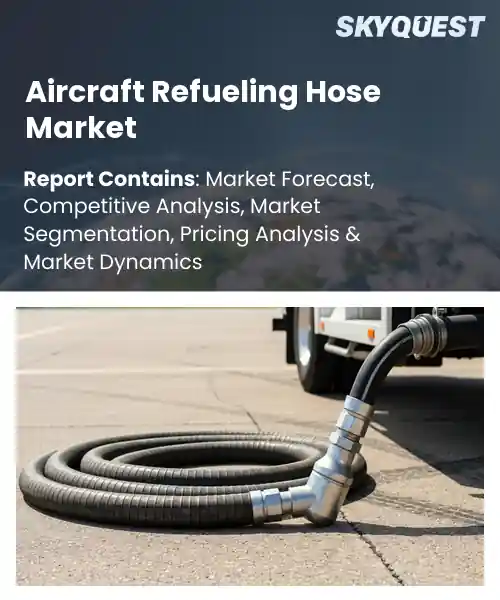
Aircraft Refueling Hose Market
Report ID: SQMIG20A2645
Report ID: SQMIG20A2645
[email protected]
USA +1 351-333-4748
Report ID:
SQMIG20A2645 |
Region:
Global |
Published Date: June, 2026
Pages:
157
|Tables:
142
|Figures:
78


Global Aircraft Refueling Hose Market size was valued at USD 182.5 Million in 2024 and is poised to grow from USD 191.66 Million in 2025 to USD 285.4 Million by 2033, growing at a CAGR of 5.02% during the forecast period (2026-2033).
The primary driver of the aircraft refueling hose market is the escalating demand for safe, rapid, and compliant fuel transfer systems across commercial, military, and general aviation sectors. Specialized hoses, couplings, and accessories in the fuel-handling market are designed to have extreme durability under pressure, withstand temperature variations, and meet specific chemical-related compatibility requirements. Fuel-handling factors also dictate operational efficiencies, regulatory compliance, and ultimately flight safety. The transition in the last 20-plus years from basic rubber hose assemblies to sophisticated, multilayer synthetic assemblies with conductive and flame-retardant characteristics can be illustrated through upgrades to airport and military fleets replacing the old legacy systems, which after safety audits were found to be deficient across the board.
A central factor shaping the global aircraft refueling hose market is regulatory harmonization and evolving safety standards, which compel manufacturers and operators to invest in higher specification products. When new laws regarding the minimum limits of flammability, conductivity and leakage are enforced by carriers, the carriers and ground handlers move their supplier base towards hoses that include a conductive yarn, an anti-static layer, and improved fittings, which in turn forces manufacturers to ramp up the production of certified hose/assembly. In addition, airports replacing old assemblies report a reduction in the number of spills and improve the turnaround time at the airport resulting in creating a business case for lifecycle cost savings that encourage future upgrades and open up opportunities for aftermarket service programs including predictive maintenance programs.
How is AI Improving Predictive Maintenance for Aircraft Refueling Hose Systems?
Through machine learning, predictive maintenance for aircraft refueling hoses systems can improve by using integrated sensors, visual inspections and embedded data to detect wear, leaks or pressure anomalies before they create a failure. The key features of predictive maintenance due to AI technologies include: continuous merging of real-time and historical datasets; physics-based models; and real-time anomaly detection that will alert MRO providers or operators of any assembly which is at risk of failure and needs to be serviced. Market momentum favors digital inspection because it reduces disruptions and lengthens service life while enabling better spare parts planning and operational transparency.
In March 2026, Odysight.ai began US flight testing of its AI visual sensing system on helicopters and other platforms demonstrating real time detection of surface defects in hard to access components. That capability supports the refueling hose market by enabling focused inspections and reducing unscheduled downtime with AI driven condition monitoring.
Market snapshot - (2026-2033)
Global Market Size
USD 182.5 Million
Largest Segment
Pressure Refueling Hoses
Fastest Growth
Tanker-to-Tanker Refueling Hoses
Growth Rate
5.02% CAGR
To get more insights on this market click here to Request a Free Sample Report
Global aircraft refueling hose market is segmented by hose type, material, application, end-user, distribution and region. Based on hose type, the market is segmented into pressure refueling hoses, overwing refueling hoses and tanker-to-tanker refueling hoses. Based on material, the market is segmented into nitrile rubber, PTFE-lined and composite materials. Based on application, the market is segmented into commercial aircraft refueling, military aircraft refueling and aerial refueling (boom/drogue). Based on end-user, the market is segmented into airport ground services and military air bases. Based on distribution, the market is segmented into direct OEM and MRO distributors. Based on region, the market is segmented into North America, Europe, Asia Pacific, Latin America and Middle East & Africa.
Pressure refueling hoses segment dominates because they are engineered to withstand high delivery pressures and integrate seamlessly with standardized pressure refueling systems, reducing operational interruptions and leak risk. The quality of build and the record of safety create a strong preference among both operators and OEMs to purchase them. Established maintenance protocols help lower lifecycle costs. Because of this reliability there is a continuous adoption cycle where system designers and ground crews give preference to the use of pressure hose systems due to consistent high volume of refueling operations.
However, overwing refueling hoses are witnessing the strongest growth momentum as lightweight designs and easier handling meet increasing demand for rapid turnaround and versatile gate side refueling. Innovations in ergonomic connectors and flexible materials enhance operator safety and reduce time on ground, driving fleet retrofits and new purchases that expand addressable demand and aftermarket service opportunities.
PTFE-lined segment leads because its chemical inertness and low surface energy prevent fuel contamination and reduce fluid friction, ensuring clean fuel transfer and minimizing maintenance interventions. Because it can be utilized with various types of fuel and meets standards for cleanliness set by regulatory agencies, PTFE is preferred by many operators and original equipment manufacturers (OEMs) who prefer long-term durability and predictable service life from equipment. As a result of the enhancements made to both contamination control and operational uptime, PTFE lined products are essential for high-reliability, refuelling programs.
However, Composite materials are emerging as the most rapidly expanding area because advanced fiber reinforcements and resin systems cut weight while maintaining pressure tolerance, aligning with industry moves toward lighter, more flexible assemblies. Their manufacturability and potential for integrated function drive new design wins, aftermarket retrofits, and opportunities for OEMs to offer differentiated hose systems.
To get detailed segments analysis, Request a Free Sample Report
North America dominates due to concentration of major OEMs and expansive commercial and military fleets, well-developed maintenance infrastructure and rigorous regulatory frameworks that drive demand for certified, high-performance hoses. With robust manufacturing capabilities and materials knowledge, advanced product development and customisation can be supported for varied aircraft. The mature aftermarket ecosystem supports lifecycle support for the airplane, including replacement and upgrade parts, which supports the relationship between suppliers and the original equipment manufacturer. In support of stable demand and long-term supplier investment, defence entities and the major airlines engage in strategic procurement. The comprehensive air transport networks and training facilities provide operational continuity. The North American supply chain between both nations provides scalability and quick response capabilities to customer needs, with continuing collaboration among industry players, research institutions and certification authorities.
Aircraft refueling hose market in United States benefits from a dense concentration of airlines, major OEMs and defense operators that demand highly certified, durable hoses. The rapid prototyping and production at established manufacturing clusters is further supported by extensive maintenance, repair and overhaul networks that help keep products operational over their entire lifecycle. In addition, the active collaboration between the various participants in the industry enables ongoing product verification and validation, as well as the ongoing use of new materials that meet domestic fleet requirements and improve operational productivity.
Aircraft refueling hose market in Canada is shaped by regional airline networks, defense requirements and operations in challenging climates that drive demand for robust, reliable hoses. By partnering with global manufacturers, businesses can utilize both new materials and methods of manufacturing, while local companies specialize in customizing products for remote serviceability and maintenance. Working closely with related neighbouring commercial markets, policymakers will support continuity of supply across borders and aftermarket assistance, as well as investing time and money into training and local technical capabilities.
Europe is experiencing rapid expansion driven by modernization initiatives across civil and military aviation, regulatory convergence emphasizing safety and environmental performance, and investments in airport and MRO capacity that increase demand for high-quality refueling hoses. Innovation in lightweight materials and connector technologies is supported by a broad network of vendor partners specializing in these areas as well as engineering centres to facilitate design and development. Proximity to large aerospace manufacturers assists with integrating and certifying new products and out of country trade and collaborative research programmes shorten the time required to develop and distribute new products. The growth of after-market services and strategic alliances between traditional companies and innovative niche players will allow for the rapid scaling of validated, effective solutions. Working closely with key customers in defence and the major airline industry will assist with efficiently certifying and adopting new advanced hose products within different operational markets via specialized testing facilities.
Aircraft refueling hose market in Germany is underpinned by a robust engineering heritage and a dense network of precision manufacturers that supply both civil and defense programs. High-performance materials and an intensive certification process promote export-based production. The direct relationships of primary aerospace integrators and a very healthy research and development (R&D) environment enable hose technology to grow continuously through refinement. The MRO marketplace is well positioned to provide long-term aftermarket demand and reliable technical support.
Aircraft refueling hose market in United Kingdom is characterized by a growing MRO landscape, strong connectivity through major international hubs and a focus on specialized services that support fleet readiness. Through the process of regulatory engagement and obtaining certification through these partnerships, new ways have been provided to quickly establish a technical support structure required to enable aftermarket growth, customized maintenance solutions, or technical training programs for these products.
Aircraft refueling hose market in France is experiencing rapid momentum driven by coordinated investments in aerospace supply chains and strong ties between OEMs and specialist component makers. Emphasis on advanced material science and integrated testing supports accelerated product refinement. An active export orientation and an encouraging industrial policy create opportunities for partners and innovation, and the MRO and aftermarket community that is expanding helps to ensure that all developments will result in actual operations and continued demand across different fleet types.
Asia Pacific is strengthening its position through expanding regional manufacturing capabilities, strategic partnerships with established global suppliers, and targeted investments in advanced materials and automation that improve cost competitiveness and quality. The growth of regional airlines and the expansion of airport infrastructure are driving the need for more localized and resilient supply chains, and both governments and other industry stakeholders are assisting with development of pathway certification and skill development allowing domestic companies to comply with the significant standards for international compliance. Japan and South Korea are at the forefront of technology innovation and component production, while developing hubs are creating capacity for maintenance, repair, and operations and aftermarket service delivery. This is leading to an increasingly diversified supply chain with enhanced technical capability and faster adoption of next-generation refueling hose solutions in both the commercial and defense sectors.
Aircraft refueling hose market in Japan is characterized by precision engineering, stringent quality control and expertise in advanced materials that translate into high-reliability solutions. By having strong connections between the component manufacturers and the leading aerospace integrators, they can work together to meet certification criteria and develop products that are specially tailored. The investment in automated production and exacting testing facilities allows for consistent production of products, while focusing on product durability and lifecycle performance ensures that both commercial and defense operations can benefit from these products.
Aircraft refueling hose market in South Korea is evolving through strong industrial capabilities, experience in high-precision manufacturing and growing integration within international supply chains. Also, many collaborations between these local suppliers and global aerospace manufacturers help to accelerate the process of achieving certification and developing new products. MRO capacity also contributes to the growth of aftermarket services, which enhances domestic suppliers' position in regional networks supplying refuelling hoses in the national market.
To know more about the market opportunities by region and country, click here to
Buy The Complete Report
Increasing Fleet Modernization Programs
Advancements In Hose Materials
Stringent Safety and Certification
High Maintenance and Lifecycle Costs
Request Free Customization of this report to help us to meet your business objectives.
The competitive landscape for global aircraft refueling hoses is consolidating as incumbents use acquisitions, targeted partnerships, and materials technology buys to protect OEM and aftermarket channels. Mergers such as Parker Hannifin’s purchase of Meggitt, PrimeFlight’s acquisition of ProFlo and ProFlo’s 2024 consolidation of Garsite illustrate consolidation driven by scale. Firms also acquire composite thermoplastics capabilities to defend margin on next generation hydrogen and composite hose designs.
Top Player’s Company Profile
Recent Developments
SkyQuest’s ABIRAW (Advanced Business Intelligence, Research & Analysis Wing) is our Business Information Services team that Collects, Collates, Correlates, and Analyses the Data collected by means of Primary Exploratory Research backed by robust Secondary Desk research.
As per SkyQuest analysis, the market's key driver is escalating demand for safe, rapid, compliant fuel transfer across commercial and military aviation, while a major restraint is stringent safety and certification requirements that slow new product adoption. North America is the dominating region and pressure refueling hoses are the dominating segment, benefiting from mature OEMs, large fleets and extensive MRO networks. A second driver is advancements in hose materials that improve durability, reduce weight and enhance chemical compatibility, enabling retrofits, aftermarket services and longer service life. Operators increasingly favor integrated monitoring and material innovations to reduce spills, speed turnarounds and lower total cost of ownership, reinforcing demand for certified, high-performance hose assemblies.
| Report Metric | Details |
|---|---|
| Market size value in 2024 | USD 182.5 Million |
| Market size value in 2033 | USD 285.4 Million |
| Growth Rate | 5.02% |
| Base year | 2024 |
| Forecast period | (2026-2033) |
| Forecast Unit (Value) | USD Million |
| Segments covered |
|
| Regions covered | North America (US, Canada), Europe (Germany, France, United Kingdom, Italy, Spain, Rest of Europe), Asia Pacific (China, India, Japan, Rest of Asia-Pacific), Latin America (Brazil, Rest of Latin America), Middle East & Africa (South Africa, GCC Countries, Rest of MEA) |
| Companies covered |
|
| Customization scope | Free report customization with purchase. Customization includes:-
|
To get a free trial access to our platform which is a one stop solution for all your data requirements for quicker decision making. This platform allows you to compare markets, competitors who are prominent in the market, and mega trends that are influencing the dynamics in the market. Also, get access to detailed SkyQuest exclusive matrix.
Table Of Content
Executive Summary
Market overview
Parent Market Analysis
Market overview
Market size
KEY MARKET INSIGHTS
COVID IMPACT
MARKET DYNAMICS & OUTLOOK
Market Size by Region
KEY COMPANY PROFILES
Methodology
For the Aircraft Refueling Hose Market, our research methodology involved a mixture of primary and secondary data sources. Key steps involved in the research process are listed below:
1. Information Procurement: This stage involved the procurement of Market data or related information via primary and secondary sources. The various secondary sources used included various company websites, annual reports, trade databases, and paid databases such as Hoover's, Bloomberg Business, Factiva, and Avention. Our team did 45 primary interactions Globally which included several stakeholders such as manufacturers, customers, key opinion leaders, etc. Overall, information procurement was one of the most extensive stages in our research process.
2. Information Analysis: This step involved triangulation of data through bottom-up and top-down approaches to estimate and validate the total size and future estimate of the Aircraft Refueling Hose Market.
3. Report Formulation: The final step entailed the placement of data points in appropriate Market spaces in an attempt to deduce viable conclusions.
4. Validation & Publishing: Validation is the most important step in the process. Validation & re-validation via an intricately designed process helped us finalize data points to be used for final calculations. The final Market estimates and forecasts were then aligned and sent to our panel of industry experts for validation of data. Once the validation was done the report was sent to our Quality Assurance team to ensure adherence to style guides, consistency & design.
Analyst Support
Customization Options
With the given market data, our dedicated team of analysts can offer you the following customization options are available for the Aircraft Refueling Hose Market:
Product Analysis: Product matrix, which offers a detailed comparison of the product portfolio of companies.
Regional Analysis: Further analysis of the Aircraft Refueling Hose Market for additional countries.
Competitive Analysis: Detailed analysis and profiling of additional Market players & comparative analysis of competitive products.
Go to Market Strategy: Find the high-growth channels to invest your marketing efforts and increase your customer base.
Innovation Mapping: Identify racial solutions and innovation, connected to deep ecosystems of innovators, start-ups, academics, and strategic partners.
Category Intelligence: Customized intelligence that is relevant to their supply Markets will enable them to make smarter sourcing decisions and improve their category management.
Public Company Transcript Analysis: To improve the investment performance by generating new alpha and making better-informed decisions.
Social Media Listening: To analyze the conversations and trends happening not just around your brand, but around your industry as a whole, and use those insights to make better Marketing decisions.
REQUEST FOR SAMPLE
 REQUEST FREE CUSTOMIZATION
Global Aircraft Refueling Hose Market size was valued at USD 182.5 Million in 2024 and is poised to grow from USD 191.66 Million in 2025 to USD 285.4 Million by 2033, growing at a CAGR of 5.02% during the forecast period (2026-2033).
The competitive landscape for global aircraft refueling hoses is consolidating as incumbents use acquisitions, targeted partnerships, and materials technology buys to protect OEM and aftermarket channels. Mergers such as Parker Hannifin’s purchase of Meggitt, PrimeFlight’s acquisition of ProFlo and ProFlo’s 2024 consolidation of Garsite illustrate consolidation driven by scale. Firms also acquire composite thermoplastics capabilities to defend margin on next generation hydrogen and composite hose designs. Note: searches did not identify verified venture stage companies founded since 2019 that focus exclusively on manufacture of aircraft refueling hoses. The selected startups operate in hydrogen production and hydrogen aviation logistics, sectors that will materially influence future hydrogen compatible refueling hose demand and qualification work. 'Parker Hannifin (Stratoflex)', 'Eaton Corporation (Aeroquip)', 'Elaflex Hiby GmbH', 'Cla-Val Company', 'Whittaker Controls (TransDigm)', 'Amfuel (API Technologies)', 'Cobham Mission Systems', 'Gamma Technologies', 'Compagnie Plastic Omnium', 'Veyance Technologies (ContiTech)', 'Senior plc', 'GKN Aerospace', 'Moog Inc.', 'Crane Aerospace & Electronics', 'Triumph Group', 'Exotic Metals Forming Company', 'Meggitt plc', 'API Technologies', 'NORDAM Group', 'B/E Aerospace (Rockwell Collins)'
Fleet modernization initiatives by airlines and military operators drive sustained demand for advanced refueling hoses because newer aircraft types and updated refueling systems require compatible, higher performance hose assemblies. As operators pursue fleet renewal and retrofit programs they prioritize components that improve reliability, safety, and maintainability, prompting procurement of modern hose solutions. This transition encourages manufacturers to supply certified, application specific products and fosters vendor partnerships and aftermarket service agreements, which together expand market opportunities and support ongoing replacement and upgrade cycles.
Sustainable Materials Adoption: Suppliers and operators are prioritizing environmentally friendlier hose compounds and recyclable assemblies to align with corporate sustainability targets and regulatory expectations. This shift emphasizes reduced lifecycle environmental impact without compromising flame resistance, chemical compatibility, or durability. Collaboration across supply chains is increasing to qualify novel elastomers and fabric reinforcements while maintaining performance under extreme operational conditions. Demand for traceable material sourcing and end of life recovery programs encourages manufacturers to redesign products for repairability, material reclamation and broader circularity goals.
Why does North America Dominate the Global Aircraft Refueling Hose Market? |@12


Want to customize this report? This report can be personalized according to your needs. Our analysts and industry experts will work directly with you to understand your requirements and provide you with customized data in a short amount of time. We offer $1000 worth of FREE customization at the time of purchase.
Feedback From Our Clients


 USA (+1) 351-333-4748

