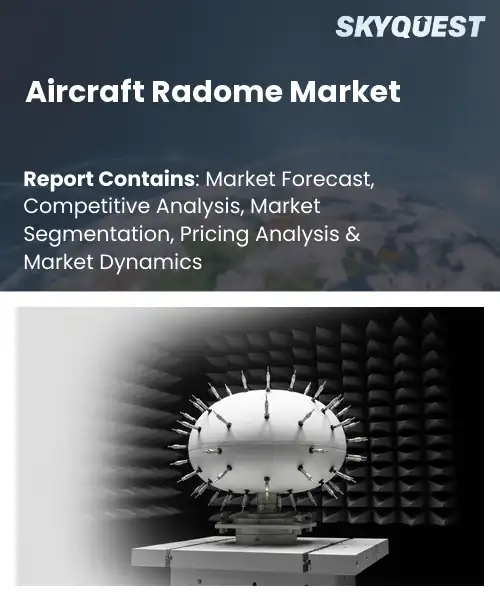
Aircraft Radome Market
Report ID: SQMIG20A2720
Report ID: SQMIG20A2720
[email protected]
USA +1 351-333-4748
Report ID:
SQMIG20A2720 |
Region:
Global |
Published Date: July, 2026
Pages:
157
|Tables:
175
|Figures:
79


Global Aircraft Radome Market size was valued at USD 1.87 Billion in 2024 and is poised to grow from USD 2.01 Billion in 2025 to USD 3.56 Billion by 2033, growing at a CAGR of 7.4% during the forecast period (2026-2033).
The global aircraft radome market comprises manufacturers and suppliers of protective enclosures that shield radar, communication and navigation antennas while preserving aerodynamic performance. The radomes are of importance because they guarantee the integrity of signals even in the tough changing environmental conditions; this demand is becoming more pressing as the technology implemented in the airframes becomes more advanced. In the past, the radomes used in military fighters were made of simple fiber-glass structures but in the 1990s the appearance of such materials as carbon-fiber-reinforced polymers made the radomes much lighter and added new stealth features. At present, in the military aviation field as well as in the civilian jet-makers, different jetmakers need to apply certain kinds of radomes to satisfy the fuel efficiency and low visibility requirements.
Building on the foundation described above, the growth catalyst for the aircraft radome market is the rising demand for lightweight, radar‑transparent structures that enable fuel efficiency and stealth performance across civilian and defense platforms. Due to airlines trying to keep their operating costs as low as possible, manufacturers started using composite radomes in their planes, which helped reduce their weight by hundreds of kilograms and resulted in fuel savings and cutting down on emissions. For example, Airbus managed to achieve a fuel burn decrease of 2 percent on its A350 model after putting carbon‑fiber radomes on its planes. The F‑35 military program is also using conformal radomes to keep a low signature of stealthiness while maximizing capabilities of phased‑array radars.
How is AI-Driven Design Automation Influencing the Aircraft Radome Market?
The market of radar domes used in aircraft designs will see major changes thanks to AI-based design automation techniques that will enable the combination of generative modeling, advanced simulation, and machine learning for material properties. With such techniques engineers will be able to evaluate many geometry patterns in no time which will minimize the time of providing necessary aerodynamic and electromagnetic characteristics. At the same time, implementation of these technologies simplifies weight decreasing since it allows creation of thinner composite layers without weakening the structure of a product. The necessity of creating more fuel-efficient aircrafts has made manufactures rely on AI techniques in terms of lowering costs of prototype creation and speeding the process up. This leads to changes in supply chains and their adjustment to new certification requirements and production of customized products for military and civilian aircraft.
In February 2025, RTX (Raytheon) successfully flight-tested its AI/ML-powered Cognitive Algorithm Deployment System (CADS), enabling aircraft radar warning systems to identify, classify, and prioritize threats with minimal latency. The breakthrough enhances next-generation airborne radar performance, increasing demand for advanced, high-performance aircraft radomes that protect sensitive radar and AI-enabled sensor systems.
Market snapshot - (2026-2033)
Global Market Size
USD 1.87 Billion
Largest Segment
Nose Radomes
Fastest Growth
Weather Radar Radomes
Growth Rate
7.4% CAGR
To get more insights on this market click here to Request a Free Sample Report
Global aircraft radome market is segmented by radome type, material type, aircraft type, application, installation, end user and region. Based on radome type, the market is segmented into nose radomes, dorsal radomes, weather radar radomes and others. Based on material type, the market is segmented into quartz fiber composites, glass fiber composites, ceramic composites and others. Based on aircraft type, the market is segmented into commercial aircraft, military aircraft, business jets and others. Based on application, the market is segmented into weather radar, satellite communication, surveillance systems and others. Based on installation, the market is segmented into line fit and retrofit. Based on end user, the market is segmented into aircraft oems, mro providers, defense organizations and others. Based on region, the market is segmented into North America, Europe, Asia Pacific, Latin America and Middle East & Africa.
Nose radomes segment dominates because they are integral to the primary aerodynamic profile and house critical navigation and communication antennas, making them indispensable for both commercial and military platforms. The designs focus on minimizing drag and maximizing signal transmission efficiency, and the continued investment in high-tech manufacturing processes reflects this fact. Some of the functions of the product and the presence of regulations guarantee the continuous demand for the product and thus secure its strong position on the world's aircraft radomes market.
However, weather radar radomes segment emerges as the most rapidly expanding area as increasing demand for atmospheric sensing drives new installations on modern aircraft. Advanced phased‑array radars and tighter safety regulations promote adoption, encouraging manufacturers to integrate lightweight, low‑loss materials. This momentum expands market opportunities and spurs innovation across radome engineering.
Glass fiber composites segment dominates because they provide a proven balance of structural strength, weight efficiency, and cost‑effectiveness that meets the rigorous certification thresholds of both commercial and military programs. They have strong production methods guaranteeing high-volume production with consistent quality and reliability of the results making their technology attractive to OEM users. This capability makes it possible to minimize the steps to be taken when going through OEM procedures while having reliable and continuous demand.
Meanwhile, quartz fiber composites segment experiences the fastest growth as aerospace engineers pursue temperature resistance and superior dielectric properties for emerging high‑frequency communication systems. Research on fiber architecture unlocks lighter, more resilient radome structures, attracting applications in stealth and avionics. This surge fuels broader market expansion and drives investment in advanced composite technologies.
To get detailed segments analysis, Request a Free Sample Report
North America benefits from a mature aerospace ecosystem anchored by leading original equipment manufacturers and a robust network of specialized suppliers. The capabilities of advanced composite materials and extensive research partnerships fuel efforts in the development of radomes. Robust defense industry and commercial aviation presence provide a solid market for radomemaking. In addition, regulatory requirements exist and contribute to high standards in terms of operability and convenience for users. The local expertise in the field and the successful operation of the means of production enable companies to perform fast prototyping and implementation of innovations in their processes, thus strengthening their market share in the industry.
Aircraft radome market activity in the United States is propelled by extensive commercial airline fleets and a substantial military aviation sector. Given the availability of large aerospace companies, strong cooperation takes place in the development of advanced and efficient radomes. Innovative research organizations and diverse supplier companies foster the process of developing new materials. The combination of advanced development and certification guarantees the reliability of the products.
Aircraft radome market growth in Canada is supported by a strong emphasis on aerospace innovation and a strategic focus on northern operations. Collaboration with government research bodies and companies has facilitated the use of durable materials which are adapted to climatic conditions. The government is promoting the manufacturing of eco-friendly lightweight composites as part of its initiative for sustainable production. A well‑established supply chain and skilled engineering workforce further strengthen Canada’s role in the sector.
Europe’s expansion is driven by a convergence of stringent environmental regulations, advanced material research, and a dense network of aerospace hubs. Producing lightweight and high-strength composite materials is advanced by means of collaborative R&D programs. In addition to this, regulatory requirements regarding noise and emissions drive manufacturers to focus on aerodynamic designs of their products. The continuous need for radomes signals that manufacturers are putting enough money into their production. Furthermore, the incorporation of modern technologies in the industry aids in ensuring the desired level of accuracy and speed to market products. Thus, Europe is positioned as a dynamic region in terms of radome technology development.
Aircraft radome market activity in Germany is anchored by its world‑class engineering culture and a concentration of leading airframe manufacturers. Research institutions focus on high-performance composites and smart materials, encouraging new radome designs. Collaboration between manufacturers and specialized suppliers guarantees fast conversion of R&D achievements to production, while quality standards maintain reliability of the radomes. This synergy sustains Germany’s dominant role in supplying advanced radomes across Europe and globally.
Aircraft radome market development in the United Kingdom is characterized by a vibrant aerospace cluster and aggressive investment in next‑generation technologies. Additive manufacturing and digital twins are favored by government initiatives which aims at speeding up design processes and providing means of customizing the designs. The presence of large operators within the sector means there has been an increase in the need for changes in lightweight designs while civilian aircrafts want the systems to be lightweight.
Aircraft radome market progress in France benefits from a legacy of aerospace excellence and a strategic focus on sustainable aviation. Top manufacturers prioritize in the use of eco‑friendly composite materials that are lightweight and aerodynamically efficient. With many state-of-the-art testing facilities and certification procedures in place, safety is never compromised. Collaborations with European institutions work further help with innovative materials and structures. This environment sustains France’s dominant position in supplying cutting‑edge radomes for both civil and military platforms.
Asia Pacific is augmenting its market presence through rapid modernization of aerospace infrastructure, increased investment in composite technology, and expanding domestic aircraft production capabilities. Countries across the regions are taking advantage of governmental incentives to promote local supply chain development with the aim of decreasing dependence on imports and stimulating innovation at the same time. A combination of partnerships with global OEMs and attention to rapidly growing civil aviation sector is resulting in demand for the better quality and lighter radomes. At the same time, it is being aided by the process of digitalization, which is speeding up prototype development procedures and making Asia Pacific one of the world centers of radome application.
Aircraft radome market activity in Japan is propelled by a strong emphasis on precision engineering and a forward‑looking approach to material science. Collaboration among major manufacturers and research institutions stimulates adoption of ultra-lightweight, high-strength composites. Government support of aerospace self-reliance promotes the establishment of domestic production capabilities. Moreover, strict safety regulations ensure reliability of products. All these developments together contribute to Japan’s competitive strength in providing advanced radomes for both civil and military purposes.
Aircraft radome market growth in South Korea is driven by a dynamic aerospace sector and aggressive technology adoption. Through focusing on new technologies, such as additive manufacturing and automated fiber placement, South Korea is able to achieve fast prototyping and to produce cost-efficient products. Through joint ventures with international aircraft manufacturers and a convenient legislation system, it is possible to increase market participation for Korea which already possesses advanced capabilities in these high-tech fields.
To know more about the market opportunities by region and country, click here to
Buy The Complete Report
Increasing Demand For Fuel Efficiency
Growth Of Unmanned Aircraft Systems
Stringent Certification Requirements
High Cost Of Advanced Materials
Request Free Customization of this report to help us to meet your business objectives.
The competitive landscape is shaped by established radome suppliers racing to embed advanced composites and sensor‑fusion capabilities, while new entrants leverage data analytics and autonomous platforms to differentiate. Recent M&A activity among legacy aerospace firms has accelerated integration of lightweight materials, and strategic partnerships—such as a leading radome maker teaming with an aircraft integrator to certify next‑generation composites—illustrate how technology innovation is driving market positioning.
Top Player’s Company Profile
Recent Developments
SkyQuest’s ABIRAW (Advanced Business Intelligence, Research & Analysis Wing) is our Business Information Services team that Collects, Collates, Correlates, and Analyses the Data collected by means of Primary Exploratory Research backed by robust Secondary Desk research.
As per SkyQuest analysis, the market is being propelled primarily by the increasing demand for fuel‑efficient aircraft, which pushes manufacturers to adopt lightweight composite radomes that cut weight and drag; a secondary catalyst comes from the rapid growth of unmanned aircraft systems that require compact, stealthy sensor housings. Stringent certification requirements remain the main restraint, extending development cycles and raising costs. North America continues to dominate thanks to its mature aerospace ecosystem and strong defense and commercial programs. Within the product mix, nose radomes hold the largest share because they integrate critical navigation and communication antennas into the aircraft’s primary aerodynamic profile, driving sustained investment.
| Report Metric | Details |
|---|---|
| Market size value in 2024 | USD 1.87 Billion |
| Market size value in 2033 | USD 3.56 Billion |
| Growth Rate | 7.4% |
| Base year | 2024 |
| Forecast period | (2026-2033) |
| Forecast Unit (Value) | USD Billion |
| Segments covered |
|
| Regions covered | North America (US, Canada), Europe (Germany, France, United Kingdom, Italy, Spain, Rest of Europe), Asia Pacific (China, India, Japan, Rest of Asia-Pacific), Latin America (Brazil, Rest of Latin America), Middle East & Africa (South Africa, GCC Countries, Rest of MEA) |
| Companies covered |
|
| Customization scope | Free report customization with purchase. Customization includes:-
|
To get a free trial access to our platform which is a one stop solution for all your data requirements for quicker decision making. This platform allows you to compare markets, competitors who are prominent in the market, and mega trends that are influencing the dynamics in the market. Also, get access to detailed SkyQuest exclusive matrix.
Table Of Content
Executive Summary
Market overview
Parent Market Analysis
Market overview
Market size
KEY MARKET INSIGHTS
COVID IMPACT
MARKET DYNAMICS & OUTLOOK
Market Size by Region
KEY COMPANY PROFILES
Methodology
For the Aircraft Radome Market, our research methodology involved a mixture of primary and secondary data sources. Key steps involved in the research process are listed below:
1. Information Procurement: This stage involved the procurement of Market data or related information via primary and secondary sources. The various secondary sources used included various company websites, annual reports, trade databases, and paid databases such as Hoover's, Bloomberg Business, Factiva, and Avention. Our team did 45 primary interactions Globally which included several stakeholders such as manufacturers, customers, key opinion leaders, etc. Overall, information procurement was one of the most extensive stages in our research process.
2. Information Analysis: This step involved triangulation of data through bottom-up and top-down approaches to estimate and validate the total size and future estimate of the Aircraft Radome Market.
3. Report Formulation: The final step entailed the placement of data points in appropriate Market spaces in an attempt to deduce viable conclusions.
4. Validation & Publishing: Validation is the most important step in the process. Validation & re-validation via an intricately designed process helped us finalize data points to be used for final calculations. The final Market estimates and forecasts were then aligned and sent to our panel of industry experts for validation of data. Once the validation was done the report was sent to our Quality Assurance team to ensure adherence to style guides, consistency & design.
Analyst Support
Customization Options
With the given market data, our dedicated team of analysts can offer you the following customization options are available for the Aircraft Radome Market:
Product Analysis: Product matrix, which offers a detailed comparison of the product portfolio of companies.
Regional Analysis: Further analysis of the Aircraft Radome Market for additional countries.
Competitive Analysis: Detailed analysis and profiling of additional Market players & comparative analysis of competitive products.
Go to Market Strategy: Find the high-growth channels to invest your marketing efforts and increase your customer base.
Innovation Mapping: Identify racial solutions and innovation, connected to deep ecosystems of innovators, start-ups, academics, and strategic partners.
Category Intelligence: Customized intelligence that is relevant to their supply Markets will enable them to make smarter sourcing decisions and improve their category management.
Public Company Transcript Analysis: To improve the investment performance by generating new alpha and making better-informed decisions.
Social Media Listening: To analyze the conversations and trends happening not just around your brand, but around your industry as a whole, and use those insights to make better Marketing decisions.
REQUEST FOR SAMPLE
 REQUEST FREE CUSTOMIZATION
Global Aircraft Radome Market size was valued at USD 1.87 Billion in 2024 and is poised to grow from USD 2.01 Billion in 2025 to USD 3.56 Billion by 2033, growing at a CAGR of 7.4% during the forecast period (2026-2033).
The competitive landscape is shaped by established radome suppliers racing to embed advanced composites and sensor‑fusion capabilities, while new entrants leverage data analytics and autonomous platforms to differentiate. Recent M&A activity among legacy aerospace firms has accelerated integration of lightweight materials, and strategic partnerships—such as a leading radome maker teaming with an aircraft integrator to certify next‑generation composites—illustrate how technology innovation is driving market positioning. 'Saint-Gobain Aerospace', 'Meggitt PLC', 'Nordam Group LLC', 'Jenoptik AG', 'Cobham Aerospace Communications', 'General Dynamics Mission Systems, Inc.', 'L3Harris Technologies, Inc.', 'RTX Corporation', 'Leonardo S.p.A.', 'Airbus Atlantic SAS', 'FACC AG', 'GKN Aerospace Services Limited', 'M.C. Gill Corporation', 'Infinite Technologies Aerospace, Inc.', 'Royal Engineered Composites LLC', 'Orbital ATK Aerospace Structures', 'HEICO Corporation', 'Marvin Engineering Company, Inc.', 'Kaman Corporation', 'Avcorp Industries Inc.'
The aviation industry prioritizes reduction of operating costs, and fuel efficiency directly influences aircraft weight and engine performance. Advanced radome designs employing lightweight composite materials and aerodynamic shaping enable lower drag, which translates into measurable fuel savings over flight cycles. Airlines adopt these solutions to meet stringent cost targets while adhering to environmental regulations, thereby creating a sustained demand for high‑performance radomes that support efficient airframe operations and competitive route economics and enhance overall fleet profitability for operators worldwide in the long term.
Lightweight Composite Adoption: The industry is increasingly shifting to advanced composite materials for radome construction, driven by the demand for reduced aircraft weight and improved fuel efficiency. These materials offer superior corrosion resistance and design flexibility, enabling manufacturers to create more aerodynamic shapes while maintaining structural integrity. As supply chains mature and certification pathways become clearer, OEMs are integrating composites into new platforms, positioning radomes as a strategic component in overall aircraft performance enhancement for future sustainable aviation initiatives globally.
Why does North America Dominate the Global Aircraft Radome Market? |@12


Want to customize this report? This report can be personalized according to your needs. Our analysts and industry experts will work directly with you to understand your requirements and provide you with customized data in a short amount of time. We offer $1000 worth of FREE customization at the time of purchase.
Feedback From Our Clients


 USA (+1) 351-333-4748

