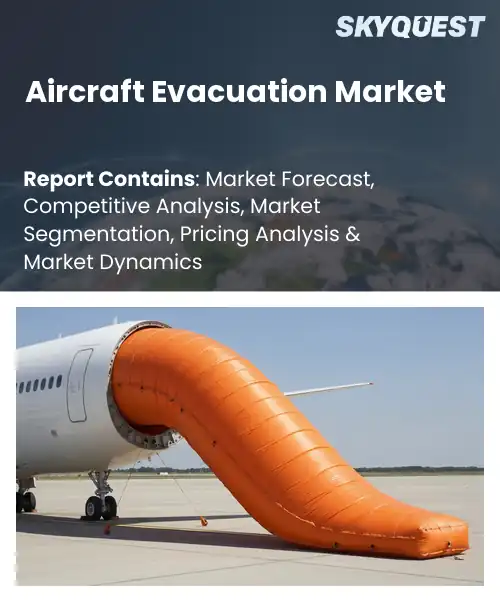
Aircraft Evacuation Market
Report ID: SQMIG20A2578
Report ID: SQMIG20A2578
[email protected]
USA +1 351-333-4748
Report ID:
SQMIG20A2578 |
Region:
Global |
Published Date: May, 2026
Pages:
157
|Tables:
233
|Figures:
81


Global Aircraft Evacuation Market size was valued at USD 1.8 Billion in 2024 and is poised to grow from USD 1.92 Billion in 2025 to USD 3.23 Billion by 2033, growing at a CAGR of 6.7% during the forecast period (2026-2033).
The main factor driving the aircraft evacuation market growth is mostly regulatory pressure and safety demands that push manufacturers and operators to lower the chances of loss of life during real emergencies. In practice, this space covers stuff like inflatable slide-rafts, emergency lighting, and floor path marking, but also software, simulation tools, and training services, things that help people exit quickly and with less confusion. It matters because passenger and crew survival rates are tied to evacuation systems that are engineered, tested, and dependable.
Over the years the aircraft evacuation sector moved from canvas slides and chemical lights to sturdier composite slide-rafts, built in sensor diagnostics, and virtual reality training. There was also a noticeable surge after incidents such as the Hudson River ditching, which showed how hard evacuation can be and what should be learned, fast. Building on those lessons, the growth factor is regulator enforcement paired with fleet renewal, because carriers need upgraded evacuation systems when older platforms age out. When rules tighten certification and airlines replace aging airframes, vendors start getting orders for slide-rafts, sensors, and connected lighting, while MRO organizations take on retrofit, inspection, and follow up work. So you end up with suppliers investing in advanced materials and IoT diagnostics to reduce failure events and lifecycle expenses, while airlines adopt VR and live scenario training to shave seconds off egress times. Real world examples include regional carriers in Asia Pacific fitting updated single aisle layouts to satisfy new standards and flag carriers using predictive maintenance strategies to avoid unexpected downtime. That, in turn, expands aftermarket revenues and the service side of the market.
AI is changing the aircraft evacuation market outlook by mixing predictive analytics, computer vision, and more life like simulation, so decisions improve and system reliability gets stronger. A few key angles, including AI-driven evacuation modeling and digital twins used to test door and slide performance; onboard sensor fusion that can detect blockages and help guide the crew in the moment; and adaptive training setups that feed realistic scenarios so responses become sharper. In general the market is shifting away from hardware-only solutions, and toward integrated software workflows that reduce downtime and support survivability. This can be seen in AI-optimized maintenance checks, vision based occupancy detection during egress, and multi-agent simulations that planners use to stress test procedures before they ever meet the real situation.
LuftCar, in March 2026, unveiled what they call an AI-powered platform named LuftPAATH Phase II, which models air-to-ground corridors and helps optimize medevac routing. The idea is that responders and operators can prioritize assets better, plan vertiports more clearly, and anticipate demand sooner. That operational efficiency supports the aircraft evacuation market penetration by enabling deployment that is more organized and evacuations that are faster, safer, and less chaotic.
Market snapshot - (2026-2033)
Global Market Size
USD 1.8 Billion
Largest Segment
Slide Evacuation Systems
Fastest Growth
Emergency Flotation Systems
Growth Rate
6.7% CAGR
To get more insights on this market click here to Request a Free Sample Report
Global aircraft evacuation market is segmented by system type, aircraft type, platform type, component, deployment mechanism, material type, end user, sales channel and region. Based on system type, the market is segmented into Slide Evacuation Systems, Life Rafts, Escape Chutes, Ejection Seats, Emergency Flotation Systems and Others. Based on aircraft type, the market is segmented into Commercial Aircraft, Military Aircraft, Business Jets, Helicopters and General Aviation Aircraft. Based on platform type, the market is segmented into Fixed-Wing Aircraft and Rotary-Wing Aircraft. Based on component, the market is segmented into Inflation Systems, Survival Kits, Harnesses and Restraints, Control and Activation Systems, Emergency Lighting Systems and Others. Based on deployment mechanism, the market is segmented into Automatic Deployment and Manual Deployment. Based on material type, the market is segmented into Nylon Fabrics, Rubber-Coated Fabrics, Composite Materials and Others. Based on end user, the market is segmented into Commercial Airlines, Defense Organizations, Aircraft OEMs, MRO Service Providers and Charter and Private Operators. Based on sales channel, the market is segmented into OEM and Aftermarket. Based on region, the market is segmented into North America, Europe, Asia Pacific, Latin America and Middle East & Africa.
As per the aircraft evacuation market analysis, the Slide Evacuation Systems take the lead, because they supply the main quick egress solution across lots of aircraft types, and they also hook in with cabin architecture and crew procedures, so passenger flow stays pretty predictable. Their record of performance, the regulatory green lights, and the fact that they are relatively simple to roll out, together reduce evacuation complexity and also lower training burdens. Thus, OEMs and airlines tend to prefer them. This ends up forming a stable base for small, incremental material upgrades and integration tweaks, which reinforce leadership in the market.
However, the Escape Chutes are showing up faster and faster. It means they are the fastest growing part, mostly because they fit narrow exits and odd configurations, so there is more room for innovation in compact packing, and in deployment mechanics that don’t waste space. Better materials and more flexible fuselage interface adaptability are opening retrofit paths, and this is pulling in investment that helps push future growth.
According to the aircraft evacuation market forecast, the Inflation Systems segment dominates because these systems are basically the core to how slides, life rafts, and flotation devices actually work; they govern deployment reliability and the broader survivability in those critical moments. The engineering side is not small, and there is the integration with aircraft power, the activation system logic, and then certification testing focus; it all turns into a sort of tech bottleneck. Suppliers that already show proven reliability tend to win preference from OEMs and service providers, especially those that need predictable performance when everything is under emergency loads.
Whereas the Emergency Lighting Systems category is predicted to gain the largest aircraft evacuation market share, largely due to LED efficiency, integrated control electronics, and improved battery solutions that lift reliability and visibility during evacuation. Regulators keep putting weight on egress under low visibility, and operators want integrated diagnostics, so that’s driving adoption. That is expanding aftermarket and retrofit chances too, which grows supplier offerings and also future revenue streams.
To get detailed segments analysis, Request a Free Sample Report
As per the aircraft evacuation market regional forecast, North America dominates the market because it has this mix of older, but reliable aviation infrastructure and a big concentration of airline activity and aircraft OEM presence, and then on top of that, strict regulatory frameworks, like safety as the main theme, not an afterthought. There’s also strong spending on research and development, plus constant retrofitting, modernization, and rework programs, and that keeps the need for more advanced evacuation solutions steady. Moreover, collaborations can be seen between carriers, manufacturers, and regulators, which helps ideas land faster, and makes standardized procedures feel more like the norm instead of something that is negotiated every time. On the ground, the operational side isn’t simple, because fleets differ a lot and passenger volumes are high, so operators end up needing evacuation systems that are more sophisticated, and training services that can handle real-world complexity.
United States Aircraft Evacuation Market
The Aircraft Evacuation sector in the United States is shaped by a dense commercial and defense aviation ecosystem, lots of OEM operations, and certification rules that are not casual at all. Operators tend to focus on advanced escape systems, structured crew training, and integrating retrofit solutions into existing aircraft. Since the supply chain is mature, and testing facilities are already established, validation and rollout feel more repeatable. Moreover, constant collaboration between carriers, manufacturers, and regulators keeps pushing improvements, including evacuation protocols, and aftermarket services and maintenance, across many aircraft platforms.
Canada Aircraft Evacuation Market
The aircraft evacuation market in Canada is more about operational resilience, especially because of those diverse climatic conditions. That reality drives demand for evacuation systems that can adapt, and equipment that’s winterized or basically prepared for cold disruptions. Regional carriers and maintenance organizations often stress crew training that’s strict, along with retrofit programs matched to the specific fleets they run. And because Canada works closely with North American regulators and specialized testing centers, certification and readiness are supported more directly. With an expanding service network and local know-how, maintenance and aftermarket upgrades can be handled across both remote routes and busier urban operations.
Europe is witnessing rapid expansion in aircraft evacuation mainly because regulations keep getting stricter, fleet modernization is moving forward, and major carriers are putting passenger safety in a higher priority lane. Investment in research, certification harmonization, and cross-border collaboration between airlines, OEMs, and service providers makes it easier for next-generation evacuation systems to be adopted sooner, along with advanced training methodologies. Also, airport capacity is under pressure in many places, and at the same time, there’s more emphasis on sustainability, and operational efficiency, so retrofits and innovative deployment approaches are more attractive.
National centers of excellence add serious testing and certification capability, while a competitive supplier landscape helps companies differentiate in product design and aftermarket offerings, too. Public safety initiatives and government-backed testing programs support market credibility. On the human side, partnerships with technical universities and simulation centers strengthen human factors research and scenario-based training, so the validation is not just theoretical, but practical and aligned with real operational expectations.
Germany Aircraft Evacuation Market
The Aircraft Evacuation Market in Germany benefits from a strong aerospace engineering base, with good maintenance and manufacturing capability, and close links to research institutions. The focus stays on rigorous certification processes and real testing, which supports advanced system development and validation. German carriers and MRO providers tend to prefer reliability and lifecycle management, and the supplier ecosystem is competitive enough to offer specialized components and retrofit expertise. Overall, the institutional emphasis on safety and technical excellence helps the adoption of sophisticated evacuation solutions stay credible.
United Kingdom Aircraft Evacuation Market
The Aircraft Evacuation Market in the United Kingdom is gaining traction due to carrier strategies, high traffic density, and a strong push for innovation inside the aerospace clusters. Operators often want modular, lightweight evacuation solutions, the kind that match fleet renewal schedules, yet still keep flexibility for variations. Growth is supported by active training centers, advanced simulation capabilities, and an agile certification environment, one that encourages experimentation and faster piloting of approaches. Moreover, a competitive ecosystem of suppliers and integrators helps deliver rapid aftermarket response and tailored service offerings when changes or upgrades are needed.
France Aircraft Evacuation Market
The aircraft evacuation market in France is emerging through targeted modernization efforts among regional operators, along with an expanding set of niche suppliers. The focus is often on ergonomics, passenger flow, and human factors research, which then shapes product design and training curricula. Collaboration between research institutes, certification bodies, and manufacturers helps adapt solutions for different aircraft types without too much friction. MRO centers and retrofit specialists also support aftermarket growth, and policy support plus cross-border partnerships encourage experimentation with innovative evacuation technologies.
Asia Pacific is strengthening its position in the aircraft evacuation market via coordinated actions among national regulators, plus a steady push to expand MRO capacity and the growth of OEM and supplier footholds all around the region. Carriers are also pushing for evacuation solutions that scale well, especially on high-density routes and across very different environmental conditions, so the need for lightweight, modular systems keeps climbing. At the same time, enhanced crew training becomes one of those non-optional priorities, because procedures aren’t just hardware. On top of that, investment in simulation centers, regional testing spaces, and localized certification paths helps reduce time to market for new offerings. Strategic partnerships between local manufacturers and global technology providers make it easier to transfer know-how, while targeted skills development makes sure operations are ready, and the aftermarket ecosystem stays resilient.
Japan Aircraft Evacuation Market
The Japanese Aircraft Evacuation Market leans into its strong manufacturing sector and systems integration know-how to push evacuation technologies ahead. The focus on human factors, design, and reliability steers local product development in a pretty deliberate way. Collaborative programs involving manufacturers, research institutes, and training centers promote simulation and also more hands-on testing of evacuation procedures. Domestic MRO capacity and a culture of continuous improvement help keep retrofits timely and support lifecycle services. Partnerships with international OEMs, meanwhile, help technology transfer happen and also support operational validation.
South Korea Aircraft Evacuation Market
The South Korean Aircraft Evacuation Market is moving forward using strengths in advanced electronics, materials engineering, and aerospace supply chain development. Local companies tend to concentrate on smart evacuation components, sensor integration, and lightweight materials, mainly to boost system functionality plus diagnostics clarity. Collaboration between industry groups, technical universities, and government agencies supports both testing and certification work. With MRO facilities expanding and partnerships with global OEMs increasing, localized retrofits, crew training, and stronger aftermarket logistics are becoming easier to deliver. This is designed to meet the specific regional operational demands without too much lag, even when conditions change fast.
To know more about the market opportunities by region and country, click here to
Buy The Complete Report
Advances In Evacuation Technology
Stringent Safety Regulations Worldwide
High Certification And Compliance Costs
Limited Retrofit Feasibility For Older Aircraft
Request Free Customization of this report to help us to meet your business objectives.
Competitive dynamics in the global aircraft evacuation market seem to be pushed along by a mix of regulatory certification pressure and those more strict advanced air mobility safety requirements, which then turn into practical playbooks like MRO and service agreements, selective acquisitions, and public-private partnerships all at once. For instance, some big suppliers are currently locking in slide repair and service agreements with airline MRO teams, while prize-style competitions are nudging newer startups toward emergency rescue autonomy and related control logic.
Top Player’s Company Profile
Recent Developments in the Aircraft Evacuation Market
SkyQuest’s ABIRAW (Advanced Business Intelligence, Research & Analysis Wing) is our Business Information Services team that Collects, Collates, Correlates, and Analyses the Data collected by means of Primary Exploratory Research backed by robust Secondary Desk research.
As per SkyQuest analysis, the global aircraft evacuation market is propelled by regulatory and safety imperatives, and that is a key driver. At the same time, the high certification and compliance costs act as a restraint, and this tends to slow some adoption. The dominating region is North America, where mature infrastructure, strong OEM presence, and rigorous regulators gather demand. The dominating part is Slide Evacuation Systems, mostly because their dependability is proven, and they already have regulatory acceptance, so yeah. A second driver is fleet renewal, plus the aftermarket retrofit cycles, which make for a steady demand for upgraded slides, inflation systems, and some integrated evacuation solutions that stick. Overall, the suppliers that emphasize integrated setups, AI-enabled diagnostic checks, and service networks are in the best position to catch the growth, even when certification hurdles show up, and the retrofit limits are there too.
| Report Metric | Details |
|---|---|
| Market size value in 2024 | USD 1.8 Billion |
| Market size value in 2033 | USD 3.23 Billion |
| Growth Rate | 6.7% |
| Base year | 2024 |
| Forecast period | (2026-2033) |
| Forecast Unit (Value) | USD Billion |
| Segments covered |
|
| Regions covered | North America (US, Canada), Europe (Germany, France, United Kingdom, Italy, Spain, Rest of Europe), Asia Pacific (China, India, Japan, Rest of Asia-Pacific), Latin America (Brazil, Rest of Latin America), Middle East & Africa (South Africa, GCC Countries, Rest of MEA) |
| Companies covered |
|
| Customization scope | Free report customization with purchase. Customization includes:-
|
To get a free trial access to our platform which is a one stop solution for all your data requirements for quicker decision making. This platform allows you to compare markets, competitors who are prominent in the market, and mega trends that are influencing the dynamics in the market. Also, get access to detailed SkyQuest exclusive matrix.
Table Of Content
Executive Summary
Market overview
Parent Market Analysis
Market overview
Market size
KEY MARKET INSIGHTS
COVID IMPACT
MARKET DYNAMICS & OUTLOOK
Market Size by Region
KEY COMPANY PROFILES
Methodology
For the Aircraft Evacuation Market, our research methodology involved a mixture of primary and secondary data sources. Key steps involved in the research process are listed below:
1. Information Procurement: This stage involved the procurement of Market data or related information via primary and secondary sources. The various secondary sources used included various company websites, annual reports, trade databases, and paid databases such as Hoover's, Bloomberg Business, Factiva, and Avention. Our team did 45 primary interactions Globally which included several stakeholders such as manufacturers, customers, key opinion leaders, etc. Overall, information procurement was one of the most extensive stages in our research process.
2. Information Analysis: This step involved triangulation of data through bottom-up and top-down approaches to estimate and validate the total size and future estimate of the Aircraft Evacuation Market.
3. Report Formulation: The final step entailed the placement of data points in appropriate Market spaces in an attempt to deduce viable conclusions.
4. Validation & Publishing: Validation is the most important step in the process. Validation & re-validation via an intricately designed process helped us finalize data points to be used for final calculations. The final Market estimates and forecasts were then aligned and sent to our panel of industry experts for validation of data. Once the validation was done the report was sent to our Quality Assurance team to ensure adherence to style guides, consistency & design.
Analyst Support
Customization Options
With the given market data, our dedicated team of analysts can offer you the following customization options are available for the Aircraft Evacuation Market:
Product Analysis: Product matrix, which offers a detailed comparison of the product portfolio of companies.
Regional Analysis: Further analysis of the Aircraft Evacuation Market for additional countries.
Competitive Analysis: Detailed analysis and profiling of additional Market players & comparative analysis of competitive products.
Go to Market Strategy: Find the high-growth channels to invest your marketing efforts and increase your customer base.
Innovation Mapping: Identify racial solutions and innovation, connected to deep ecosystems of innovators, start-ups, academics, and strategic partners.
Category Intelligence: Customized intelligence that is relevant to their supply Markets will enable them to make smarter sourcing decisions and improve their category management.
Public Company Transcript Analysis: To improve the investment performance by generating new alpha and making better-informed decisions.
Social Media Listening: To analyze the conversations and trends happening not just around your brand, but around your industry as a whole, and use those insights to make better Marketing decisions.
REQUEST FOR SAMPLE
 REQUEST FREE CUSTOMIZATION
Global Aircraft Evacuation Market size was valued at USD 1.8 Billion in 2024 and is poised to grow from USD 1.92 Billion in 2025 to USD 3.23 Billion by 2033, growing at a CAGR of 6.7% during the forecast period (2026-2033).
Competitive dynamics in the global aircraft evacuation market are shaped by regulatory certification pressure and advanced air mobility safety requirements, driving concrete strategies such as MRO and service contracts, targeted acquisitions, and public private partnerships. For example, major suppliers are securing slide repair and service agreements with airline MROs, while prize competitions are directing startup innovation toward emergency rescue autonomy. 'Safran Aerosystems', 'Collins Aerospace', 'Survitec Group Limited', 'Trelleborg AB', 'EAM Worldwide', 'SWITLIK Survival Products', 'DART Aerospace', 'Martin-Baker Aircraft Co. Ltd.', 'Tulmar Safety Systems', 'Cobham Limited', 'Mustang Survival', 'HRD Aero Systems, Inc.', 'Lufthansa Technik AG', 'Hong Kong Aircraft Engineering Company Limited', 'Astronics Corporation', 'Honeywell International Inc.', 'Eaton Corporation', 'The MEL Group', 'NPP Zvezda PAO', 'FCAH Aerospace'
Advances in fire-resistant materials, compact slide systems, sensor-enabled monitoring, and simulation-driven design improvements have enhanced the effectiveness and reliability of evacuation equipment, prompting airlines and manufacturers to prioritize upgrades and new installations. These technological improvements increase confidence in evacuation outcomes, reduce perceived operational disruptions, and support smoother certification discussions, collectively encouraging procurement and investment in modern evacuation solutions across fleets and new aircraft programs. Operators often view these advances as value enhancing due to improved passenger safety perception and simplified maintenance, which encourages broader adoption and aftermarket retrofit activity.
Integrated Evacuation Systems: Manufacturers and airlines are increasingly adopting integrated evacuation systems that combine slide deployment, door automation, and signaling interfaces to streamline egress procedures. Emphasis is on cohesive system design that reduces variability during emergency scenarios, supports crew coordination, and improves reliability through standardized interfaces. Development focuses on modular solutions adaptable to different aircraft types and cabin configurations, enabling easier certification and maintenance while aligning vendor offerings with airline operational protocols and training practices for more predictable evacuation outcomes and regulatory expectations.
Why does North America Dominate the Global Aircraft Evacuation Market? |@12


Want to customize this report? This report can be personalized according to your needs. Our analysts and industry experts will work directly with you to understand your requirements and provide you with customized data in a short amount of time. We offer $1000 worth of FREE customization at the time of purchase.
Feedback From Our Clients


 USA (+1) 351-333-4748

