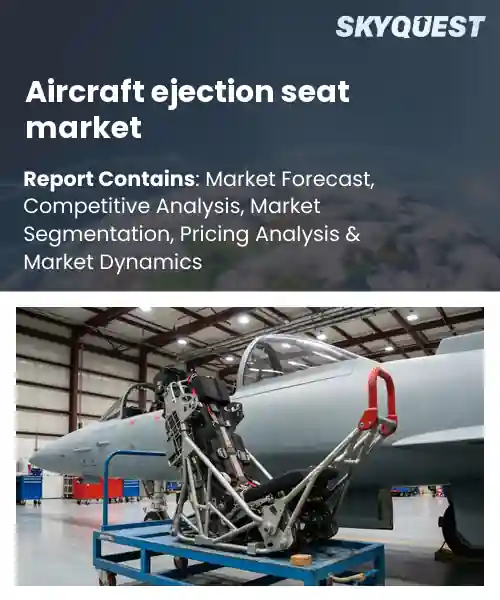
Aircraft ejection seat market
Report ID: SQMIG20A2730
Report ID: SQMIG20A2730
[email protected]
USA +1 351-333-4748
Report ID:
SQMIG20A2730 |
Region:
Global |
Published Date: July, 2026
Pages:
157
|Tables:
178
|Figures:
69


Global Aircraft Ejection Seat Market size was valued at USD 1.2 Billion in 2024 and is poised to grow from USD 1.26 Billion in 2025 to USD 1.83 Billion by 2033, growing at a CAGR of 4.8% during the forecast period (2026-2033).
The global aircraft ejection seat market comprises manufacturers, suppliers, and end‑users involved in designing, producing, and equipping military and civilian aircraft with emergency escape systems. Its significance stems from the life‑saving function of ejection seats, which directly influences pilot survivability and consequently national defense readiness. Historically, the market emerged after World War II when early pneumatic devices proved unreliable, prompting the adoption of rocket‑propelled seats in the 1950s such as the U.S. Martin‑Baker MK‑6. Over the past three decades, incremental advances in lightweight alloys, digital fire‑control software, and zero‑zero capability have expanded applicability from combat jets to trainer aircraft, reinforcing the market’s strategic relevance. The primary growth catalyst now lies in the accelerating modernization programs of air forces across Asia‑Pacific and the Middle East, where aging fleets demand retrofitting with newer ejection solutions that meet safety standards. As governments allocate defense budgets, manufacturers such as BAE Systems and Airbus secure contracts to replace legacy seats on platforms like the F‑16 and JAS‑39, driving revenue spikes. This procurement surge also spurs after‑market services, including predictive maintenance powered by IoT sensors that lower costs and extend intervals. Consequently, the market experiences a cycle: adoption fuels R&D, which yields lighter, more reliable seats that entice forces to upgrade, reinforcing expansion.
How is AI-driven automation improving safety and reliability in the aircraft ejection seat market?
AI‑driven automation is reshaping the aircraft ejection seat market by embedding intelligent sensors, real‑time data analytics and autonomous decision loops into the seat system. Modern seats now capture acceleration, pressure and biometric signals during flight and use machine‑learning models to predict component fatigue before a failure. The algorithms can also evaluate pilot posture and environmental conditions to select the optimal ejection trajectory, reducing the chance of a mis‑fire. By automating health monitoring and sequencing, manufacturers lower maintenance downtime and increase confidence in the seat’s reliability. This shift is especially important as newer combat aircraft demand faster response times and higher survivability standards.Martin‑Baker March 2024, introduced an AI‑based seat health monitoring system that continuously analyses sensor data to forecast wear and trigger proactive maintenance, thereby boosting operational readiness and reinforcing confidence in ejection safety. The capability reduces unexpected failures and aligns with airlines’ and military operators’ push for higher reliability, supporting market growth as fleets modernize.
Market snapshot - (2026-2033)
Global Market Size
USD 1.2 Billion
Largest Segment
Single-seat Ejection Seats
Fastest Growth
Advanced Smart Ejection Seats
Growth Rate
4.8% CAGR
To get more insights on this market click here to Request a Free Sample Report
Global aircraft ejection seat market is segmented by seat type, aircraft type, component, application, end user, technology and region. Based on seat type, the market is segmented into Single-seat Ejection Seats, Twin-seat Ejection Seats, Zero-Zero Ejection Seats, Lightweight Ejection Seats and Advanced Smart Ejection Seats. Based on aircraft type, the market is segmented into Fighter Aircraft, Trainer Aircraft, Combat Aircraft and Experimental & Special Mission Aircraft. Based on component, the market is segmented into Ejection Seat Structure, Rocket Motor Systems, Restraint & Harness Systems, Survival Kits, Parachute Systems and Electronic Sequencing Systems. Based on application, the market is segmented into Military Aviation, Defense Training Aircraft and Aerospace Testing Programs. Based on end user, the market is segmented into Air Forces, Naval Aviation, Defense Agencies and Aircraft OEMs. Based on technology, the market is segmented into Conventional Ejection Systems, Rocket-assisted Ejection Systems and Digitally Controlled Ejection Systems. Based on region, the market is segmented into North America, Europe, Asia Pacific, Latin America and Middle East & Africa.
Zero Zero Ejection Seats segment dominates because they guarantee survivability from zero altitude and zero airspeed, meeting the most stringent safety requirements of contemporary combat aircraft. Their integrated rocket motor and automatic deployment system deliver reliable ejection throughout the entire flight envelope, fostering confidence among pilots and procurement officials. The combination of proven performance, regulatory endorsement, and inclusion in next generation fighter designs consolidates their leading position in the market.
Meanwhile, Advanced Smart Ejection Seats are rapidly expanding as embedded sensors and AI driven algorithms provide real time health monitoring and adaptive ejection profiles. These innovations attract new aircraft platforms seeking higher mission readiness and lower lifecycle costs, accelerating procurement and creating fresh growth opportunities within the ejection seat market.
Parachute Systems segment dominates because they are the final critical element that safely decelerates the occupant after ejection, ensuring survivability across diverse flight regimes. Their proven reliability, ease of integration, and compliance with stringent certification criteria make them the default choice for air forces and OEMs. Their ability to operate in extreme temperatures and to pair with both conventional and zero altitude rocket boosters further cements their preferential status.
On the other hand, Electronic Sequencing Systems are experiencing the strongest growth as digital control units enable precise timing, adaptive sequencing, and health diagnostics during ejection events. These intelligent capabilities attract modern aircraft programs focused on reducing pilot workload and enhancing safety, driving accelerated adoption and expanding market opportunities.
To get detailed segments analysis, Request a Free Sample Report
North America leads the aircraft ejection seat market through a blend of advanced aerospace capabilities, intensive defense investment, and a deep pool of technical expertise. The United States hosts the world’s largest defense contractors and a concentration of original equipment manufacturers that embed ejection technology in advanced fighter platforms. Canada contributes highly capable research institutions and a resilient supply chain that fuels component innovation and rapid prototyping. Together, the region benefits from stringent safety regulations, extensive flight‑test facilities, and long‑standing collaboration between military agencies and industry. This integrated environment accelerates development, ensures rigorous certification, and drives continuous upgrades, reinforcing North America’s position as the market’s primary hub. Regulatory frameworks that streamline testing while maintaining stringent safety criteria further encourage manufacturers to introduce cutting‑edge solutions, reinforcing Europe’s position as a dynamic market for ejection seat technology.
United States Aircraft ejection seat market
Aircraft ejection seat market in the United States is driven by a robust defense acquisition program that prioritizes survivability and crew safety across a spectrum of combat aircraft. Leading manufacturers collaborate closely with the Department of Defense to integrate cutting‑edge propulsion, sequencing, and canopy‑burst technologies. Continuous modernization of legacy platforms and the introduction of fifth‑generation fighters sustain demand for high‑performance seats, while extensive testing infrastructure accelerates certification and fielding processes.
Canada Aircraft ejection seat market
Aircraft ejection seat market in Canada benefits from government support for aerospace research and an ecosystem linking universities, defense agencies, and prime contractors. Emphasis on advanced materials and lightweight design drives component innovation, while joint test programs with allied nations enhance credibility and export potential. A focused approach to integrating ejection systems into maritime and land‑based platforms ensures Canadian manufacturers remain competitive in domestic procurement and North American supply chains.
The rapid expansion of the aircraft ejection seat market in Europe stems from coordinated defense modernization, collaborative research initiatives, and a concentration of premier aerospace manufacturers. European nations prioritize crew survivability as a core requirement for next‑generation combat aircraft, prompting substantial procurement programs that incorporate advanced ejection technologies. Cross‑border projects under the European Defence Agency facilitate shared development costs and harmonized certification standards, accelerating product introductions. Strong industrial bases in Germany, the United Kingdom, and France generate a steady pipeline of innovative seat designs, while an emphasis on modularity and lightweight materials meets the evolving needs of both legacy upgrades and new platform launches. This collaborative environment fuels sustained growth across the continent. Regulatory frameworks that streamline testing while maintaining stringent safety criteria further encourage manufacturers to introduce cutting‑edge solutions, reinforcing Europe’s position as a dynamic market for ejection seat technology.
Germany Aircraft ejection seat market
Aircraft ejection seat market in Germany is propelled by a commitment to defense innovation and a dense network of engineering firms specializing in performance safety systems. Close collaboration between the Bundeswehr and leading manufacturers drives the integration of next‑generation propulsion and automated sequencing into frontline fighter jets. Emphasis on modular architectures enables rapid upgrades for existing fleets, while European research programs bolster technology transfer and create avenues for export growth.
United Kingdom Aircraft ejection seat market
Aircraft ejection seat market in the United Kingdom stands out due to expertise in aeronautical safety and a defense procurement framework that emphasizes capability. Leading British firms collaborate closely with the Royal Air Force to tailor ejection solutions for legacy and next‑generation platforms, integrating advanced avionics and ergonomic improvements. Investment in simulation and testing facilities shortens development cycles, while export relationships with Commonwealth partners extend market reach beyond domestic requirements.
France Aircraft ejection seat market
Aircraft ejection seat market in France is emerging through incentives and a growing network of specialized suppliers focused on lightweight composites and control systems. Programs between the French Air Force and domestic manufacturers aim to retrofit existing fighters while preparing for future aircraft, fostering innovation in sequencing and adaptive seat geometry. Participation in European projects enhances technology sharing, positioning France as a rising contributor to the continent’s ejection seat capabilities.
Asia Pacific is strengthening its position in the aircraft ejection seat market by leveraging rapid defense modernization, expanding domestic manufacturing capabilities, and deepening strategic collaborations with global OEMs. Nations in the region prioritize survivability as air forces acquire advanced fighter platforms, prompting investments in indigenous seat development and integration expertise. Growth of high‑tech industrial parks and focused research institutes accelerates innovation in lightweight materials, smart sequencing and digital diagnostics. Furthermore, joint ventures and technology‑transfer agreements with established Western suppliers enhance local competency, while regional defense exhibitions foster market visibility. This confluence of increased procurement, R&D commitment and collaborative ecosystems enables Asia Pacific to evolve from a peripheral consumer to an influential contributor in the global ejection seat landscape. Increasing focus on sustainability and cost‑effective lifecycle support further solidifies the region’s competitiveness in the sector.
Japan Aircraft ejection seat market
Aircraft ejection seat market in Japan is shaped by an emphasis on precision engineering and close coordination with the Self‑Defense Forces to equip fighter aircraft. Domestic manufacturers focus on advanced pyrotechnic charge designs and compact seat architecture to meet weight constraints. Collaborative R&D initiatives with university laboratories drive progress in sensor integration and health‑monitoring systems, while testing facilities ensure rigorous certification standards that support both national deployment and export opportunities.
South Korea Aircraft ejection seat market
Aircraft ejection seat market in South Korea is driven by a focus on self‑reliance and air‑fleet modernization. Korean firms concentrate on propulsion units and seat designs that prioritize pilot survivability. Partnerships with defense firms facilitate technology transfer, while domestic testing ranges provide validation for new concepts. Government incentives encourage R&D in composites and control algorithms, positioning the nation as a growing player in the regional ever expanding aerospace supply chain.
To know more about the market opportunities by region and country, click here to
Buy The Complete Report
Increasing Defense Spending
Advancements In Ejection Technology
High Manufacturing Costs
Regulatory Certification Challenges
Request Free Customization of this report to help us to meet your business objectives.
The competitive landscape is shaped by intense rivalry among established defense contractors and emerging aerospace firms, each pursuing advanced ejection seat technologies to meet stringent safety standards. Recent market dynamics include strategic M&A activity, such as larger defense groups acquiring niche ejection seat specialists, and partnerships that integrate next‑generation materials and digital diagnostics into seat systems, driving differentiation and performance gains.
Top Player’s Company Profile
Recent Developments
SkyQuest’s ABIRAW (Advanced Business Intelligence, Research & Analysis Wing) is our Business Information Services team that Collects, Collates, Correlates, and Analyses the Data collected by means of Primary Exploratory Research backed by robust Secondary Desk research. As per SkyQuest analysis, the global aircraft ejection seat market is being propelled primarily by rising defense spending, which is prompting air forces worldwide to modernise fleets and replace ageing seats, while a second strong catalyst is the rapid advancement of ejection‑seat technology that brings lighter structures, digital sequencing and AI‑driven health monitoring, expanding the appeal of new‑generation solutions. The market’s growth is tempered by high manufacturing costs that make upgrades costly for budget‑constrained programmes. North America remains the dominant region thanks to its deep aerospace supply chain and major defence contractors, and within the product mix the Zero‑Zero ejection seat segment leads the market, offering survivability at zero altitude and airspeed and setting the benchmark for new aircraft programs.
| Report Metric | Details |
|---|---|
| Market size value in 2024 | USD 1.2 Billion |
| Market size value in 2033 | USD 1.83 Billion |
| Growth Rate | 4.8% |
| Base year | 2024 |
| Forecast period | (2026-2033) |
| Forecast Unit (Value) | USD Billion |
| Segments covered |
|
| Regions covered | North America (US, Canada), Europe (Germany, France, United Kingdom, Italy, Spain, Rest of Europe), Asia Pacific (China, India, Japan, Rest of Asia-Pacific), Latin America (Brazil, Rest of Latin America), Middle East & Africa (South Africa, GCC Countries, Rest of MEA) |
| Companies covered |
|
| Customization scope | Free report customization with purchase. Customization includes:-
|
To get a free trial access to our platform which is a one stop solution for all your data requirements for quicker decision making. This platform allows you to compare markets, competitors who are prominent in the market, and mega trends that are influencing the dynamics in the market. Also, get access to detailed SkyQuest exclusive matrix.
Table Of Content
Executive Summary
Market overview
Parent Market Analysis
Market overview
Market size
KEY MARKET INSIGHTS
COVID IMPACT
MARKET DYNAMICS & OUTLOOK
Market Size by Region
KEY COMPANY PROFILES
Methodology
For the Aircraft ejection seat market, our research methodology involved a mixture of primary and secondary data sources. Key steps involved in the research process are listed below:
1. Information Procurement: This stage involved the procurement of Market data or related information via primary and secondary sources. The various secondary sources used included various company websites, annual reports, trade databases, and paid databases such as Hoover's, Bloomberg Business, Factiva, and Avention. Our team did 45 primary interactions Globally which included several stakeholders such as manufacturers, customers, key opinion leaders, etc. Overall, information procurement was one of the most extensive stages in our research process.
2. Information Analysis: This step involved triangulation of data through bottom-up and top-down approaches to estimate and validate the total size and future estimate of the Aircraft ejection seat market.
3. Report Formulation: The final step entailed the placement of data points in appropriate Market spaces in an attempt to deduce viable conclusions.
4. Validation & Publishing: Validation is the most important step in the process. Validation & re-validation via an intricately designed process helped us finalize data points to be used for final calculations. The final Market estimates and forecasts were then aligned and sent to our panel of industry experts for validation of data. Once the validation was done the report was sent to our Quality Assurance team to ensure adherence to style guides, consistency & design.
Analyst Support
Customization Options
With the given market data, our dedicated team of analysts can offer you the following customization options are available for the Aircraft ejection seat market:
Product Analysis: Product matrix, which offers a detailed comparison of the product portfolio of companies.
Regional Analysis: Further analysis of the Aircraft ejection seat market for additional countries.
Competitive Analysis: Detailed analysis and profiling of additional Market players & comparative analysis of competitive products.
Go to Market Strategy: Find the high-growth channels to invest your marketing efforts and increase your customer base.
Innovation Mapping: Identify racial solutions and innovation, connected to deep ecosystems of innovators, start-ups, academics, and strategic partners.
Category Intelligence: Customized intelligence that is relevant to their supply Markets will enable them to make smarter sourcing decisions and improve their category management.
Public Company Transcript Analysis: To improve the investment performance by generating new alpha and making better-informed decisions.
Social Media Listening: To analyze the conversations and trends happening not just around your brand, but around your industry as a whole, and use those insights to make better Marketing decisions.
REQUEST FOR SAMPLE
 REQUEST FREE CUSTOMIZATION


Want to customize this report? This report can be personalized according to your needs. Our analysts and industry experts will work directly with you to understand your requirements and provide you with customized data in a short amount of time. We offer $1000 worth of FREE customization at the time of purchase.
Feedback From Our Clients


 USA (+1) 351-333-4748

